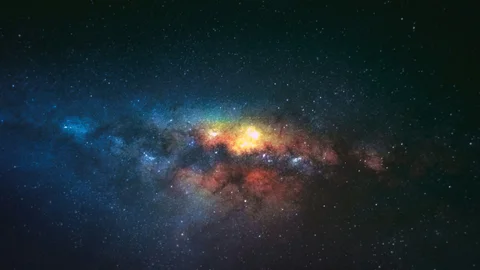
Researchers led by David Lee of the University of Toronto have discovered the existence of an unusual galaxy, CDG-2, in the Perseus cluster at a distance of 300 million light years. This structure is a unique cosmic formation, 99% of whose mass is formed by dark matter. The common substance is only one percent, and the starlight is so weak that traditional observation methods do not allow to fix an object.
The main instrument of detection were globular clusters - dense star groups held by gravity. First, the Hubble Space Telescope recorded four such clusters, then the Euclid and Subaru observatories detected barely detectable glow around them. The total luminosity of the galaxy is less than one million suns, with the clusters themselves producing 16% of all visible radiation.
Scientists have suggested that the common substance has left the galaxy as a result of the gravitational effects of more massive neighbors in the dense cluster of Perseus. The discovery of CDG-2 demonstrates the effectiveness of searching for "dark galaxies" by their marker globular clusters and opens up possibilities for detecting other similar objects that were previously invisible to astronomers.