

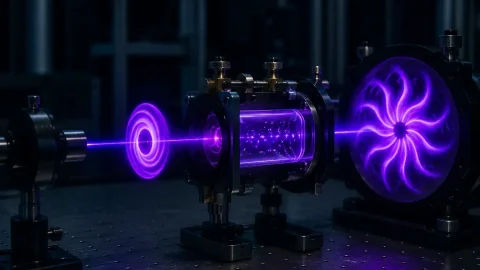
Researchers at the Physics Department of Vilnius University have developed a theoretical model that allows atoms to be "programmed" using light without the use of external magnetic fields. According to the concept, the laser beam first adjusts atoms in the gas and then the prepared atomic environment begins to change the shape and polarization of complex laser beams, creating a feedback effect.
The key element of the model is the optical vortices - light beams with a spiral structure, where at the center the intensity falls to zero. The size of this dark area determines the topological charge, which theoretically allows up to 10,000 different states. This paves the way for the use of cubits (multilayer quantum cells) instead of traditional two-state kubitas.
The interaction of a bundle with atomic gas (with three energy levels) results in the environment inheriting a spatial pattern of light, and then reshapes the bundle itself, transforming a simple annular structure into an intricate petallike pattern. Previously, such control required powerful magnetic fields and bulky equipment, while new technology could accelerate the development of quantum processors, secure communication networks, and ultra-high-precision optical sensors.