
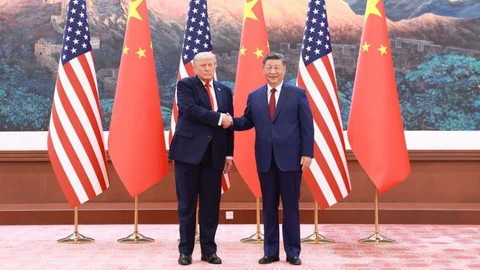
The meeting between Donald Trump and Xi Jinping showed that Washington and Beijing are choosing managed de-escalation over another immediate trade shock. China said it plans to buy 200 Boeing aircraft and wants to extend the current trade truce, which is set to expire in November 2026. For markets, that was a constructive signal: the world’s two largest economies are trying to keep the dispute inside a negotiation framework.
But the summit did not resolve the core tensions. The two sides are discussing reciprocal tariff cuts on roughly $30 billion worth of goods each, along with concessions tied to agriculture, aviation, export controls and rare earth minerals. Many details remain unclear, especially on farm purchases: the U.S. says China agreed to buy an additional $17 billion in agricultural goods annually, while Beijing’s public language has been more cautious.
The main takeaway is that the trade war has not ended. It has moved into a risk-management phase. Beijing is willing to make deals when they provide stability and do not look like concessions under pressure. Washington still wants to use tariffs as leverage, but that strategy has limits: too much pressure can trigger retaliation and keep businesses in a permanent state of uncertainty.
For investors, the summit lowers the risk of a near-term escalation but does not create a stable long-term framework. Companies will still need to price in tariff risk, export-control uncertainty and policy-driven disruptions across supply chains.