
Japanese researchers show 40-picosecond memory switching with minimal heat
5/21/2026, 10:45 AM • Яна Усс
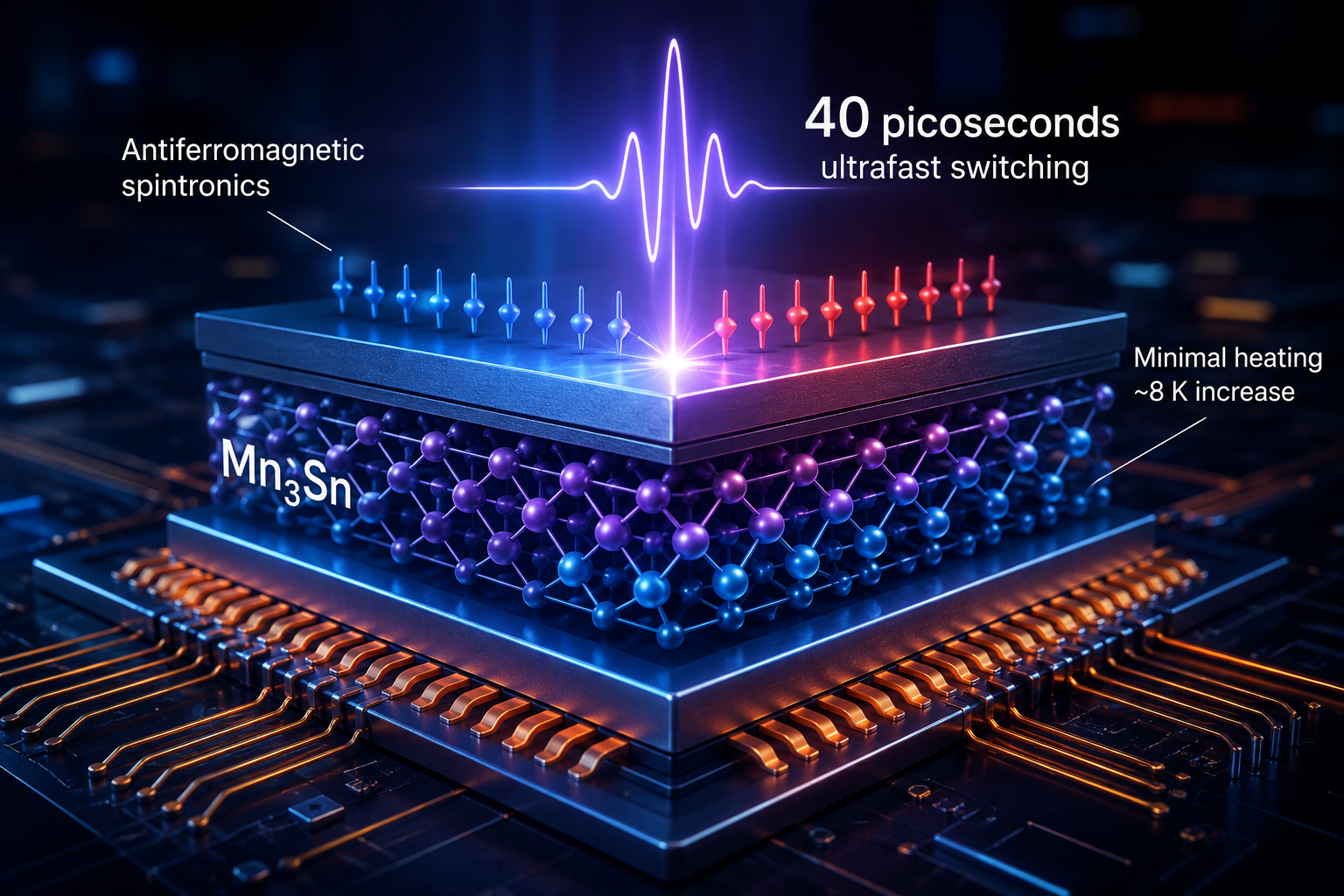
Researchers at the University of Tokyo have demonstrated an experimental spintronic switching device that could become a foundation for faster and more energy-efficient memory. The device is based on the antiferromagnetic material Mn₃Sn and can switch states in 40 picoseconds, placing it in a speed range roughly three orders of magnitude faster than nanosecond-scale switching used in many current computing systems.
The key point is not only speed, but how the information is written. Instead of relying on heat-heavy switching, the device uses spin-orbit torque to flip a magnetic state more directly. In one configuration, simulations showed a temperature increase of only about 8 K, making the approach especially relevant for AI data centers, where power use and cooling are becoming major bottlenecks.
Still, this is not a finished memory product for consumer computers. The result is a laboratory demonstration published in a scientific paper, not a commercial DRAM, SSD or processor module. Researchers still need to solve scaling, reliability, manufacturing and integration challenges before the technology can move into real hardware.
If those barriers are overcome, the approach could support memory that retains data without power, switches much faster and wastes far less energy as heat. For now, it is best understood as a promising research breakthrough rather than an immediate replacement for modern memory.