

Why AI Tokens Were Among the Leaders of the Crypto Market in 2026
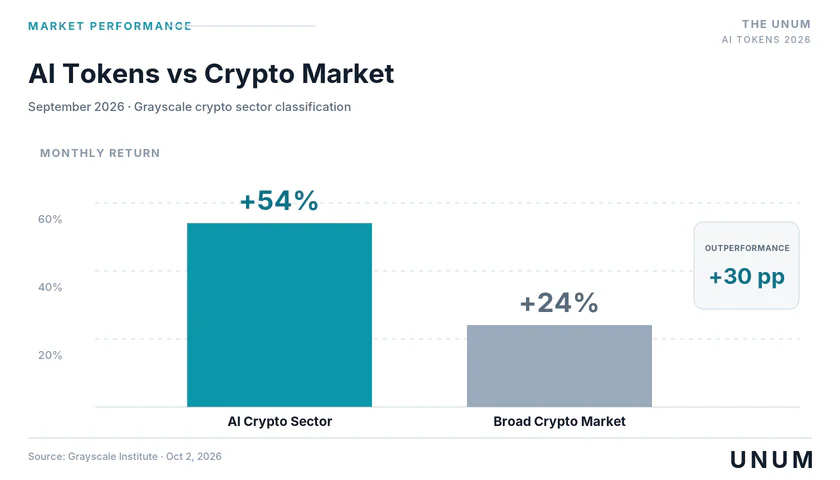
In September 2026, the cryptocurrency sector index for artificial intelligence, calculated by Grayscale, rose by 54%, while the broader cryptocurrency market, according to the company's classification, gained 24%. Thus, the AI sector had an advantage of 30 percentage points. These results, published by Grayscale Institute on October 2, show how much investor interest in projects at the intersection of blockchain and artificial intelligence has intensified.
As of October 12, 2026, the capitalization of the Artificial Intelligence category on CoinGecko was approximately $27 billion. However, this figure requires cautious interpretation. The category includes not only specialized AI protocols but also universal blockchain platforms that use artificial intelligence in specific areas of activity. For example, among the largest assets is NEAR Protocol, whose market capitalization in one of the October data snapshots exceeded $7.5 billion.
Therefore, the capitalization of the entire category is not equivalent to the value of the specialized decentralized artificial intelligence industry. Similarly, the Grayscale index and the CoinGecko list cannot be used as interchangeable indicators: they differ in asset composition, weights, and methodology.
What Supports Demand for AI Cryptocurrencies
The new impetus is associated not only with the popularity of generative artificial intelligence but also with the gradual transition to autonomous software agents. Such systems are capable of performing sequences of actions, accessing external services, obtaining data, and interacting with other programs. For full-fledged economic activity, they additionally need tools for payments, fund management, and obligation verification.
This is where blockchain can find practical application. Programmable wallets, smart contracts, and stablecoin settlements allow automating operations that often require an intermediary or additional confirmation in traditional financial infrastructure.
A significant event was the update of Coinbase for Agents on September 22, 2026. The company added the ability to make payments for external data and model usage through the x402 protocol, as well as work with stocks and exchange-traded funds. This expanded the range of tasks that a software agent can potentially perform within a single infrastructure with user-set limitations.
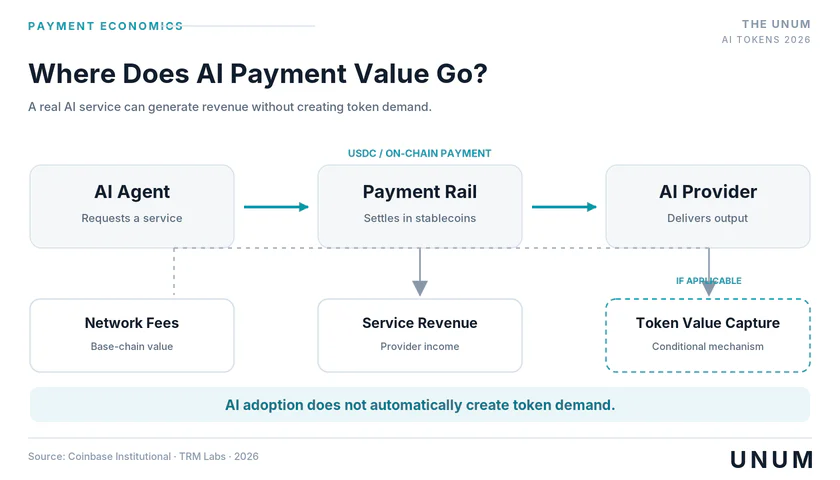
However, the spread of such tools does not guarantee an increase in the value of specialized AI tokens. Payments may occur in stablecoins, fees may go to base blockchains, and the main revenues from model usage may remain with computing service providers.
Therefore, the growth of the sector must be considered from three perspectives: market dynamics, actual product usage, and the mechanism of economic value distribution.
Independent Trend or Increased Interest in Risky Assets
Another question is how much the September rally was related to fundamental changes within the AI industry and how much it was due to a general increase in investor risk appetite.
To assess this difference, the absolute returns of individual cryptocurrencies are not as important as their performance relative to Bitcoin, Ethereum, and the broader market over the same time intervals. Additional information is provided by trading volumes, liquidity, open interest in futures, and funding rates for perpetual contracts.
If the value of AI tokens is growing mainly along with other high-risk crypto assets, it is premature to speak of an exclusively fundamental nature of the movement. However, if the sector demonstrates a sustainable advantage along with increased paid usage of its own products, there are more arguments in favor of an independent investment direction.
September data from Grayscale confirms strong relative returns but does not establish its cause by itself. For this, it would be necessary to study a longer period and compare market dynamics with the commercial results of projects.
Where Artificial Intelligence Really Needs Blockchain
The technological connection between artificial intelligence and cryptocurrencies exists in several segments, but their business models and economic prospects vary significantly.
Decentralized Computing and GPU Leasing
Training and using modern models require significant computational resources. Traditionally, these are provided by large cloud companies that control data centers and manage client access to equipment.
Decentralized networks offer an alternative approach: owners of computational power connect their GPUs to a shared infrastructure and receive rewards for completing tasks.
The potential advantage of this model lies in the ability to use distributed equipment, increase the availability of specific types of computations, and offer more flexible leasing terms. However, real competitiveness is determined not by the presence of blockchain, but by the quality of the service.
For commercial clients, the cost of computing, execution speed, node reliability, data protection, service stability, and the ability to scale the load are important. If decentralized infrastructure falls short of centralized clouds in these characteristics, token incentives will not ensure sustainable demand.
Additionally, it's important to distinguish between model training and inference — obtaining results from an already trained model. These processes have different requirements for equipment, latency, and data exchange. High efficiency of a distributed network for one category of tasks does not imply its universal suitability for another.
Inference — executing requests to an already trained AI model. This definition is already present in the text, so it doesn't need to be repeated in subsequent sections.
Decentralized AI Markets
Another approach involves creating markets where model developers and computational resource providers compete for rewards. Instead of paying for access to equipment, users or protocols receive results from executing specific tasks.
This concept is implemented by Bittensor. Participants in specialized subnets produce results, and verification and economic incentive mechanisms determine the distribution of rewards.
The advantage of this model is that it potentially allows for the coordination of AI service development and provision without a single control center. However, the distribution of cryptocurrency rewards should not automatically be considered market revenue from service sales.
Significant economic activity may exist within the network, financed by token issuance, even if independent clients currently pay for only a small portion of the produced results.
Autonomous AI Agents and Machine Payments
In 2026, payments between programs capable of independently finding necessary resources and paying for their usage are attracting special attention.
The x402 protocol allows embedding a payment request directly into the process of accessing an internet service. For example, a program requests data, the server reports the access cost, after which the payment is confirmed and the paid resource becomes available.
This mechanism is suitable for micropayments, where a user or program pays not for a monthly subscription, but for an individual request, computation, or information retrieval.
Smart contracts allow this system to be supplemented with conditional escrow of funds. Money can be reserved until the task is confirmed, potentially easing interaction between independent software agents.
However, such payments do not necessarily require a separate AI token. A basic blockchain, a settlement asset like a stablecoin, and a software mechanism to initiate and confirm payments are sufficient.
This distinction becomes crucial in the fundamental analysis of AI cryptocurrencies: the real demand for blockchain infrastructure does not prove the necessity of each token associated with this infrastructure.
Real Demand for AI Infrastructure and What Payments Show
One of the most insightful studies of commercial activity by AI agents was published by TRM Labs on September 9, 2026. Analysts examined transactions through x402 in the Base, Solana, and Polygon blockchains to determine which portion of operations could truly be associated with autonomous agents.
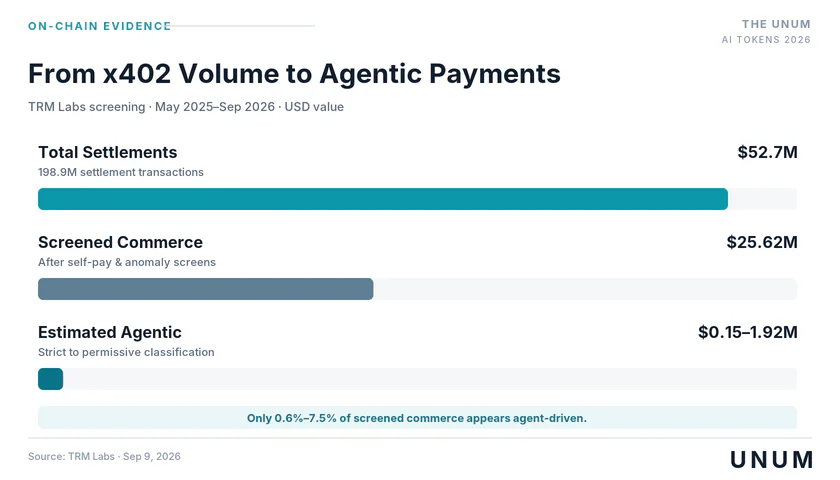
According to the study, about $52.7 million passed through the examined payment mechanisms since May 2025, with the total number of settlement transactions reaching 198.9 million.
At first glance, these figures suggest the rapid formation of a new market. However, an analysis of the transaction structure revealed a significant difference between the total turnover and payments that can be confidently linked to commercial activity.
Why Only Part of the $52.7 Million Can Be Considered Commercial Payments
TRM Labs consistently excluded several categories of activity from the examined sample: transfers between addresses controlled by one participant, large flows from a small number of payers, and transactions with sellers who had fewer than ten different buyers.
After applying these filters, the settlement volume decreased to $25.62 million. After excluding self-payments, concentrated flows, and sellers with a small number of buyers, the sample under study was reduced to $25.62 million. This does not mean that all the excluded volume was fictitious or non-commercial.
Analysts then attempted to determine what portion of the remaining payments could indeed have been made by autonomous AI agents.
The problem is that the blockchain records the transaction but does not allow for directly establishing who made the payment decision: an autonomous model, a regular software script, or a human using an automated interface.
Therefore, researchers applied two classification models. The softer one considered payments that could potentially be made by agents, while the stricter one required additional signs of prolonged activity and interaction with multiple counterparties or agent registration.
As a result, the share of probable agent payments ranged from 0.6% to 7.5% of the cleared volume, or approximately from $154,000 to $1.92 million for the studied period.
This range is not an accurate estimate of the entire AI agent economy. It reflects the result of specific selection criteria and may not account for specialized programs that regularly pay only one provider.
Nevertheless, the study convincingly shows why the number of transactions or the total volume of transfers cannot be used as standalone evidence of the mass commercial adoption of artificial intelligence.
Why Most Payments Go Through Stablecoins
Another important result from TRM Labs is related to the choice of settlement asset. Of the approximately $52.68 million in studied settlements, about $52.47 million, or 99.6%, was accounted for by Circle's dollar stablecoin.
The author of the study, Noah Hodge from TRM Labs, summarized the main conclusion as follows:
Today, the economy of agent payments through public payment infrastructure is a stablecoin economy.
This settlement structure has a practical explanation. To pay for computing resources and digital services, participants need to understand the cost of the operation in stable units. Using a volatile token adds currency risk and complicates pricing.
This does not exclude the use of specialized crypto assets in other infrastructure elements, such as for securing obligations, distributing fees, or gaining access to computing. However, payment data shows that the development of the agent economy is not necessarily accompanied by a direct increase in demand for AI tokens.
Why Coinbase Data Differs from Research Results
On September 22, Coinbase reported that over the existence of the x402 protocol, it processed more than 230 million transactions with a total volume exceeding $54 million. These figures surpass TRM Labs' data from September 9, but nearly two weeks have passed between the publications, and accounting methodologies may differ.
Importantly, Coinbase provides a cumulative indicator of infrastructure usage, while TRM Labs separately evaluates signs of commercial activity and autonomous behavior.
Therefore, an increase in the number of payments through x402 does not in itself indicate a proportional growth in the number of paying AI agents.
To assess real demand, it is necessary to additionally monitor the share of independent buyers, the number of repeat commercial operations, payments after the completion of incentive programs, and the revenue of digital service providers.
Which AI Crypto Projects Create Measurable Economic Value
Despite the limited confirmed agent commerce, some AI projects already have functioning infrastructure and measurable results. However, they should be compared based on the nature of the services provided, rather than solely on token capitalization or community activity.
Bittensor and the Economy of Decentralized Intelligence
Bittensor represents a network of specialized subnets, whose participants perform specialized computational tasks and evaluate the quality of the results obtained. Different subnets can engage in model training, information generation, forecasting, and other tasks.
The project's economy is based on the distribution of rewards linked to activity and market demand for subnets. One of the key questions remains the ability of such a system to direct resources to truly useful products, rather than just to participants attracting speculative capital.
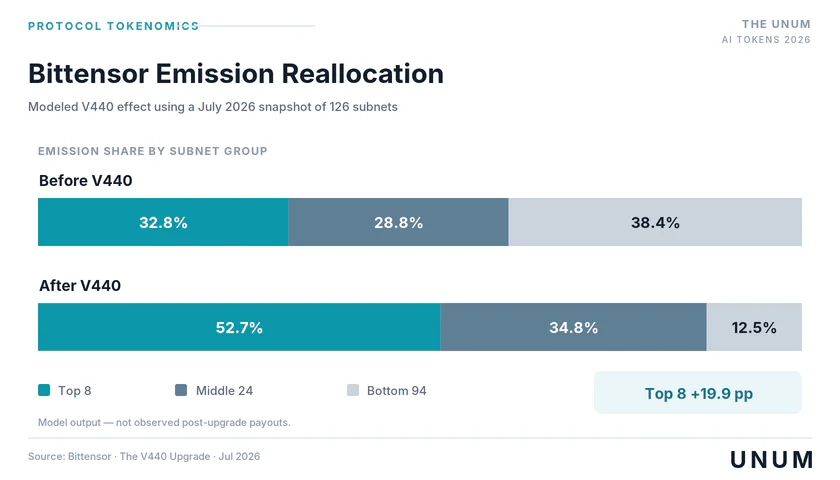
In July 2026, Bittensor developers introduced the V440 update with a new emission distribution mechanism. Its projected effect is shown in the July network snapshot. Its goal was to reduce rewards for economically weak participants and concentrate emissions in subnets attracting relatively greater demand from token holders.
In the published model based on a snapshot of the network from 126 subnets, the emission share for 94 subnets was below the threshold in the July network snapshot, in the model where all 126 subnets were considered emission recipients, it decreased from 38.4% to 12.5%. Simultaneously, the share of the eight largest subnets increased from 32.8% to 52.7%.
These figures describe the estimated impact of the mechanism on the July distribution, not the growth of the network's commercial revenue. They primarily show a change in the rules for distributing token incentives.
From an economic perspective, such an update is important as it reduces the attractiveness of passive participation and intensifies competition for capital within the system. However, the demand from token holders to participate in subnets still needs to be separated from the solvent demand of external clients for AI services.
To confirm the fundamental value of Bittensor, it is not enough to consider the number of subnets, the volume of locked capital, or the number of distributed tokens. Information about commercial customers, the cost of paid services, the quality of completed tasks, and the ability of projects to exist with reduced token rewards is necessary.
The main risk for Bittensor lies in the potential discrepancy between the scale of the internal incentive economy and the volume of external revenue. At the same time, the network's ability to produce technologically complex results should not be underestimated: the fundamental question is how effectively such results are converted into a sustainable business.
Render and Demand for Distributed Computing
Render offers infrastructure for performing computational tasks using distributed graphics processors. Initially, the network developed around visualization and 3D graphics, and then expanded into computational services, including tasks related to artificial intelligence.
Unlike projects whose economy is primarily built around future application scenarios, Render has a measurable history of completed tasks.
As of the October review, the official Render Network statistics dashboard showed:
Over 82 million frames processed in the network's history.
Approximately 5,600 nodes throughout the network's history, according to the Total Nodes Since Inception metric on the official dashboard.
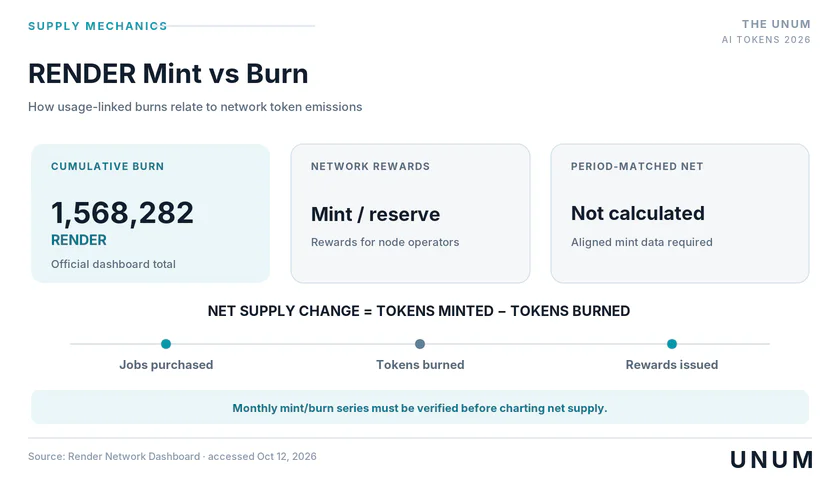
Approximately 1.57 million Render tokens burned cumulatively.
However, the number of historically registered nodes does not equal the number of simultaneously operating operators, and processed frames should not be considered AI tasks. A breakdown of computational work by type and period is necessary for a comprehensive analysis.
Of particular interest is Render's economic model, where token burning is linked to payment for computations, and new tokens are distributed as rewards to network participants according to the approved emission schedule.
According to the official Render Network documentation, users can pay for computational tasks in monetary equivalent, after which the corresponding tokens are burned. Rewards for computational resource providers are distributed according to network mechanisms.
Thus, there is a relatively direct mechanism linking the commercial use of infrastructure and the token economy.
However, its presence does not guarantee a sustainable reduction in supply. If the emission volume exceeds the burning volume, the total number of tokens may continue to increase even with the growth of network usage.
To assess Render's fundamental prospects, it is important to track not only the total number of completed tasks but also the cost of paid computations over the last 30 and 90 days, the burning volume in dollar equivalent, emission, and operator yield.
Additionally, Render competes with centralized computing platforms. Therefore, the project's prospects will depend not only on the development of artificial intelligence but also on the ability to provide quality computing services at a competitive price.
Virtuals Protocol and Commercial Activity of AI Agents
Virtuals Protocol develops infrastructure for the creation, coordination, and monetization of autonomous software agents. The project integrates tools for agent interaction, transaction processing, and tokenization of individual ecosystem participants.
According to the official Virtuals documentation, the platform's base token is used in liquidity mechanisms for agent tokens and individual operations within the ecosystem. This creates an economic link between platform activity and demand for its native crypto asset.
However, the nature of such activity is crucial.
On the official statistics page of Virtuals, metrics of completed tasks, agent revenues, and the overall economic output of the agent ecosystem are published. In the available October statistics display, there were about 2.54 million completed tasks and $4.53 million in agent revenues.
At the same time, the platform reflected a significantly larger figure of overall economic activity by agents — about $481.82 million. These values are the project's own metrics, and they cannot be equated without a detailed examination of the calculation methodology. Dynamic indicators may change, and their coverage needs to be clarified as of the publication date.
It is especially important to distinguish between revenues from performing commercial tasks and operations related to issuing or trading agent tokens.
Two situations can be conditionally imagined. In the first, an organization pays an agent for document processing, data analysis, or performing another useful task. In the second, participants buy tokens associated with the agent, hoping for an increase in their value.
Both operations may be accompanied by increased blockchain activity, but only the first directly confirms the solvent demand for artificial intelligence services.
To assess Virtuals, data on the share of independent buyers, repeat commercial orders, revenues of active agents, and revenue concentration are needed. If a significant portion of turnover depends on the emergence of new tokenized projects, the platform's economy may be sensitive to deteriorating market sentiment.
Therefore, the prospects of Virtuals are determined not by the number of created agents, but by the ability to form a market for regularly paid digital services.
Venice and the Tokenization of Access to Artificial Intelligence
Venice represents a different model of economic connection between artificial intelligence and cryptocurrency. The platform provides access to AI models, and its token is used in staking mechanisms and obtaining computing capacity.
An additional digital asset, DIEM, operates in the ecosystem, which can be created by locking a corresponding amount of staked Venice tokens. According to the official documentation, one locked DIEM provides one dollar of daily updated credits for using the models.
This structure differs from a regular subscription: the user gets the opportunity to ensure regular access to computing services by locking tokens and obtaining the corresponding computing capacity.
In April 2026, Venice announced programmatic buybacks and token burns, associated with new subscriptions. The buyback size was set at $2, $5, or $10 depending on the tariff plan.
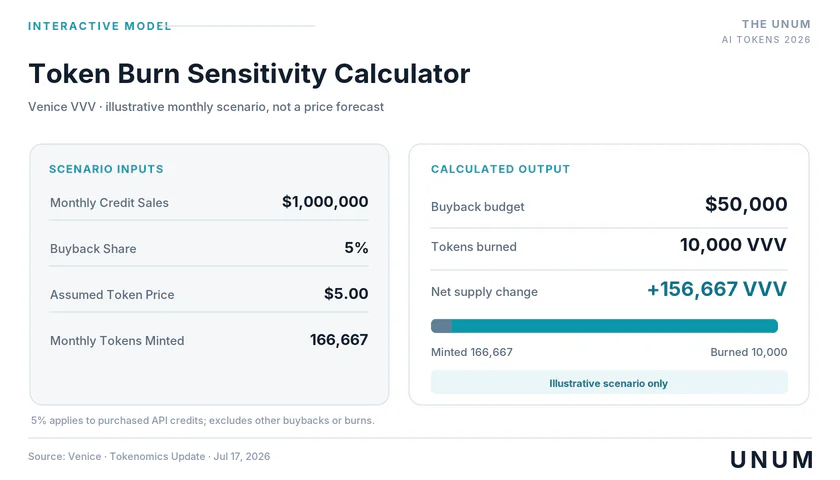
In July, the project expanded this mechanism: $5 from every $100 purchase of computing credits began to be directed to token buybacks and burns. This created a more transparent link between individual sources of commercial revenue and changes in the supply of the crypto asset.
In the update of August 5, the company also introduced a schedule for reducing annual emissions from 3 million to 2 million tokens, with the final stage planned for October 1, 2026. To confirm the execution of this schedule on a specific date, smart contract data must be used, not just published plans.
Back in April, Venice reported that since November 2025, about 180,000 tokens had been burned through discretionary buybacks, equivalent to approximately $1.35 million at the time of the respective operations.
At the same time, the total historical amount of burning cannot be automatically considered the result of commercial sales. A significant portion of the destroyed Venice tokens was associated with unclaimed distribution, rather than money received from clients.
Thus, Venice offers one of the more direct ways to link the commercial use of AI with the token economy, but the effectiveness of the model still needs to be evaluated based on actual revenue, the use of computing credits, and the net dynamics of supply.
The most important indicator here is not the number of locked tokens per se, but the volume of actually demanded computations for which users are willing to pay regardless of the investment attractiveness of the crypto asset.
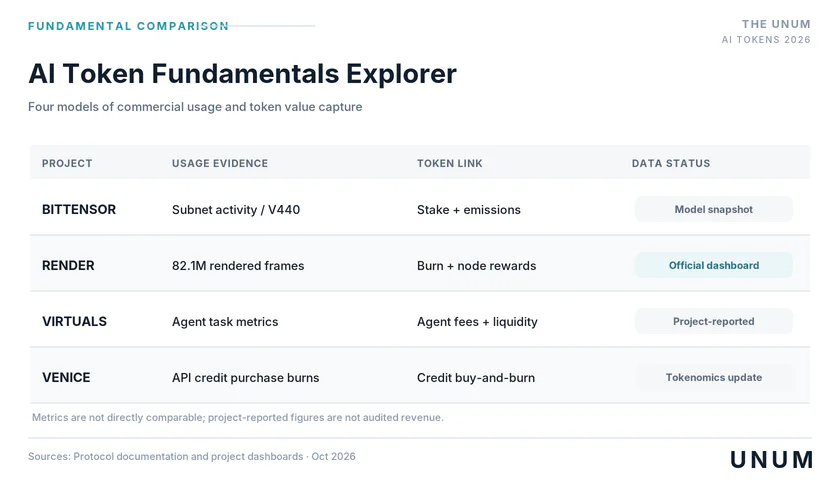
Comparison shows that projects offer fundamentally different ways of monetization. Bittensor develops a system for incentivizing AI producers, Render links the use of computations with token burns, Virtuals builds a commerce infrastructure between agents, and Venice uses tokenization of computing capacity and buybacks funded by part of the revenue.
Therefore, there is no universal indicator that would unequivocally determine the most fundamentally strong AI token. For each project, commercial activity, token supply, and the rights or economic advantages that their owner receives must be analyzed separately.
How the Use of Artificial Intelligence Affects Token Value
One common mistake when evaluating AI cryptocurrencies is the assumption that the success of a technological product necessarily leads to the growth of the corresponding token.
In practice, there can be several independent economic mechanisms between the use of a service and the market value of a crypto asset.
For example, a client pays for the use of a model in stablecoins. The computing provider receives payment, the application operator retains a commission, and the blockchain processes the transaction. If a specialized AI token is not involved in the calculations, does not provide access to the service, and is not linked to revenue distribution, an increase in the number of clients may not create direct demand for it.
Schematically, the movement of economic value looks as follows:
Client payment → service provider income → protocol commission or revenue → token demand, lock, or burn mechanism → potential impact on market value.
At each stage, part of the economic value may remain with another participant in the system. Moreover, even a reduction in token supply does not guarantee a price increase, as the result depends on demand, liquidity, and investor behavior.
In the Coinbase Institutional study dated March 31, 2026, analysts Colin Baskow and David Duong note:
Economic benefits are likely to be unevenly distributed among infrastructure levels.
Researchers highlight the basic payment infrastructure, agent coordination tools, and systems for verifying their work results. These areas may receive economic benefits at different times and through different mechanisms.
This approach is especially important for investors as it allows them to separate the prospects of the technology from the investment characteristics of a specific token.
Why staking and burning do not always indicate growth in fundamental value
Staking reduces the number of tokens available for immediate sale, but the nature of its impact depends on the source of rewards.
If users earn income from fees paid by external clients, staking may reflect the redistribution of genuinely created economic value. If rewards are predominantly paid in new tokens, nominal yield is accompanied by an increase in supply.
Similarly, burning does not always lead to a reduction in the total number of tokens. When issuance exceeds the volume of destroyed assets, supply continues to increase. Therefore, analysis requires considering the net change in circulating supply, not just individual staking or burning operations.
For example, if a protocol destroyed tokens worth $1 million over a certain period but simultaneously issued new tokens with a market value of $3 million, the mere fact of burning does not prove the deflationary nature of the model. Moreover, for accurate comparison, it is necessary to consider the dates of operations, token prices, and the conditions of their circulation.
Why capitalization may not reflect the real value of a project
Market capitalization is calculated as the product of the token price and its circulating supply. Fully diluted valuation shows the hypothetical value of the supply considering all tokens under the chosen calculation methodology.
Fully diluted valuation is the estimated value of the token supply considering its total quantity according to the methodology used. It should be clarified that it is not equivalent to the sum of future token sales.
The difference between these indicators helps identify potential pressure from future unlocks and issuance.
For example, in one of the October snapshots CoinGecko the capitalization of Bittensor was about $3.31 billion, while the fully diluted valuation reached approximately $6.14 billion. For Venice, the corresponding values were around $1.17 billion and $1.96 billion.
This means that the estimated value of the total supply significantly exceeded the capitalization of circulating tokens. However, the difference cannot be automatically interpreted as the volume of future sales: it is necessary to consider the release schedule, locked assets, circulation restrictions, and tokenomics specifics.
For fundamental analysis, ratios of capitalization or fully diluted valuation to annual revenue can be used, but they must be applied with caution. Unlike stocks, owning most cryptocurrencies does not grant direct rights to company profits.
Therefore, even if an AI project generates commercial revenue, the token's value multiplier to this revenue may be economically uninformative without a proven link between them.
Are There Signs of a Speculative Bubble in the AI Token Market
The rapid rise in cryptocurrency prices is not sufficient evidence of a bubble. Technological markets can anticipate expected returns from infrastructure that is just beginning to develop.
However, there is a fundamental difference between evaluating future commercial potential and capitalization that is almost entirely supported by expectations of further price increases.
For AI tokens, several signs are most indicative of possible overheating:
Capitalization grows significantly faster than commercial revenue. Especially if the increase in value occurs without a comparable growth in the number of independent clients and paid services.
Main activity is formed within the cryptocurrency market itself. High trading volumes of tokens, creation of new assets, and internal transfers are not equivalent to payments for useful AI products.
The project's economy depends on the constant issuance of new tokens. If rewards sustain participant activity but are not offset by external income, a decline in market prices can weaken the entire incentive system.
Investor positioning becomes overly speculative. An increase in open interest and funding rates with limited liquidity can amplify price movement in both directions.
Future unlocks create additional supply. The situation is particularly dangerous when large volumes of tokens become available for sale before sustainable commercial demand emerges.
At the same time, the absence of significant revenue does not in itself prove a project's overvaluation. In the early stages of development, technology companies and protocols often invest in infrastructure long before achieving sustainable monetization.
Therefore, evaluating AI cryptocurrencies requires analyzing not only the current level of income but also the quality of the product, potential market, competitiveness, financial stability, and the mechanism for distributing economic value.
Why Real Technology Can Become the Basis of a Speculative Bubble
The history of technology markets shows that the real significance of innovation does not preclude excessive valuation of related assets.
Investors may correctly identify a promising direction but err in the timing of its commercial development, the scale of future demand, or the distribution of income among market participants.
For artificial intelligence, this risk is particularly noticeable due to the high uncertainty of future business models. Technologies are rapidly improving, the cost of some computational operations is decreasing, and competition between centralized and decentralized providers is intensifying.
The reduction in inference costs can stimulate demand for computing, but at the same time reduce the profitability of individual operations. Therefore, even a rapid increase in the number of requests to the model does not necessarily lead to a corresponding increase in revenue.
Additional pressure is created by the possibility of replacing one provider with another. If a user can obtain a comparable service at a lower cost, the crypto project must have a sustainable competitive advantage that is difficult for other market participants to replicate.
As a result, the AI token market can simultaneously include economically promising protocols and individual assets whose price does not match confirmed commercial potential.
What Awaits AI Tokens in the Next 6–12 Months
The future dynamics of the sector will depend on how quickly technological infrastructure can transition from experimental use to regular commercial payments.
Based on current data, three main scenarios can be identified for the end of 2026 and the first half of 2027.
Positive Scenario
Paid use of autonomous agents and decentralized computing begins to grow at a steady pace. The number of independent clients increases, the range of in-demand services expands, and individual protocols demonstrate positive revenue dynamics without the need to constantly increase token incentives.
In such a situation, projects with a direct link between product usage and token economy potentially receive stronger fundamental support.
To confirm the scenario, data on the growth of repeat payments, commercial revenue, and net demand for tokens after accounting for issuance will be required.
Base Scenario
Infrastructure continues to develop, but commercial use is concentrated in a limited number of products. Some platforms find stable customers, while others remain dependent on incentive programs and speculative activity.
The growth of payments in stablecoins may outpace the increase in demand for specialized AI tokens. In this case, the sector will continue to exist as a separate investment direction, but the divergence in returns between projects will become more significant.
The main sign of such a scenario will be uneven revenue growth while maintaining high volatility in market valuations.
Negative Scenario
Speculative interest is waning faster than commercial demand is developing. Declining quotes reduce the attractiveness of token rewards, decrease liquidity, and complicate the financing of new projects.
Ecosystems where a large part of economic activity depends on issuance, trading of own assets, or a constant influx of new participants are particularly vulnerable.
Meanwhile, technological products can continue to develop even during the decline of associated cryptocurrencies. Such an outcome will confirm that the value of infrastructure and the cost of its token do not always move synchronously.
How Investors Can Distinguish a Promising AI Project from a Speculative Token
Fundamental analysis of artificial intelligence cryptocurrencies requires a deeper approach than comparing capitalization and price dynamics. First of all, it is necessary to determine what exactly the project sells, who pays for its services, and how commercial activity affects its own token.
Five groups of indicators appear to be the most informative.
Commercial demand. It is necessary to assess the number of independent paying clients, the volume of repeat payments, and revenue dynamics over comparable periods. It is especially important to understand whether activity persists after the completion of user reward programs.
Quality of use. A large number of transactions, registered agents, or computational tasks have limited analytical value without understanding their origin. Data on the cost of actually provided services, customer concentration, and the share of paid operations are needed.
Tokenomics. It is necessary to consider current issuance, unlocking schedules, burning volume, sources of staking income, and mechanisms for mandatory token use.
Competitiveness. A decentralized AI project should offer clients a measurable advantage over existing solutions — in terms of price, availability, sustainability, privacy, or quality of services provided.
Market evaluation. Capitalization should be compared with confirmed commercial activity, potential obligations for issuing new tokens, and real mechanisms for revenue distribution.
The quality of information disclosure deserves special attention. Projects that publish verifiable usage statistics, data on token flows, and a detailed methodology for calculating their own indicators provide investors with more grounds for fundamental assessment.
At the same time, the absence of transparent reporting increases uncertainty. It does not necessarily indicate the absence of a business, but it limits the ability to confirm the justification of market value.
AI Tokens: Forming a New Market or Repeating a Speculative Cycle
Data from 2026 shows that the intersection of artificial intelligence and blockchain is no longer limited to concepts and experimental projects. Distributed computing networks perform real tasks, payment protocols process millions of operations, and individual platforms implement mechanisms linking the use of AI services with token demand.
However, the scale of confirmed commercial activity still significantly differs from market expectations. Research by TRM Labs demonstrates that a significant portion of payment turnover cannot be confidently attributed to autonomous agent commerce. Comparison of Bittensor, Render, Virtuals, and Venice also shows how different the mechanisms of incentives, monetization, and value distribution are.
Therefore, it would be incorrect to unequivocally label the entire AI cryptocurrency market as a speculative bubble. The sector has functioning technological products and promising economic models, but the high price of an individual token does not yet confirm the sustainability of the corresponding business.
The main question for investors is not whether artificial intelligence will continue to develop, but which crypto protocols will be able to gain sustainable economic benefits from its use and what portion of these benefits will actually be linked to the value of their tokens.
It is the dynamics of paid activity, commercial revenue, issuance, and net demand for crypto assets that should form the basis of sector evaluation at the end of 2026 and throughout 2027. Until more complete and comparable reporting emerges, the strong technological potential of AI cryptocurrencies will coexist with an increased risk of speculative overvaluation.
The material is prepared as of October 12, 2026. Market indicators change in real time. Data published by projects is not always independently audited. The article is informational and analytical in nature and is not an individual investment recommendation.