What happened to Binance and how serious is the damage
On October 30, 2026, the largest cryptocurrency exchange Binance announced an investigation into a major security incident. According to the company's preliminary version, the attacker may have accessed the internal infrastructure through a compromised DevOps engineer's laptop. This could have allowed the attacker to penetrate the service container and send unauthorized withdrawal requests.
The overall scale of the incident is preliminarily estimated at $6.3 billion. With the assistance of partners, Binance managed to freeze assets worth about $3 billion on blockchains. However, the freeze limits the movement of tokens but does not mean they are fully returned under the exchange's control. The actual size of the losses and the amount of compensation are yet to be determined.
In an official statement from October 30, 2026, Binance emphasized: "We have found no evidence of wallet private key leaks."
As a precaution, the platform temporarily suspended cryptocurrency deposits and withdrawals, revoked affected permissions, and engaged law enforcement and blockchain analytics companies. Binance also promised to cover the losses through the SAFU fund and its own funds, and to publish an updated proof of reserves after the checks are completed.
The final technical causes of the attack have not yet been established. However, the preliminary version shows that the security of cryptocurrency exchanges depends not only on the protection of private keys but also on the control of internal operations, the delineation of employee powers, and the management of service infrastructure.
If the stated damage estimate is confirmed as the volume of stolen assets, the incident will become the largest known theft in the history of the cryptocurrency industry. However, its long-term impact will be determined not only by the amount of losses but also by Binance's ability to restore operations and fulfill obligations to clients.
Why the hack of one exchange threatens trust in the entire crypto market
Binance holds a significant place in the crypto market infrastructure. Millions of users use centralized crypto exchanges not only for trading but also for storing cryptocurrencies, exchanging stablecoins, and managing investment portfolios. Therefore, problems at the largest platform can affect the perception of the security of the entire industry.
At the same time, it is necessary to distinguish between two concepts: the reliability of the blockchain and the security of the organization that services digital asset operations.
For example, Bitcoin (BTC) exists in a decentralized network, whose operation does not depend on a single exchange. If an attacker gains access to Binance's infrastructure, it does not mean they have hacked the Bitcoin protocol itself. Similarly, an attack on exchange wallets with Ethereum (ETH) does not indicate a vulnerability in the Ethereum blockchain.
However, for the average investor, such a distinction is not always obvious. A person may perceive the loss of funds on an exchange as proof of the unreliability of cryptocurrencies in general, especially if they do not manage private keys themselves.
A particularly serious reputational risk arises when withdrawals are restricted. Even users whose assets are not affected by the attack may temporarily lose the ability to freely dispose of them. In such conditions, promises of compensation do not fully replace confidence in the availability of one's own money.
This turns the Binance incident from a cybersecurity issue into a broader test of trust in centralized financial intermediaries. For the crypto industry, the consequences may be more significant than the immediate financial losses.
Why cryptocurrencies remain a risky investment in the eyes of investors
The incident occurred against the backdrop of a decline in the share of cryptocurrency owners among American investors, which was recorded even before the attack.
According to a Gallup study, published on September 21, 2026, the share of cryptocurrency owners among American investors decreased from 17% in 2025 to 11% in 2026. In 2021, this figure was 6%.
At the same time, 63% of respondents considered cryptocurrencies a very risky investment, and 66% showed no interest in buying them. Notably, the share of investors who rate cryptocurrencies as a very risky asset has not changed compared to 2025.
The study was conducted from June 1 to 15 among 2,043 adult U.S. residents, including more than a thousand investors with investment assets of $10,000 or more. Its results do not reflect the consequences of the October hack and cannot be automatically applied to the entire global market.
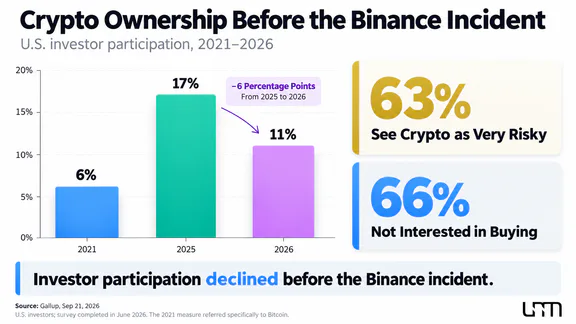
Nevertheless, the results show that even before the incident at Binance, a significant portion of investors approached digital assets with caution. High volatility, the complexity of evaluating cryptocurrencies, and fears of losing funds remain barriers for new market participants.
Major cyberattacks on crypto exchanges can exacerbate these concerns. For someone who has long held digital assets, an exchange hack may mean the need to reconsider how they store them. For a potential investor, such an event could become an additional argument against making their first purchase.
Therefore, the long-term threat lies not only in the potential outflow of existing clients but also in slowing the attraction of new capital into the industry. Even if current investors maintain their positions, the caution of the potential audience may limit the further spread of cryptocurrencies.
Will people stop buying and storing cryptocurrencies?
Despite the scale of the incident, it is premature to talk about an inevitable mass abandonment of cryptocurrencies. The behavior of market participants depends on their experience, investment horizon, and reasons for owning digital assets.
For an investor buying BTC for several years, the Binance hack does not necessarily change their perception of the long-term value of bitcoin. However, it may alter their assessment of how safe it is to leave assets on the trading platform.
For novice users, the situation is different. For them, a cryptocurrency exchange often remains the main way to access the market, so losing trust in the intermediary can lead to a refusal to invest in digital assets altogether.
The possible reactions of different categories of investors are as follows.
Category | Possible Reaction | Long-term Consequence |
|---|---|---|
Novice Investors | Refusal to buy or reduction in investments | Slowing the attraction of new users |
Long-term Holders | Transferring part of assets to personal wallets | Reducing dependence on exchange storage |
Active Traders | Diversifying platforms and reducing leverage | Redistribution of trading liquidity |
Institutional Investors | Increasing requirements for custodians | Growing demand for regulated infrastructure |
These scenarios describe possible behavior of market participants, not confirmed consequences of the Binance hack.
The issue of self-custody is particularly important. A personal crypto wallet reduces dependence on a centralized exchange, but the user assumes responsibility for the safety of private keys, backup phrases, and the security of signed transactions.
A hardware wallet allows storing private keys in a separate device but does not eliminate the risk of losing access or confirming a malicious transaction.
Thus, reduced trust in crypto exchanges does not necessarily mean a decrease in demand for cryptocurrencies themselves. Investors may continue to hold digital assets while redistributing funds between different storage methods.
How the Binance hack affects cryptocurrency market prices and liquidity
The initial market reaction showed that problems at the largest exchange can quickly reflect on the value of digital assets.
According to Reuters data from October 30, bitcoin fell to a six-week low of around $77,646, Ethereum to a two-month low of around $2,239. BNB, a token historically linked to the Binance ecosystem, lost more than 8% in a day and traded around $694.
These values reflect the initial market reaction at the time of the Reuters report, not current quotes. It is impossible to assert that all the decline was caused solely by the hack. The dynamics of cryptocurrencies are simultaneously influenced by macroeconomic expectations, market volatility, positions of major participants, and the use of leverage.
For traders, it is especially important to monitor not only the price but also the state of the trading infrastructure. The liquidity of the crypto market depends on the availability of assets, the depth of orders, and the ability of participants to execute trades without significant changes in quotes.
Key indicators that may signal the development of a crisis:
Net flows from exchanges. A steady withdrawal of cryptocurrency may indicate a redistribution of capital, although it does not in itself prove panic.
Market depth and spreads. A reduction in available orders can increase the cost of executing large trades.
Open interest and funding rates. A sharp reduction in leveraged positions may indicate a forced reduction in risk.
Stablecoin reserves. Their dynamics help assess potential purchasing liquidity on trading platforms.
Notably, even before the incident on Binance, stablecoin reserves were decreasing. As reported by UNUM on October 28, since the beginning of the month, their volume decreased by approximately 5%, from $43.2 billion to $41.1 billion. These data were provided by CryptoQuant analyst Darkfost.
The reduction in reserves could limit the volume of stablecoins available for purchasing digital assets, but it did not necessarily mean a deterioration in the depth of the order book. Since the outflow was observed before the attack, it cannot be considered a consequence of the hack.
Even if quotes quickly recover, this does not yet mean a complete return of confidence. The market price may stabilize significantly earlier than users are convinced of the availability of their own funds.
What the crypto market learned after FTX and Bybit
The industry has already experienced events that questioned the security of centralized platforms. However, the causes of such crises varied significantly.
In November 2022, the FTX exchange went bankrupt. Subsequent investigations by U.S. authorities established that its founder, Sam Bankman-Fried, organized the improper use of billions of dollars of client funds. In March 2024, he was sentenced to 25 years in prison.
According to the U.S. Department of Justice, client funds were used, among other things, to finance operations of the affiliated company Alameda Research. The FTX crisis was caused not by an external cyberattack but by internal abuses, hidden obligations, and insufficient control.
Another example is the Bybit hack on February 21, 2025, when attackers withdrew assets worth approximately $1.46 billion. The company promptly attracted additional liquidity and restored the security of client assets.
According to the Hacken report published by Bybit on February 24, 2025, within 72 hours, the exchange restored the coverage of the audited assets to a level not lower than 1:1.
This did not mean the return of all stolen funds or a full audit of the company's entire financial activity, but it demonstrated its ability to replenish affected reserves and continue fulfilling obligations to clients.
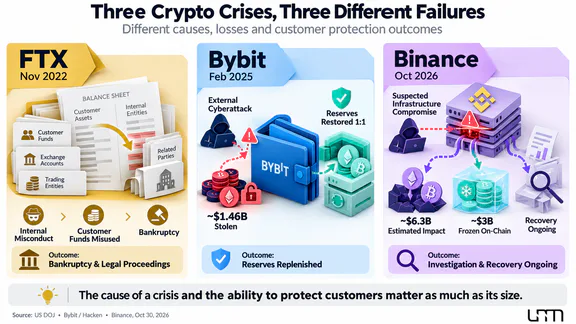
The situation with Binance does not yet have a definitive outcome. The company has stated its intention to compensate for losses, but confirmations of actual fulfillment of obligations will be required to restore investor confidence.
History shows that the scale of losses is not the only factor determining the future of an exchange. Equally important are the transparency of management actions, the sufficiency of liquid reserves, and the speed of operations recovery.
Can the SAFU fund guarantee the safety of funds
One of Binance's main arguments in favor of protecting users remains the Secure Asset Fund for Users (SAFU) — a reserve fund intended to protect clients in certain emergencies, including security incidents.
In February 2026, Binance completed the transfer of the fund's assets into Bitcoin. According to The Block, after the conversion, SAFU contained 15,000 BTC worth approximately $1 billion at the time of completion.
The company also announced that if the market value of the fund falls below $800 million due to BTC price fluctuations, it will replenish it to $1 billion.
However, having such a reserve does not guarantee coverage of all potential losses. The preliminary assessment of the incident's consequences significantly exceeds the value of SAFU at the time it was converted into Bitcoin.
This does not prove a lack of funds at Binance. The company stated that it will use its own capital, and some of the affected assets have already been frozen. For an objective assessment, it is necessary to establish the actual size of unreimbursed losses, the volume of available liquid assets, and obligations to users.
Proof of Reserves deserves special attention — a confirmation of reserves that, depending on the methodology, allows verification of the presence of certain assets and their compliance with the obligations covered by the audit on a specific date.
This mechanism increases transparency but is not equivalent to a full financial audit. It may not account for all off-chain obligations of the company, its financial risks, and its ability to meet client demands in a timely manner.
The limitations of such audits were previously highlighted by the American audit regulator PCAOB.
To assess the reliability of a crypto exchange, it is necessary to distinguish between three levels of verification:
Proof of Reserves can confirm the presence of certain assets and their compliance with the client balances covered by the audit, but the result depends on the methodology and completeness of the data.
An independent financial audit evaluates the company's financial statements, including assets, liabilities, and other significant indicators.
A solvency check should establish the organization's ability to meet obligations considering its financial position, available liquidity, and risks.
After the incident, investors should pay attention not only to the updated proof of reserves from Binance but also to the availability of funds, the volume of actual compensations, and the results of independent audits.
Why the future of cryptocurrencies may lie with regulated intermediaries
Large-scale attacks on exchanges create a contradictory trend. On one hand, they highlight the advantages of self-custody of digital assets. On the other, they may strengthen the demand for professional custodial services, regulated funds, and traditional financial institutions.
According to a study by EY and Coinbase, conducted in January 2026 among 351 institutional investors, 81% of respondents with direct spot exposure to cryptocurrencies preferred to obtain it through registered ETFs and ETPs rather than holding individual crypto assets directly on an exchange or in a wallet.
Meanwhile, 49% of study participants reported increased attention to risk management, liquidity, and position size.
These results were obtained before the Binance hack and do not reflect the reaction of institutional investors to the incident. However, they show that the industry was already gradually transitioning to more regulated investment methods.
Cryptocurrency ETFs allow for price exposure to digital assets without the need to manage private keys independently. However, exchange-traded funds do not eliminate all risks: the security of underlying assets still depends on custodians, and ETF shareholders do not gain direct control over the cryptocurrency.
A paradox arises. Cryptocurrencies initially developed as an alternative to a financial system based on intermediaries, yet the further mass adoption of digital assets may occur precisely through regulated investment structures.
Another contradiction is related to the freezing of stolen funds. The ability to block certain stablecoins helps limit damage from cyberattacks but simultaneously demonstrates the dependence of such assets on decisions by centralized issuers.
This does not mean that all cryptocurrencies are equally subject to external control. For example, the governance mechanisms of Tether (USDT) are significantly different from the principles of Bitcoin.
In the long term, investors will have to choose not only between different digital assets but also between various models of control, security, and financial independence.
How the crypto market will change after the Binance hack
The long-term consequences of the Binance hack will depend on several interrelated factors. The main ones are the speed of resuming operations, the size of final losses, the fulfillment of compensation promises, and the results of the technical investigation.
Three possible directions for the development of the situation can be highlighted.
Restoring trust. Binance resumes operations, compensates for losses, and provides convincing audit results. In this case, the negative market reaction may gradually weaken, and the incident will become a stimulus for improving security standards.
Redistribution of Trust. Clients maintain interest in cryptocurrencies but reduce holding funds on centralized exchanges. Some capital is moving to personal wallets, other custodians, or regulated investment instruments.
Prolonged Crisis. Delays in fund withdrawals, insufficient transparency, or issues with compensations heighten investor concerns. In such a scenario, the pressure could spread to the liquidity of other platforms and the interest of new participants in the crypto market.
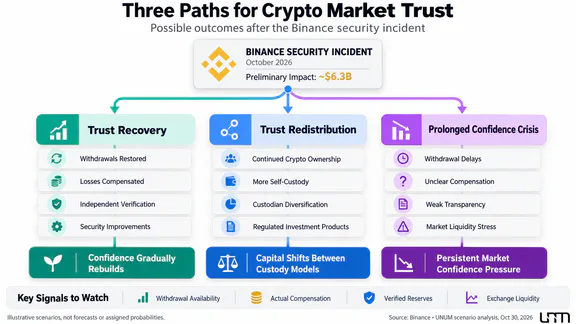
None of these scenarios can be considered inevitable. Their assessment will require actual indicators of fund movements, reserve status, trading activity, and withdrawal availability.
It is especially important to distinguish between short-term emotional reactions and sustainable changes in investor behavior. Withdrawal from one exchange may indicate a loss of trust in a specific intermediary but does not necessarily mean a rejection of digital assets as an investment class.
What Investors and Traders Should Do After the Incident
The main practical takeaway from the Binance situation is the need to assess not only the market risk of cryptocurrency but also the reliability of the infrastructure through which the investor accesses it.
For long-term holders, it makes sense to determine what portion of the portfolio should actually be on the exchange. Assets not used for regular trading can be considered for self-custody if the owner can ensure the security of private keys, hardware wallets, and backups.
Traders should consider additional risks associated with leverage. Withdrawal restrictions, reduced market depth, or temporary unavailability of trading infrastructure can complicate position management even with relatively small price changes.
When assessing the reliability of a crypto exchange, it is useful to check several conditions:
Availability of asset withdrawals and operational restrictions
Transparency of client reserves and completeness of obligation disclosure
Presence of independent audits and a clear structure for fund storage
Account protection mechanisms and transaction confirmations
Company's crisis response history and loss compensation procedures
Binance users should especially monitor official announcements about the resumption of operations, investigation results, and compensation mechanisms. During major incidents, the risk of fraud posing as support services also increases, so any offers of fund recovery should be verified through official channels.
Decisions to sell cryptocurrencies should not be made solely based on the scale of the initially reported damage. A more reasoned approach is to determine the acceptable dependence of one's portfolio on a single platform, consider possible access restrictions to assets, and plan actions in advance in case of infrastructure disruptions.
Will Investors Lose Trust in Cryptocurrencies
The Binance hack could become a serious reputational challenge for the entire cryptocurrency industry, especially among novice investors for whom fund security remains one of the main conditions for entering the market.
However, losing trust in a specific exchange does not equate to abandoning cryptocurrencies. Some participants may continue to hold digital assets while simultaneously reassessing storage methods, intermediary requirements, and acceptable risk levels.
The ultimate scale of the consequences will depend on whether Binance can fulfill its obligations to clients and restore trust through transparent actions, not just public promises.
Perhaps the main outcome of this crisis will not be a mass exodus of investors from cryptocurrencies but a change in the very understanding of security: trusting a digital asset and trusting the company that holds it are not the same thing.