
Why Oil is Over $100 Again
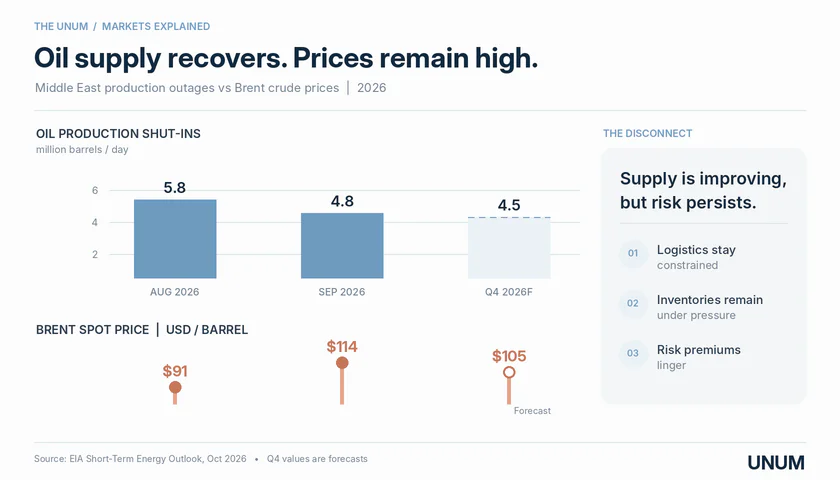
On the morning of October 14, 2026, Brent was trading around $106.27 per barrel. In September, the average spot price reached $114 compared to $91 in August, and on September 15, quotes rose to $131. These are the data from the U.S. Energy Information Administration (EIA).
The main reason for the rise in oil prices is disruptions in supplies from the Middle East. Military actions and infrastructure damage disrupt certain export routes, increase transportation costs, and create the risk of new supply disruptions, increase the cost of ship insurance, and force carriers to use more expensive routes.
The blow to the East-West pipeline in Saudi Arabia, which allowed the export of more than 5 million barrels per day bypassing the Strait of Hormuz, was particularly painful. According to the EIA, in September, production capacities of about 4.8 million barrels per day were idle due to restrictions.
In its October forecast, the EIA expects the average Brent price to be $105 in the fourth quarter of 2026, which is $14 higher than the September estimate. The agency assumes that export restrictions will remain, and global oil inventories will continue to decline.
Thus, it is not just a speculative jump in quotes, but a supply shock whose consequences can spread far beyond the energy market.
How Expensive Oil Affects Bitcoin
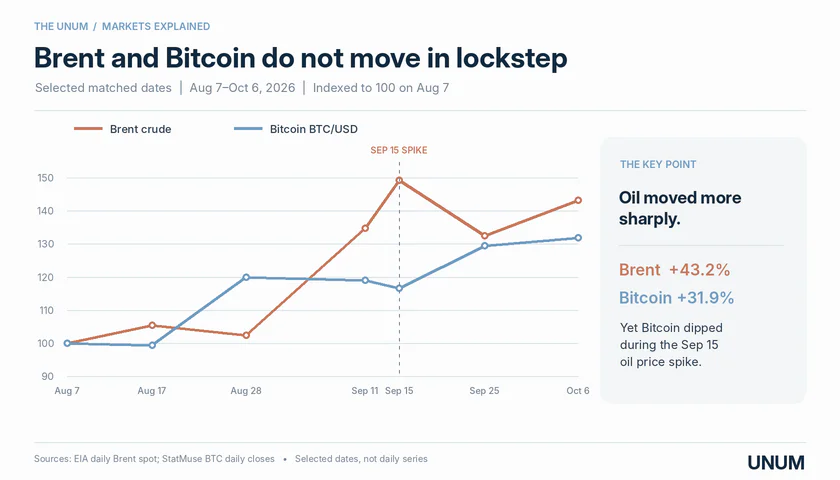
There is no direct dependence between the price of a barrel and the price of Bitcoin. However, an oil shock triggers a chain of economic changes that affect investment demand.
1. Rising oil prices increase inflationary pressure. Higher fuel prices increase transportation, production, and logistics costs. Over time, producers and suppliers pass on some of the additional costs to consumers, leading to higher prices for goods and services.
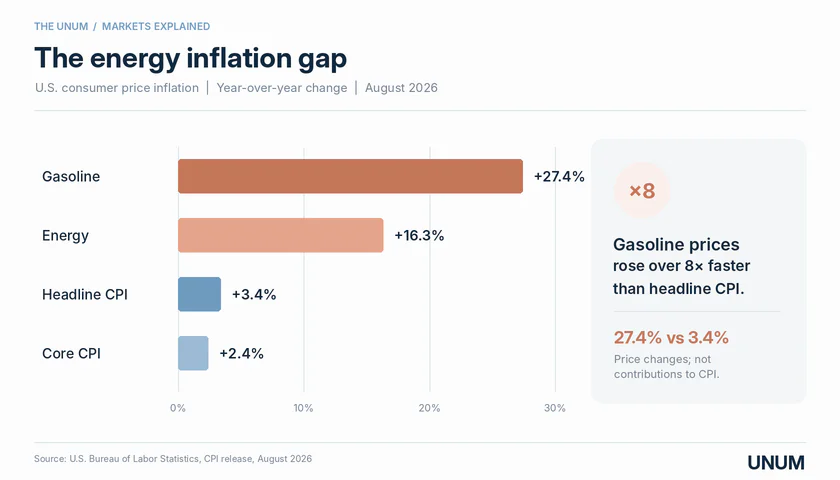
According to the Bureau of Labor Statistics, in August 2026, consumer inflation CPI in the US was 3.4% year over year, and the energy component of the index rose by 16.3%. Gasoline prices increased by 27.4% over the same period.
2. Inflation limits the Fed's options. When inflationary pressure threatens the Fed's 2% PCE index target, the regulator may maintain a restrictive monetary policy for longer. In September, the regulator raised the rate by 25 basis points to a range of 3.75–4.00%.
The problem is exacerbated by rising inflation expectations. According to the September survey by the New York Fed, American households expect inflation to be 3.9% over the next year, compared to 3.6% a month earlier.
Cleveland Fed President Beth Hammack warned on October 12:
Each month of sustained elevated inflation increases the risk that inflation expectations become entrenched in the economy.
3. High rates change the attractiveness of assets. When the yield on US government bonds rises, investors have the opportunity to earn more on relatively safe instruments. At the same time, the cost of borrowed capital increases, and risk appetite may decrease.
4. Pressure shifts to the crypto market. Bitcoin does not provide fixed interest income, so when financial conditions tighten, competition for investment capital intensifies. Speculative positions financed by leverage become particularly sensitive.
This mechanism makes oil a potential threat to cryptocurrencies, even though Bitcoin itself is not linked to the oil industry.
What Research Says About Bitcoin's Dependence on Oil
Historical data does not confirm a simple rule that rising oil prices are necessarily accompanied by a Bitcoin decline.
The study by Ihsen Abid, published in June 2026 in the journal Studies in Economics and Finance, covers monthly data from August 2010 to June 2025. The author found significant correlations of Bitcoin with oil prices, US stock indices, and US monetary policy. However, the influence of individual factors varies over short and long time horizons. However, the study is based on data up to June 2025 and does not allow for a direct assessment of the consequences of the October 2026 oil shock.
Another important argument is contained in the International Monetary Fund study. According to the IMF study in 2022, the correlation of daily returns between Bitcoin and the S&P 500 increased from 0.01 in 2017–2019 to 0.36 in 2020–2021. This indicates a strengthening connection between cryptocurrencies and traditional financial markets, although it does not mean that such correlation remains unchanged.
The year 2022 is also indicative, when the energy crisis was accompanied by accelerating inflation, rising rates, and a deep fall in the crypto market. However, Bitcoin was additionally pressured by internal industry upheavals, including the collapse of Terra and the bankruptcy of FTX.
The key difference lies in the nature of the oil price increase. If a barrel becomes more expensive due to strong global demand, this may coincide with favorable conditions for risky assets. However, if the growth is due to infrastructure destruction and supply shortages, it simultaneously raises inflation and worsens economic prospects.
Why ETFs Could Amplify Bitcoin Sell-off
The development of spot Bitcoin ETFs has expanded institutional investors' access to cryptocurrencies, but at the same time has increased the influence of the overall sentiment of financial markets.
When fund managers reduce the share of risky assets, sales may also affect Bitcoin. Through the mechanism of creation and redemption of ETF shares, net outflows can lead to the sale of the underlying asset, although individual transactions with shares on the exchange do not require immediate purchase or sale of BTC.
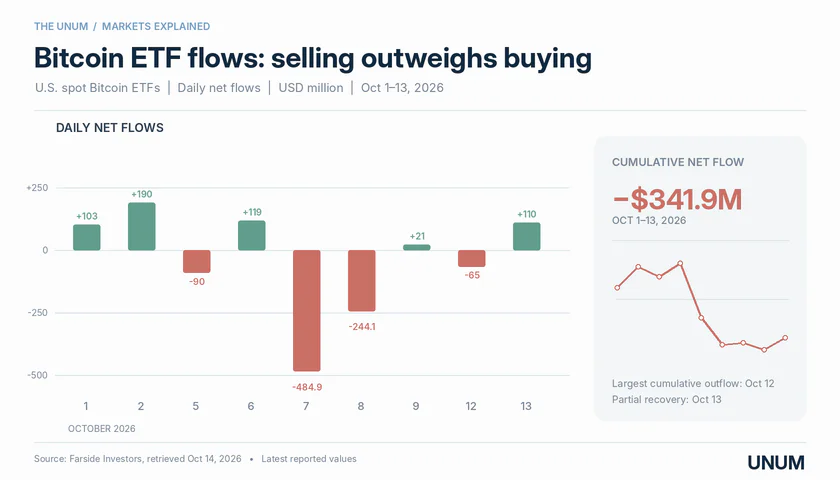
October statistics show sharp fluctuations in institutional capital flows. According to Farside Investors:
On October 7, the net outflow from US spot Bitcoin ETFs amounted to $484.9 million.
On October 8, investors withdrew another $244.1 million.
In the first seven trading days of October, the total net outflow reached $386.3 million.
On October 13, US spot Bitcoin ETFs recorded a net inflow of $109.8 million, reducing the total net outflow since the beginning of October to approximately $341.9 million.
These figures confirm fluctuations in institutional demand, but do not in themselves prove that the reason for the sales was expensive oil.
The crypto derivatives market poses an additional danger. If a decline in Bitcoin leads to mass closing of leveraged positions, forced liquidations can accelerate the price drop. In such a situation, the initial macroeconomic impulse can turn into a more large-scale sell-off.
In April 2026, IMF financial advisor Tobias Adrian, commenting on the consequences of the Middle East conflict, noted:
All this led to an increase in bond yields and put pressure on the prices of risky assets.
Could the Energy Crisis Hit Mining
Another channel of influence is related to the cost of Bitcoin mining. Mining requires significant electricity expenses, so rising energy tariffs can reduce the profitability of companies and force them to sell part of their cryptocurrency reserves.
According to the Cambridge Digital Mining Industry Report, published in 2025 based on data from surveyed mining companies, electricity accounts for more than 80% of the cash operating expenses of surveyed mining companies. At the same time, the share of oil in their energy balance is estimated at only 0.5%, while natural gas accounts for 38.2%.
Therefore, the connection with the oil market here is predominantly indirect. For miners, the local cost of electricity, the energy sources used, and the terms of long-term contracts are significantly more important.
Three Scenarios for Bitcoin with Expensive Oil
The forecast for Bitcoin depends not so much on the specific price of Brent as on the duration of the energy crisis and the response of central banks.
Scenario | Conditions | Possible Consequences for Bitcoin |
|---|---|---|
Easing | Brent $85–95, supply recovery | Easing of inflationary pressure and increased interest in risky assets |
Prolonged Shock | Brent $100–115, high inflation | Pressure from rates, the dollar, and volatile ETF flows |
Escalation | Brent above $120, new supply disruptions | Increased risk of large-scale sell-off and cascading liquidations |
The ranges represent conditional scenarios, not official forecasts of Bitcoin's price or the likelihood of a crash.
The first scenario suggests a recovery in oil supplies and a gradual decrease in energy prices. This outcome aligns with the direction of the EIA's baseline forecast, which anticipates an average Brent price of around $84 in 2027.
In the second case, inflationary pressure persists long enough to limit the Fed's options. Bitcoin may remain volatile, reacting to CPI and PCE statistics, bond yields, and decisions by institutional investors.
The third scenario is the most dangerous. If a new escalation simultaneously heightens inflationary expectations and forces investors to massively reduce risk, Bitcoin's decline may be exacerbated by the liquidation of leveraged positions, especially if there is significant open interest in the market.
However, even a prolonged oil crisis does not guarantee a crash. The crypto market also depends on its own investment cycle, regulation, demand for ETFs, and the state of the global economy.
Indicators Crypto Investors Should Monitor
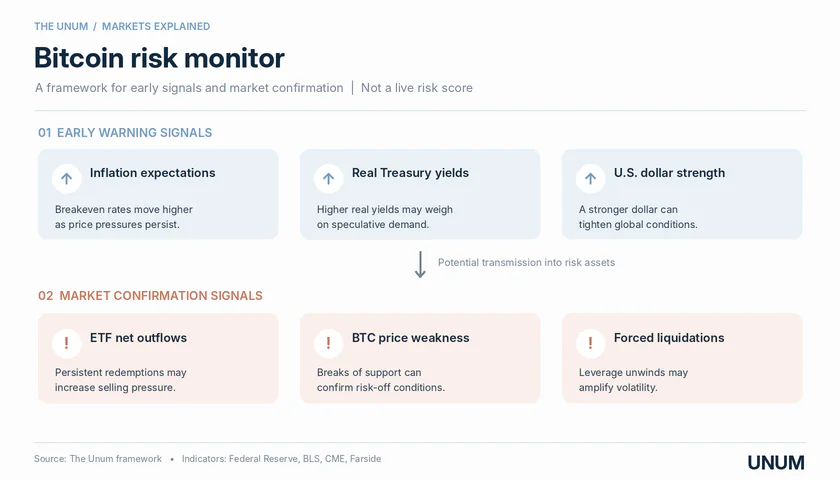
To assess the threat, it is not enough to track only Brent quotes. It is more important to determine whether the energy shock is being transmitted to other segments of the financial market.
The first signals are the rise in inflation expectations and the yield on U.S. government bonds, especially the real yield on TIPS. Then, it is necessary to evaluate the DXY dollar index, CPI and PCE dynamics, Fed rate expectations, and capital flows into spot Bitcoin ETFs.
Additional information is provided by the open interest in Bitcoin futures, funding rates for perpetual contracts, and the volume of liquidations. Their joint deterioration may indicate increased vulnerability of the crypto market.
As of the morning of October 14, investors are awaiting the release of the U.S. September CPI. This indicator will allow for a more accurate assessment of how much the oil shock has already affected consumer prices and whether it can change the Fed's future decisions.
How to Manage Crypto Assets in High Volatility Conditions
Understanding macroeconomic risks is only part of a crypto investor's work. It is equally important to be able to track market quotes, choose the right moment for a deal, and control one's own operations, especially when Bitcoin reacts sharply to economic news.
For these tasks, you can use the crypto platform TRADEX, which combines spot trading, exchange, and storage of digital assets. Users have access to market and limit orders, charts with technical analysis indicators, and transaction history. The platform also allows exchanging cryptocurrencies for fiat money, including USD, EUR, and BYN, and provides an OTC service for large transactions.
In times of increased uncertainty, such tools help organize work with crypto assets and pre-determine the conditions of transactions. However, even limit orders do not eliminate market risk, and no trading platform can guarantee protection against a drop in Bitcoin's value.
Oil Doesn't Control Bitcoin, But It Changes the Game
A barrel at $100 is not an independent signal to sell Bitcoin. The threat arises when high energy prices entrench inflation, support tight monetary policy, and force investors to reduce risk.
This is why a crypto investor has to keep an eye on oil prices as much as on the Fed's decisions. A new energy shock could be a serious test for Bitcoin, but the scale of the consequences will be determined not by the oil price itself, but by how deeply the crisis alters global financial conditions.