Address of a Major Miner Transferred 483 BTC to Binance
The address, which analyst Ember associates with a major miner, transferred 483 BTC to Binance. According to his observations, the funds come from mining pools AntPool, F2Pool, and SpiderPool, and the accumulated coins are periodically directed to the trading platform.
As stated in Ember's report, such transfers occur at intervals of several days. This activity suggests that the market participant regularly uses the exchange to manage funds obtained from mining. However, the address's ownership by a specific company has not been established.
The scale of the operation is notable: 483 BTC is comparable to the estimated daily block subsidy—about 450 BTC with an average block creation time of ten minutes. However, the transfer of previously accumulated coins cannot be equated to new issuance or confirmed sales.
Funds transferred to Binance can be used for placing orders, managing liquidity, or other operations. Although regular large transfers create a potential source of additional supply, their impact on the Bitcoin price depends on how much of the coins actually enter the market.
How Much Have BTC Transfers by Miners to Exchanges Increased in November
The event attracted attention against the backdrop of an earlier increase in BTC transfers from mining pool addresses to trading platforms. According to CryptoQuant data, on November 10, the Miner-to-Exchange Flow indicator reached 2,077 BTC—the highest daily value since February 2026.
This was approximately 16 times the average daily volume for the previous 30 days, which was about 127 BTC. At the same time, approximately 97% of the recorded flow was attributed to AntPool, so the spike mainly reflected the activity of one mining pool rather than the entire industry.
Indicator | Value |
|---|---|
Average daily volume of miner transfers to exchanges over a 30-day period | 127 BTC |
Miner transfers to exchanges on November 10 | 2,077 BTC |
Miner Reserve reduction on November 10 | ~1,860 BTC |
Separate transfer to Binance reported on November 19 | 483 BTC |
Sources: CryptoQuant and Ember. Indicators reflect different periods and samples
An additional signal was the reduction of the Miner Reserve by approximately 1,860 BTC on November 10. This metric accounts for the number of coins on addresses that the analytical platform associates with miners and mining pools.
Decreasing miner reserves may indicate the movement of accumulations, but possible Bitcoin sales by miners need to be confirmed with additional data. Funds may be transferred between wallets, used for over-the-counter settlements, or for managing corporate reserves.
Thus, November's statistics indicate periods of increased activity, but do not prove that miners are massively selling BTC.
Why the Decline in Bitcoin Price Increases Pressure on Miners
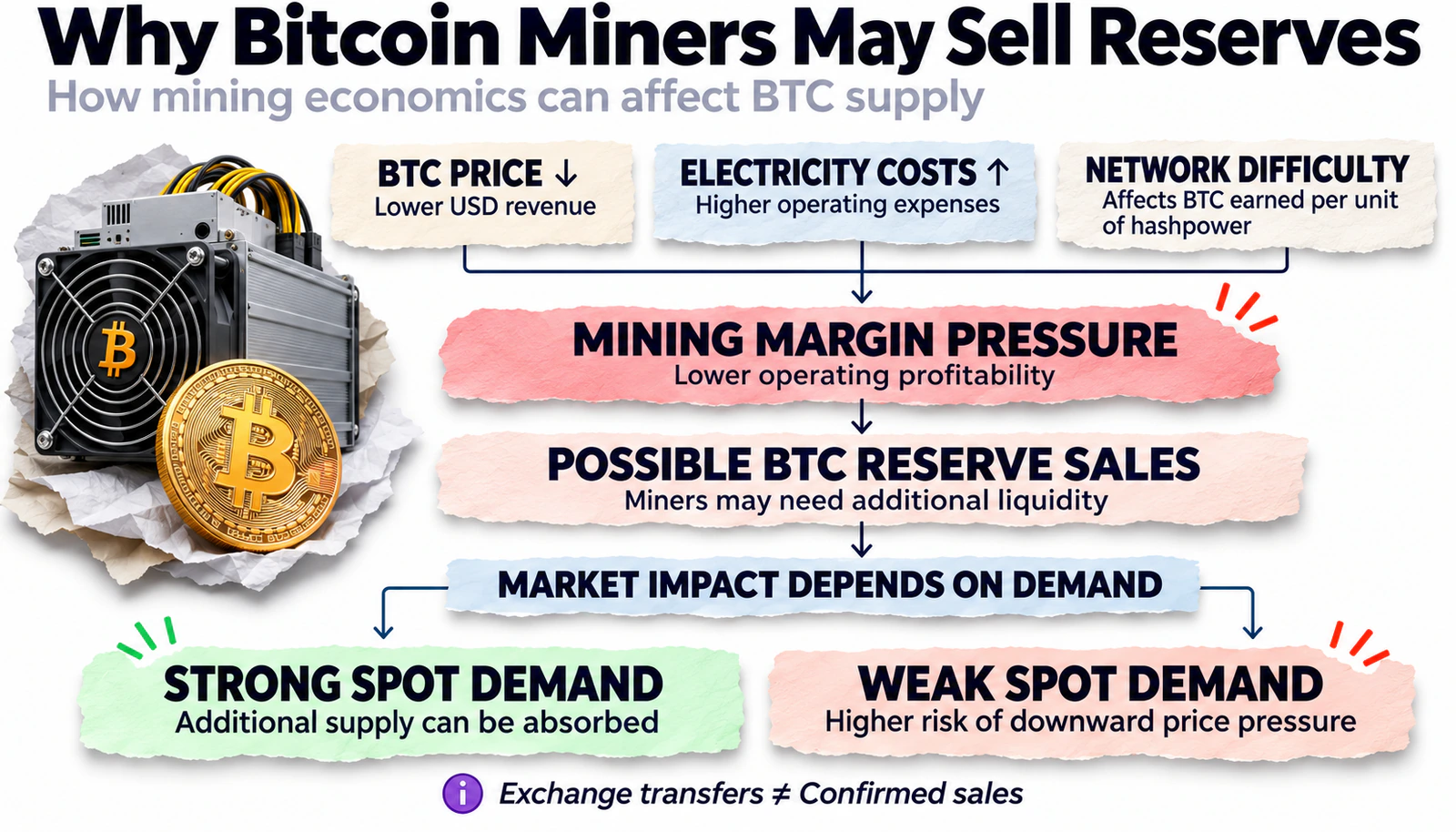
Bitcoin mining becomes less profitable when the BTC price declines, as miners' profitability depends on the cryptocurrency's price, network difficulty, and electricity costs. Miners receive rewards in BTC, while a significant portion of operational expenses are incurred in fiat currencies.
After the April 2024 halving, the reward for a found block was reduced to 3.125 BTC. To maintain profitability, mining companies need to control costs for equipment, electricity, and infrastructure maintenance.
One of the key industry indicators is hashprice, which reflects the expected daily revenue per unit of computing power. According to Hashrate Index, as of November 16, 2026, it was $30.45 per PH/s per day, down 4.7% over the week.
The drop in hashprice is particularly sensitive for companies with outdated equipment, high energy costs, and debt obligations. As profitability decreases and the need for cash increases, selling accumulated BTC may become one way to maintain liquidity.
A notable example is MARA Holdings. According to the company's report, in the first nine months of 2026, it sold about 26,984 BTC for $1.9 billion. After September 30, the company additionally sold 13,597 BTC for approximately $1.1 billion, directing part of the proceeds to repay secured Bitcoin loans of $750 million.
In MARA Holdings' quarterly report, it is stated: “We regularly sell bitcoins mined during our mining activities” (MARA Holdings, Form 10-Q dated November 9, 2026).
The company views cryptocurrency reserves as a source of funding for operations and business development. Therefore, large sales do not always indicate a financial crisis: they can also be part of a capital management strategy.
How miners' sales affect the BTC rate
Miners receive new BTC as a reward for creating blocks, as well as fees for included transactions. They keep part of the mined cryptocurrency in reserves and may sell some to cover expenses and fund further activities.
Pressure on the BTC market is determined not only by miners' activity but also by the resilience of demand for Bitcoin from other investors. If buyers can absorb the additional supply, even large sales do not necessarily lead to a prolonged price decline.
The movement of capital through exchange-traded funds is of particular importance. According to Farside Investors, on November 17, U.S. spot Bitcoin ETFs recorded a net outflow of $239.9 million, and on November 18, another $306.5 million. These figures reflect capital flows through a specific investment instrument and do not allow for an assessment of the entire institutional demand.
The combination of net outflows from spot Bitcoin ETFs and the potential increase in supply from miners can intensify pressure on quotes. An additional risk factor is the liquidation of leveraged positions, which can accelerate short-term price movements.
UNUM examined the impact of ETFs, liquidations, and spot demand in more detail in an analysis of Bitcoin's decline to $73,700.
At the same time, the state of the cryptocurrency market also depends on broader financial conditions. Changes in interest rates, global liquidity, and investor risk sentiment can affect Bitcoin independently of miners' actions. This relationship was thoroughly analyzed in UNUM's material on the Nasdaq decline.
Are there signs of Bitcoin miners' capitulation
Miners' capitulation implies a significant deterioration in economic conditions, where some participants are forced to sell reserves, reduce operations, or shut down unprofitable equipment.
On November 14, the Bitcoin network difficulty decreased by 9.1% to 134.82 trillion, but this indicator alone does not indicate capitulation. Analysts at Hashrate Index attribute a significant portion of the hashrate reduction to the temporary shutdown of equipment due to expensive electricity in Texas.
In an independent study by Hashrate Index, it is noted that from October 29 to November 14, the cost of electricity exceeded the expected revenue of equipment with an efficiency of 25 J/TH for 45% of the hours in West Texas. In the preceding similar period, the figure was 9%.
When electricity became cheaper, some equipment returned to operation despite the continued decline in BTC. This shows why a short-term reduction in computing power cannot automatically be considered a sign of financial capitulation.
Bitcoin's hashrate and mining difficulty need to be analyzed alongside hashprice and electricity costs. For a more comprehensive assessment of the industry's state, the following indicators are important:
Miner Reserve — a steady reduction in reserves may reflect a decrease in accumulation but does not reveal the purpose of all transfers.
Miner-to-Exchange Flow — an increase in inflows to exchanges indicates a potential rise in the available supply for sale.
Puell Multiple — shows the ratio of the current dollar value of daily Bitcoin issuance to its 365-day average. A decline in the indicator may indicate a deterioration in mining profitability.
Hashrate and hashprice — allow for the comparison of equipment activity with changes in the profitability of computing power.
November data confirms the growing financial pressure on individual industry participants. However, the observed signs are not yet sufficient to assert a widespread miner capitulation.
Is Bitcoin Facing a New Wave of Decline
The short-term forecast for Bitcoin depends on whether the cryptocurrency market can absorb the additional supply without a prolonged price decline. The significance lies not in a single large transaction but in the sustainability of sales and the state of demand.
There are three main scenarios for the future movement of BTC:
Negative scenario. If the Miner-to-Exchange Flow remains elevated, reserves continue to decline, and spot Bitcoin ETFs maintain net outflows, selling pressure may intensify. With weak liquidity, this increases the likelihood of further price declines and the renewal of local lows.
Neutral scenario. If miner transfers stabilize and buyers begin to absorb incoming BTC, the market may shift to consolidation. In this case, even persistent difficulties for mining companies may not necessarily trigger a new wave of decline.
Positive scenario. A recovery in spot demand, sustained inflows into Bitcoin ETFs, and a reduction in miner exchange transfers can ease pressure on prices. However, a single price rebound is not enough to confirm a market reversal.
To assess the likelihood of each scenario, it is necessary to simultaneously monitor miner reserves, hashprice, capital flows through ETFs, and trading activity. The current dynamics can be observed on the Bitcoin quotes page in UNUM.
November events show that the decline in BTC prices and high operating costs create additional pressure on the mining industry. However, exchange transfers are not equivalent to actual sales, and a reduction in hashrate does not always indicate capitulation. The main factor in Bitcoin's future movement remains the balance between coin supply and investor demand.