


Why crypto exchanges are expanding beyond cryptocurrencies
For a long time, the core business of crypto exchanges was operations with Bitcoin, Ethereum, and other digital assets. During price surges, exchanges attracted new clients, and trading volumes increased. During prolonged corrections, interest in risky tokens waned, and income from trading fees became less predictable. Expanding the offering of traditional assets on crypto exchanges allows platforms to serve users even when activity in the crypto market declines.
The crypto market in 2026 is changing not only due to price dynamics: the expansion of exchanges towards traditional finance began much earlier. According to a CoinGecko study, since the beginning of 2025, crypto platforms have accelerated the launch of tools related to traditional financial markets (Traditional Finance, TradFi). CoinGecko links the expansion of offerings to regulatory changes, the development of asset tokenization, the emergence of new issuers of tokenized instruments, and the infrastructure for their distribution. For exchanges, this is also a way to compete with brokers for clients who want to manage different assets through a single account.
A notable example is Bitget. In January 2026, the platform opened access to trading 79 instruments related to currencies, metals, indices, and commodities, settled in USDT. According to the company, during the testing period, the waiting list exceeded 80,000 users.
Bitget CEO Gracy Chen explained the strategy as follows: “Traders want the ability to freely choose between assets within a single ecosystem.”
However, a unified trading interface does not necessarily mean equal rights to the instruments presented in it. Trading gold on crypto exchanges does not always imply ownership of the metal: many platforms offer derivative contracts whose value depends on the price of gold. Similarly, stock quotes in the trading interface may represent instruments of different legal nature.
What traditional assets crypto platforms are already offering
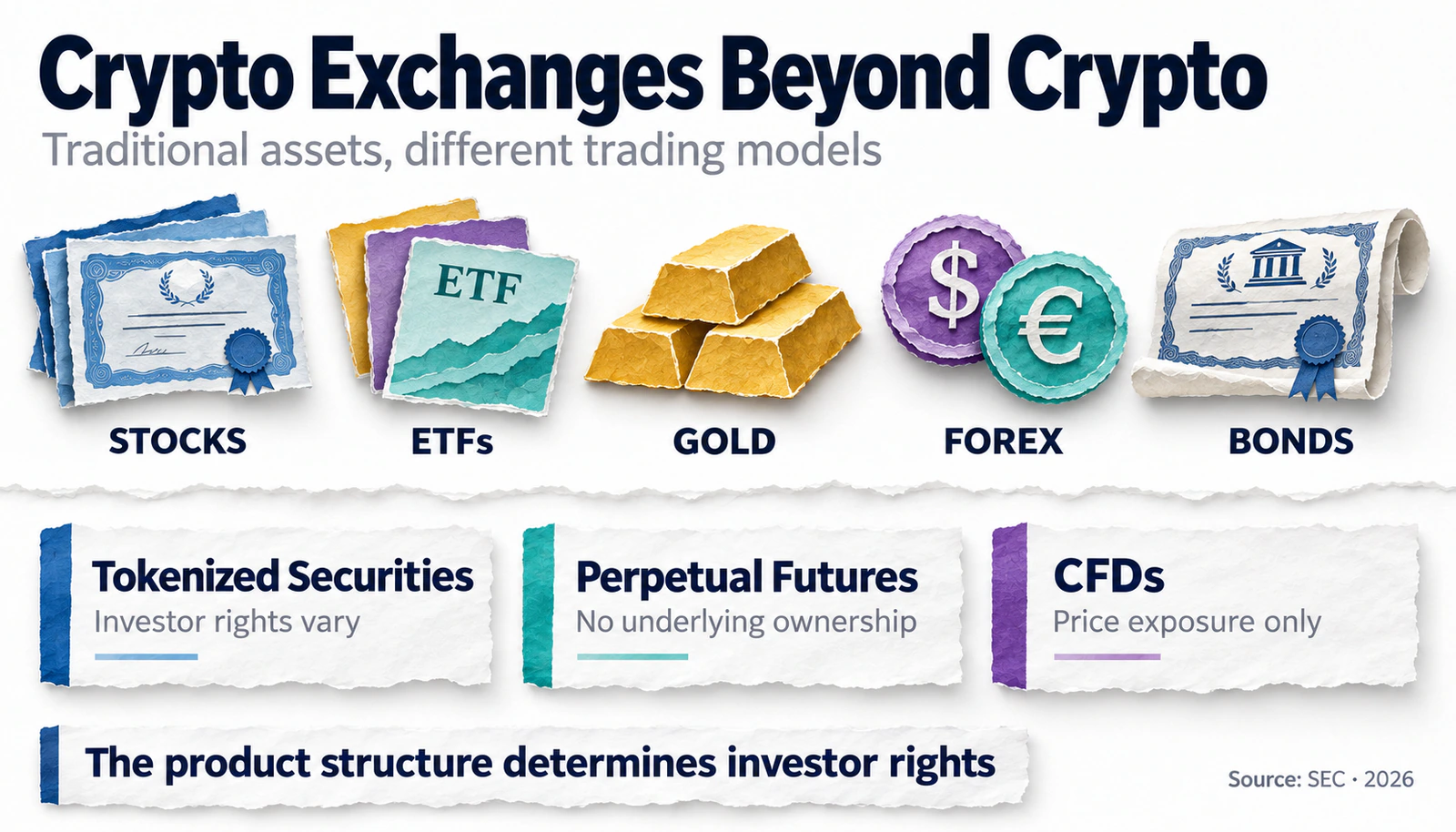
The term “stocks on crypto exchanges” today can mean either a tokenized instrument or a derivative contract on the price of Nvidia, Tesla or another company. The offering also includes exchange-traded funds (ETFs), gold, currency pairs, oil contracts, and instruments related to government bonds. However, not all of them are tokenized assets in the strict sense.
To compare the products discussed in the article, it is convenient to highlight three models: tokenized instruments based on securities, perpetual futures, and CFDs.
Tokenized securities. A tokenized instrument can reflect rights to the underlying security or provide a financial claim whose value depends on it. The holder's rights are determined by the issuer and the issuance structure: the mere presence of underlying securities does not guarantee the right to vote or receive dividends in the usual form.
Perpetual futures. The contract allows trading on the price change of stocks, indices, or gold, usually using collateral and sometimes leverage. The contract buyer does not become the owner of the underlying stock.
CFD, or contracts for difference. The outcome of the transaction depends on the price change between the opening and closing of the position. The asset is not physically acquired, and the fulfillment of obligations depends, among other things, on the counterparty and platform conditions.
In the January SEC clarification on tokenized securities, it is noted that the digital representation of an asset does not in itself determine investor rights. If a token is issued by an entity independent of the company, the holder's rights are determined by the issuance terms: some models imply claims to the underlying securities, while others provide only economic dependence on their price.
The shift of crypto exchanges towards TradFi is clearly visible in specific products.
Platform | Product Example | What the User Gets |
|---|---|---|
Kraken / xStocks | Two types of products: xStocks tokens backed by underlying stocks and separate perpetual futures on stocks, indices, and gold | Digital instrument or derivative contract; rights and risks depend on the product |
Bitget TradFi | Currency pairs, metals, indices, commodities | Access to trading price changes through CFD |
Tokenized BUIDL fund in the deal collateral system | For eligible institutional clients — the ability to use the fund as collateral, not just regular bond purchases through spot | |
OKXICE | Planned trading of tokenized American stocks and ETFs | According to the stated model — digital rights to underlying securities with shareholder rights for eligible clients |
Perpetual contracts on traditional assets | Trading position dependent on the price of the underlying instrument without owning it |
Two November events are particularly important. On November 11, Payward, the owner of Kraken, announced the launch of the first batch of more than 200 tokenized instruments tied to stocks traded on UK and EU platforms. According to the company, the total number of instruments in the xStocks ecosystem exceeded 1,500. Access to them is limited to permitted jurisdictions and does not mean that residents of countries where the underlying stocks are traded can necessarily purchase the corresponding tokens.
Payward's Chief Commercial Officer Mark Greenberg stated the goal as: “An investment portfolio should have no borders and no trading time restrictions.”
During the same period, the joint project of OKX and Intercontinental Exchange (ICE), the owner of the New York Stock Exchange, announced plans to launch the OKXICE platform on November 23. Initially, more than 70 assets are declared, including 59 ETFs from Direxion.
As of November 16, the launch of OKXICE has not yet occurred. The company indicates that the platform will operate under a temporary SEC exemption but is not registered as an exchange or broker-dealer and is not approved by the SEC.
The difference between the projects is fundamental. According to the xStocks terms, the tokens are backed by underlying stocks, but their holders do not receive ordinary voting rights or direct claims to the companies' stocks. OKXICE, on the other hand, claims a model with rights to dividends, voting, and corporate actions, although access to the platform is limited to eligible US clients. Thus, the term “tokenized stocks” encompasses several different ownership models.
How Fast Trading of Traditional Assets on Crypto Exchanges is Growing
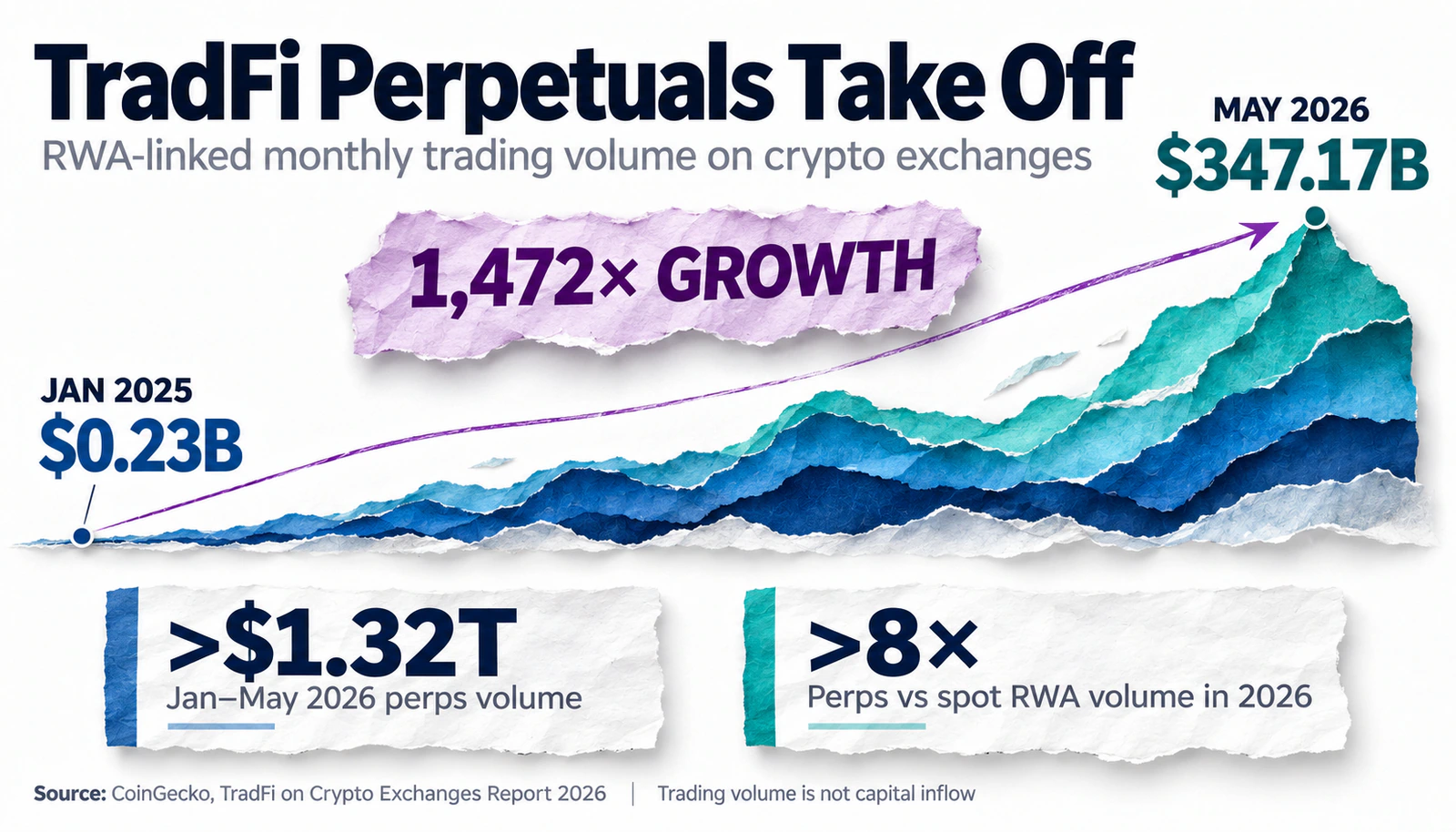
The new products are backed by significant trading activity, although a substantial portion is in derivatives. According to CoinGecko's calculations, the monthly trading volume of perpetual contracts linked to real assets (Real World Assets, RWA) grew from $0.23 billion in January 2025 to $347.17 billion in May 2026. From January to May 2026, the total turnover of these contracts on the surveyed platforms exceeded $1.32 trillion.
According to CoinGecko's sample, from January to May 2026, the turnover of perpetual TradFi contracts was more than eight times the turnover of spot RWA instruments.
The report highlights Binance, MEXC, and Hyperliquid, with Nvidia, Tesla, and Micron among the stock instruments. The study covers a specific set of centralized and decentralized platforms up to May 2026: the amounts presented should not be taken as the volume of the entire market in November. Moreover, high turnover of futures is not equivalent to the influx of the same volume of long-term capital into tokenized assets.
The use of tokenized assets in financial infrastructure is also growing, but it is not always reflected in spot trading volumes. For example, the BlackRock BUIDL fund, associated with short-term US debt instruments, is used as collateral in certain trading schemes on Binance.
In April 2026, OKX, BlackRock, and Standard Chartered announced a similar institutional model where collateral is held by a regulated custodian. These examples show that tokenized assets can be used as collateral for trading positions, including storage with a regulated custodian.
UNUM discussed in detail how blockchain is changing the accounting and transfer of securities rights in the analysis of DTCC tokenization.
Why Venture Capital is Paying More Attention to AI
Alongside the development of traditional assets, the priorities of tech investors are shifting. Venture funds, previously focused on Web3, are considering artificial intelligence (AI), robotics, and other Frontier Tech areas as additional sources of growth. However, claiming that $150 billion shifted from cryptocurrencies to AI in a month is unfounded: this estimate is not supported by the original materials.
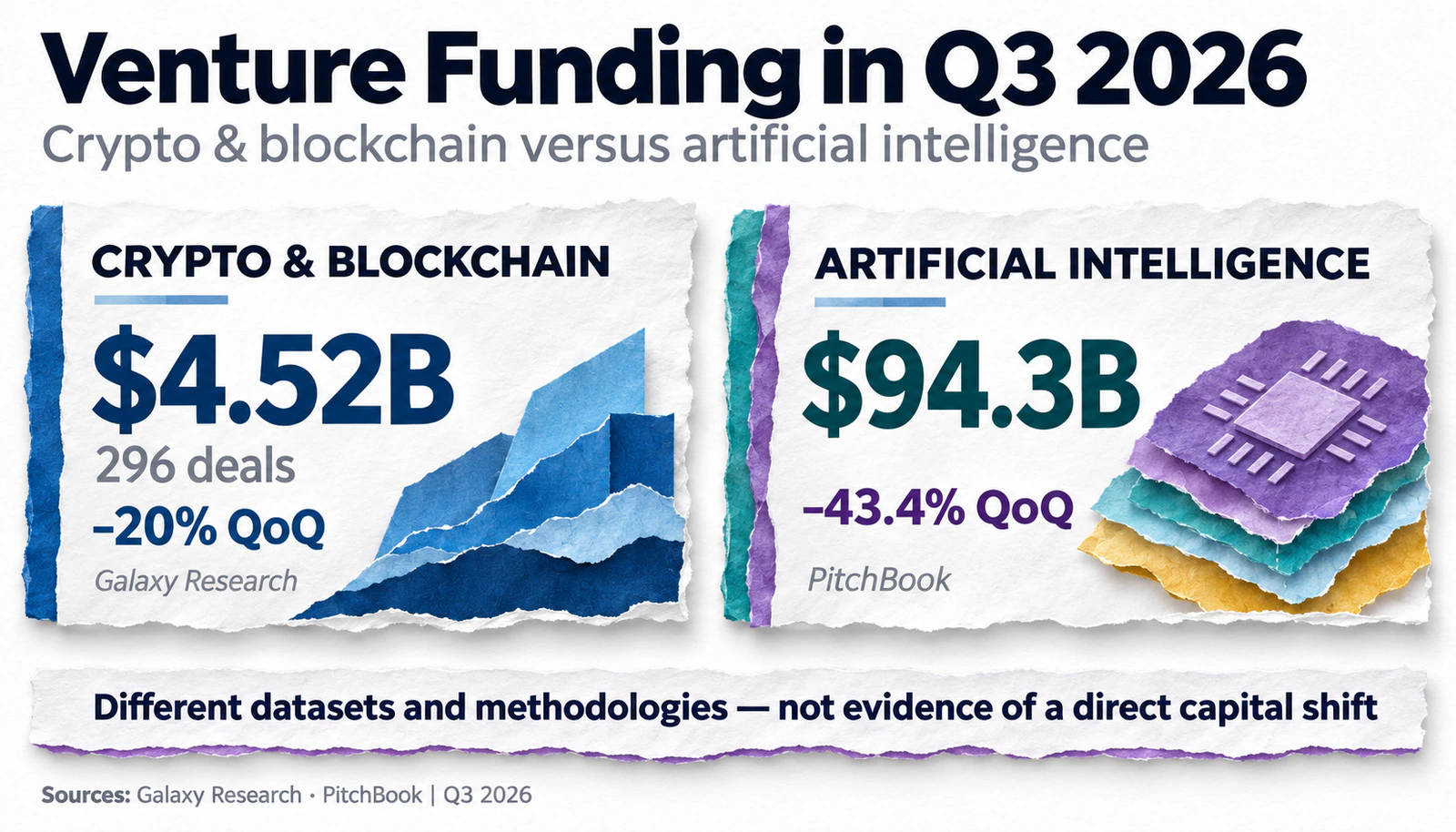
Venture funding metrics indeed indicate differences in industry scales. According to Galaxy Research, in Q3 2026, crypto and blockchain startups received $4.52 billion across 296 deals. This is 20% less in terms of amount and 24% less in terms of deal count compared to Q2.
More than half of the investments went to projects in trading, exchanges, investing, and lending. Separately, investors provided about $1.3 billion in capital to three new crypto venture funds for subsequent investments.
Institutional investors are paying more attention to AI, but the published data does not allow for measuring the direct reallocation of funds from the crypto industry. The PitchBook report shows a significantly larger volume of venture deals with AI companies, but it cannot be directly compared to Galaxy's quarterly statistics due to differences in periods, geography, and methodology.
According to PitchBook data, in the first nine months of 2026, venture capital investments in AI exceeded $500 billion. However, the sector did not show continuous acceleration: in Q3, the deal volume decreased by 43.4% compared to Q2, to $94.3 billion.
A separate report by PitchBook and NVCA estimated the share of AI in the value of US venture deals for January–September at 82.7%. These data describe different investment aggregates and do not allow for calculating a direct transfer of funds from the crypto industry to AI.
Alliance DAO co-founder Imran Khan in a November 13 publication described a discussion with investors representing about $15 billion in capital. Participants discussed the potential convergence of crypto venture funds with the broader advanced technology market over one or two investment cycles. It was about a strategic investor assessment, not a measured withdrawal of $15 billion from the crypto market.
One reason for revising investment priorities is related to the economics of venture funds. A large fund requires quite a few projects with the potential for significant value increase, while mature Web3 areas are becoming more competitive. At the same time, crypto technologies may find applications within AI — for example, for payments of software agents, automation of settlements, and operation of digital wallets.
Therefore, the supposed capital flow into AI does not exclude future convergence of industries: blockchain can be used for payments and financial infrastructure of AI services.
Is the Web3 Restructuring Related to Bitcoin's Decline
Market pressure has intensified discussions about changes in the crypto industry, but it has not become a proven reason for exchanges transitioning to TradFi. According to market reviews, on November 15, Bitcoin dropped to approximately $62,000 — the lowest since July 2026, and on November 16, it traded around $65,000. The current dynamics of cryptocurrencies can be tracked in the UNUM quotes section. The decline occurred amid reduced demand, a strengthening dollar, and the closing of leveraged positions.
To assess the pressure on BTC, at least three independent indicators are important:
Bitcoin ETF flows. According to Farside Investors, from November 2 to 13, U.S. spot funds recorded a total net outflow of about $2.35 billion. This is a calculation based on daily service data, not an estimate of the total volume of Bitcoin sales on crypto exchanges.
Stablecoin supply. Glassnode analysts in the November 11 report recorded a reduction in tracked supply by $14.2 billion over 30 days. This figure indicates a decrease in the volume of digital dollars in circulation but does not reveal which assets investors exchanged the withdrawn funds for. The mechanism is further analyzed in the UNUM analysis on the stablecoin market.
Macroeconomic conditions and liquidations. In the November review by Binance Research, a 9.1% reduction in the crypto market capitalization in October to $2.70 trillion was noted. Rising inflation expectations, revised Fed rate forecasts, and decreased interest in risky assets increased pressure, and forced closing of leveraged positions could accelerate price movement.
It is important to separate these mechanisms. Outflows from ETFs reflect changes in demand through regulated funds, the reduction of stablecoins — changes in the money supply within the crypto ecosystem, and liquidations — the market's reaction to leveraged positions on already occurring price movements. No single indicator alone explains the entire BTC dynamic.
A detailed analysis of the interconnection between ETFs, liquidity, and leverage is presented in the UNUM analysis on the reasons for Bitcoin's decline. The impact of inflation and rates is further examined in the material on Fed policy and the dollar.
Thus, the restructuring of the Web3 market and Bitcoin's weakness coincide in time, but the exit of crypto exchanges into TradFi began long before the November correction. It cannot be reduced to an attempt to urgently replace falling cryptocurrencies with stocks and gold.
What Opportunities and Risks Does the Convergence of Crypto Exchanges with TradFi Bring
For users, the main change is access to multiple asset classes through a familiar interface. Exchanges gain the ability to service different market strategies, and blockchain platforms can apply stablecoins, tokenized collateral, and automated settlements beyond the cryptocurrency market. In the long term, this could enhance the significance of Web3 infrastructure even without proportional growth of individual crypto tokens.
However, 24/7 trading does not mean round-the-clock operation of the underlying market. When the stock exchange is closed, token and derivative contract prices may temporarily deviate from the last stock quote. Upon opening of the main market, these discrepancies can quickly narrow, causing increased volatility. Additional risks are created by leverage, potential liquidations, insufficient order depth, and dependence on the tokenized product provider.
Legal differences are equally important. A token holder must understand who owns the underlying securities, who ensures their custody, how dividends are accounted for, and what happens if the issuer encounters problems. In the case of xStocks, for example, voting rights on the underlying shares are not transferred to the token holder; in the announced OKXICE model, on the contrary, shareholder rights are provided. Therefore, comparing products solely by ticker, price, and trading mode is insufficient.
Finally, the growth of RWA does not guarantee automatic demand growth for Bitcoin, Ethereum, or infrastructure project tokens. Revenues from the issuance, custody, and trading of digital securities may concentrate among issuers, exchanges, and technology providers. Even if settlements occur via blockchain, the link between asset turnover and the economic benefit of native network token holders needs to be proven separately.
What Will Determine Market Development in 2027
Further convergence of crypto platforms and traditional finance can proceed in several directions. In a favorable scenario, not only will the number of available instruments grow, but also the actual trading volume of tokenized assets, the number of active holders, and the use of RWA as collateral.
In a more moderate scenario, crypto exchanges will maintain a hybrid model: cryptocurrencies will remain the central product, while TradFi instruments will form an additional market. A negative scenario suggests that access restrictions, weak liquidity, and legal complexities will prevent new products from becoming a significant source of sustainable demand.
To distinguish these scenarios, it is more important to monitor measurable indicators than the number of announced partnerships:
Actual turnover of TradFi instruments with the separation of spot tokens, CFDs, and perpetual futures.
Volume of issued RWA and holder activity, not just the number of available tickers.
Venture investments in Web3 and AI, including the number of deals and the share of funding for young companies.
Net flows into Bitcoin ETFs and the supply of stablecoins as different indicators of market demand.
Liquidity and investor rights — depth of trading, quality of execution, storage conditions, and token collateral.
Judging by the products already launched, crypto exchanges are gradually becoming part of a broader financial services market, but the speed of this process still depends on demand, regulation, and infrastructure quality.
The main change is that the development of Web3 and the crypto market is increasingly determined not only by the dynamics of individual tokens: payments, trading mechanisms, storage, and transfer of rights to real assets are gaining importance. Whether this infrastructure will benefit specific tokens and their holders is a separate question, the answer to which will require data, not just the growth of the RWA segment.