

After a busy week with U.S. labor market statistics, investors' attention will still be focused on interest rates. Also, from October 5 to 11, several major financial markets will receive new guidelines: the U.S. will get the minutes of the September Fed meeting, Europe will see details of the latest ECB decision, Japan will have new signals from the Bank of Japan, and China will return to trading after a week-long holiday break.
Additionally, the oil market will react after the OPEC+ meeting, employment statistics in Canada, and the start of a new series of major corporate reports. For Bitcoin, the week will pass without key events, but precisely because of this, BTC may become a convenient indicator of how investors react to rates, the dollar, and changes in global risk appetite.
The main question of the trading week will not be so much about which individual event turns out to be the most important, but whether high rates and bond yields will continue to determine the direction of global markets at the beginning of the fourth quarter.
What the OPEC+ Decision Will Change for the Oil Market
The oil market week will start with the assessment of the new OPEC+ decision. At the previous meeting, Saudi Arabia, Russia, Iraq, Kuwait, Kazakhstan, Algeria, and Oman decided to maintain September's oil production levels in October. The next meeting of the seven countries participating in voluntary production adjustments is scheduled for Sunday, October 4.
Thus, by the opening of trading on Monday, the decision will already be known, and investors' attention will shift to the reaction of Brent and WTI. The market will have to assess whether the OPEC+ position changes the balance between global oil demand and supply and what consequences it may have for energy prices.
Several scenarios are possible here:
If production parameters do not change significantly, the market will assess the balance between supply and global demand. The reaction of Brent and WTI in this case may depend more on expectations for inventories and the global economy, as well as on the actual compliance with quotas by the group countries.
If OPEC+ signals more limited supply, attention will quickly shift to the risk of further increases in energy costs.
If supply is increased, the reason for such a decision will matter: producers' confidence in stable demand or an attempt to regain market share.
The connection of oil with other assets is especially important now. Rising oil prices can amplify inflation expectations. And if investors expect more persistent inflation, they may also revise forecasts for central bank rates.
What to watch: OPEC+ decision, comments from member countries, Brent, WTI, government bond yields, and market inflation expectations.
How the Fed Minutes Will Change Rate Expectations
After Friday's labor market statistics, investors will have the opportunity to compare new data with how the situation was assessed by the Fed representatives in mid-September. Therefore, the main American event of the new week for market forecasting will be the publication of the FOMC minutes.
On October 7, the Fed will publish the minutes of the meeting held on September 15–16. At that meeting, the federal funds rate range was raised by 25 basis points to 3.75–4%. The decision was unanimous. The next meeting is scheduled for October 27–28.
The decision itself is already known to the market. The minutes are interesting for another reason: they show what arguments were discussed by the meeting participants and what risks they consider most serious.
In the text, investors will look for answers to several questions:
how strong the concern about inflation remains;
how FOMC participants assess the resilience of the economy;
whether they consider the September increase sufficient;
what conditions might be required for the next rate change.
A particularly important comparison will be the minutes with statistics released after the meeting. If new data show a strong economy and persistent price pressure, the strict wording in the minutes may gain additional weight. If the economy begins to noticeably lose momentum, the market may perceive the same words more cautiously.
ISM Services Will Show the State of the Services Sector Before the Fed Minutes Release
Before the Fed minutes are released, the market will receive another important indicator of the state of the U.S. economy. On Monday, October 5, the ISM Services PMI for September will be released. It will help assess whether the services sector maintains resilience amid high interest rates.
The overall index is important, but in the current situation, it is more useful to look at several components:
Indicator | What it shows |
Business Activity | current business activity |
New Orders | change in new orders |
Employment | companies' demand for workers |
Prices | price dynamics paid by businesses |
The Prices component is especially important. If the services sector maintains activity along with high price pressure, the Fed has more reason not to rush with policy easing. If both activity and prices slow down simultaneously, the market may see signs that the high cost of money is gradually cooling the economy.
What to watch: ISM Services PMI, FOMC Minutes, two-year Treasury yields, ten-year Treasury yields, DXY, S&P 500, and Nasdaq.
What Signals the ECB Minutes Will Provide on Further Policy
The U.S. Fed is not the only major central bank whose policy will be discussed this week. In Europe, investors are also trying to understand how far the regulator is willing to go in fighting inflation.
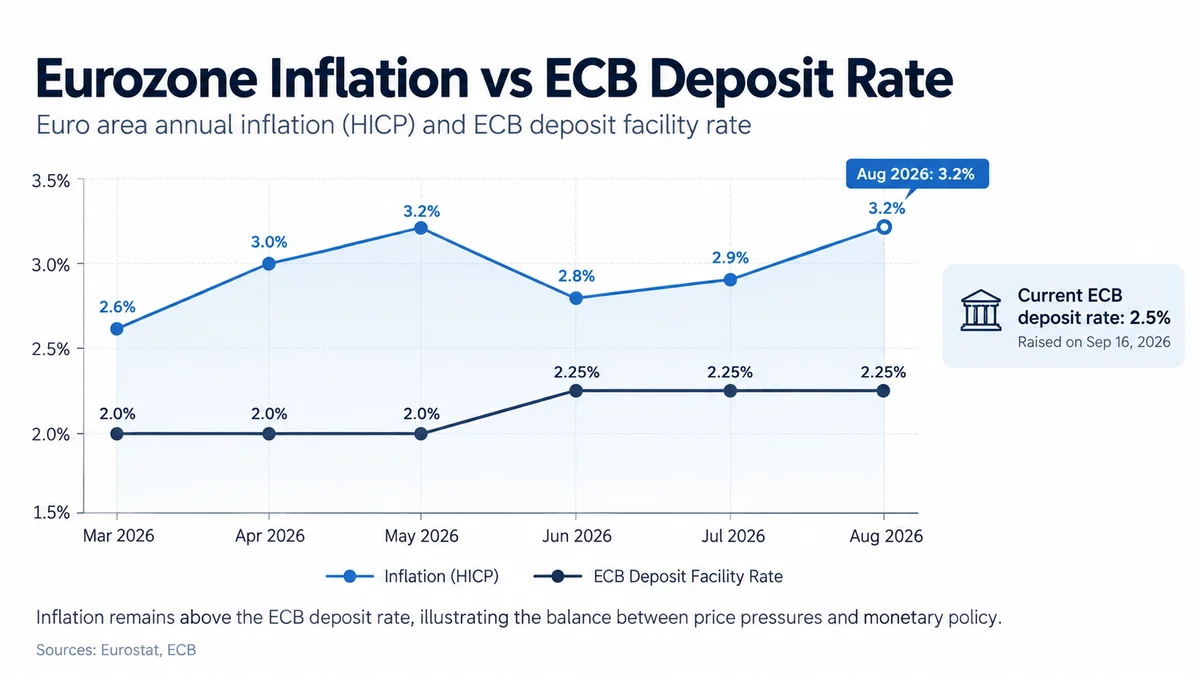
On September 10, the ECB decided to raise three key rates by 25 basis points. As of September 16, the deposit rate is 2.5%, the main refinancing operations rate is 2.65%, and the marginal lending rate is 2.9%. The regulator explained the decision by the persistent inflationary pressure.
On October 8, the ECB will publish a detailed report on the monetary policy meeting. Such documents provide a more detailed understanding of the discussions within the Governing Council and are usually released about four weeks after the meeting.
For the market, it is important to understand how strong the support for further tightening was. Here arises a complex balance. On one hand, inflation remains a problem. In August, annual price growth in the eurozone accelerated to 3.2% from 2.9% in July. On the other hand, the high cost of credit is gradually affecting consumers and companies.
An additional guideline will appear on October 6, when Eurostat publishes retail sales for August. In July, the volume of retail trade in the eurozone decreased by 0.6% compared to June.
Therefore, the two events of the week should be considered together:
retail sales will show what is happening with the consumer;
the ECB report will help understand how these economic risks are weighed against the inflation problem.
For the currency market, this combination is primarily interesting through EUR/USD. If investors see a more hawkish ECB stance, expectations for European rates may change. But the effect will also depend on what signals are almost simultaneously coming from the U.S.
What to watch: eurozone retail sales, ECB accounts, EUR/USD, Euro Stoxx 50, and German government bond yields.
What Kazuo Ueda Will Say About the Bank of Japan's Future Policy
In Japan, the week will pass without a rate meeting, but that does not mean the absence of signals from the central bank. For the yen and Japanese bonds, any comments on the future direction of monetary policy are especially important now.
On October 6 the head of the Bank of Japan, Kazuo Ueda, will speak at the national conference of securities market participants. On October 8 the Bank of Japan will also publish a regional economic report. The next regulator meeting will be held on October 29–30. Therefore, Ueda's speech will be evaluated primarily in the context of the end of the month.
Traders will be interested in whether the assessments of three factors have changed:
Inflation. How sustainable is price growth and does the regulator see a risk of its persistence.
Wages. The dynamics of household incomes help understand whether price growth can be supported by domestic demand.
Economy. Whether domestic consumption and corporate activity are resilient enough to withstand changes in financial conditions.
An additional background was already provided by the quarterly Bank of Japan Tankan survey published on October 1, which reflects the sentiments of large companies and their assessment of the economy. The Bank of Japan survey showed that the business conditions index for large manufacturing companies rose from 22 points in June to 24 points.
Individual data alone do not determine the central bank's decision, so it will be more important to see how Ueda links the state of business, inflation, and future policy.
What to watch: Ueda's speech, USD/JPY, Nikkei 225, and Japanese government bond yields.
China Returns After a Week-Long Break
One of the most unusual moments of the week will occur on Thursday. While most global markets will be trading as usual, mainland China will have spent the first seven days of October off the market. The Shanghai Stock Exchange is closed from October 1 to 7 due to national holidays. Trading will resume on October 8.
This means that at one opening, the Chinese market will have to react to events from several previous days. Therefore, the first day after a long break may be interesting not so much for a single specific news but for the accumulated reassessment of the global background.
For investors outside China, the reaction also matters. A strong movement in Chinese stocks can reflect on the Hong Kong market and companies linked to the Chinese economy. The yuan influences regional currencies. And changes in expectations for Chinese demand are important for copper, iron ore, and other commodity assets.
It is also worth considering the difference between markets. Hong Kong does not fully replicate the mainland exchanges' calendar, so some global news may be reflected in the Hang Seng earlier than in the CSI 300 or Shanghai Composite. This will allow comparing how much the opening of the mainland market differs from the movement that has already occurred in other financial centers.
What to watch: CSI 300, Shanghai Composite, Hang Seng, yuan, copper, and stocks of companies sensitive to Chinese demand.
Can Bitcoin Continue to Rise Amid High Yields
This trading week, there is no scheduled event on the crypto market that could compare in scale to a central bank decision. But precisely because of this, Bitcoin is conveniently viewed as an indicator of how global financial conditions affect risk demand.
Bitcoin ended the third quarter with a growth of about 43%. At the same time, government bonds experienced a noticeable increase in yields, and borrowing costs became one of the main factors for global markets.
At the beginning of October, Bitcoin will be influenced by three groups of factors:
Macroeconomics. If after the Fed minutes investors start expecting a longer period of high rates, bond yields and the dollar may gain support. For assets without fixed cash flow, this usually means tighter financial conditions. But this connection is not mechanical. Bitcoin can move under its own factors.
ETF flows. Institutional investor interest remains an important part of the picture. On October 1, Citigroup separately noted renewed inflows into ETFs as a support factor for the crypto market. Therefore, it will be especially useful to compare two signals. If yields rise, the dollar strengthens, and simultaneous outflows from Bitcoin ETFs are recorded, macroeconomic pressure receives confirmation within the crypto market itself.
If BTC maintains stability despite tighter conditions in the bond market, this may indicate the presence of its own demand.
Global risk appetite. On October 8, China will add to this picture. If the return of mainland markets supports global risk-on, Bitcoin may move along with other risky assets. If stocks in Asia, Europe, and the U.S. are simultaneously under pressure, it will be interesting to see if BTC repeats this movement or starts behaving independently.
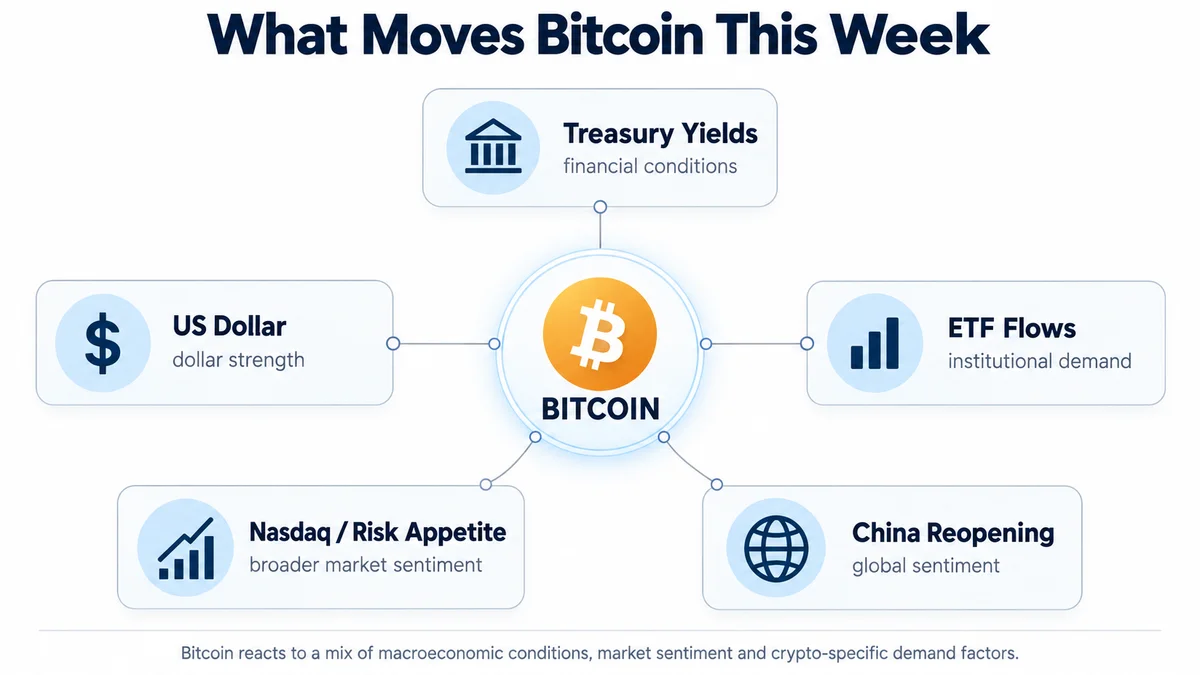
What to watch: BTC/USD, flows into spot Bitcoin ETFs, DXY, two-year Treasury yields, and Nasdaq 100.
What the New Canadian Labor Market Report Will Show
At the end of the week, another major employment report will be released outside the U.S. For the global market, its impact is less than the American Nonfarm Payrolls, but for the Canadian dollar and expectations for the Bank of Canada's rate, the publication remains one of the main monthly guidelines.
On October 9, Statistics Canada will publish the Labour Force Survey for September. The agency confirms this date in the official calendar.
In the report, it is worth looking not only at the change in the number of employed. Three indicators will provide a more complete picture:
employment — how many jobs appeared or disappeared;
unemployment — how easy it is for people to find work;
wages — whether there is pressure on labor costs.
The combination of these data affects expectations for monetary policy. A strong labor market gives the central bank more room for a hawkish policy. Rapid deterioration in employment, on the other hand, can make the state of the economy a more important factor.
What to watch: employment, unemployment, wages, USD/CAD, and Canadian government bond yields.
PepsiCo and Delta Will Show How Consumer Behavior Is Changing
Macroeconomic reports show the economy through statistics, but corporate results allow us to see it from another angle — through real sales, prices, and business expenses. This week, two major American companies will provide useful signals about the state of consumer demand.
PepsiCo will release its third-quarter results on the morning of October 8.
Here, not only revenue and profit are important. Investors will look at whether sales volumes are changing, whether the company manages to raise prices, what happens with margins, and how management assesses consumer demand.
Such a report is interesting because PepsiCo's products are related to everyday expenses. Therefore, the dynamics of volumes and prices help understand how willing buyers are to accept higher product costs.
The next day — October 9 — Delta Air Lines will present its third-quarter results. The airline has a different set of indicators: demand for air travel, ticket prices, corporate travel, aircraft load, and fuel costs.
The last point is especially interesting after the OPEC+ meeting. If the cost of oil changes significantly, the market will be able to immediately assess how the energy factor aligns with the forecasts of one of the largest airlines.
Thus, PepsiCo and Delta will help look at the consumer from two sides: everyday purchases and more expensive travel expenses.
A New Survey Will Show What Americans Expect from the Economy
Another important signal about the state of the American consumer will appear on Friday. Unlike corporate reporting, this indicator reflects not real sales but how households themselves assess their financial situation, economic prospects, and future price dynamics.
On October 9, the preliminary University of Michigan Consumer Sentiment for October will be released. In September, the final index value was 48.1 points.
However, for the market, not only the level of consumer sentiment is important. Investors will pay particular attention to inflation expectations. In September, Americans expected prices to rise by 4.6% over the next year and by 3.4% over a 5–10 year horizon.
That is why this report is directly related to the main theme of the week. If inflation expectations remain high, the market may see this as another argument in favor of a more cautious Fed policy.
If consumers continue to expect rapid price growth, central banks find it harder to be confident that inflation is steadily returning to target. If expectations begin to decline, the picture becomes more favorable.
What to watch: Consumer Sentiment, Current Conditions, Consumer Expectations, and inflation expectations for one year and the long-term horizon.
Three Main Questions of the Week
The economic calendar looks scattered, but most events can be reduced to three common questions.
1. How hawkish do the major central banks remain?
The answer will be sought in the Fed minutes, the detailed ECB report, and Kazuo Ueda's comments. It is important not only what the regulators did at previous meetings but also what conditions they consider necessary for the next decisions.
2. Does inflation remain the main risk for global markets?
This will be simultaneously indicated by oil prices after OPEC+, the Prices component in ISM Services, American consumer inflation expectations, and central bank rhetoric. If several indicators simultaneously point to persistent price pressure, the market may again focus more on the prospects of high rates.
3. Can risky assets withstand high bond yields?
This question concerns stocks, Bitcoin, and emerging markets. The reaction to the Fed minutes and the opening of Chinese exchanges will be especially indicative. If bond yields remain high, it will become clear whether corporate results, economic growth, and inherent demand for individual assets are sufficient to maintain investor interest in risk.
Key Events by Day
Date | Region / Market | Event |
October 4, Sun | Global Markets | OPEC+ Seven Countries Meeting |
October 5, Mon | USA | ISM Services PMI for September |
October 6, Tue | Eurozone | Retail Sales for August |
October 6, Tue | Japan | Speech by Bank of Japan Governor Kazuo Ueda |
October 7, Wed | USA | Fed Meeting Minutes from September 15–16 |
October 8, Thu | China | Opening of Chinese Exchanges After Golden Week |
October 8, Thu | Eurozone | ECB Report on the Last Meeting |
October 8, Thu | Japan | Bank of Japan Regional Economic Report |
October 8, Thu | USA | PepsiCo Report |
October 9, Fri | Canada | Labor Market Report for September |
October 9, Fri | USA | Preliminary University of Michigan Consumer Sentiment Index |
October 9, Fri | USA | Delta Air Lines Report |