

Central banks worldwide are increasing their gold reserves while the share of the dollar in international currency assets is gradually declining. According to ECB estimates, by the end of 2025, the share of gold in total official reserves reached about 27%, while US Treasuries accounted for about 22%. However, these categories differ in asset composition, holder coverage, and valuation methodology. At first glance, this seems to confirm the de-dollarization of the global economy. However, physical gold reserves are growing significantly slower than their market value, and the increase in gold reserves is not always accompanied by the sale of dollar assets. Are central banks really changing the architecture of the global financial system, or does the growing role of gold mainly reflect a revaluation effect? To answer this question, it is necessary to separate real metal purchases, price changes, and the redistribution of international reserves.
Gold Returns to the Global Reserve System
For several decades after the collapse of the Bretton Woods monetary system, gold gradually lost its former significance in international settlements. In 1971, the US ceased exchanging dollars for gold for foreign monetary authorities, and subsequent changes in the international monetary system finally deprived the metal of its function as an official anchor of dollar value.
Nevertheless, gold did not disappear from central bank reserves. The US, Germany, Italy, and France retained significant reserves, formed mainly in previous decades. For these countries, the metal remained part of their financial heritage, while many developing economies preferred foreign currencies and government bonds, which provide interest income and the ability to conduct currency interventions quickly.
After the global financial crisis of 2008–2009, attitudes towards gold began to change. In 2010, the official sector became a net buyer of gold for the first time in 21 years, marking the beginning of a long period of metal accumulation by central banks. Demand gradually shifted towards developing economies. This process was influenced by the desire to diversify assets, uncertainty about the long-term stability of currencies, and changes in the perception of financial risks.
A particularly noticeable acceleration occurred after 2022. According to the World Gold Council, official net gold purchases exceeded 1,000 tons annually in 2022, 2023, and 2024. In 2025, demand decreased to 863.3 tons but remained almost double the average annual figure for 2010–2021, which was 473 tons.
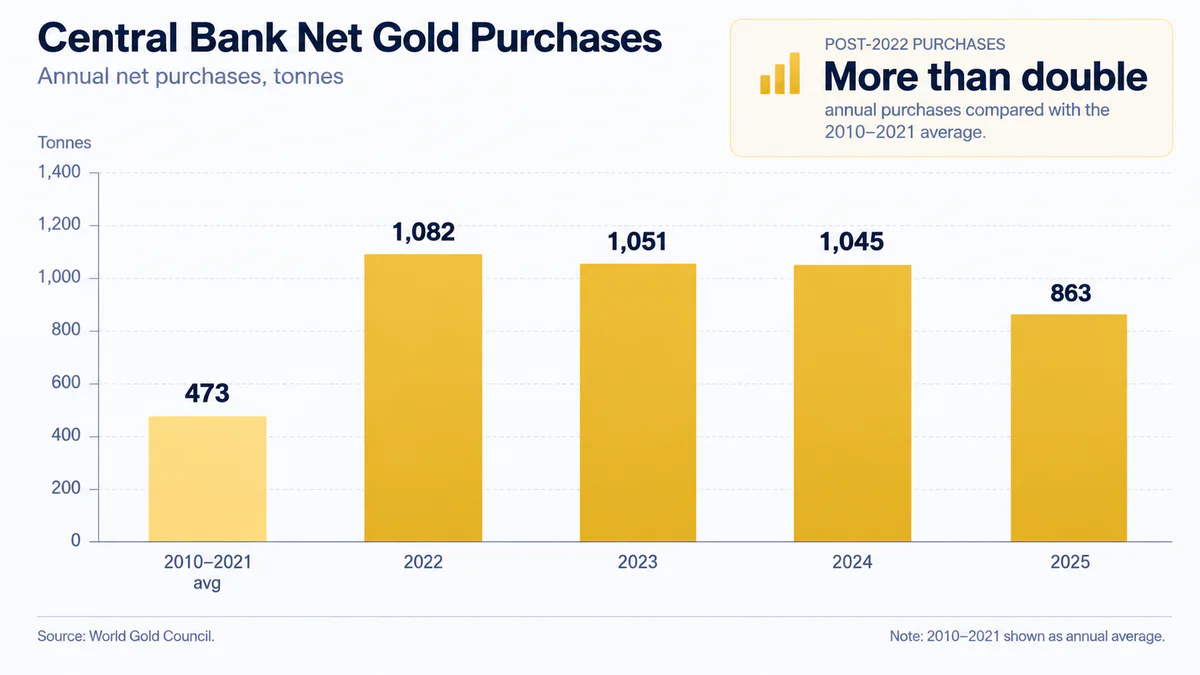
The scale of purchases indicates a structural change in official demand. However, it does not necessarily mean that central banks are abandoning the dollar. Gold purchases can be financed through current currency inflows, the sale of assets in various currencies, domestic market operations, or changes in the structure of newly formed reserves.
Moreover, international reserves serve several functions simultaneously. They are used to maintain confidence in the monetary system, conduct currency interventions, service external obligations, and insure the economy against crises. The decision to increase the share of gold may reflect a desire to enhance balance sheet resilience without implying a rejection of dollar instruments.
Why the Share of Gold Rose to 27%
In June 2026, the European Central Bank published the report "The International Role of the Euro," which assessed the structure of global official reserves as of the end of 2025.
According to ECB calculations, gold accounted for about 27% of reserves, while the euro accounted for approximately 15%, and US Treasuries for 22%. This formed the basis for discussions about possible changes in central banks' preferences towards the metal.
However, it is necessary to consider methodological differences here. Gold is a standalone reserve asset, the euro is a currency in which a whole set of financial instruments is denominated, and US Treasuries are a specific class of dollar-denominated debt securities. Therefore, the value of gold exceeding foreign official investments in Treasuries does not mean it has surpassed all dollar reserves.
In international comparisons used by the ECB, the value of gold reserves is assessed at market prices, although national accounting rules may differ. Even if a central bank has not acquired a single additional bar, the appreciation of the metal increases its balance sheet value and automatically raises the percentage share.
In 2024, the price of gold rose by approximately 30%, and in 2025 by another roughly 60%, according to ECB estimates. This significantly altered the ratio between gold and other reserve assets, even without considering new purchases.
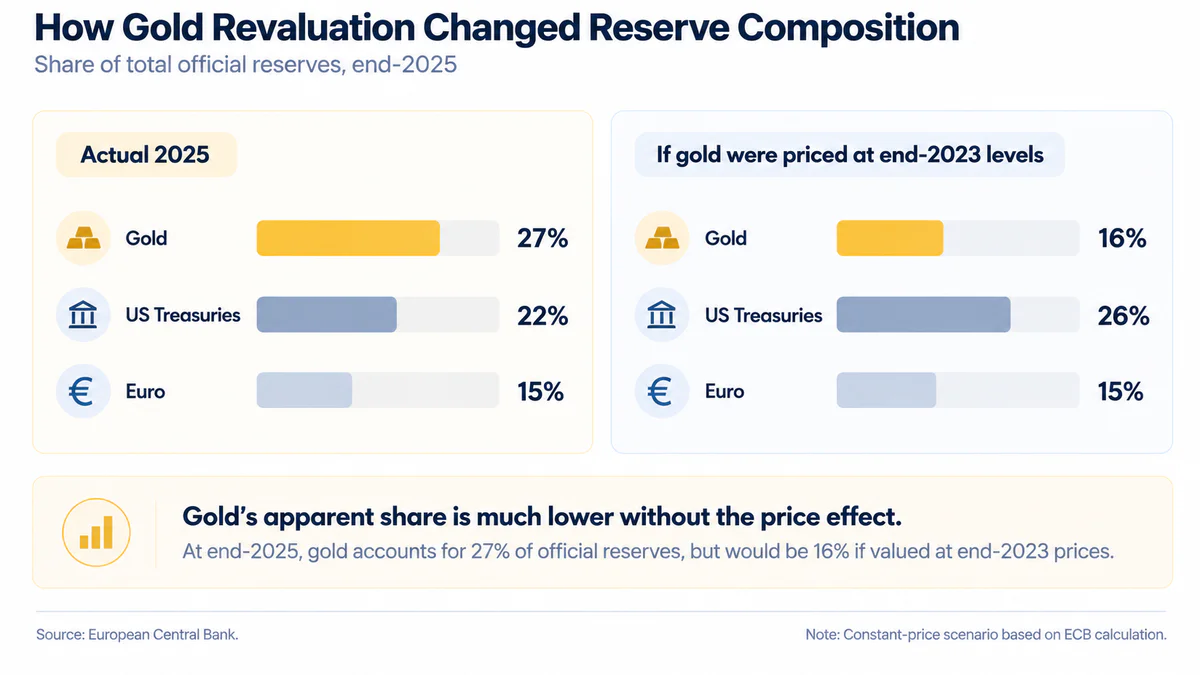
Thus, the change in the metal's price is crucial for assessing its role in the international reserve system. The growth in the share of gold indeed reflects an increase in the value of the corresponding assets but does not necessarily indicate a comparable change in central bank strategies.
Moreover, the appreciation of the metal can increase its percentage share to such an extent that the central bank no longer needs to make additional purchases to achieve the target reserve structure. In some cases, this may even create an incentive for partial gold sales to restore the original portfolio proportions.
Real Purchases and the Revaluation Effect
A detailed analysis of the discrepancy between physical gold reserves and their market value was presented by Istvan Mak and Etienne Vaccaro-Grange in the IMF study "Gold in Central Bank Reserves: Strategic Considerations, Market Risks, and Practical Guidance," published on July 9, 2026.
The authors found that from 2018 to 2025, the market value of gold on central bank balance sheets increased from approximately $1.2 trillion to $4.5 trillion. This represents a 268% increase, while the physical volume of reserves grew by only 8.5%.
Notably, almost two-thirds of the increase in market value was driven by central bank gold reserves, whose physical volume remained virtually unchanged. This indicates that a significant portion of the growth in reserves in value terms occurred without additional metal acquisitions.
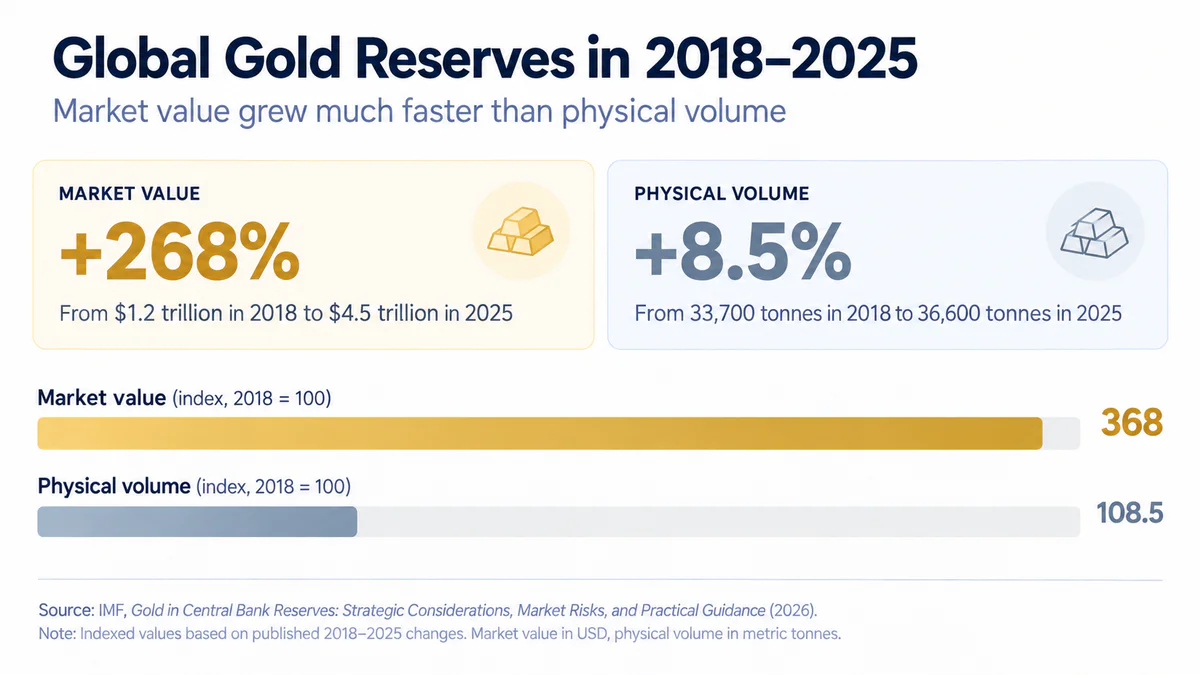
The difference between the figures is explained by a simple relationship: the value of gold reserves equals the product of the amount of metal and its current market price (V=QP).
If the physical volume of gold increased by 8.5% and its market value grew approximately 3.68 times, the primary contribution to the change in value must have been the price factor. Using the IMF's published rounded figures for changes in value and quantity of gold, the implied price increase between the initial and final dates is approximately 239%. This is a calculated estimate, not a separate indicator of the average market price over the period.
This is an illustrative ratio, not a separate assessment of the official gold price: the actual decomposition depends on the sample composition, reserve assessment dates, and other methodological features of the source data.
For a comprehensive analysis, it is necessary to separate two effects:
Accumulation effect — change in reserve value due to the purchase or sale of physical gold.
Revaluation effect — change in the value of existing reserves due to market price movements.
Both effects are real from a financial balance perspective. The difference is that the first reflects central bank actions, while the second can occur independently of its decisions.
This circumstance limits the ability to use the growth in the market share of gold as standalone evidence of dedollarization.
What happens when the price of gold falls
The revaluation effect has a downside. If gold appreciates faster than other reserve assets, it takes up an increasing share of the balance, but when prices decline, this process reverses.
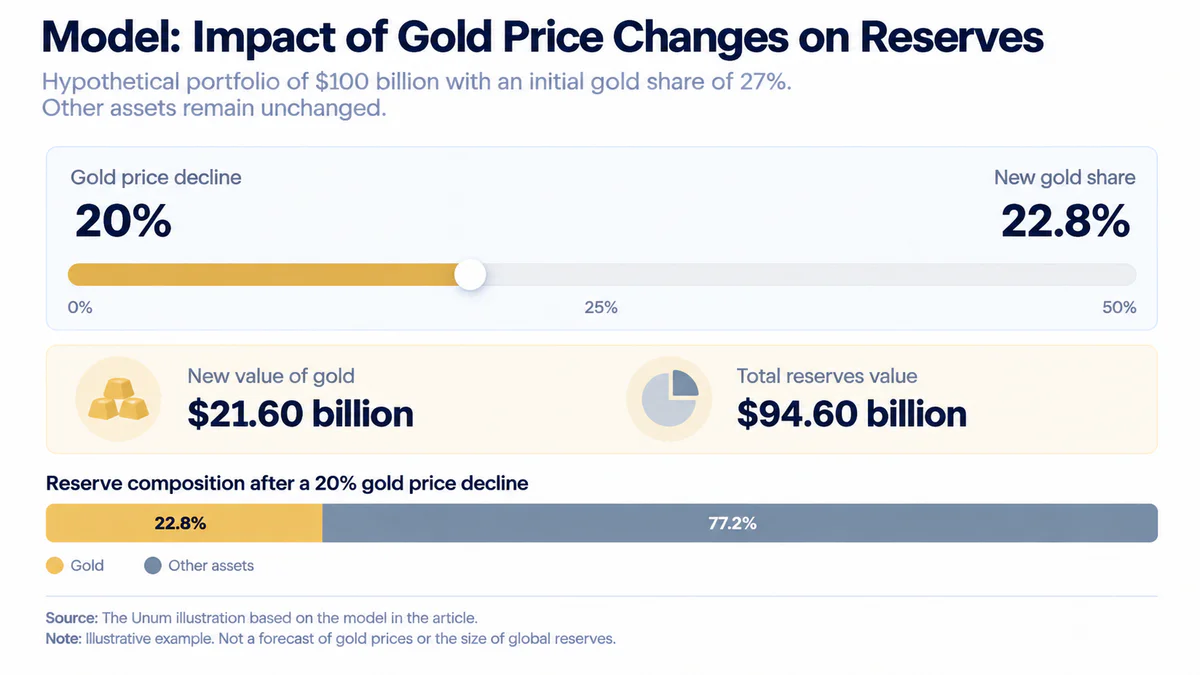
Suppose that on a certain date, official reserves amount to $100 billion, of which $27 billion is in gold. The rest of the portfolio equals $73 billion.
If gold depreciates by 20% while the value of other assets remains unchanged, the gold component decreases to $21.6 billion. The total reserve value decreases to $94.6 billion, and the gold share drops to approximately 22.8%.
The central bank made no transactions, yet the gold share in the reserve portfolio decreased by more than four percentage points.
The July IMF study highlights this risk. An increase in gold value improves nominal reserve adequacy indicators but does not always lead to a comparable increase in a country's ability to promptly cover external payments.
The authors emphasize that gold has high volatility, and its protective properties depend on the nature of the financial shock. Therefore, an increase in the value of gold reserves should not automatically be interpreted as a sustainable improvement in the quality of the reserve portfolio.
Has gold really surpassed U.S. bonds?
The comparison between gold and U.S. Treasury bonds has become a key argument in the dedollarization debate. However, in September 2026, Federal Reserve economist Colin Weiss published a separate paper explaining the limitations of such a comparison.
The paper is titled "Why Gold Didn't Actually Overtake Treasury Securities as the World's Favorite Reserve Asset."
The author identifies two key reasons why direct comparison may create a misleading impression of central bank actions.
First, a significant portion of the increase in the value of official gold reserves in 2024–2025 was driven by rising metal prices, with private investment demand playing an important role in this process.
Second, global gold reserves include large historical stocks of developed countries, primarily formed during the Bretton Woods era. These reserves continue to be accounted for in global statistics, even if the respective central banks have not made significant purchases for decades.
The example of the USA is particularly important. The American state possesses the largest official gold reserves in the world, but its own treasury bonds cannot be considered foreign reserve assets for the USA. Thus, when comparing all global gold reserves with foreign official investments in US Treasuries, different categories of assets and their holders are being compared.
Weiss also points to the change in the structure of reserves due to currency management operations. The sale of foreign assets for currency intervention does not necessarily mean a politically motivated abandonment of the dollar.
Therefore, the correct conclusion is not that gold has ceased to be a significant reserve asset, but that the increase in its market value cannot be equated with a change in the preferences of all central banks.
What is happening with the dollar in international reserves
While the value of gold increases, the share of the American currency in global reserves is indeed gradually decreasing. However, to understand what is happening, it is necessary to refer to a separate dataset — the Currency Composition of Official Foreign Exchange Reserves (COFER), which is published by the International Monetary Fund.
COFER reflects the distribution of official foreign exchange reserves among the dollar, euro, yen, pound sterling, yuan, and other currencies. Monetary gold is not included in this aggregate, so COFER data cannot be directly compared to the percentage share of gold in total official reserves.
According to the latest IMF publication on October 8, 2026, in the second quarter of 2026, total global foreign exchange reserves increased from $13.10 trillion to $13.22 trillion. During this period, the share of the dollar decreased from 57.18% to 56.70%, while the volume of dollar claims remained virtually unchanged.
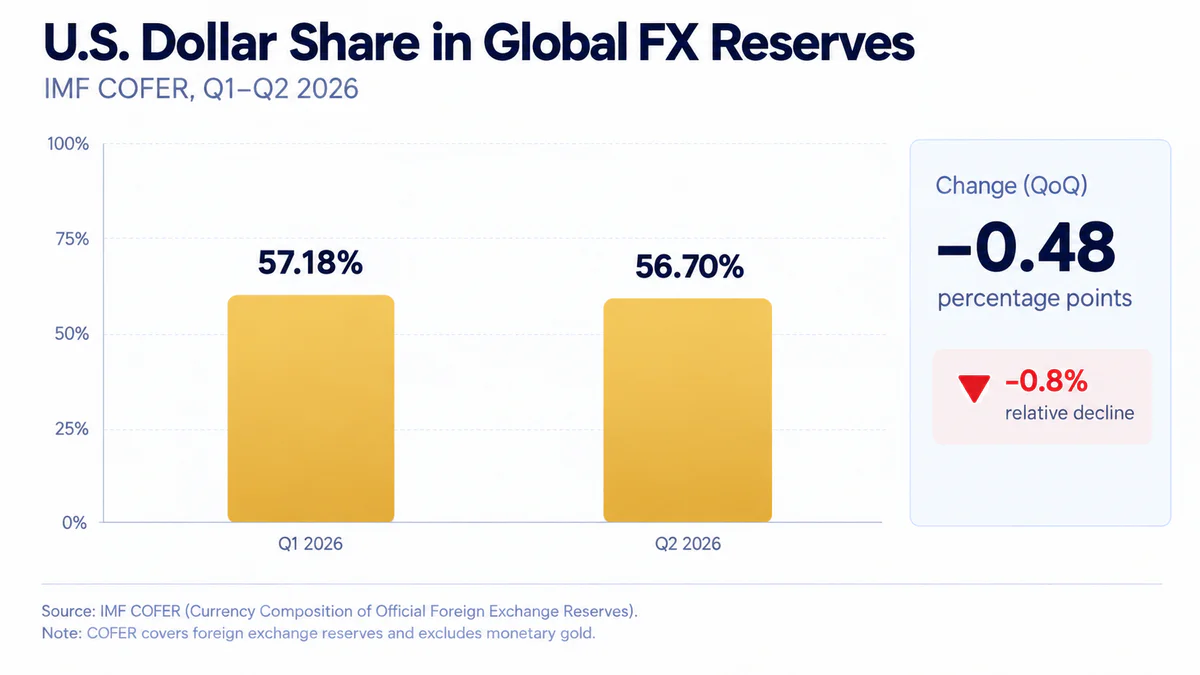
At first glance, the reduction in the dollar's share confirms the trend of dedollarization. But a change in the percentage structure of reserves is possible even without the sale of dollar assets.
For example, a central bank can maintain the previous volume of dollar bonds while simultaneously increasing reserves in euros. As a result, the absolute volume of dollar assets remains the same, but their share in the overall portfolio decreases.
Another mechanism is related to exchange rates. COFER presents the value of assets in dollar terms, so the strengthening of the euro, yen, or pound increases the dollar value of the corresponding reserves even with unchanged quantities of assets in national currencies.
In the second quarter of 2026, according to the IMF, currency fluctuations were relatively limited — within approximately 2%. This means that the change in shares likely reflected other price changes and portfolio redistribution to a greater extent. However, the published global data itself does not allow for determining the exact contribution of each mechanism.
Therefore, a decrease in the dollar's percentage share does not always indicate an absolute reduction in dollar reserves. To confirm real dedollarization, it is necessary to investigate changes in the physical volumes of assets, their currency denomination, and the investment decisions of central banks.
Dedollarization is not limited to reserves
Even if a central bank gradually reduces the dollar's share in its portfolio, this does not necessarily mean a reduction in the role of the American currency in the international financial system.
The dollar simultaneously performs several different functions:
Reserve currency. Central banks hold deposits, bonds, and other foreign assets in it.
Currency of international settlements. Companies use the dollar to pay for goods and services and to invoice external trade contracts.
Financing currency. States, banks, and corporations attract dollar loans and issue debt instruments.
Currency of the global Forex market. The dollar is one side of a significant portion of currency transactions.
These functions are interconnected but not identical. For example, a state may increase its gold reserves while maintaining a significant need for dollar liquidity to service external debt, pay for imports, and stabilize the currency market.
Data from the Bank for International Settlements (BIS) shows how stable the dollar's position is outside of reserve portfolios.
In April 2025, according to the BIS triennial survey, the US dollar was involved in 89.2% of global currency transactions compared to 88.4% in 2022. Meanwhile, the average daily turnover of the global currency market reached $9.6 trillion.
This does not mean that the dollar occupies nearly 90% of the global currency market in the usual sense of market share distribution. Since any currency operation involves two currencies, the aggregate shares of currencies in BIS statistics equal 200%. The dollar's figure indicates its presence on one side of approximately nine out of ten transactions.
Thus, the available data demonstrate two parallel processes: a gradual decline in the share of the dollar in official foreign exchange reserves and the maintenance of its extremely high role in global currency operations.
To assess the de-dollarization of the global economy, it is necessary to consider both processes, rather than transferring conclusions about the structure of reserves to international trade and financial markets.
Buying gold does not always mean selling dollars
The main question for assessing de-dollarization is not whether gold reserves are increasing, but whether their accumulation is accompanied by a systematic reduction in dollar assets.
This issue was explored by Federal Reserve economist Colin Weiss in the paper De-Dollarization? Diversification? Exploring Central Bank Gold Purchases and the Dollar’s Role in International Reserves, published in September 2025.
The author compared changes in central banks' gold reserves with data on the currency structure of reserves and official sector investments in American assets. The study covers the long-term dynamics of reserves and separately analyzes gold accumulation in 2022–2023.
The main conclusion is that the increase in gold reserves in most of the countries studied is not accompanied by a systematic reduction in dollar reserves. Exceptions exist, but the overall picture better corresponds to a gradual diversification of international assets rather than a deliberate sale of dollars for gold purchases.
This fundamentally changes the interpretation of global demand. Central banks can simultaneously increase gold reserves, maintain dollar instruments, and acquire assets denominated in other reserve currencies.
To understand the reasons, it is necessary to trace how additional metal purchases are financed.
The 2026 WGC survey shows that the financing of purchases is indeed heterogeneous. Half of the responding central banks indicated that they plan to purchase additional gold in the domestic market for national currency, while 38% reported intentions to finance purchases by selling existing reserve assets. These options should not be interpreted as shares of the global volume of operations: they refer to the responses of institutions, not the actual distribution of cash flows.
Purchases for national currency are especially important for countries with developed gold mining. Their central banks can obtain metal directly in the domestic market without selling foreign government bonds.
In other cases, gold acquisition may indeed be accompanied by a reduction in foreign assets. However, without detailed information on the currency structure of the sold instruments, it is impossible to determine what part of the financing was provided by the dollar.
There is also an additional problem: most central banks do not publish a complete breakdown of reserves by currencies, specific instruments, and storage jurisdictions. Therefore, even a noticeable increase in a country's gold reserves does not always allow determining whether there was a parallel reduction in dollar exposure.
Who is really buying gold
Gold purchases are unevenly distributed among countries. Moreover, the reasons for metal accumulation vary significantly depending on the level of development of the financial system, export structure, currency risks, and the strategic objectives of the central bank.
The latest WGC review, prepared by Marisa Salim and published on October 6, 2026, covers central bank reporting operations up to August.
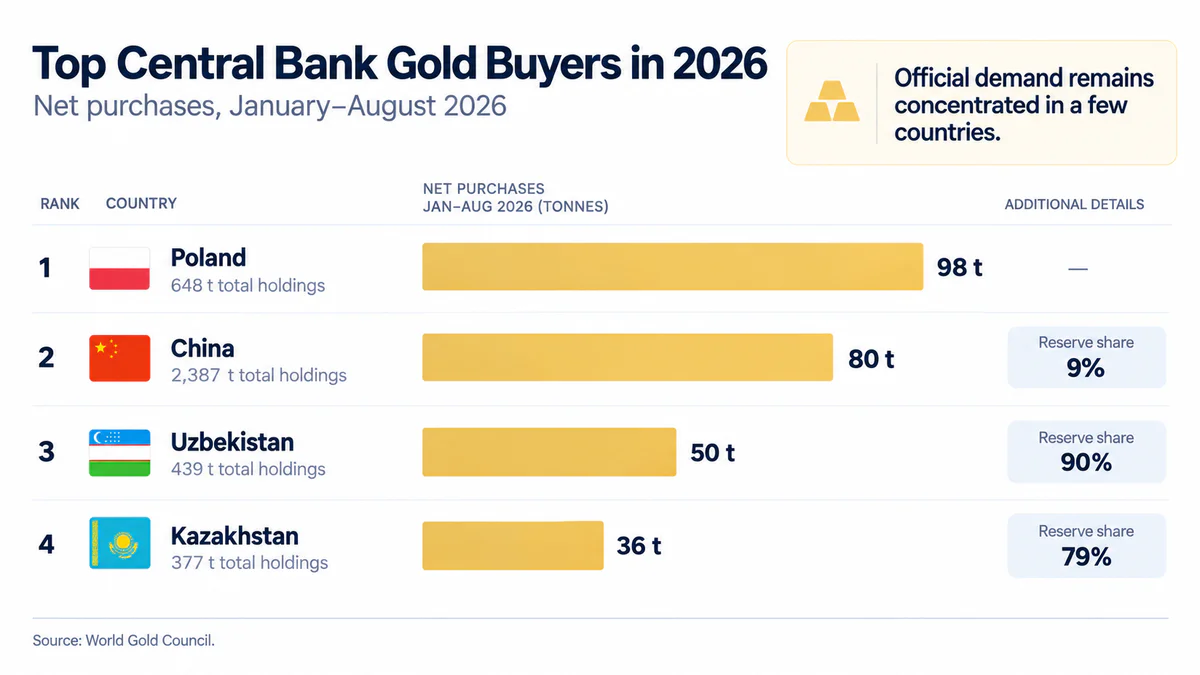
According to published central bank data, net purchases amounted to 39 tons in August and 170 tons for January–August 2026. These figures reflect recorded operations and are not equivalent to a full assessment of official demand, including undisclosed purchases. Among the largest buyers were Poland, China, Uzbekistan, and Kazakhstan.
Country | Net purchases January–August 2026 | Stocks at end of August | Gold share in reserves |
Poland | 98 t | 648 t | — |
China | 80 t | 2,387 t | 9% |
Uzbekistan | about 50 t | 439 t | 90% |
Kazakhstan | about 36 t | 377 t | 79% |
Source — World Gold Council, October 6, 2026. Figures are rounded. A dash indicates that a comparable value is not provided in the review used. Share figures depend on the date and methodology of asset valuation.
These data show an important distinction. China, with significant foreign reserves, is increasing its gold share from a relatively low base. Uzbekistan and Kazakhstan, on the other hand, already have an extremely high concentration of reserves in metal. Poland continues to implement a long-term accumulation program.
Therefore, even the same increase in stocks by 20 tons can have completely different implications for the financial stability and reserve policy of individual countries.
China and Diversification of International Reserves
China is one of the most illustrative examples, as its role in international trade, huge reserve volume, and relations with the US make changes in reserve policy particularly significant.
According to the WGC, in August 2026, the People's Bank of China increased its official gold reserves by 20 tons. This marked the 22nd consecutive month of recorded growth. The total physical volume reached approximately 2,387 tons, corresponding to 9% of the country's official reserves. In the first eight months of 2026, China reported acquiring 80 tons of gold.
In the longer term, accumulation also appears significant. The ECB estimates the increase in Chinese stocks since the onset of the full-scale Russian invasion of Ukraine in 2022 at more than 350 tons by the period considered in its June study of 2026.
At the same time, in recent years, there has been discussion about reducing Chinese investments in US Treasury bonds. However, even with confirmed reductions in such positions, it would be incorrect to conclude a direct exchange of Treasuries for gold.
The reason is that investments in Treasuries reflect only part of the dollar exposure. Reserves may include bank deposits, agency securities, other government and corporate instruments. Moreover, US Treasury TIC statistics allocate part of the assets by jurisdiction of custody, complicating the determination of their ultimate owner.
Possible changes in the location of American securities storage can also affect published country figures without a comparable change in the currency structure of reserves.
To test the hypothesis of China's dedollarization, it would be necessary to simultaneously assess:
changes in the physical volume of the People's Bank of China's gold reserves;
changes in the value of official international reserves and their currency structure;
dynamics of Chinese investments in US government securities;
changes in other dollar assets, including instruments accounted for through foreign depositories;
the impact of exchange rates, changes in market prices, and foreign exchange regulation operations.
The issue is that the detailed currency structure of China's official reserves is not fully disclosed. Consequently, the available information allows us to confidently speak about the long-term accumulation of gold, but does not provide the ability to accurately determine how many dollars were sold to acquire it.
This does not exclude the dedollarization of certain elements of China's reserve portfolio. However, the evidence base for claiming systematic direct replacement of the dollar with gold remains incomplete.
Poland and Strategic Gold Accumulation
Poland's strategy significantly differs from China's. The country is part of the European economic system, maintains close financial ties with Western markets, and at the same time remains one of the largest gold buyers among the world's central banks.
According to the WGC, the National Bank of Poland purchased 102 tons of gold in 2025, ranking first among officially registered buyers for the second consecutive year. From January to August 2026, its reserves increased by another 98 tons, to approximately 648 tons.
The Polish central bank publicly considers increasing gold reserves as part of a long-term strategy for managing international assets. The October WGC report notes the approach of reserves to the target benchmark of 700 tons.
When analyzing Poland's strategy, several circumstances must be taken into account. Gold is considered a long-term asset capable of diversifying the balance, reducing dependence on individual issuers, and preserving value in conditions of financial uncertainty. At the same time, Poland continues to use foreign exchange reserves to maintain monetary and financial stability.
Therefore, the mere increase in Poland's gold reserves cannot be considered sufficient evidence of a political or economic rejection of the US dollar.
This example shows that motives for reserve diversification can exist even in countries closely integrated into the Western financial system. The increased role of gold in this case is compatible with the preservation of traditional reserve currencies and government bonds.
Uzbekistan and Kazakhstan as Gold Producers
Uzbekistan and Kazakhstan are particularly interesting, where the increase in gold reserves must be considered in the context of the national economy's structure.
Both countries have a developed gold mining industry, so some metal transactions occur directly on the domestic market. Unlike the central bank of an importing country, a reserve manager in a gold-producing economy can purchase metal from domestic producers for the national currency.
According to the WGC, by August 2026, Uzbekistan accumulated about 439 tons of gold, which corresponded to approximately 90% of its official reserves. In Kazakhstan, gold reserves amounted to about 377 tons, or 79% of reserves.
Such a high share creates a fundamentally different risk structure compared to China or most developed economies.
On one hand, significant physical gold reserves reduce dependence on foreign issuers' obligations and can represent a long-term strategic resource.
On the other hand, the aggregate value of reserves becomes especially sensitive to changes in the global metal price. If gold sharply depreciates, the value indicators of a country's international reserves may deteriorate even without external capital outflows or the use of reserves for currency interventions.
Another feature is that domestic gold purchase programs can have implications for monetary policy. By purchasing metal from national producers for local currency, the central bank creates or redistributes liquidity, the impact of which may require additional sterilization operations.
In the IMF study of 2026, the risks of such programs are separately considered, including issues of balance management, central bank independence, transparency of purchases, and the transformation of non-monetary gold into full-fledged reserve assets.
Therefore, the high share of gold in Uzbekistan's or Kazakhstan's reserves should not automatically be interpreted as evidence of particularly intense dedollarization. Significant roles are played by the characteristics of the domestic market and historically established reserve policies.
Turkey and the Use of Gold During Crises
Turkey demonstrates another model — gold can not only be accumulated but also used for managing external liquidity.
In recent years, Turkey has both increased and decreased its gold reserves. These operations occurred against a backdrop of currency instability, inflation, and changing economic liquidity needs. However, the contribution of each factor to specific decisions requires separate confirmation.
In the June ECB review, it is noted that in 2026, Turkish authorities sold or provided around 130 tons of gold as part of operations amid external economic and geopolitical shocks. It is important to distinguish between the final sale and the transfer of metal within financial operations: their consequences for ownership and reserve structure are not identical.
The Turkish example shows that gold can be used as a tool for financial adaptation. Its presence expands the central bank's potential capabilities but does not eliminate the need for foreign currency.
During a crisis, the state may still require dollar liquidity to pay for imports, service external debt, and stabilize the currency market. In such conditions, gold can serve as a source of funds, which are subsequently converted into the necessary currencies.
Thus, a high level of gold reserves does not mean that the economy ceases to depend on the dollar. In certain circumstances, the metal is used precisely to obtain additional currency liquidity.
Why Old Gold Reserves Change Global Statistics
A separate group includes the USA, Germany, Italy, and France. These countries hold large physical gold reserves but have not been comparable in purchasing activity to China or Poland in recent decades.
Their significance for analysis is primarily related to the revaluation effect.
For example, the official US gold reserves amount to about 261.5 million troy ounces, or approximately 8,133 tons. However, in the US accounting records, gold is valued at a legally established price of $42.22 per troy ounce, rather than at the current market value.
For international comparison, the value of these physical reserves can be recalculated at market quotations. Therefore, the increase in the global value of official gold partly occurs due to the rise in the market valuation of American reserves, which were not recently acquired.
The same applies to a significant portion of the historical reserves of the major Western European countries.
This effect is especially important when comparing the value of gold with official investments in US Treasuries. If the growth in the share of gold is mainly due to the revaluation of metal that has been on the balance sheets of the same countries for decades, it says practically nothing about the current choices of reserve managers.
Colin Weiss emphasizes this circumstance in the September 2026 Federal Reserve study: global statistics combine old reserves and new purchases, whereas to analyze changes in preferences, they need to be considered separately.
Therefore, when analyzing changes in reserve policy, the physical increase in gold reserves must be considered separately from revaluation. However, by itself, it is not proof of de-dollarization without data on changes in dollar assets, which cannot be replaced by market value indicators.
Why 2022 Was a Turning Point for Reserve Policy
One of the central questions of the study is how much the change in central banks' behavior is related to increased geopolitical and sanction risks.
After the full-scale invasion of Ukraine by Russia in February 2022, the US, the European Union, and several other jurisdictions imposed restrictions that effectively blocked the Bank of Russia's ability to manage a significant portion of foreign reserve assets located in the respective jurisdictions.
This episode demonstrated that international reserves can be subject not only to market, interest, and currency risks but also to access restrictions dependent on the decisions of foreign authorities.
For a reserve manager, there is a fundamental difference between owning an asset and being able to use it in a crisis situation.
US government bonds represent obligations of the American government. Foreign bank deposits are claims on the respective financial institutions. Their usability depends on the financial infrastructure, storage system, settlements, and applicable legislation.
Physical gold is not a debt obligation of another country. If the metal is stored in the national jurisdiction, the central bank has more direct control over it. However, having bullion does not guarantee the ability to quickly use it for international settlements, especially if operations with financial counterparties are restricted by sanctions.
The increased interest in gold after 2022 can therefore be seen as a possible reaction to the changing perception of jurisdictional risks.
According to the ECB, among the largest gold buyers since the start of the full-scale war were China, Poland, Turkey, and India. Researchers also found that major gold buyers are more often located in countries with a relatively high level of external conflict risk.
But the presence of a statistical connection does not prove causation. For some states, geopolitical risks may be the main factor in buying gold, while for others, it may be just one element of a broader diversification strategy.
Moreover, high demand existed even before 2022. Therefore, the notion that central banks began acquiring gold solely after the freezing of Russian reserves does not align with historical data.
How Much Demand Increased After 2022
According to WGC estimates, the average annual purchases by central banks in 2010–2021 amounted to 473 tons. In 2022–2024, they exceeded 1,000 tons annually, reaching 863 tons in 2025.
Data indicates a significant acceleration in gold accumulation compared to the previous decade. However, to prove the sanction effect, it is necessary to separate several simultaneously acting factors:
increased geopolitical uncertainty and the risk of restricted access to foreign assets;
changes in inflation, interest rates, and financing conditions;
the rise in the market price of gold and related changes in investment preferences;
long-term diversification programs initiated before 2022;
economic characteristics of individual buyers, including domestic gold production.
A more rigorous analysis suggests comparing the pace of gold purchases in countries with varying levels of sanction risk, taking into account previous trends, reserve volumes, inflation, and financial stability indicators.
However, even such a model would not fully overcome the limitations associated with undisclosed reserve operations and the complexity of quantifying geopolitical motives.
Data on gold purchases and survey results indicate increased attention from central banks to geopolitical risks after 2022. However, the exact contribution of these risks to changes in physical demand remains uncertain.
Where Gold is Stored and Why It Matters
The geography of storage has become an independent question of reserve strategy.
A central bank may own gold physically located on its territory or place part of its reserves in international financial centers. In the latter case, access to the metal may be linked to the depository infrastructure and legal conditions of the storage country.
Both models have advantages and limitations.
Domestic storage reduces dependence on foreign jurisdictions and provides more direct control over the physical metal. However, if there is a need to quickly use gold for international operations, additional costs and organizational complexities may arise.
Conversely, gold placed in major international precious metal trading centers is potentially easier to use in transactions, swaps, and other operations with financial counterparties.
Thus, a reserve manager must choose not only between gold and foreign currency but also between different forms of ownership and storage of the metal.
The 2026 WGC survey shows that 57% of responding central banks indicated the Bank of England as a storage location for gold. At the same time, 9% of respondents reported an increase in reserves within the national jurisdiction over the previous 12 months, and 10% reported diversification of foreign storage locations.
These figures do not mean that the corresponding share of the world's gold is stored in the Bank of England or moved to other countries. They reflect practices and changes among survey participants, with one central bank potentially using multiple storage locations simultaneously.
Nevertheless, the results confirm that the location of gold reserves has become an important part of the discussion on financial stability.
Repatriation of gold is not equivalent to its purchase. If a central bank returns its owned bars from a foreign vault, the physical volume of reserves does not change. What changes primarily is the jurisdictional and operational structure of storage.
Can Gold Protect Against Inflation and Financial Crises
In addition to geopolitical risks, central banks consider the investment characteristics of gold. The metal is traditionally seen as an asset capable of preserving value over long time horizons, but its behavior significantly depends on macroeconomic conditions.
One of the key factors is real interest rates — nominal rates adjusted for expected inflation.
Since physical gold does not yield coupon income, an increase in the real yield of reliable government bonds may increase the opportunity costs of holding it. If an investor can earn a positive real yield on debt instruments, holding gold becomes relatively less attractive in terms of current income.
However, this dependence is not constant. During periods of geopolitical upheaval, financial uncertainty, or concerns about the sustainability of debt assets, demand for gold may increase even at relatively high interest rates.
The dollar exchange rate also plays a role. Since gold is predominantly quoted in US dollars on the international market, changes in its value can affect the metal's accessibility for buyers using other currencies.
At the same time, there is no mechanical inverse relationship between gold and the dollar. In certain periods, both assets may appreciate simultaneously, for example, when there is high global demand for safe-haven instruments.
It is especially important to distinguish gold's reputation as a safe-haven asset from its actual ability to offset losses in a crisis situation.
What IMF Studies Show
In July 2026, IMF researchers Istvan Mak and Etienne Vaccaro-Grange conducted a detailed study of the market risks of gold from the perspective of managing official reserves.
They concluded that the protective properties of gold depend on economic conditions and the nature of the shock. Specifically, gold can provide certain protection against interest rate risk and dollar depreciation, but its effectiveness as a hedge against unexpected changes in inflation, stock market declines, and geopolitical shocks varies depending on market conditions.
The study also emphasizes that gold does not always serve as a reliable safe-haven asset during periods of extreme market instability.
This conclusion is important for central banks, as their task differs from that of private investors. Reserve assets must not only preserve value over the long term but also provide access to liquidity when the economy urgently needs foreign currency.
Gold can enhance long-term balance sheet diversification, but excessive concentration of it can simultaneously increase short-term market risks.
Therefore, a central bank must assess not only the expected price dynamics of gold but also its behavior under stress scenarios, including simultaneous declines in market value and increased demand for currency liquidity.
Why Gold Cannot Fully Replace the Dollar
Despite the increasing role of gold in international reserves, its economic functions differ significantly from those of the American currency.
The dollar is not only a store of value but also a unit of international settlements, a lending currency, and the basis of a significant volume of financial obligations. Gold, on the other hand, is primarily used as a means of preserving value and diversifying the reserve portfolio.
This difference is particularly noticeable when comparing the characteristics of gold and short-term US Treasury bonds.
Characteristic | Physical Gold | US Treasuries |
Regular Income | Does not yield interest income | Coupon income or discount income |
Issuer Credit Risk | Absent | Depends on US obligations |
Market Risk | High price volatility | Interest rate risk, depending on the term |
Currency Risk | Depends on valuation currency and future obligations | Dollar denomination |
Operational Liquidity | Depends on form and storage location, market access | High in liquid market segments |
Jurisdictional Risk | Depends on storage location and ownership method | Depends on legal regime and infrastructure |
Use for Interventions | Usually requires sale, swap, or other operation | Dollar funds can be obtained through sale or redemption |
This comparison shows that the choice between reserve assets depends on the central bank's objectives.
For long-term balance sheet protection from specific risks, gold can have significant advantages. It is not tied to the solvency of a particular government and does not require servicing a debt obligation by the issuer.
However, for conducting currency interventions, servicing short-term external obligations, and ensuring payments in foreign currency, highly liquid instruments denominated directly in the required currency may be more suitable.
Additionally, the U.S. government bond market has a well-developed trading and collateral operations infrastructure. Treasuries are actively used by financial institutions and central banks for liquidity management.
Gold also has a large and liquid international market, but physical ownership of the metal can incur additional costs for storage, insurance, and transaction execution.
Gold's liquidity is not equal to its market value
In the 2026 IMF study, an important distinction is made between the nominal value of gold reserves and their effective liquidity.
The metal may be valued at billions of dollars at current market prices, but the real ability to quickly convert it into funds for international payments depends on market conditions, infrastructure, counterparty availability, and required timeframes.
In a stress scenario, a central bank may need to sell the asset at an unfavorable time, accept a price discount, or engage in complex financial operations.
Therefore, the IMF recommends considering potential market value losses and liquidity constraints when assessing gold's ability to cover urgent financial needs. The authors believe that the metal is better suited for the long-term investment portion of reserves than for a portfolio intended for immediate payment coverage.
This conclusion explains why even central banks actively increasing gold reserves continue to hold currency assets. It is not necessarily about choosing one instrument over another, but about distributing different financial functions among several types of reserves.
How central banks assess the future of gold and the dollar
Long-term changes in the reserve system can be assessed not only by completed operations but also by the expectations of official reserve managers.
In June 2026, the IIF presented the results of an annual survey involving 76 central banks. The number of responses to individual questions ranged from 73 to 74 and could differ in other sections of the questionnaire.
The results show a steady interest in further increasing gold reserves:
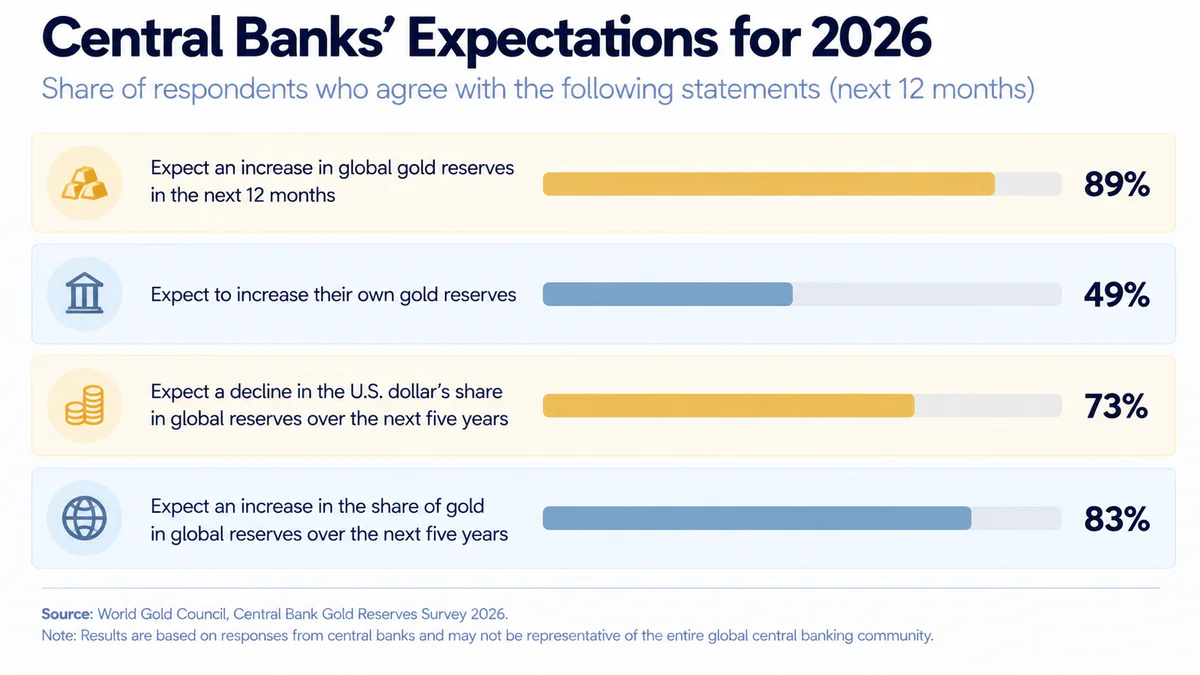
Particularly noteworthy is that 74% of respondents expect the dollar's share in global reserves to decrease over the next five years. However, it is important to consider the nature of this indicator: it reflects the expectations of reserve managers, which may differ from the future actions of their institutions.
Moreover, the reduction in the dollar's share may occur due to the growth of other reserve components, not implying a mass sale of existing dollar assets.
It is also notable that there is a discrepancy between expectations regarding global demand and individual plans. While 89% of respondents expect an increase in total global gold reserves, only 45% anticipate increasing their own central bank's reserves in the next 12 months.
This indicates heterogeneity in reserve policy: market participants may expect further large purchases from other countries without planning similar operations themselves.
The possibility of continued structural diversification does not mean that all central banks will act uniformly.
Towards which model is the global reserve system moving
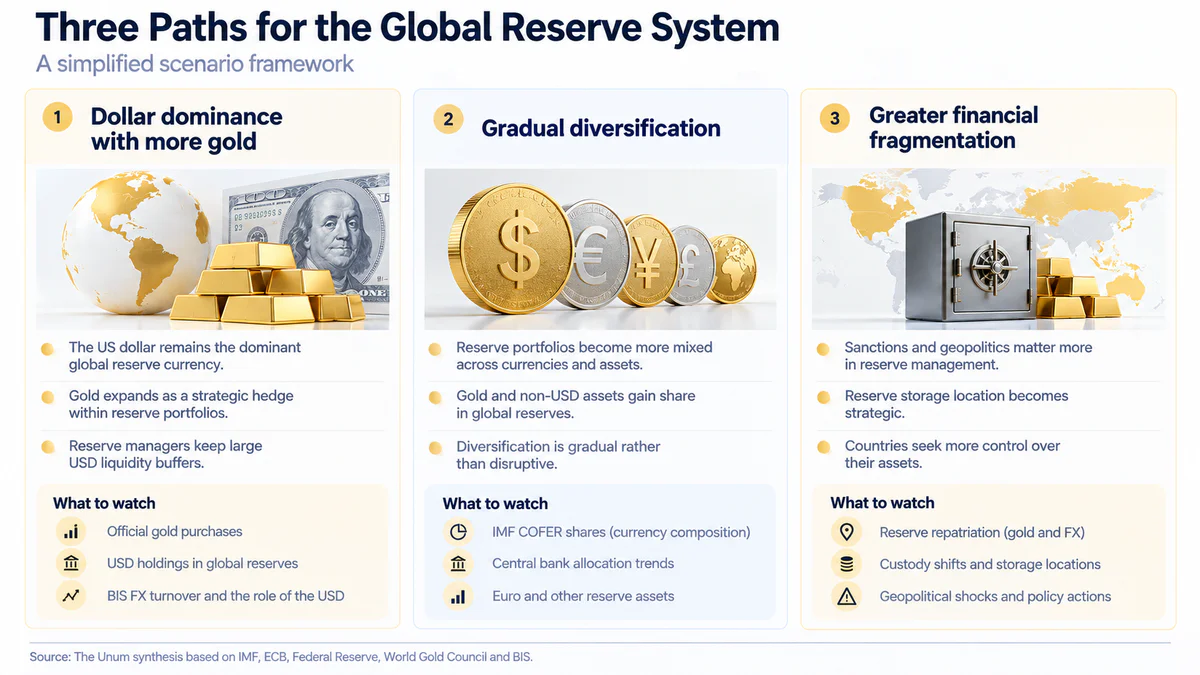
Based on available data, several directions for the further development of international reserves can be considered. They do not completely exclude each other, as individual countries may adhere to different strategies simultaneously.
Maintaining dollar dominance while expanding the role of gold
In this model, the dollar remains the primary reserve currency, providing international settlements and financial liquidity, while gold gradually increases its share in the long-term portion of reserve portfolios.
This configuration aligns with the results of a Federal Reserve study, which suggests that gold accumulation in most countries examined is better explained by diversification than by direct dollar substitution.
Support for this model will come from maintaining significant absolute volumes of dollar reserves, the high role of the U.S. currency in the global Forex market, and continued gold purchases without systematic reduction of dollar assets.
Gradual formation of more multi-component reserves
Another scenario involves further redistribution of reserves among the dollar, euro, gold, and other assets.
In this case, the share of the U.S. currency may gradually decrease, even if the dollar retains its status as the most widely used reserve and settlement currency.
Such a process will not necessarily lead to the emergence of a new dominant asset. On the contrary, the reserve system may become more diverse, and the choice of instruments may depend more on the economic and geopolitical characteristics of specific countries.
This scenario should be verified not only by currency shares but also by changes in the absolute volumes of assets adjusted for exchange rate and market revaluation.
Intensification of Geopolitical Fragmentation
The third scenario involves further growth of sanction risks, restrictions on cross-border financial operations, and states' desire to control access to their own reserves.
In such a situation, central banks may focus more on the physical storage of gold, diversification of jurisdictions, and reducing the concentration of foreign assets.
However, even with significant intensification of geopolitical fragmentation, gold will not necessarily become a full-fledged replacement for dollar instruments. States will still need liquidity in currencies used for foreign trade operations and debt servicing.
A more likely consequence of such a process is a change in the structure of ownership and storage of reserves, rather than an automatic return to a system where gold directly ensures international monetary settlements.
What the Data Really Prove
Research by the IMF, ECB, Federal Reserve, and BIS statistics allow us to distinguish several processes that are often combined into one in the de-dollarization discussion.
The first conclusion is that the physical accumulation of gold has indeed accelerated. The official sector acquired more than 1,000 tons of metal annually in 2022–2024 and another 863 tons in 2025. These volumes significantly exceed the historical average of the previous decade.
The second conclusion is that the increase in the market value of gold reserves significantly outpaces their physical growth. IMF research shows that from 2018 to 2025, the value of official gold increased by 268%, while its quantity increased by only 8.5%. Thus, the growing role of gold in the value structure of reserves largely reflects price changes rather than new purchases.
The third conclusion is that the share of the dollar in foreign exchange reserves is gradually decreasing, but this is not always accompanied by a reduction in the absolute volume of dollar assets. The latest COFER data for Q2 2026 shows exactly this situation: the percentage share of the dollar decreased, while the volume of dollar claims remained almost unchanged.
The fourth conclusion is that the accumulation of gold is not a universal indication of direct dollar substitution. Federal Reserve research shows that for most countries considered, metal purchases correspond more to a gradual diversification of reserves. However, individual examples of reduced dollar exposure may exist and require independent analysis.
The fifth conclusion is that geopolitical risks have indeed gained more significance. After 2022, there has been increased attention to sanction risk and control over reserve assets, but it is impossible to determine the exact contribution of these factors to each gold purchase without more detailed country-specific data.
The sixth conclusion is that the growing role of gold does not imply the disappearance of the fundamental functions of the dollar. The American currency maintains a central position in the international currency market and remains the most important tool for global financing and liquidity management.
These results are based on different types of evidence. Changes in the quantity and market value of gold are confirmed by reserve statistics and estimates of official demand. The motives for purchases are reconstructed from statements, surveys, and studies, so conclusions about the reasons for individual operations have a higher degree of uncertainty. Therefore, the degree of confidence in the conclusions varies.
Gold vs. Dollar or a New Reserve Structure
The growth of central banks' gold reserves is neither a statistical illusion nor unequivocal evidence of global de-dollarization. Physical purchases have indeed increased, especially after 2022, but the change in the market value of already accumulated metal has been significantly more substantial. This is why gold has come to occupy a much larger share of official reserves than could be expected based solely on new acquisitions.
At the same time, the reduction in the dollar's share in global foreign exchange reserves is an independent process that is not always related to gold purchases. In certain countries, changes in reserve policy may reflect a desire to reduce dollar exposure, but on a global scale, the data so far better support a combination of diversification, market revaluation, and changes in approaches to managing financial risks.
The key difference lies in the functions of the assets. Gold allows central banks to store part of their reserves outside the debt obligations of foreign issuers, while dollar instruments provide yield, operational liquidity, and access to international financing infrastructure. These characteristics make the assets not only competitors but also complementary components of a reserve portfolio.
Therefore, the main result of the ongoing changes is not the confirmed replacement of the dollar with gold, but the gradual complication of the global reserve system. Central banks distribute assets differently between preserving value, generating income, ensuring liquidity, and protecting against external constraints. How far this process will go will depend not only on future gold purchases but also on whether countries will sustainably reduce dollar assets in absolute terms and whether the role of the American currency will change beyond reserve portfolios.
Research limitations. The full currency structure of individual countries' reserves is not always publicly available. This limits the ability to directly establish whether specific gold purchases were financed by selling dollar assets. The presented country comparisons reflect confirmed trends and results of published studies, but do not constitute an independent econometric verification of causality for each country.
The model of reserve revaluation and the index comparison of gold value with physical stocks are provided as illustrations of the calculation mechanics. They do not replace a full-fledged country decomposition of time series.
What This Means for Traders and Investors
The growth of central banks' gold reserves is an important long-term demand factor, but it is not in itself a signal to buy gold or sell the dollar. The decisions of reserve managers are calculated over years, while market quotes react to interest rates, macroeconomic data, exchange rates, and changes in investment expectations.
When assessing the prospects for gold and dollar assets, several indicators should be considered:
Purchases of gold by central banks. Sustained demand from the official sector can support the market in the long term, but does not rule out short-term corrections.
Real yield on US Treasuries. Its increase raises the opportunity cost of holding gold, which does not yield interest income.
DXY Dollar Index. The dynamics of the American currency help assess external conditions for gold, although the inverse relationship between them is not constant.
Capital flows into gold ETFs. They allow assessing changes in investment demand, which can amplify or offset the impact of central bank purchases.
Geopolitical and sanction risks. They can increase the attractiveness of gold as a reserve asset, but the market reaction depends on the nature of events.
For short-term traders, central bank purchase statistics serve more as a backdrop than a tool for determining entry points: data is published with a delay, and a significant portion of strategic demand may already be priced in.
For long-term investors, this information is useful in assessing the role of gold in portfolio diversification. However, increased demand from central banks does not guarantee further price increases and does not eliminate the risk of significant declines in the metal's value.
The main practical takeaway: it is important to distinguish between structural changes in gold demand and short-term price factors. Dedollarization may be a long-term investment theme, but making trading decisions solely based on the growth of central banks' gold reserves is insufficient.
This material is prepared solely for informational purposes and does not constitute financial advice or a recommendation.