
Each new crypto market cycle is accompanied by the same question: when will capital start shifting from Bitcoin to altcoins? In past years, the answer seemed obvious—after a strong BTC rally, investors began seeking riskier assets, and the market entered a phase of widespread growth of alternative cryptocurrencies.
This happened in 2017 and 2021. Bitcoin set the direction, then attention shifted to Ethereum, followed by the rise of dozens and even hundreds of altcoins. Projects without significant history and large user bases could show multiple increases in value solely due to general market interest.
But the new cryptocurrency cycle is developing differently. Bitcoin has become part of the traditional financial infrastructure, institutional investors have gained access to digital assets through regulated instruments, and the number of crypto projects has grown so much that capital is no longer distributed among all assets simultaneously.
The main question of the current market is not only whether the altseason has begun but whether the rules of the game have changed. Perhaps a new altcoin growth season has indeed started, but it will look different: without the mass growth of the entire market and with more focus on specific sectors, technologies, and projects.
Why Investors Are Talking About Altseason Again
Altseason is a period when alternative cryptocurrencies start to outperform Bitcoin in growth dynamics. It is usually accompanied by an increase in altcoin capitalization, trading volumes, and renewed interest from retail investors.
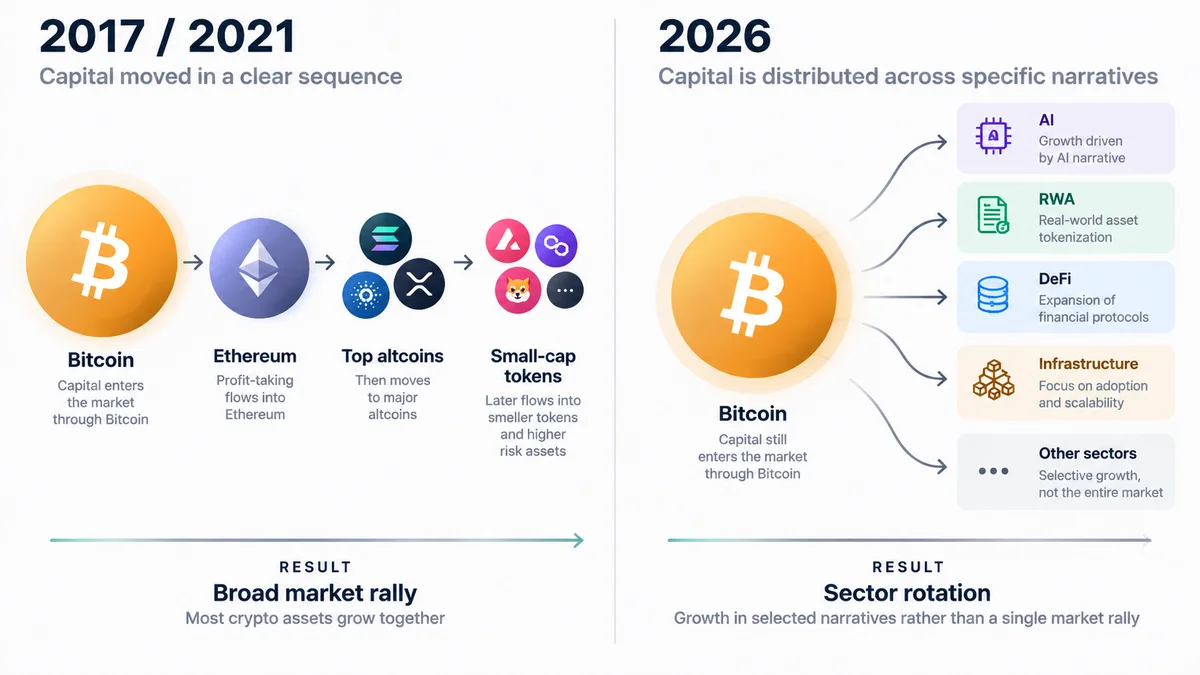
In past cycles, capital movement looked something like this: Bitcoin → Ethereum → large altcoins → medium and small projects → speculative assets.
Initially, investors chose the largest cryptocurrency as the market's main asset, then moved to riskier instruments in search of higher returns.
2017 Cycle: The ICO Era. The first large-scale altseason was associated with the ICO boom. Investors actively bought tokens of new projects, primarily evaluating the idea, technology, and team's potential. Many assets showed strong growth even before the emergence of a working product and a broad user base.
2021 Cycle: DeFi, NFT, and New Blockchains. The next major altseason was shaped by other directions:
decentralized finance (DeFi);
NFT;
first-level blockchains;
new ecosystems like Solana;
a massive influx of retail investors.
After Bitcoin's rise, capital again began moving into riskier assets, creating a broad rally across the market.
However, the current cycle is developing differently. The number of crypto projects has significantly increased, and the demand structure has changed: capital is distributed more selectively rather than directed to most tokens simultaneously. Therefore, the new altseason might look different: not as the growth of most tokens simultaneously, but as capital movement into specific sectors and the strongest projects.
Why the New Crypto Market Cycle Differs from 2017 and 2021
The main difference in the current market is the emergence of new infrastructure around digital assets. Today, cryptocurrencies exist not only within the crypto community. They have become part of the broader financial system.
Several factors have changed:
Institutional investors have become important market participants. Large funds and financial companies evaluate crypto assets differently than retail traders. For them, market volume, the ability to quickly buy or sell an asset, regulation, transparency, and risk management are important. Therefore, a significant portion of institutional demand is concentrated around the largest assets.
The number of tokens has sharply increased. Another feature of the new cycle is the high competition among crypto projects. Today, investors have to choose from thousands of assets. This creates a problem: even if new capital enters the market, it is distributed among a large number of projects. As a result, only a limited group of assets may experience growth.
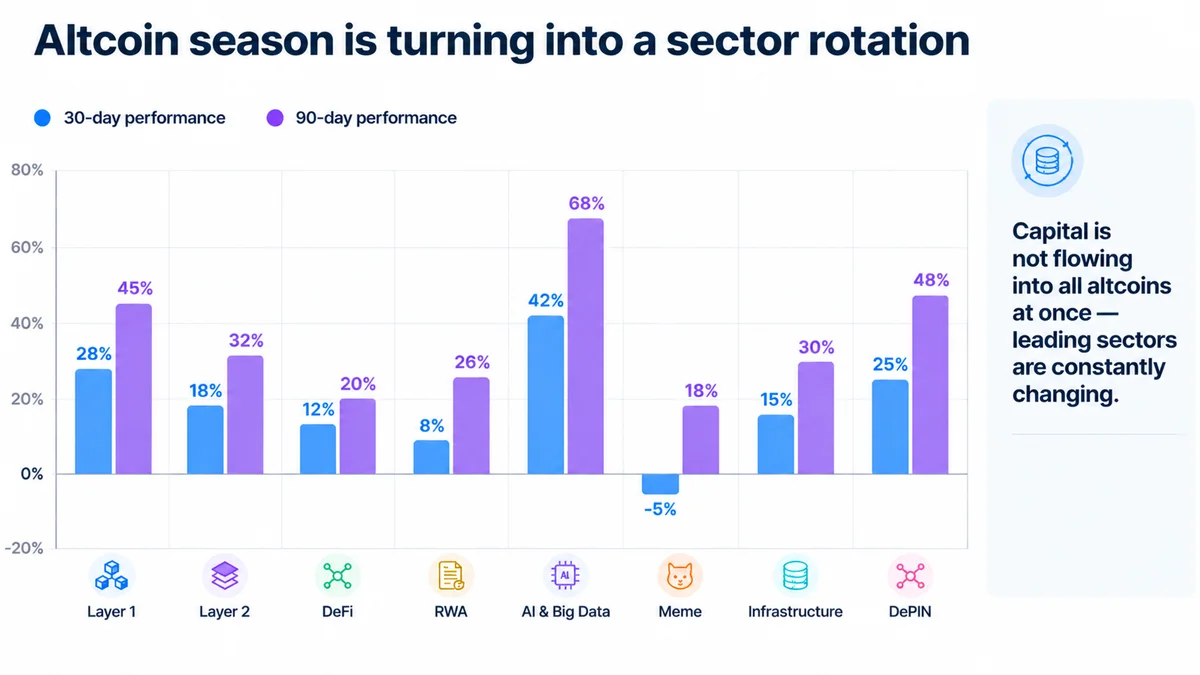
Narratives have become more important than overall market growth. In past cycles, the main factor was the general sentiment: "cryptocurrencies are growing—so almost everything is growing." Now the market more often moves in separate directions. For example, AI tokens may grow due to interest in artificial intelligence, RWA projects due to the development of real asset tokenization, and DeFi due to the increased use of financial protocols.
This makes the new altseason more like a rotation between sectors rather than a unified movement of the entire market.
Bitcoin Dominance – The Main Signal of Altseason or an Outdated Indicator?
One of the most popular ways to determine the start of an altseason is to monitor Bitcoin dominance. The Bitcoin dominance indicator reflects BTC's share in the total cryptocurrency market capitalization. In the classic model, its decline indicates that other digital assets are starting to grow faster than the largest cryptocurrency.
Historically, the logic worked quite well. Initially, money flowed into Bitcoin, then part of the profits moved to Ethereum and large altcoins, and finally to riskier assets. Therefore, a sustained decline in BTC's share often coincided with a rally expansion to the rest of the market.
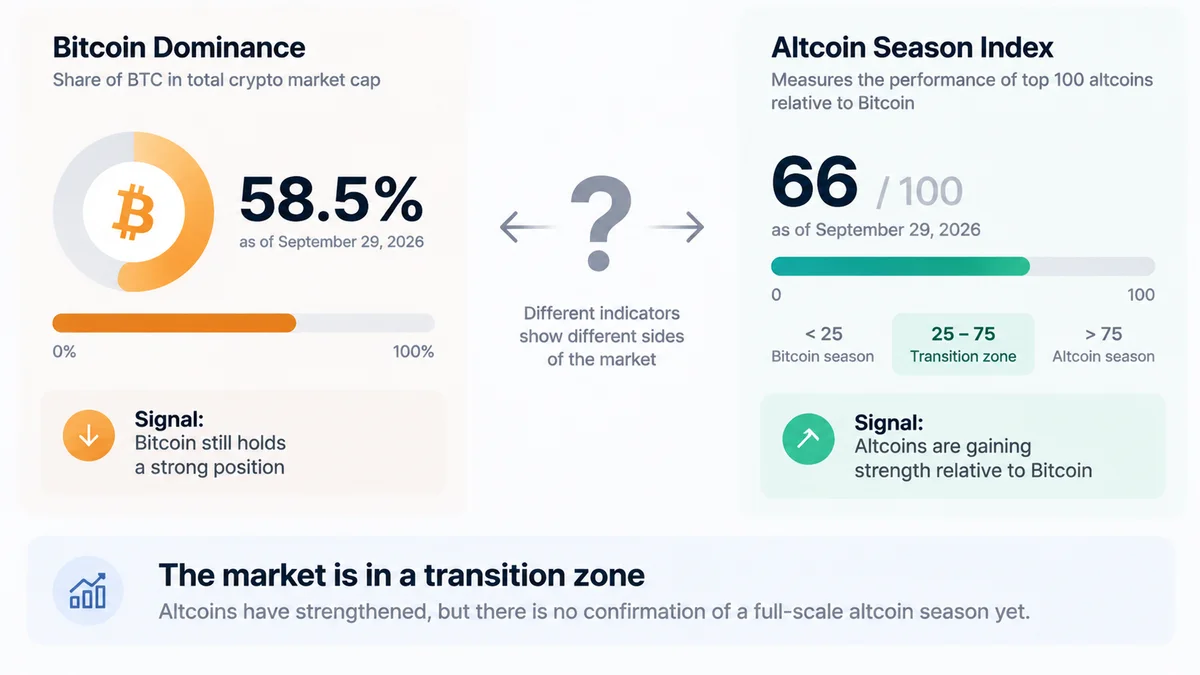
But in the fall of 2026, the picture looks contradictory. As of September 29, Bitcoin dominance was about 58.5%, while the Altcoin Season Index was at 66 points. On CoinMarketCap, a value above 75 is considered the altseason zone, and below 25 is the "Bitcoin season." This results in an intermediate situation: altcoins have already strengthened relative to BTC, but there is no confirmation of a full-fledged broad altseason yet.
Even at the end of August, the contradiction was more noticeable. BeInCrypto analyst Jakub Dziadkowiec noted that the ETH/BTC pair rose to a seven-month high after increasing by more than 30% from the June low, but at the same time, Bitcoin dominance exceeded 60%. One indicator suggested the start of capital rotation towards Ethereum, while the other indicated strong BTC positions.
This is why Bitcoin dominance alone is not enough to assess the market's state.
Why Bitcoin Dominance Has Become Harder to Interpret
The first reason is institutional demand. Bitcoin now receives capital through a separate financial infrastructure, including spot ETFs. For example, the current BTC growth in the third quarter was accompanied by significant inflows into exchange-traded funds. By the end of September, Bitcoin had gained more than 40% since the beginning of the quarter, showing the best quarterly result in almost two years.
Such capital does not necessarily pass through the traditional crypto market chain BTC → ETH → altcoins. An investor can gain exposure to Bitcoin through a regulated fund and not transition to other tokens afterward.
The second reason is that the altcoin market itself has become heterogeneous. Ethereum, RWA tokens, or individual DeFi projects can grow simultaneously, while most smaller cryptocurrencies lag behind. In this case, capital rotation is already happening, but the classic dominance indicator does not necessarily indicate the start of a mass altseason.
Therefore, Bitcoin dominance remains a useful indicator, but it is better to consider it alongside ETH/BTC, altcoin capitalization, trading volumes, and market breadth.
Which Crypto Sectors Are Currently Attracting Investor Attention
If you only look at Bitcoin and the overall altcoin capitalization, you might miss the main change in the current cycle. The market increasingly moves not as a unified front but in separate sectors. This is where one of the key differences between previous cryptocurrency cycles and today's market lies.
RWA: Betting on Real Asset Tokenization
One of the most notable directions has been RWA—tokenized real assets. This category includes traditional financial instruments whose rights are represented on the blockchain: from bonds and money market funds to stocks and other assets.
According to Binance Research, by September 15, 2026, the volume of assets under management in the RWA segment reached $34.18 billion, increasing by 85.2% since the beginning of the year. The largest category remained bonds and money market funds—$18.29 billion.
Importantly, it's not just about capitalization growth. RWA connects cryptocurrency infrastructure with traditional financial markets, making the sector attractive to both crypto companies and institutional investors.
This fits well into the new altseason model: capital seeks not just tokens with high potential growth but directions where real blockchain usage emerges.
DeFi: The Market Demands Real Usage
Decentralized finance remains an important part of the crypto market, but the criteria for evaluating DeFi projects have changed.
In previous cycles, high demand could arise around the very idea of a new protocol. Now investors are more often paying attention to more measurable indicators: the volume of locked capital, fees, protocol revenues, number of users, and tokenomics sustainability.
This does not mean the disappearance of speculative demand. However, within DeFi, the difference between projects that are actually used and tokens whose growth depends mainly on market sentiment is becoming more important.
AI: A Strong Narrative, but Not a Constant Leader
The connection between blockchain and artificial intelligence has become one of the most notable investment narratives in recent years. This category includes projects related to computing resources, data, AI agents, and decentralized infrastructure.
However, artificial intelligence shows how quickly sector rotation is happening now. In mid-September, ACIS Research noted a weakening in the breadth of AI token growth alongside a relative strengthening of ETH, RWA, and payment infrastructure.
Thus, even a popular narrative does not guarantee a constant capital inflow. Money can quickly move from one category to another.
This is the key difference in the new market: instead of one big altseason, several small "seasons" of individual directions may emerge.
Institutions Are Changing the Altseason Mechanism
There is another reason why comparing the current cryptocurrency cycle to 2017 or 2021 should be done cautiously: the type of participant forming a significant part of trading flows has changed.
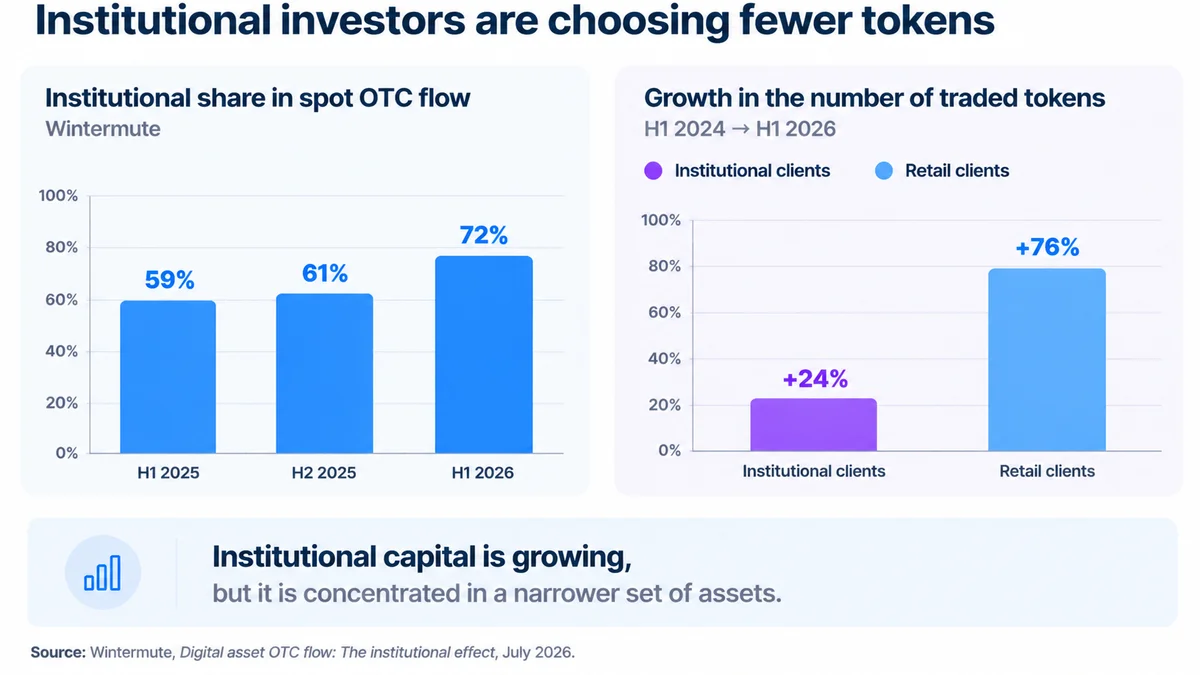
This is especially evident from data from market maker Wintermute. In the first half of 2026, institutional clients accounted for a record 72% of Wintermute's spot OTC turnover. By comparison, in the second half of 2025, the figure was 61%, and in the first half of the same year, it was 59%.
Even more interesting is which assets different groups of participants choose. From the first half of 2024 to the first half of 2026, the number of unique tokens traded by Wintermute's institutional clients increased by only 24%. For retail clients, the growth was 76%.
In other words, large capital is expanding its presence in the crypto market but not necessarily expanding the list of assets to the same extent.
Wintermute directly links this trend to a change in market structure: liquidity is concentrated in tokens that interest institutional participants, while the so-called long tail—a multitude of smaller assets—receives less attention. The company also notes an increase in the use of derivatives: the nominal trading volume of altcoin options on its OTC platform has grown by about 3.4 times compared to the second half of 2025.
Will There Be a New Season of "Multipliers," or Has the Market Become More Selective?
On one hand, conditions for capital rotation exist. Ethereum periodically strengthens relative to Bitcoin, individual crypto sectors are growing, and the Altcoin Season Index has noticeably moved away from the zone of clear BTC dominance.
On the other hand, there is still no main sign of a classic altseason—a sustained growth of a wide range of assets. And data suggests that this may not be a temporary anomaly.
According to the analysis provided by Wintermute, the ten largest altcoins, excluding stablecoins, accounted for about 80.5% of the market capitalization without Bitcoin and stablecoins. In turn, data from Kaiko, cited in the same analysis, previously showed an increase in the share of the ten largest altcoins in trading volumes from approximately 50% to 63%.
CryptoQuant CEO Ki Young Ju believes that one of the main features of past cryptocurrency cycles—the automatic capital shift from Bitcoin to altcoins—has stopped working in its previous form.
The rotation of assets from Bitcoin to altcoins, which used to be the driver of altseasons, has almost disappeared. Altcoin trading volumes in BTC pairs have sharply declined since 2021. The era when altcoins grew just because Bitcoin was growing may be over.
In his opinion, this indicates a structural change in the market: Bitcoin's growth no longer necessarily becomes a source of liquidity for a wide range of altcoins. However, Ki Young Ju's conclusion reflects the position of a specific analyst and is based on CryptoQuant's trading volume data, rather than being proof that mass altcoin growth periods are impossible in the future.
DWF Labs Managing Partner Andrey Grachev expressed a similar point of view: too many tokens compete for limited capital, while institutional investors primarily focus on Bitcoin, Ethereum, and tokenized real assets.
This does not mean that the multiple growth of individual altcoins has become impossible. Rather, the likelihood that such growth will simultaneously cover a large part of the market is changing.
In the new cycle, investors have to answer two different questions: "Is the cryptocurrency market growing overall?" and "Which specific assets are receiving this capital?" Previously, the answers often coincided. Now—not necessarily.
What Needs to Happen to Talk About a Full-Fledged Altseason
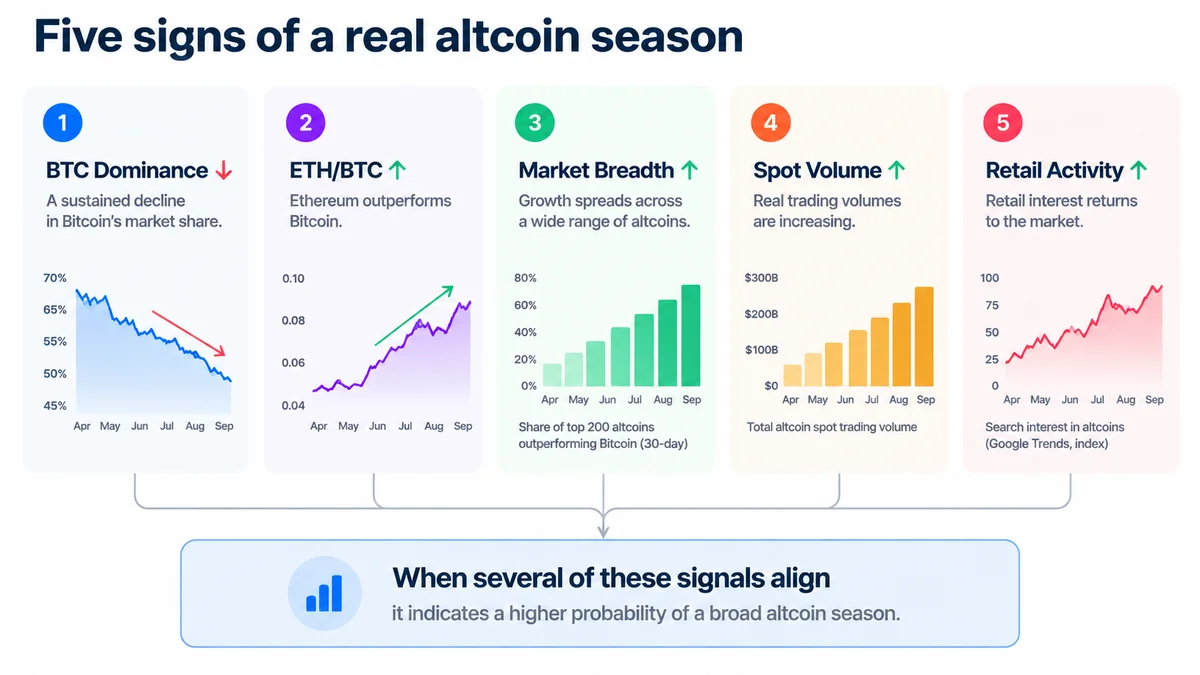
A sharp rise in Ethereum, Solana, or several dozen tokens is not enough to claim that a full altcoin season has begun. More confident confirmation will require the convergence of several signals.
Sustained decline in Bitcoin dominance. A drop of a few percentage points alone guarantees nothing. It is more important to see a prolonged period when altcoin capitalization grows faster than BTC capitalization. If Bitcoin remains relatively stable or continues moderate growth, conditions for capital rotation become more favorable.
Strengthening ETH/BTC. An increase in this ratio will mean that ETH is starting to outperform BTC. Historically, such periods often coincided with increased interest in other crypto assets. But this indicator cannot be used alone. August 2026 already showed a situation where ETH/BTC was strengthening simultaneously with high Bitcoin dominance.
Market expansion. This is perhaps one of the most important indicators of the new cycle. If five or ten of the largest altcoins are growing, this is not yet a broad altseason. For its confirmation, growth must spread to a significantly larger number of liquid assets and sectors. This is why it is useful to monitor not only the overall market capitalization but also the share of tokens that outperform Bitcoin over 30, 60, or 90 days.
The logic of the CoinMarketCap Altcoin Season Index is built precisely on comparing the results of major altcoins with BTC: a level above 75 is used as a guide to the Altcoin Season zone.
Growth in trading volumes. Price without liquidity can give a false impression of movement strength. A full-fledged altseason should usually be accompanied by an increase in spot trading volumes, not just a rise in open interest in futures or the use of leverage. If prices rise mainly due to derivatives, the movement may be more unstable.
Return of retail investors. Finally, retail demand is important for a broad altseason. Institutional investors can support Bitcoin, Ethereum, and a limited set of large assets. But for the simultaneous growth of hundreds of small tokens, a much broader risk appetite is usually required.
Therefore, it is worth monitoring not only the BTC price but also activity on crypto exchanges, search interest, the number of active users, and trading volumes of small assets.
So Has Altseason Already Started?
As of the end of September 2026, the data suggests more of an expansion of interest in altcoins than a classic altseason. The Altcoin Season Index has approached the corresponding zone, Ethereum has shown periods of strengthening relative to Bitcoin in recent months, and capital is actively moving between individual crypto sectors. Meanwhile, BTC dominance remains high—around 58.5% as of September 29.
But something else is more important. Even if the index crosses the conditional mark of 75 soon, it does not mean a return to the market of 2017 or 2021.
The structure of the crypto market has changed. Institutional investors play a larger role, ETFs create a separate capital inflow channel into Bitcoin, the number of tokens has significantly increased, and liquidity is concentrated in the largest assets and specific investment narratives.
Therefore, the question "when will altseason start?" is gradually complemented by another: "which altseason is starting?"
Perhaps the old rules of the game have not completely disappeared. But the market has already changed enough that applying them without adjustments to the new capital structure would be risky. And if the new altseason is ultimately confirmed, its main difference from previous cycles may not be the scale of growth but the number of assets that can fully participate in it.
Related articles