


What Last Trading Week Showed
In the previous issue on events from October 12–16, the main question was whether global economic growth could withstand the return of inflationary pressure. By the end of the week, the answer became somewhat clearer: it's too early to talk about a recession, but the room for rapid monetary policy easing has noticeably narrowed.
In the US, the September Consumer Price Index rose by 0.6% for the month and 3.7% year-on-year compared to 3.4% in August. Core inflation accelerated from 2.4% to 2.6%, the energy index was 20.4% higher than last year's level, and gasoline prices increased by 9.1% in September alone.
The Producer Price Index looked even stronger. PPI rose by 1.3% month-on-month and 6.3% year-on-year — the highest annual rate since December 2022. Prices for final demand goods increased by 2.6%, with more than 80% of this increase attributed to energy, which rose by 10.8% for the month.
Meanwhile, consumer demand has not shown a clear collapse yet. US retail sales increased by 0.8% month-on-month and 6.3% year-on-year, reaching $745 billion. However, the Census Bureau does not adjust these figures for price changes. Sales excluding automobiles and gasoline rose by only 0.2% for the month, and this change is statistically indistinguishable from zero at the 90% confidence level. Therefore, part of the strong headline result may be explained not only by real consumption growth but also by price increases.
The International Monetary Fund also did not see a global recession. The new World Economic Outlook suggests global economic growth of 3.1% in 2026 and 3.4% in 2027, but the IMF warns that its resilience is simultaneously being tested by an energy shock, high financing costs, and reliance on growth from the investment boom around artificial intelligence.
The global economy has shown resilience, but this resilience is under pressure, and the risks are tilted towards deterioration.
Thus, in the week of October 19–23, markets will be looking not so much for new signs of an inflation shock, but for traces of its impact on investments, credit conditions, and consumption.
China to Show Quality of Economic Growth
The main macroeconomic event at the start of the week will come from China. On October 19, the National Bureau of Statistics will release GDP for the third quarter along with industrial production, retail sales, investments, and real estate market indicators.
According to the Reuters consensus forecast, GDP may grow by about 4.4% year-on-year after 4.3% in the second quarter. This is slightly below the lower bound of Beijing's official target for economic growth for the entire year of 2026 — 4.5–5%. Comparing quarterly growth with the annual target directly is not possible, but the new release will show how realistic the official target remains.
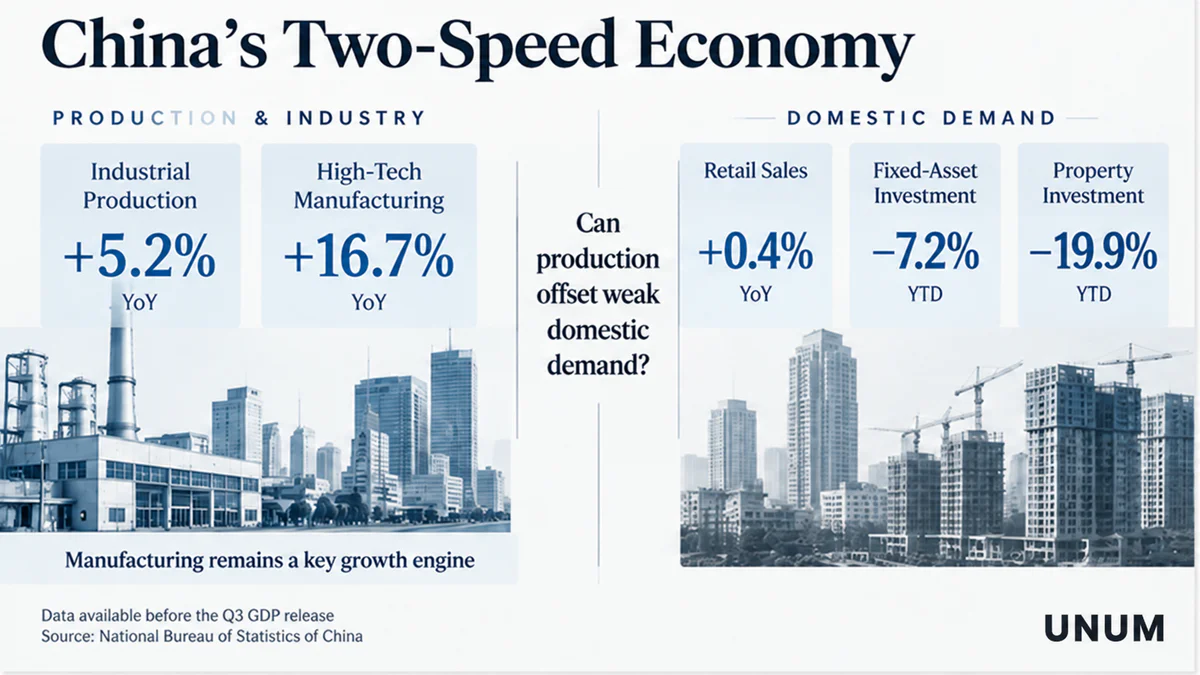
Ahead of the data release, the gap between different parts of the economy remains significant. In August, China's industry grew by 5.2% year-on-year, with output in high-tech manufacturing increasing by 16.7%. At the same time, China's retail sales increased by only 0.4%, and fixed asset investments for January–August decreased by 7.2%. Private investments fell by 10.1%.
The real estate market in China looks even weaker. Investments in the sector for the first eight months of the year decreased by 19.9%, sales of new commercial real estate in monetary terms fell by 13%, and the volume of new construction dropped by almost 25%.
At the same time, corporate costs are rising. In September, China's CPI was only 0.9% year-on-year, while PPI accelerated to 5.0%. Prices in raw material industries rose by 9.4%, and purchasing prices for industrial producers increased by 6.9%. This indicates cost pressure with limited ability to fully pass them on to final consumer prices.
The main question for Monday is therefore not only whether GDP will exceed the forecast. More importantly, it's about understanding how China continues to grow. If industry and exports once again prove significantly stronger than retail sales, private investments, and real estate, the structural imbalance in the economy will persist.
What to watch: China's GDP, industrial production, retail sales, fixed asset investments, real estate investments, CSI 300 index, Hang Seng index, USD/offshore Chinese yuan (USD/CNH), copper, iron ore.
The US Housing Market to Test the Price of Expensive Money
After a week filled with inflation releases, the US economic calendar will become noticeably calmer. The next Federal Reserve meeting will take place on October 27–28, so the market will assess how the current level of interest rates affects the sectors most sensitive to lending.
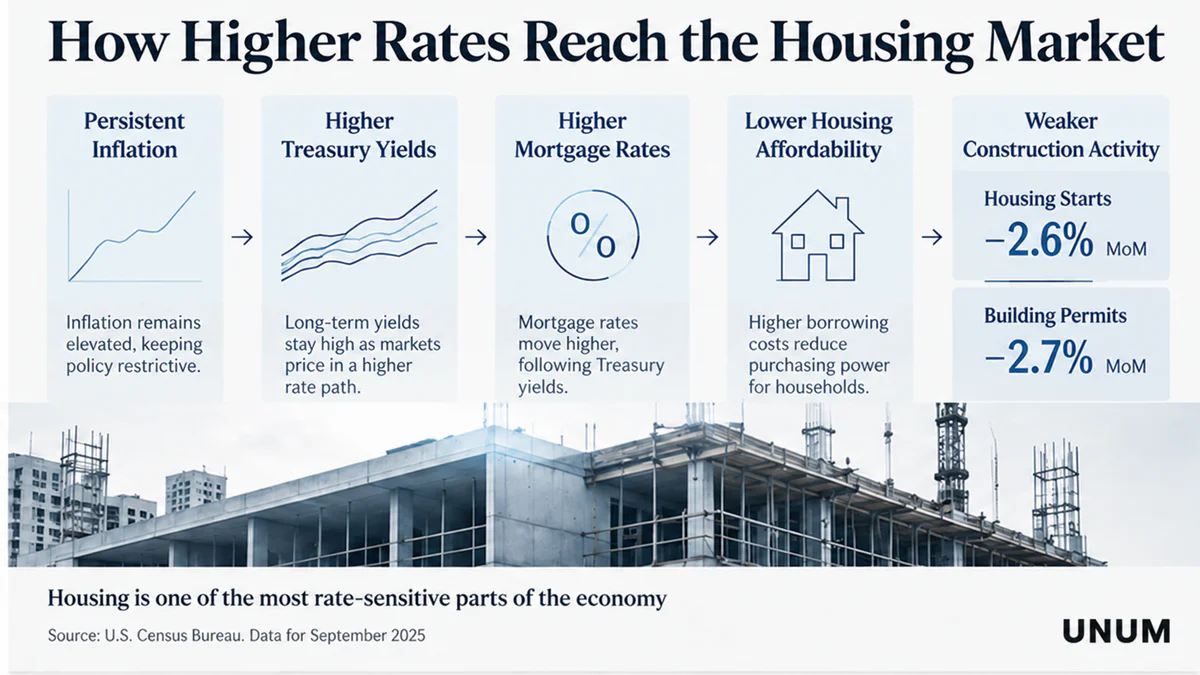
On October 20, the Census Bureau will release data on new housing construction for September. In August, housing starts fell by 2.6% month-over-month to 1.275 million units annually, and building permits decreased by 2.7%.
The housing market is particularly important because mortgage rates are closely tied to the yields on long-term US Treasuries, although the movement is not one-to-one. Mortgage costs are also influenced by credit spreads, the specifics of the mortgage-backed securities market, and other factors.
The transmission of high rates into the economy looks roughly like this: Persistent inflation → expectations of tighter policy and pressure on Treasury yields → more expensive mortgages → reduced housing affordability → pressure on construction.
High rates thus tighten credit conditions long before an obvious recession appears in general statistics. Therefore, September's housing starts and building permits will be one of the first tests of whether the high cost of money is beginning to more noticeably constrain real economic activity.
Corporate Earnings to Show Who Can Withstand High Capital Costs
The next phase of the corporate earnings season will allow for an examination of several parts of the economy. On October 20, General Motors and Netflix will report their third-quarter results, and on October 21, Tesla will do the same. IBM also lists October 21 in its investor calendar, but currently marks this date as tentative.
For this analysis, EPS figures themselves are secondary. What is much more interesting is what companies will say about demand and the cost of financing:
GM — demand for cars, prices, consumer credit, and margins;
Netflix — consumer spending on subscriptions, advertising, and engagement dynamics;
Tesla — automotive margins, sales, CapEx, energy business, AI, and autonomous driving;
IBM — if the date is confirmed, corporate IT budgets, cloud services, and demand for AI solutions.
The tech sector is particularly interesting. From a fundamental perspective, demand for computing power remains very strong. TSMC finished the third quarter with revenue of $46.72 billion, a gross margin of 66.4%, and an operating margin of 58.7%, and forecasts $52.3–54.3 billion for the fourth quarter.
Demand is extremely strong... and we see no signs of slowing down.
But the market has simultaneously begun to ask another question — who will pay for this growth. The sell-off of CoreWeave's stocks and bonds has heightened concerns about debt financing for AI infrastructure. High yields and borrowing costs are becoming increasingly important factors for companies with large capital expenditures.
This creates an important distinction. The issue with AI now is not necessarily weak demand for chips or data centers. The risk arises because, with high rates, financing massive investment programs becomes more expensive.
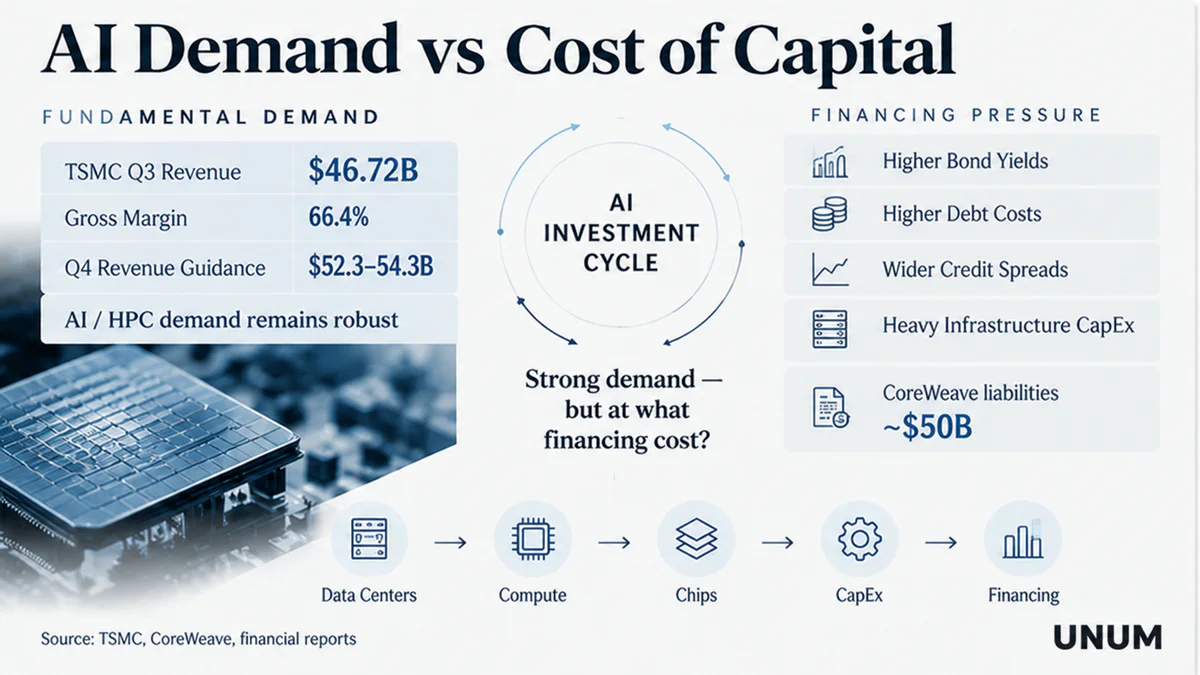
This creates an important distinction: the issue with AI now is not necessarily weak demand for chips or data centers. The risk arises because, with high interest rates, financing massive capital expenditures becomes more expensive.
The UK to Examine Labor Market, Inflation, and Consumer
The UK will receive an almost complete set of data on the state of its domestic economy. On October 20, the ONS will release the employment report, on October 21, CPI, PPI, and public finances, and on October 23, retail sales.
The UK labor market and inflation will give the Bank of England two potentially opposing signals. The preliminary estimate of the number of employees in the PAYE system for August decreased by 145,000 year-on-year and by 26,000 month-on-month. These figures may still be revised, but they indicate a cooling demand for labor.
At the same time, inflation is accelerating. In August, the UK CPI rose from 2.9% to 3.1% year-on-year, core inflation was 2.6%, and services inflation was 3.4%. The energy effect is particularly noticeable: motor fuel prices increased by 23% year-on-year.
Meanwhile, real retail sales volumes in August increased by 0.5% month-on-month and 2.4% year-on-year. UK retail sales on Friday will show how much price increases are already affecting real consumption volumes.
For the Bank of England, this is a familiar dilemma. A cooling labor market restrains arguments for further tightening, while accelerating inflation prevents the regulator from taking a soft stance.
What to watch: employment, wage growth, overall and core Consumer Price Index (CPI), services inflation, retail sales volumes, GBP/USD, and yields on UK government bonds.
European debt will be the next test of high rates
In the eurozone, the focus will shift from inflation to public finances. On October 20 Eurostat will publish the second notification on deficit and debt for 2025, as well as quarterly figures for government debt and budget deficit for the second quarter of 2026.
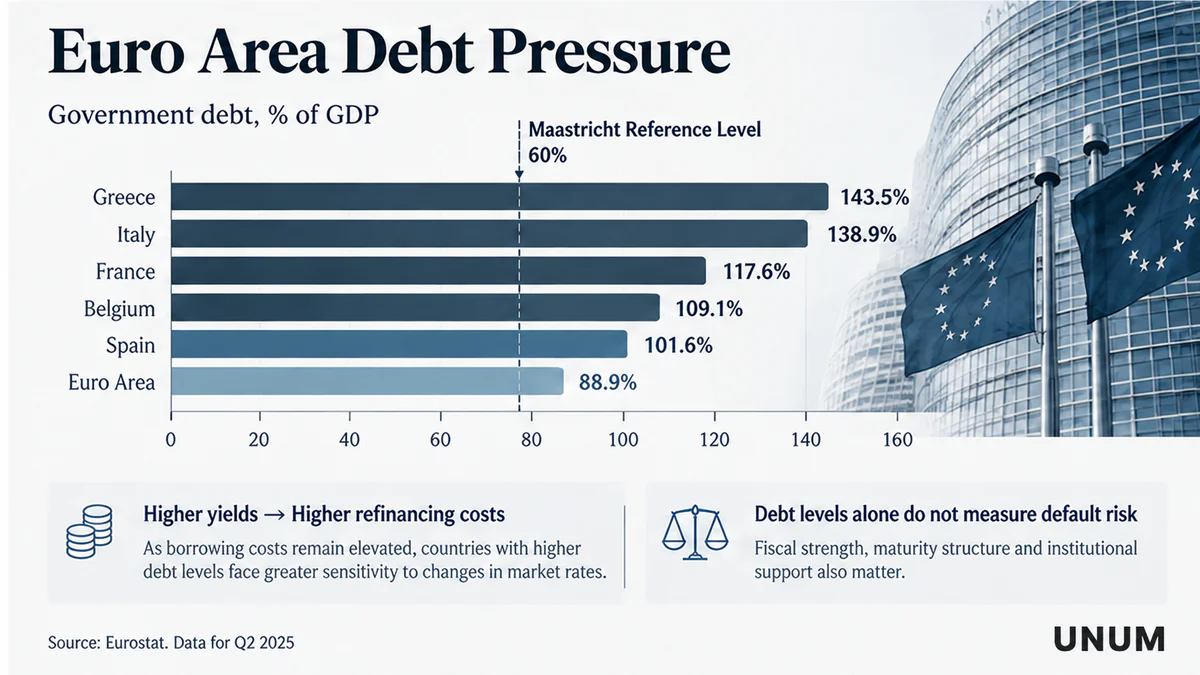
At the end of the first quarter, the eurozone's government debt was already 88.9% of GDP compared to 87.7% at the end of 2025. In Greece, the figure reached 143.5%, in Italy — 138.9%, in France — 117.6%, in Belgium — 109.1%, in Spain — 101.6%.
At the same time, the seasonally adjusted budget deficit of the eurozone in the first quarter was 3.1% of GDP.
A high debt-to-GDP ratio in itself does not indicate a debt crisis. The sustainability of government debt is influenced by the maturity of obligations, economic growth rates, the average cost of debt servicing, and the government's ability to finance itself in the market.
However, with high yields persisting, servicing new issues is gradually becoming more expensive. Therefore, European government debt is becoming more sensitive to expensive financing precisely when governments are simultaneously increasing spending on energy, defense, and infrastructure.
The market will monitor not only overall debt-to-GDP ratios but also the yields on European bonds and spreads relative to German government bonds. If differences in borrowing costs begin to widen, government debt could become another channel through which the high cost of money affects European financial markets.
Japanese inflation will be the last guide before the Bank of Japan
On October 23 Japan will release the national CPI for September — one of the last major macroeconomic releases before the Bank of Japan meeting on October 29–30. On the same day, the BoJ will present the October Financial System Report.
In August, Japan's overall CPI rose by 1.9% year-on-year, the index excluding fresh food by 1.7%, and the CPI excluding fresh food and energy by 1.9%. Meanwhile, real household spending decreased by 3.1% year-on-year.
For the Bank of Japan, not only the level of inflation is important but also its nature. If the September CPI accelerates mainly due to rising prices for imported energy, while domestic demand remains weak, this does not necessarily indicate the need for aggressive tightening. However, if price growth becomes more widespread, the market may revise expectations for further normalization of monetary policy.
What to watch: CPI, USD/JPY, JGB yields, and Bank of Japan comments on financial stability.
Expensive oil will affect almost everything
In the oil market calendar for October 19–23, there is no event on the scale of an OPEC+ meeting or a new Oil Market Report. However, oil prices will remain an important variable for almost all economies in the article.
The October IEA report showed how unusual the situation has become. The agency expects that global oil demand in 2026 will decrease by an average of 2.6 million barrels per day, to 102.4 million barrels per day. This reflects the impact of high fuel prices and economic slowdown.
At the same time, the supply buffer remains limited. According to the IEA, by the end of September, observed global oil inventories were 509 million barrels below pre-war levels. The agency also expects that the tightness in the supply of middle distillates may persist for a significant part of 2027.
This results in a paradoxical combination:
Demand weakens → economic slowdown intensifies
but at the same time
Inventories remain low → price pressure may persist
Therefore, Brent and other oil benchmarks will continue to influence not only the energy sector. High oil prices increase transportation and production costs, support inflation in the UK and Japan, reduce real household incomes, and may increase pressure on corporate margins.
Bitcoin will test its link to tech risk
For Bitcoin, there is no single pre-scheduled cryptocurrency event during the week that can independently determine the market direction. It is much more interesting to see how BTC will behave amid changes in capital costs and tensions in the tech sector.
The recent sell-off of debt instruments by AI companies has shown that investors have become much more cautious about corporate debt. If the high cost of borrowing continues to pressure businesses with large capital expenditures, the overall appetite for risk may decrease even with strong fundamental performance in the tech sector.
Two different behavior models are possible for Bitcoin.
Nasdaq declines + credit spreads widen + BTC falls — Bitcoin continues to trade predominantly as a high-risk asset.
Nasdaq declines + BTC maintains relative stability — then the crypto market's own factors, primarily liquidity and capital flows through spot Bitcoin ETFs, may become more significant.
Therefore, the key indicators of the week will be BTC/USD, DXY, the yield on 10-year US Treasuries, Nasdaq 100, credit spreads, and ETF flows into spot Bitcoin ETFs.
Three main questions of the week
1. Can China maintain growth without a recovery in domestic demand?
Strong GDP with low retail sales, private investment, and real estate will confirm that the economy remains dependent on industry and exports.
2. Where do high rates begin to impact the real economy the most?
Answers will come from the US housing market, UK employment and consumption, European public finances, and corporate reporting.
3. Does the AI boom remain an economic support with expensive financing?
TSMC confirms strong physical demand for computing power, but the debt market shows that investors are becoming significantly more demanding of cash flow and borrower quality.
The week of October 19–23 will test not so much whether interest rates remain high, but who can live with them longer. China needs to show if industry can compensate for weak domestic demand. The US housing market — how much expensive credit limits investment. The UK — whether consumers can withstand the combination of inflation and a cooling labor market. Europe — how sensitive public debt servicing becomes. And tech companies and Bitcoin will show whether the market is still willing to pay a high price for growth when money has become expensive again.