

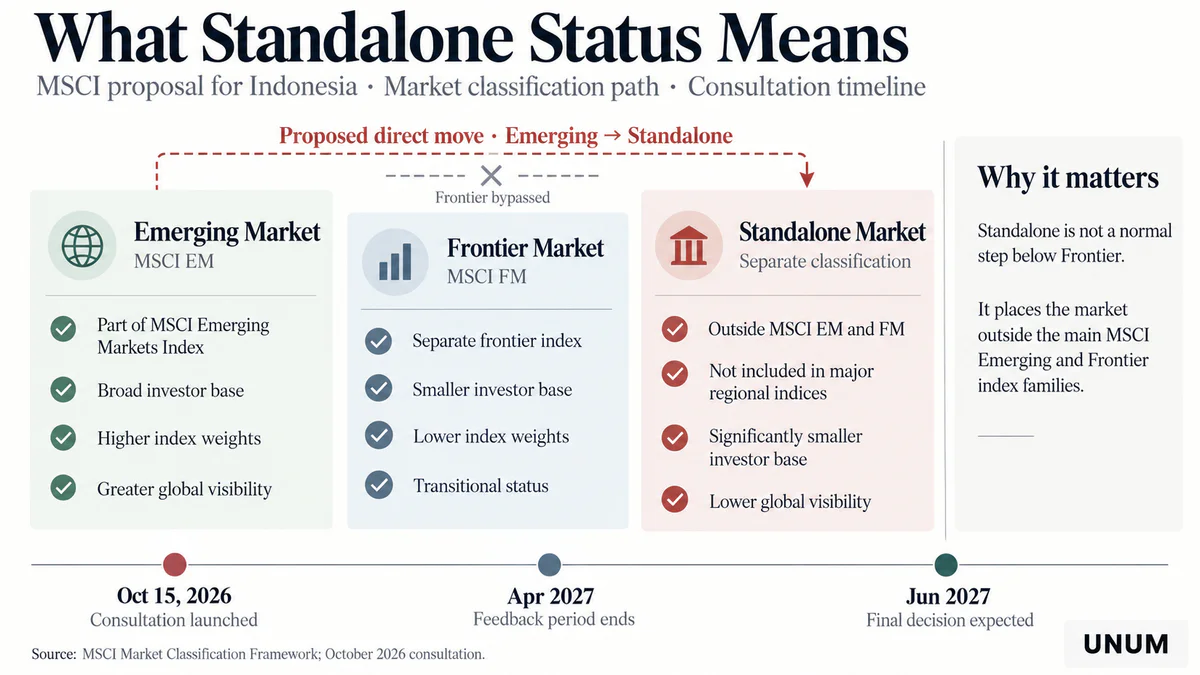
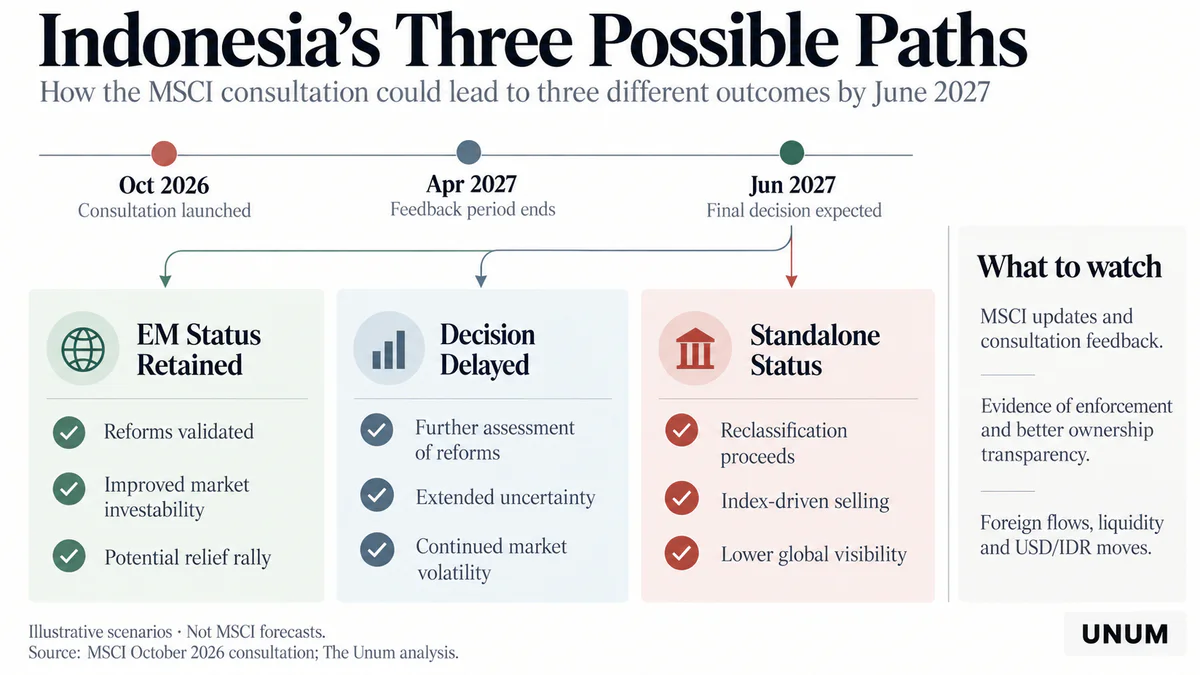
However, a final decision has not yet been made. On October 15, 2026, MSCI announced a consultation with market participants, which will last until April 30, 2027. The provider intends to determine the country's further classification no later than June 30, 2027. Until then, Indonesian authorities must convince international investors that financial market reforms have indeed increased ownership transparency, improved trading conditions, and ensured effective oversight of operations.
Why Indonesian stocks fell more sharply than other Asian markets
On October 16, the Jakarta Composite Index (IDX Composite, or IHSG) fell by 11.4% during the trading session, marking the sharpest intraday drop since 1998. According to Reuters, during the sell-off, the Indonesia Stock Exchange halted trading after a protective mechanism was triggered. The fall primarily affected the most liquid companies, traditionally in demand by foreign institutional investors.
Shares of Bank Central Asia, Bank Rakyat Indonesia, and Bank Mandiri lost nearly 15%. At the same time, pressure on the national currency increased: the Indonesian rupiah moved towards historically weak levels against the dollar.
The scale of the sell-off is particularly noticeable against the backdrop of other Asian markets. Meanwhile, Japan's Nikkei 225 added about 1.9%, and South Korea's KOSPI rose approximately 3.3%. These figures reflect market dynamics during the news release on October 16, not necessarily the final closing prices.
Thus, the collapse of the Indonesian market was primarily linked to national factors rather than a simultaneous deterioration in sentiment across the Asian region.
However, the October event did not arise out of nowhere. Since the beginning of 2026, Indonesian stocks have already been under pressure due to questions about market transparency, limited liquidity of individual companies, and foreign investors' concerns about oversight effectiveness. MSCI had previously warned about deficiencies in determining the free float of shares, and subsequent index constraints increased uncertainty.
The proposal to reclassify the country directly to Standalone Market marked a new stage in this conflict. It forced investors to reassess the likelihood that Indonesian assets would remain part of standard emerging market portfolios.
What MSCI's proposal means for Indonesia
The American company MSCI develops stock indices that international management companies, pension funds, and ETFs use to form investment portfolios and evaluate management results.
One of the most well-known benchmarks is the MSCI Emerging Markets Index, which includes stocks from developing countries. When classifying national markets, MSCI considers not only company size and liquidity but also market accessibility for international investors.
The classification system includes several categories:
Emerging Market — developing markets whose stocks can be included in the main MSCI Emerging Markets indices.
Frontier Market — frontier markets represented in a separate family of MSCI Frontier Markets indices.
Standalone Market — a standalone category, whose markets are not included in the main composite indices of Emerging Markets and Frontier Markets.
Standalone Market is not necessarily an intermediate step between developing and frontier markets. Reclassification to this category signifies a fundamental change in market accessibility for investors focused on major regional MSCI indices.
On October 15, the company proposed moving Indonesia directly from Emerging Market to Standalone Market, without an intermediate transition to Frontier Market. In an official statement, MSCI outlined its position: "MSCI considers the continued classification of Indonesia as an emerging market to be inappropriate."
The company indicated its intention to proceed with the proposed reclassification unless convincing evidence of significant improvements in market functioning and corporate governance quality emerges during the consultation.
While a decision is pending, MSCI maintains restrictions on certain changes to the composition of Indonesian indices. Specifically, the provider will not increase the Foreign Inclusion Factor (FIF) and the Number of Shares (NOS), include new securities in the MSCI Indonesia Investable Market Index, or move existing components to higher size segments.
At the same time, MSCI will continue to exclude from its indices securities identified by Indonesian authorities under the High Shareholding Concentration (HSC) mechanism and use disclosed data on owners of more than 1% of shares to adjust free float estimates. This specifically pertains to the composition of MSCI indices, not to the automatic delisting of companies from the Indonesia Stock Exchange.
Consequently, the impact of the decision on the Indonesian stock market begins even before the final reclassification: some mechanisms that could increase the presence of national companies in international indices are already limited.
Why MSCI Stopped Trusting the Structure of the Indonesian Market
MSCI's main concerns are not directly related to Indonesia's economic growth rates, government budget, or the profitability of its largest corporations. The index provider doubts the reliability of data on ownership structure and the market's ability to ensure fair pricing.
In the June Market Classification Review, MSCI identified two systemic issues: lack of transparency in share ownership and suspicions of coordinated trading actions.
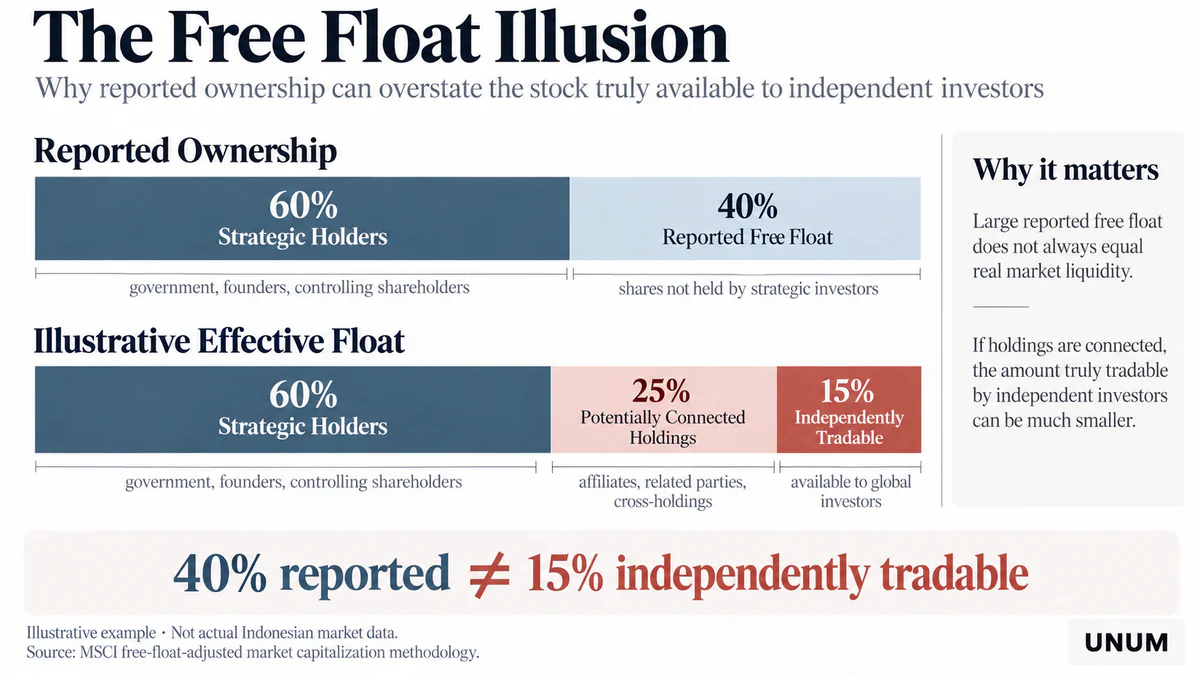
The first issue affects the determination of free float — the portion of shares that are freely traded. If formally independent holders of securities are actually interconnected, the volume of shares truly available to external investors may be significantly less than stated.
For example, a company may disclose a free float level of 40%, but if a significant portion of these shares is owned by affiliated structures, the actual number of shares independently traded on the market will be lower. This is a hypothetical illustration of the mechanism, not an assessment of any specific Indonesian company.
The second issue concerns the quality of trading. If a significant portion of transactions is conducted between coordinated participants, observed prices and volumes may not reflect the real balance of independent supply and demand.
For index funds, both circumstances create risk. Their strategies assume that shares included in the index are available for purchase and sale in volumes corresponding to their index weight without excessive impact on market price.
If this assumption is not met, managers face additional transaction costs and difficulties in replicating the index. Formally high company capitalization no longer guarantees sufficient liquidity of its shares.
This is why MSCI pays special attention to the investability indicator — the practical suitability of the market for institutional investments.
At the same time, suspicions of coordinated trading are not equivalent to proven manipulations by specific companies. MSCI points to systemic risks and insufficient evidence of effective oversight, rather than making legal judgments about the guilt of individual participants.
What Reforms Indonesia Implemented and Why They Didn't Convince MSCI
Indonesian authorities began responding to the index provider's concerns in the first half of 2026. The financial regulator OJK, the Indonesia Stock Exchange IDX, and the central depository KSEI developed a program to enhance transparency and the quality of market infrastructure.
In April, regulators announced the implementation of several measures, including expanding disclosure of ownership structure and developing mechanisms for monitoring share concentration. Simultaneously, a phased transition to a higher minimum free float was approved.
Reform Direction | Content of Changes | Significance for Investors |
|---|---|---|
Shareholder Disclosure | Publication of data on owners of more than 1% of shares | Ability to more accurately determine ownership structure |
Concentration Monitoring | High Shareholding Concentration mechanism | Identification of excessive concentration of share capital |
Investor Classification | Increasing KSEI data detail to 39 categories and types | More transparent information about securities owners |
Minimum Free Float | Phased transition from 7.5% to a target threshold of 15% | Potential increase in the volume of freely traded shares |
Raising the minimum free float threshold to 15% does not mean that all public companies have already met this requirement. It is a reform whose implementation involves a transition period.
The changes aim to enhance transparency of ownership structure, protect investors, and improve conditions for international capital participation. However, MSCI evaluates not only the presence of new rules but also the consistency of their application.
In the June Market Classification Review, the company recognized the reforms as a positive step while emphasizing the need for sustainable measurable outcomes.
Raman Aylur Subramanian, Head of Market Classification and Taxonomy at MSCI, outlined the general principle of assessment:
Inclusion in indices and market classification are not immutable decisions
For international institutional investors, real changes in corporate governance, ownership transparency, and the ability of regulators to curb violations are of fundamental importance.
Thus, there remains a significant discrepancy between the position of Indonesian authorities and the requirements of MSCI. Regulators point to the adopted regulatory measures, while the index provider expects evidence that these measures have already changed the market's functioning.
By October, MSCI had not seen sufficient sustainable progress and specifically pointed out the need for evidence of effective enforcement of supervisory measures.
This aspect may be the most challenging for the Indonesian government. Establishing new shareholder disclosure requirements can be done relatively quickly, but proving the effectiveness of combating market manipulation can only be achieved through long-term supervisory practice results.
Why exclusion from MSCI threatens mass sell-offs
MSCI indices are used not only to track the dynamics of financial markets. They form the basis of investment strategies that determine the allocation of capital between countries, companies, and sectors.
Therefore, MSCI reclassification — a change in a country's classification by the index provider — can directly influence the decisions of international managers.
In the event of Indonesia's final transition to Standalone Market, the consequences will vary depending on the investment strategy.
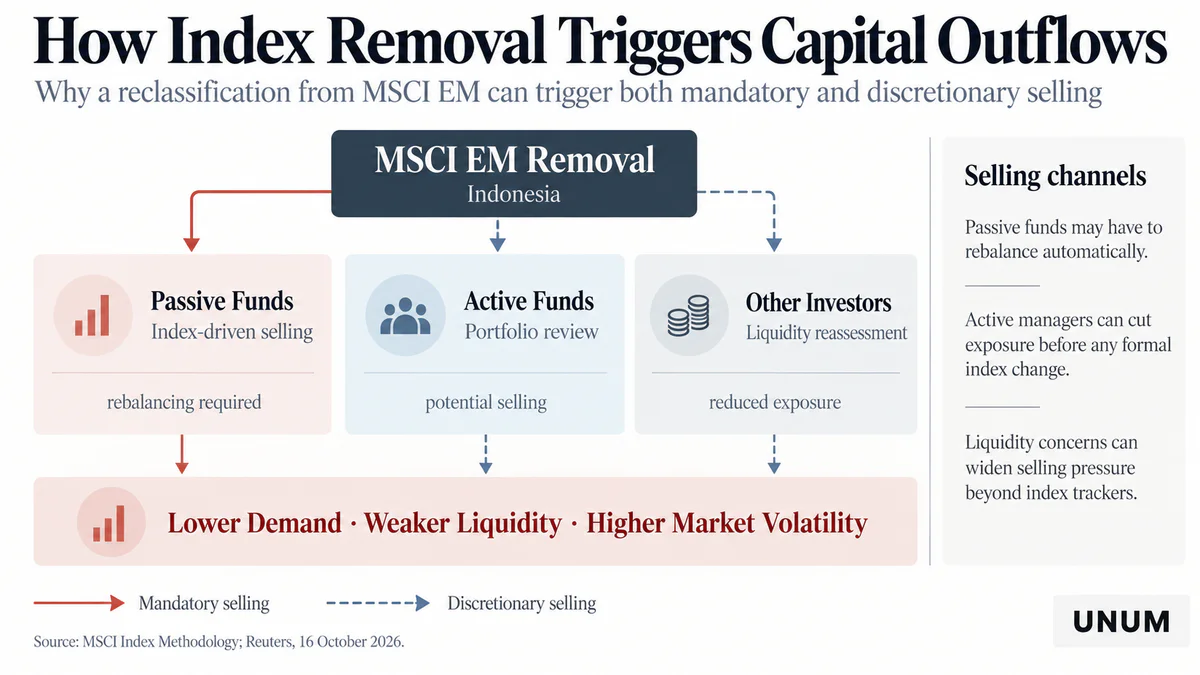
Passive funds and index ETFs. Funds required to replicate the affected MSCI Emerging Markets indices will need to rebalance their portfolios. For such strategies, the exclusion of Indonesian stocks from the base index means the need to reduce or close corresponding positions.
Active funds with an index benchmark. Managers may retain Indonesian securities, but large positions outside the base index increase the risk of the fund's results deviating from the chosen benchmark. Therefore, MSCI's decision may prompt them to reduce investments even in the absence of a direct ban on asset ownership.
Independent institutional investors. They are not obliged to follow MSCI Emerging Markets, but may reconsider investment plans due to the expected decrease in liquidity, increase in currency risk, and worsening exit conditions from positions.
Thus, the potential forced sale of shares by passive funds represents just one channel of outflow.
The anticipatory market reaction also plays an important role. Investors may reduce positions even before MSCI's final decision if they consider reclassification likely and seek to avoid simultaneous sales of a large number of securities.
Such a sequence can intensify market pressure: the expectation of index changes leads to a reduction in investments, liquidity decreases, and the prospect of further sales increases the risk premium required by investors.
This is why a potential MSCI downgrade poses a threat not only to index ETFs but also to a broader range of international capital market participants.
How much capital Indonesia risks losing
The scale of potential capital outflow from Indonesia depends on the volume of assets oriented towards MSCI indices, the current weight of the national market, and the decisions of active managers.
According to MSCI data, as of September 30, 2026, the MSCI Indonesia Index, covering large and mid-cap companies, included nine securities with a total free float-adjusted capitalization of $53.35 billion. The broader MSCI Indonesia IMI included not only large and mid-cap but also small-cap companies, so these two indices should not be equated.
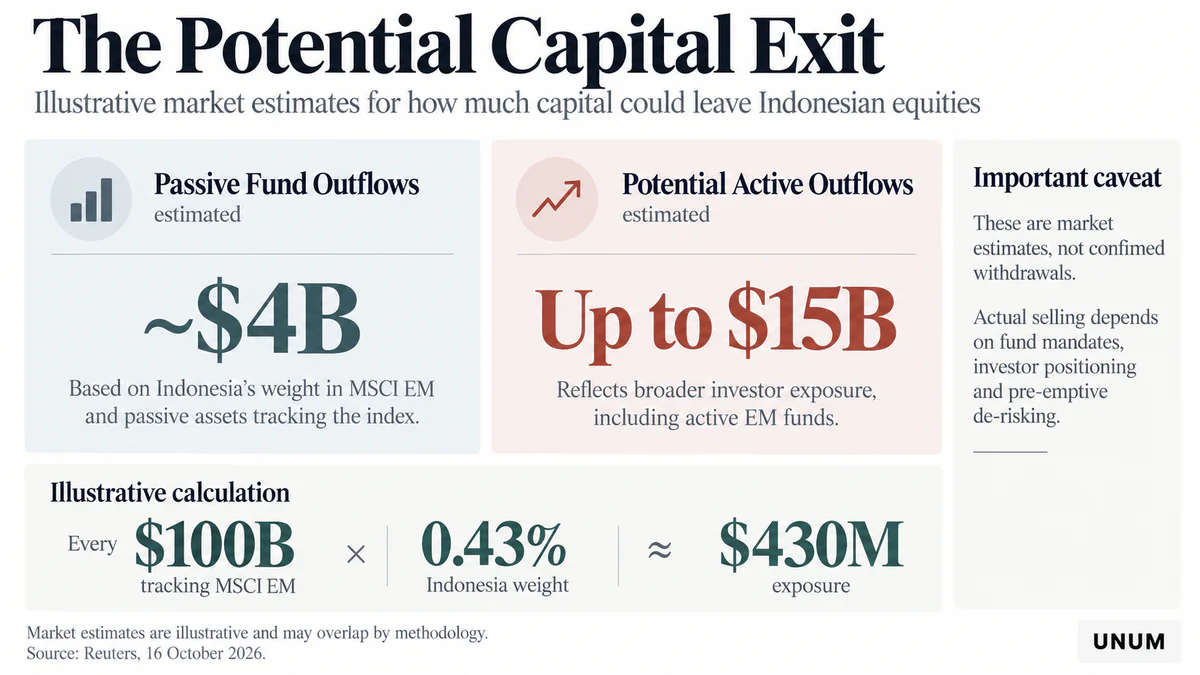
For comparison, the adjusted capitalization of MSCI Emerging Markets on the same date was about $12.28 trillion. The ratio of these figures gives an approximate weight of Indonesia of about 0.43%.
This is The Unum's estimated calculation based on index capitalization, not the official weight of the country in a specific investment fund's portfolio.
At this weight, every $100 billion of assets fully replicating the corresponding index theoretically implies about $430 million in investments in Indonesian securities. However, real funds may use different versions of indices, replication methods, and hedging tools.
Market estimates of potential sales vary significantly. According to Reuters, the potential outflow is estimated at approximately $4 billion from passive strategies and up to $15 billion from active funds.
These figures do not represent a confirmed volume of future capital outflows. Some investors may have already reduced their positions, some managers may choose to retain Indonesian stocks, and the methodologies for assessing active and passive flows may overlap.
It is also necessary to distinguish between a decrease in market capitalization and an actual outflow of funds. Even a relatively small volume of sales can cause a significant drop in capitalization if buyer demand is insufficient.
For the Indonesian market, the concentration of foreign investments in a few large companies is particularly significant. If funds simultaneously reduce positions in these stocks, the pressure on quotes may be disproportionately strong relative to the actual volume of transactions.
Why Major Banks Are at the Center of the Sell-Off
The decline in Indonesian stocks was particularly noticeable in the banking sector, which accounts for the majority of the MSCI Indonesia Index's capitalization.
As of September 30, 2026, the four largest banks held the following shares of the index:
Bank Central Asia — 31.41%;
Bank Rakyat Indonesia — 19.96%;
Bank Mandiri — 15.70%;
Bank Negara Indonesia — 4.64%.
The combined weight of the financial sector was about 71.7%. Just three of the largest banks accounted for approximately 67% of the MSCI Indonesia Index.
This concentration explains why the reduction of foreign participation in index strategies primarily affects large banking stocks.
If a fund sells Indonesian stocks proportionally to their index weights, about two-thirds of the corresponding volume falls on Bank Central Asia, Bank Rakyat Indonesia, and Bank Mandiri.
However, a decline in market quotes does not necessarily indicate a deterioration in the banks' fundamental indicators. The reason may be a change in the structure of investment demand, not directly related to the profit, loan portfolio, or capital adequacy of specific organizations.
However, a prolonged decline in valuations creates additional constraints. If banking companies need to attract new equity capital, an unfavorable market environment may increase the cost of placements.
Thus, the high concentration of the MSCI Indonesia turns potential index reclassification into a particularly significant risk factor for the country's largest financial organizations.
Foreign Investors Began Reducing Positions Before the October Crash
The threat of exclusion from international indices arose amid an already ongoing reduction in foreign participation in the Indonesian stock market.
According to international financial media reports, since the beginning of 2026, net sales of Indonesian stocks by foreign investors have approached $5 billion. This figure reflects the difference between purchases and sales of securities, not the confirmed volume of funds withdrawn from the country.
Foreign investments in Indonesia include several directions: investments in stocks, government and corporate bonds, as well as direct investments in enterprises. Therefore, a possible MSCI reclassification primarily affects portfolio capital focused on the stock market.
Throughout the year, uncertainty increased gradually. In January, MSCI highlighted issues with free float transparency, continued to apply restrictions to Indonesian securities in the following months, and in June warned of a possible classification review.
At an early stage, investors mainly discussed the risk of the country transitioning to Frontier Market. However, the October proposal was tougher: MSCI deemed it necessary to consider a direct transfer to Standalone Market.
This significantly changes the assessment of investment prospects. Instead of moving between two large index families, Indonesia risks being left out of both, which could limit the inflow of funds from international funds with strictly defined investment mandates.
Therefore, the stabilization of the Jakarta Composite alone will not be sufficient proof of restored confidence. To assess market resilience, it will be necessary to monitor actual foreign portfolio flows, the structure of stock ownership, and liquidity dynamics.
Why Pressure on Stocks Could Weaken the Indonesian Rupiah
The consequences of a possible reduction in foreign investments extend beyond the stock market.
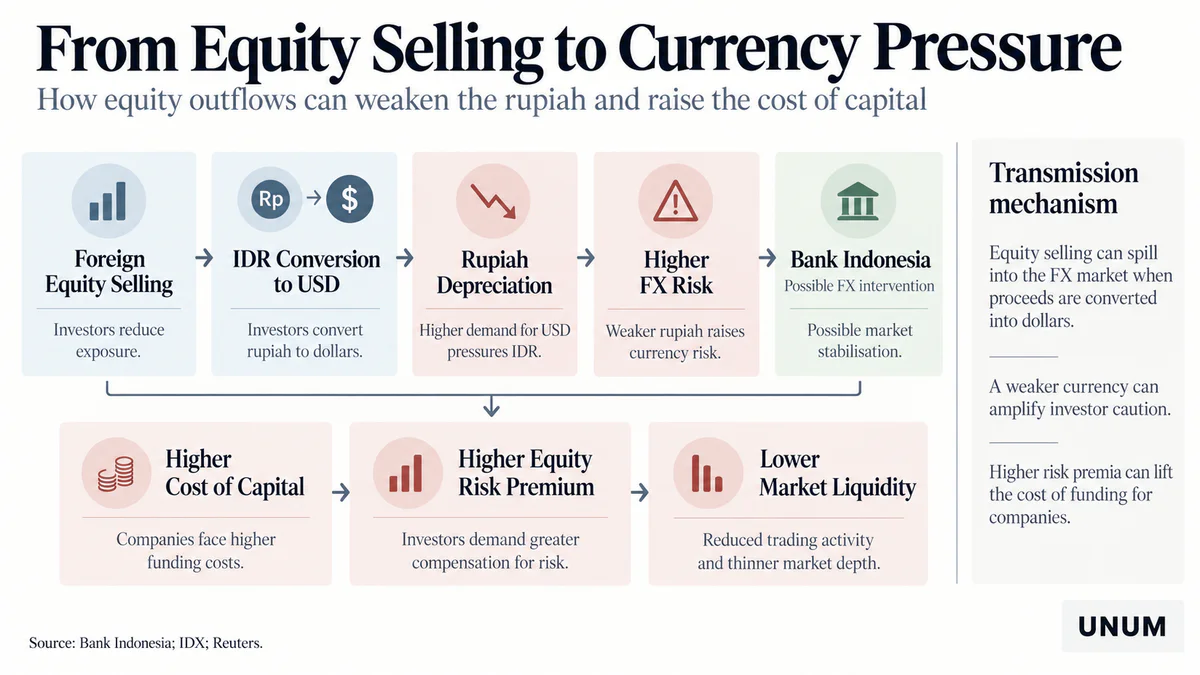
When an international investor sells Indonesian stocks and decides to withdraw the proceeds, they need to exchange rupiah for foreign currency, most often the US dollar.
Additional demand for dollars can increase pressure on the Indonesian rupiah's exchange rate, especially if stock sales occur simultaneously among a large number of participants.
On October 16, the rupiah approached historically weak levels against the dollar. According to Reuters, its decline occurred simultaneously with the collapse of the Jakarta Composite, which heightened concerns about further reductions in foreign capital.
It is important to understand that each sale of Indonesian stocks by a foreign investor does not necessarily lead to an immediate conversion of funds into dollars. The proceeds may remain in rupiah and be directed towards the purchase of other local assets.
The risk intensifies precisely when the reduction in equity investments is accompanied by an actual outflow of capital from the national currency.
The weakening of the rupiah also affects the results of foreign investors. Even with stabilization of quotes in local currency, the value of the portfolio in dollar terms may continue to decline.
Thus, two interrelated sources of risk arise simultaneously: the fall in stock prices and currency losses.
The increase in uncertainty may require more active actions from Bank Indonesia. The central bank can use currency interventions and other monetary policy tools to limit sharp fluctuations, but such measures do not eliminate the fundamental issues of stock market transparency.
The depreciation of the rupiah also increases the cost of imported goods and servicing obligations denominated in foreign currency if the corresponding risks are not hedged.
Therefore, the dynamics of USD/IDR becomes one of the important indicators of whether the stock sell-off is turning into a broader crisis of confidence in the country's financial assets.
How Losing Emerging Market Status Will Change Capital Costs
The most long-term risk for Indonesia is not a one-day drop in the Jakarta Composite, but the potential deterioration of conditions for attracting international capital.
If institutional investors reduce their participation in the national stock market, stock liquidity may decrease, and transaction costs may increase. In such conditions, new investors usually demand higher expected returns as compensation for risk.
In corporate finance, this mechanism is reflected in the cost of equity capital.
All else being equal, an increase in the required return for investors means a decrease in the fair valuation of companies. For businesses planning an additional stock issue, this may lead to the need to place shares at a less favorable price.
The increase in the equity risk premium primarily affects companies that depend on regular access to the public capital market.
Potential consequences can be divided into several levels:
For public companies — reduced market valuation, higher cost of new placements, and limited opportunities for raising equity financing.
For institutional investors — increased transaction costs, currency risks, and requirements for expected returns.
For the economy — possible reduction in companies' investment activity and increased dependence on bank lending.
An additional channel of impact is related to the debt market. Although MSCI reclassification does not require the automatic sale of Indonesian government bonds, a deterioration in the overall perception of country risk may affect the yields of debt instruments and the investment policy of international managers.
At the same time, the direct consequences of index exclusion need to be separated from broader macroeconomic scenarios. The fall in stocks itself does not imply an immediate deterioration in Indonesia's financial stability.
The scale of the potential impact depends on the duration of the outflow, the reaction of domestic investors, the state of the banking system, and the ability of regulators to restore market confidence.
Have There Been Similar MSCI Decisions Before
The direct transition of a country from Emerging Market to Standalone Market is relatively rare, but such practice has existed.
In 2021, MSCI reclassified Argentina from Emerging Markets to Standalone Markets. The decision was related to prolonged capital movement restrictions, which significantly hindered international investors' access to the national market.
In the same period, Pakistan was reclassified to Frontier Markets, as MSCI's concerns were primarily about the size and liquidity of the market rather than similar capital movement restrictions.
These examples show that the classification by an index provider is not determined solely by the scale of the economy or the number of registered companies.
For MSCI, the conditions under which international investors can buy and sell stocks, obtain reliable data on their trading, and manage portfolio risks are of fundamental importance.
However, a direct comparison of Indonesia with Argentina would be incorrect. In Argentina's case, the main issue was related to currency restrictions and access to capital, whereas MSCI's concerns with Indonesia primarily involve ownership transparency, market liquidity, and supervisory efficiency.
Moreover, the assessment of the quality of the national stock market is not equivalent to the assessment of the entire economy. Indonesian companies may maintain stable financial performance even amid a significant reduction in international portfolio investments.
Therefore, the key question is not how strong Indonesia's economy is overall, but whether its stock market meets the requirements of global institutional investors.
What Might Happen by June 2027
MSCI is accepting feedback from consultation participants until April 30, 2027, and plans to announce a final decision no later than June 30. Before this time, the company may publish an interim assessment of the comments received.
The further situation will depend on the results of reforms and whether Indonesian authorities can present convincing evidence of increased market transparency.
Indonesia Retains Emerging Market Status
The most favorable scenario suggests that MSCI will recognize the reform results as sufficient to maintain the Emerging Market classification.
To achieve this, regulators need to demonstrate the reliability of free float data, sustainable improvement in corporate governance, and effective enforcement of anti-market manipulation rules.
In such a case, reduced uncertainty may support the return of foreign investors and the recovery of demand for major bank stocks.
However, maintaining the status alone does not guarantee a return of quotes to previous levels. Further dynamics will also depend on company profitability, interest rates, and global demand for emerging market assets.
Final Decision Delayed
The second analytical scenario suggests continued evaluation of regulatory reforms or a change in the decision timeline.
MSCI has not announced this option as the main plan, but the possibility of additional assessment cannot be completely ruled out.
For investors, this outcome means continued uncertainty. Managers may delay new investments, and some funds may maintain reduced exposure to Indonesian stocks until final clarity emerges.
In such a situation, the market may stabilize after an initial drop, but liquidity and demand for new placements will remain under pressure.
Indonesia Reclassified as Standalone Market
The most unfavorable scenario for international index investors involves the approval of the proposed reclassification.
Once the implementation order is determined, funds replicating the affected MSCI indices will need to adjust their portfolio compositions. Active managers may also reduce positions, considering the change in the country's status and market liquidity.
Potential consequences include reduced foreign participation, higher stock volatility, and increased capital costs for individual companies.
However, the exact scale of market pressure is unknown in advance. Some investors may sell stocks before the official classification change, while counter-demand from local participants may mitigate the impact.
Thus, MSCI's final decision will be an important factor, but not the sole determinant of the state of Indonesia's financial market in 2027.
Indicators to Assess Trust Recovery
In the coming months, assessing the prospects of the Indonesian market solely by the Jakarta Composite dynamics will be insufficient.
Sustainable recovery requires not only rising quotes but also normalization of foreign portfolio flows, improved liquidity, and confirmation of the effectiveness of regulatory changes.
To assess the situation, investors should monitor several groups of indicators:
MSCI decisions and reform progress. The most important events will be interim updates from the consultation, OJK announcements, High Shareholding Concentration statistics, and results of new shareholder disclosure requirements.
Foreign portfolio flows. IDX data on net purchases and sales by non-residents will help determine whether international capital is returning or if rising quotes are mainly supported by domestic investors.
Liquidity and market concentration. Trading volumes, bid-ask spreads, and the actual free float of major companies will allow assessment of how well the market meets institutional investor requirements.
USD/IDR exchange rate and Bank Indonesia actions. The rupiah's stability, foreign reserve dynamics, and central bank decisions will show whether pressure from the stock market is spreading to other segments of the financial system.
Indonesia's banking sector. The performance of Bank Central Asia, Bank Rakyat Indonesia, and Bank Mandiri relative to the broader index will help determine if preferential sales of MSCI's most significant stocks continue.
Cost of capital raising. Conditions for new stock placements, corporate bonds, and government securities yields will help assess whether index uncertainty is evolving into a broader increase in financial costs.
Comparing these indicators will help distinguish a temporary recovery in quotes from a structural improvement in the country's investment attractiveness.
The main risk for Indonesia lies in the loss of trust
The October crash was a telling example of how strongly the decisions of international index providers can influence national stock markets. Even a consultation that does not immediately change the classification can cause a large-scale reassessment of assets if investors consider the likelihood of an unfavorable decision to be high.
For Indonesia, the situation is complicated by the concentration of international index investments in the largest banks, the prolonged reduction of foreign portfolio investments, and currency instability.
Collectively, these circumstances create a risk that stock market problems will gradually affect the value of equity capital, business investment activity, and financial conditions in the country.
At the same time, a possible exclusion from the MSCI Emerging Markets does not automatically mean a deterioration of all indicators of the Indonesian economy. The country retains a large domestic market, a developed corporate sector, and the ability to attract capital that is not directly dependent on index strategies.
Until June 2027, the main condition for restoring trust will not be the growth rate of the Jakarta Composite, but the ability of Indonesian authorities to prove that new rules have indeed increased transparency of share ownership, improved market oversight, and strengthened investor protection.
The results of these changes will determine whether the October decline remains a temporary market shock or becomes the beginning of a more prolonged reduction of international capital in the Indonesian stock market.