Why Bitwise Decided to Close the Dogecoin ETF
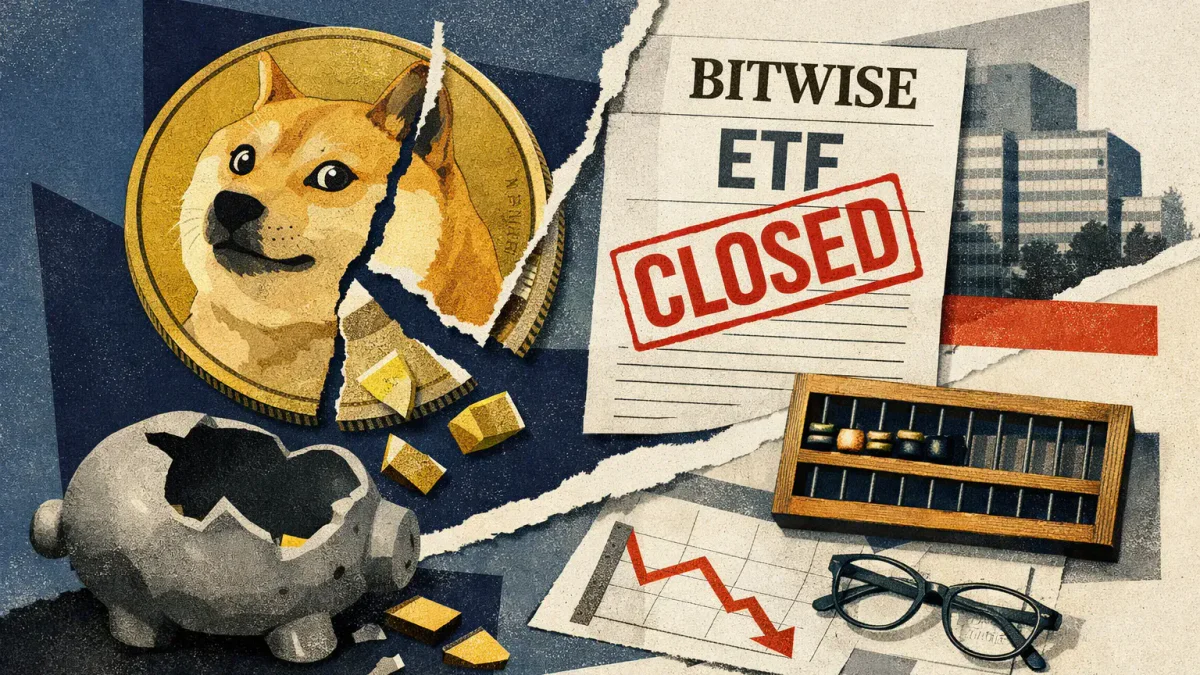
American management company Bitwise announced the liquidation of the Bitwise Dogecoin ETF (BWOW) on September 10, 2026. The fund began operations on November 25, 2025, and its shares started trading on NYSE Arca the following day. The last scheduled trading day was October 14, after which the company began winding down operations.
According to Bitwise's official notice published in the SEC, remaining investors were to be paid cash compensation around October 22. The payout amount was calculated based on the net asset value (NAV) as of October 21. At the time of writing, there is no confirmation that all settlements have been completed.
According to the official BWOW website, as of October 20, assets under management (AUM) were only $536,811, with an annual management fee of 0.34%. With such a capital volume, commission income is small, whereas maintaining the investment product requires ongoing expenses.
Despite being called an ETF, legally BWOW is classified as an exchange-traded product (ETP) and is not registered as an investment company under the U.S. Investment Company Act of 1940. Therefore, it does not benefit from all the protective mechanisms provided by this law for traditional registered investment funds.
In the official statement, the company explained its decision as follows:
Bitwise decided to liquidate the fund as part of an ongoing optimization of its product lineup, taking into account the changing needs of investors.
The company did not cite insufficient demand as the sole reason for the closure, but the small size of the fund allows its financial sustainability to be considered as one of the possible factors influencing the decision.
BWOW's assets were declining even before the liquidation announcement. According to the SEC quarterly report, at the end of December 2025, their value was $1.15 million, and by June 30, 2026, it had decreased to $473,547. During the first half of the year, the fund did not issue new shares, and the number of shares in circulation decreased from 60,000 to 40,000. The decline in AUM reflected both changes in the market value of DOGE and the redemption of shares by investors.
Previously, UNUM reported on Bitwise's decision to cease trading BWOW. However, the case of the fund is interesting not only for the liquidation itself but also for why a popular cryptocurrency asset could not ensure sustainable demand for the associated investment product.
Why the Popularity of Dogecoin Did Not Ensure Demand for the ETF
At the time of BWOW's launch, Dogecoin ranked seventh among the largest cryptocurrencies by market capitalization, which was estimated at approximately $22 billion on November 24, 2025. According to data provided by Bitwise, DOGE's daily trading volume on centralized crypto exchanges reached $1 billion. Nevertheless, high activity in the token's market did not translate into comparable demand for the investment fund.
One possible explanation is the differences between the audiences of the direct DOGE market and exchange-traded investment products. Buyers of meme coins often use cryptocurrency exchanges and wallets, where they can directly own tokens and conduct transactions without the involvement of a fund. The ETF is primarily targeted at investors who prefer to access cryptocurrency through a traditional brokerage account.
Moreover, purchasing an ETF does not imply direct ownership of DOGE. An investor buys shares of the fund, the value of which depends on the price of the underlying cryptocurrency and the costs of maintaining the product. Direct investments in Dogecoin do not involve an annual management fee, although they may be accompanied by trading commissions and storage costs.
Cryptocurrency investment products also vary significantly in demand. A telling comparison is between BWOW and another fund from the same management company — Bitwise Solana Staking ETF (BSOL).
Indicator | BWOW (Dogecoin) | BSOL (Solana) |
|---|---|---|
Assets Under Management | $473,547 | $592.34 million |
Base Management Fee | 0.34% | 0.20% |
Staking Income | No | Provided |
Data as of June 30, 2026. Sources: quarterly reports BWOW and BSOL in the SEC. In addition to the base fee, BSOL has staking expenses: the total annual expense ratio in Q2 was 0.56%.
At the end of June, BSOL's assets exceeded BWOW's by approximately 1,250 times, even though both products are issued by the same manager and provide access to separate cryptocurrencies.
BSOL differs not only in its underlying asset but also in the ability to earn income from staking Solana. After deducting relevant expenses, rewards can increase the fund's asset value or be distributed to investors according to its documents. However, it cannot be claimed that staking alone ensured higher demand: product attractiveness is also influenced by liquidity, volatility, investment strategies, and market participants' attitudes towards a specific cryptocurrency.
ETF liquidity is also important — the ability to buy and sell its shares without significant price deviation from the value of underlying assets. To assess it, one must consider trading volumes, the bid-ask spread, and the mechanism for creating and redeeming fund shares.
Thus, the popularity of a cryptocurrency does not equate to investors' willingness to buy an associated ETF. The small volume of BWOW indicates limited demand for a specific investment product but does not imply a lack of interest in DOGE.
Meanwhile, the Dogecoin ecosystem continues to develop independently of the fund's fate. In October, Dogecoin Labs united several projects to develop payment and user services. The demand for these initiatives will depend on their practical application rather than the number of available investment funds.
How Many Assets a Cryptocurrency ETF Needs for Sustainable Operation
The economy of an exchange-traded fund is primarily built on commission income, the size of which depends on the value of assets under management. The more funds an ETF attracts, the higher the potential revenue for the managing company. However, maintaining a fund requires ongoing expenses for administration, custodial storage, auditing, legal support, reporting, and maintaining the exchange listing.
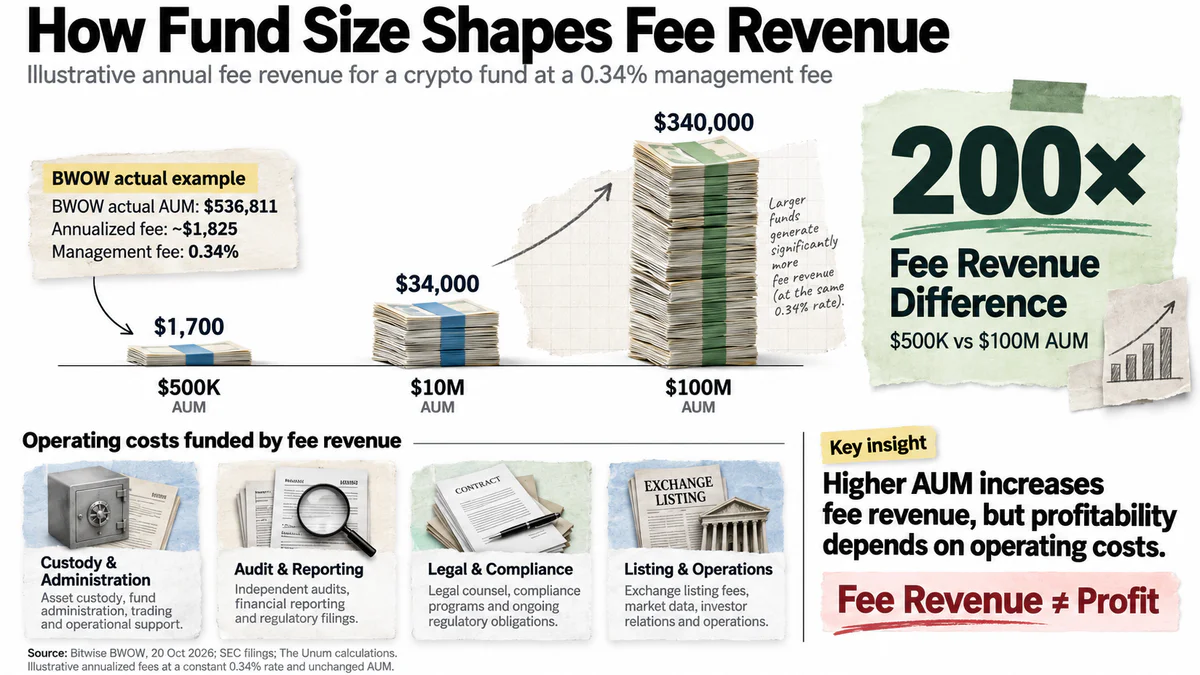
With AUM of $536,811 and an annual fee of 0.34%, the estimated commission income for BWOW would be approximately $1,825 per year if the asset value remained unchanged.
Actual reports show a comparable scale. For the first half of 2026, the fund accrued $1,215 in management fees, including $531 for the second quarter. These amounts are not Bitwise's profit, as the company uses commission income to service the product.
BWOW's expense structure provides that most operational costs are covered by the manager from a single fee. Exceptions include certain extraordinary expenses, including legal costs and some operational expenses not included in the standard fund servicing.
To understand the dependency of commission income on asset volume, consider three hypothetical scenarios at a 0.34% annual rate:
$500,000 AUM — about $1,700 in commission income per year.
$10 million AUM — about $34,000 per year.
$100 million AUM — about $340,000 per year.
The calculations assume a constant asset volume and commission rate. They do not account for market revaluation, possible discounts, and specifics of agreements with servicing companies, thus not reflecting the actual profit of the manager.
There is no single threshold of assets under management required for the profitable operation of cryptocurrency ETFs. The financial sustainability of an ETF depends on the expense structure, fee size, and the ability to leverage the overall infrastructure of the management company. Large organizations can potentially support smaller funds for longer, but the economic viability of such a strategy is determined individually.
The closure of BWOW raises questions about the prospects of other specialized cryptocurrency funds. As new altcoin products emerge, competition for investor capital intensifies. Management companies need not only to offer access to a specific token but also to convince investors that using the fund aligns with their strategies and justifies the additional costs.
The Bitwise case does not imply an inevitable mass closure of altcoin ETFs. However, it shows why it is important to consider not only the prospects of the underlying cryptocurrency but also the amount of capital raised, the liquidity of the fund's shares, and its economic sustainability when evaluating such instruments.
The closure of the Dogecoin ETF demonstrates the difference between the popularity of a cryptocurrency and the commercial success of an investment product. Even an asset with a multi-billion-dollar capitalization does not guarantee sufficient fee income for the management company. For the sustainable operation of an ETF, capital is needed to cover the fund's maintenance costs.
Infographic placement: after the third section, before the conclusion. Comparison of the annual fee income of a cryptocurrency ETF at different AUM levels — from $500k to $100 million — with a mark of BWOW's asset level before liquidation.