
At the end of 2025, the trajectory of global monetary policy seemed relatively clear: inflation was gradually returning to target levels, and high interest rates were expected to slowly decline. By the fall of 2026, this scenario had to be rewritten. The Federal Reserve had returned to raising rates, the ECB had increased them twice since June, and some leaders at the Bank of England were advocating for further tightening. The reason was a new surge in inflation, with an energy shock being one of the main factors, compounding existing price pressures, and now threatening to spread to a wider range of goods and services. The main question is no longer when cheap money will return, but whether central banks can stop a new wave of inflation before it becomes entrenched in wages, consumer expectations, and core prices.
The Scenario of Rate Cuts Has Collapsed
The scale of changes is best seen in the forecasts of the Federal Reserve System.
Median FOMC Participant Projections for End of 2026 | December 2025 | September 2026 |
PCE Inflation | 2.4% | 3.7% |
Federal Funds Rate | 3.4% | 4.1% |
Source: Federal Reserve, Summary of Economic Projections
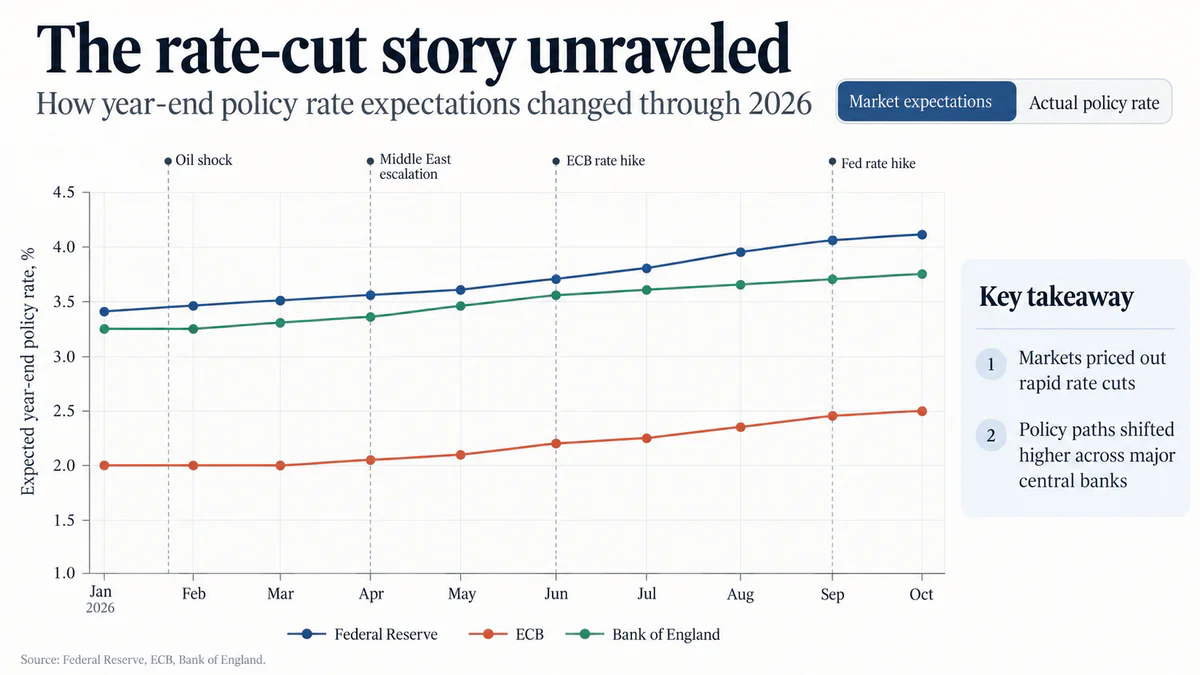
In nine months, the Fed had to revise both its inflation forecast and the expected rate trajectory. Instead of further easing monetary policy, the regulator returned to tightening. On September 16, the rate was raised by 25 basis points to a range of 3.75–4.00%.
In Europe, the turnaround was no less noticeable. As of December 2025, ECB staff expected average inflation in the eurozone to be around 1.9% in 2026. In January, inflation indeed fell to 1.7%, which aligned well with the scenario of nearly completed disinflation.
By September, the picture had changed:
According to a preliminary estimate by Eurostat, inflation in the eurozone accelerated to 3.8% in September;
The ECB raised rates twice since June;
The deposit rate increased from 2.0% to 2.5%;
The Fed returned to raising rates;
The Bank of England kept the rate at 3.75%, but three MPC members already advocated for raising it to 4%.
Therefore, the expression "markets awaited cheap money" does not mean a return to the zero rates of the pandemic era. It was about gradually cheaper financing as inflation returned to 2%. The fall of 2026 showed that this process is at least being postponed.
Inflation Hasn't Returned Equally Everywhere
The new wave of inflation is already visible in official statistics, but its structure is very different from the 2021–2022 crisis.
Indicator | USA | Eurozone | UK |
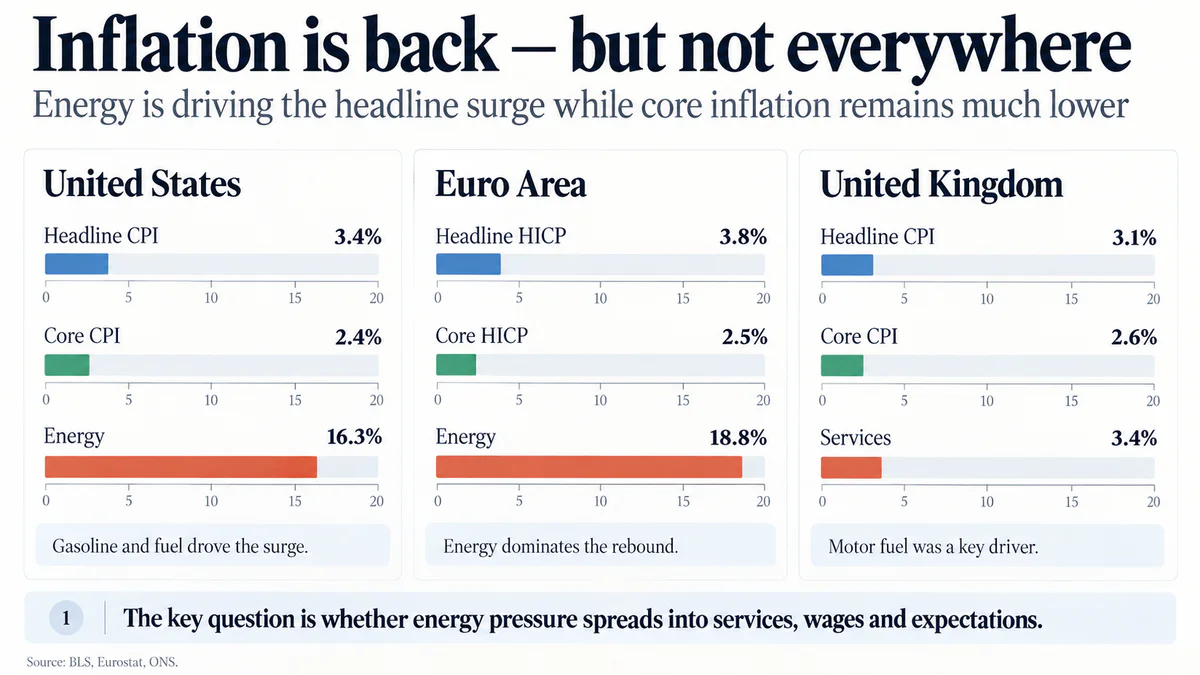
Overall Inflation | CPI 3.4% | HICP 3.8% | CPI 3.1% |
Core Inflation | Core CPI 2.4% | Core HICP 2.5% | Core CPI 2.6% |
Energy | +16.3% | +18.8% | transport, mainly motor fuel, is the main acceleration factor |
Services Inflation | — | 3.2% | 3.4% |
Sources: U.S. Bureau of Labor Statistics, Eurostat, Office for National Statistics
In the USA, the gap between overall and core inflation is particularly noticeable. CPI in August rose by 3.4% year-on-year, but core CPI only by 2.4%. The energy component, meanwhile, increased by 16.3%, gasoline by 27.4%, and heating oil by 52%.
The Fed's preferred PCE index shows a slightly more alarming picture. Overall PCE rose by 3.4% year-on-year in August, while core PCE rose by 3.0%.
In the eurozone, the difference is even more pronounced. Overall inflation in September reached 3.8%, while the measure excluding energy, food, alcohol, and tobacco was 2.5%. Energy inflation rose to 18.8%.
In the UK, CPI accelerated to 3.1%, but core inflation remained at 2.6%.
The important conclusion is that a new wave of overall inflation has already occurred, but a full second wave of core inflation has not yet formed.
It is precisely the transition from the first process to the second that central banks are now trying to prevent.
Oil Has Once Again Become a Source of Global Shock
The main external source of new inflationary pressure is the energy market.
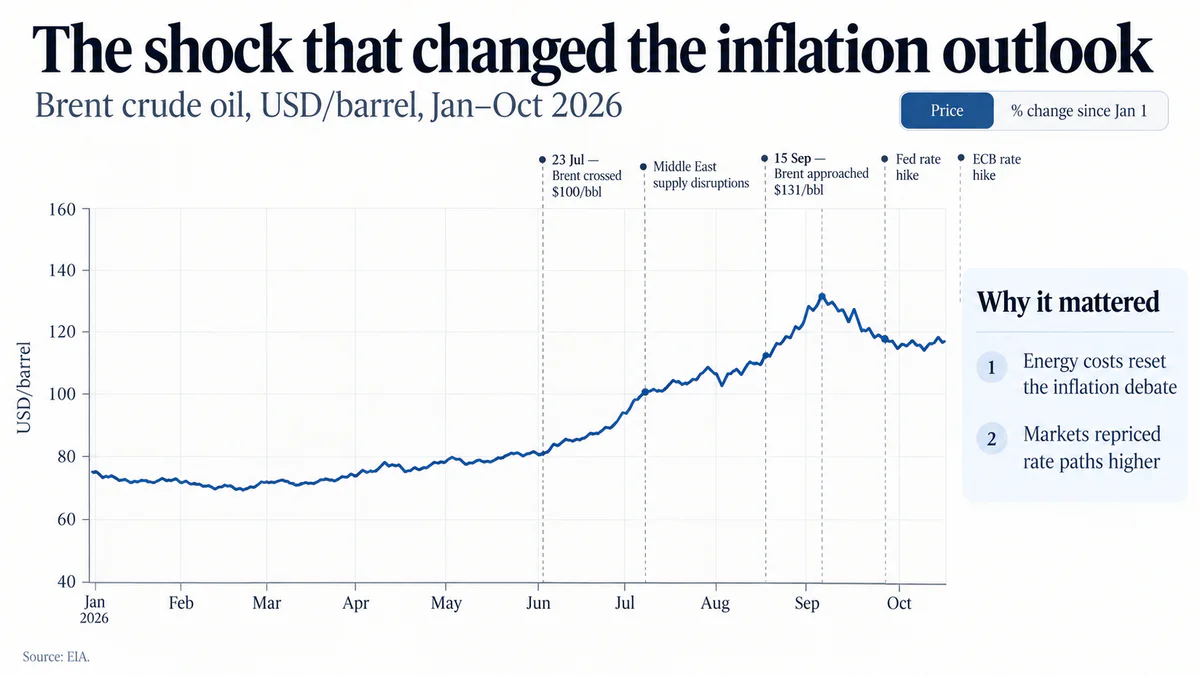
According to the U.S. Energy Information Administration, the average spot price of Brent in September was $114 per barrel compared to $91 in August. For comparison, the Brent futures at the beginning of Q3 were priced at about $72 per barrel. On certain days, oil rose to nearly $131 per barrel following attacks on oil infrastructure and tankers in the Middle East. For comparison, at the beginning of July, Brent was around $72 per barrel.
Thus, in just a few months, the energy market went from relatively comfortable prices for the global economy to a new oil shock.
But oil affects inflation much more broadly than just through gasoline prices.
The transmission chain looks like this:
Oil and gas become more expensive → fuel and electricity costs rise → transportation and production costs increase → businesses face higher costs → some costs are passed on to prices of goods and services → households demand compensation through wages → risk of entrenched core inflation rises
The first links of this chain are already clearly visible in the data. The latter remain the main risk, not a realized fact.
Why This Is Not Yet a Repeat of 2022
A comparison with the previous inflationary crisis suggests itself, but there are important differences between the two episodes.
2021–2022 | 2026 | |
Main Source of Inflation | demand, supply chains, energy | primarily energy |
Rates at the Start of the Crisis | very low | already high |
State of Demand | overheated | more mixed |
Labor Market | very strong | gradually cooling |
Core Inflation | quickly accelerating | still noticeably below headline |
Main Risk | triggering an inflationary spiral | re-entrenchment of inflation |
ECB analysis shows that about 90% of the increase in energy inflation in the eurozone from January to May 2026 was explained by negative energy supply shocks.
In 2021–2022, inflation was fueled simultaneously by a shortage of goods, strong consumer demand, large-scale government stimuli, and an energy crisis. In the eurozone, the initial impulse of 2026 is much more concentrated in the energy shock.
However, the new episode has its own danger. The energy shock came at a time when the consequences of the previous inflation had not yet fully disappeared. Services inflation in Europe remains above target, labor costs are rising, and consumers have been living with elevated prices for several years.
Isabel Schnabel, a member of the ECB's Executive Board, described the situation quite bluntly:
Inflation has resumed and is once again affecting the daily lives of citizens.
European Central Bank, speech on September 30, 2026
That is why the current shock cannot be assessed solely by its initial scale. It is more important to understand how easily it will spread within the economy.
The Problem Is No Longer Limited to Energy
If the price increase were explained solely by oil and gas, central banks would find it easier to take a wait-and-see position. Monetary policy acts with a delay and cannot quickly increase the physical supply of energy resources.
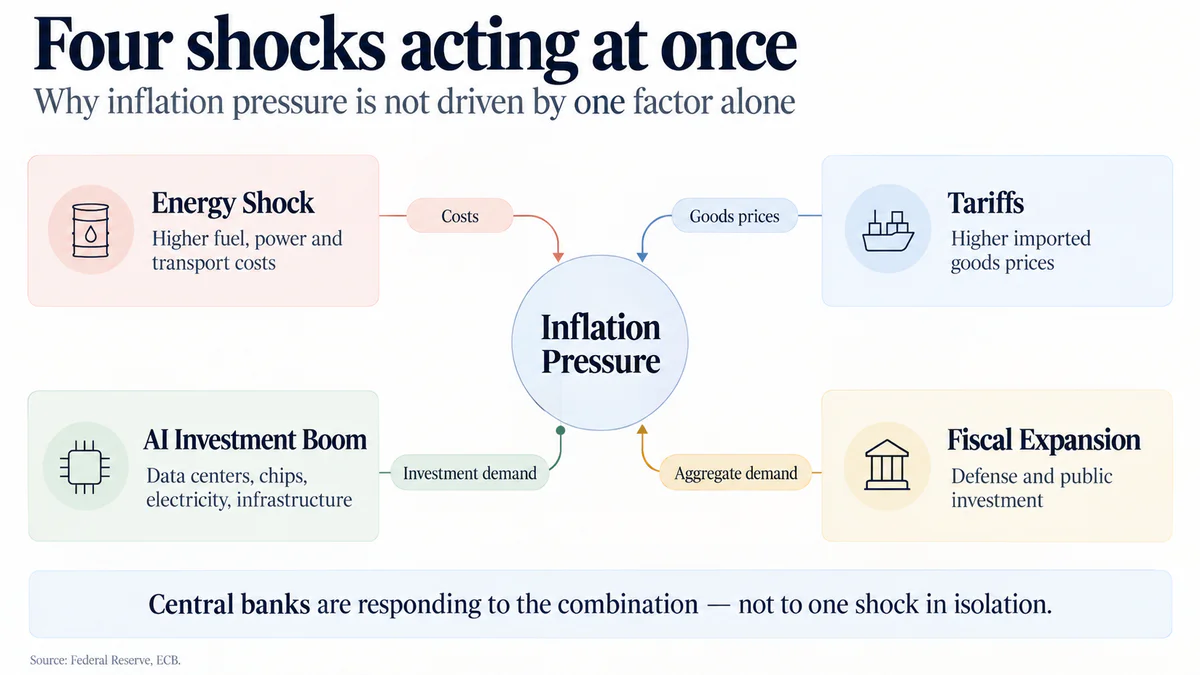
But other factors are acting alongside the energy shock.
In the USA
tariffs increase the cost of some imported goods;
the AI boom stimulates investment in data centers, chips, and energy;
the economy remains resilient enough for some companies to pass on cost increases to consumers.
In Europe
government defense spending supports demand;
the German fiscal package increases investment volumes;
the energy shock coincides with already elevated services inflation.
Federal Reserve Board member Michael Barr notes that increased import tariffs have already affected the prices of certain goods, and the energy shock has added a new source of pressure.
The investment boom around artificial intelligence plays an unusual role. In the long term, AI can increase productivity and reduce costs, but currently, building data centers and infrastructure requires huge volumes of equipment, electricity, and capital.
Therefore, regulators have to consider several shocks simultaneously.
We cannot afford the luxury of considering each of these shocks separately.
Philip Jefferson, Vice Chair of the Federal Reserve System. Source: Federal Reserve, speech on October 1, 2026
Energy, tariffs, AI investments, and budget spending act through different channels but can reinforce each other.
The Fed Is Caught Between Inflation and the Labor Market
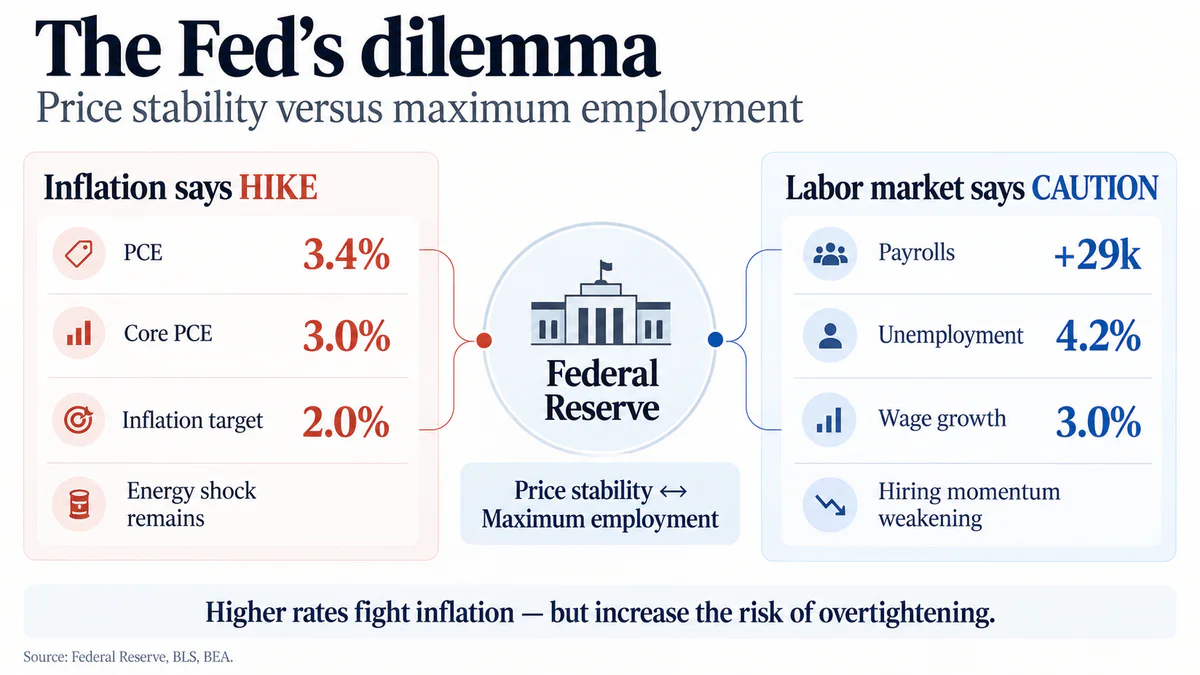
For the Federal Reserve System, the choice is particularly difficult due to its dual mandate. The regulator must simultaneously ensure price stability and support maximum employment.
On the inflation side, the arguments for a tight policy are obvious:
PCE is at 3.4%;
core PCE is at 3.0%;
the PCE forecast for the end of 2026 has been raised from 2.4% to 3.7%;
the energy shock has not yet fully passed through the economy.
But the labor market sends the opposite signal. According to a preliminary BLS estimate, in September, non-farm payrolls increased by 29,000, the unemployment rate was 4.2%, and average hourly earnings rose by 3.0% year-on-year.
The average monthly job growth over the previous 12 months was only about 45,000 jobs.
This results in an almost textbook dilemma: inflation demands tighter policy, while the state of the labor market calls for caution.
In September, the FOMC deemed a 25 basis point rate hike consistent with the dual mandate amid persistently high inflation and raised the rate to 3.75–4.00%. But the Fed does not promise an automatic continuation of the cycle.
Future decisions will depend on what happens faster: whether inflation starts to spread to core categories or whether economic cooling itself limits price growth.
The ECB Is Experiencing an Even Sharper Turnaround
In the eurozone, the change in the macroeconomic picture is particularly noticeable. In January, overall inflation was 1.7%, and energy inflation was negative. It seemed that the return to price stability was almost complete.
Eight months later:
overall inflation reached 3.8%;
energy prices rose by 18.8% year-on-year;
the ECB raised key rates twice;
the deposit rate increased to 2.5%.
The forecast for core inflation is particularly indicative.
ECB Forecast | 2026 | 2027 | 2028 |
Overall Inflation | 3.0% | 2.5% | 2.1% |
Inflation Excluding Energy and Food | 2.5% | 2.6% | 2.3% |
Source: European Central Bank, September 2026 Forecast
Formally, overall inflation should gradually decrease. But core inflation in 2027, according to the ECB forecast, will initially even rise slightly. This detail shows that the regulator expects a gradual transmission of the energy shock to other prices.
The scheme looks like this: expensive energy → increased business expenses → margin recovery → price increases → pressure on wages → more sustainable core inflation.
So far, actual data looks calmer than the projected risk. Growth in compensation per worker in the eurozone has slowed, and there has been no clear acceleration in wages following the energy shock.
In other words, the ECB is raising rates not because an inflationary spiral has already formed, but because it does not want to wait for that moment.
The UK Is Testing the Limits of Patience
The UK presents another variant of the same problem. In September, the Bank of England kept the rate at 3.75%, but the decision was made by six votes to three. Three members of the Monetary Policy Committee advocated for an increase to 4%.
The inflation picture looks like this:
CPI | 3.1% |
Core CPI | 2.6% |
Services Inflation | 3.4% |
Bank Rate | 3.75% |
The main risk lies ahead. The Bank of England's short-term forecast suggests that CPI could exceed 4% in the first quarter of 2027.
MPC member Catherine Mann points to another problem: a new peak in inflation could coincide with the spring round of wage negotiations. This creates a risk of secondary effects.
First round: oil and fuel prices rise → higher overall inflation.
Second round: workers demand compensation → wages rise faster → companies increase service costs → inflation persists even after oil stabilizes.
It is the second round that can turn a temporary energy shock into a persistent inflationary problem.
Why Raise Rates If Oil Won't Get Cheaper
There is an obvious paradox in the current monetary policy. A central bank cannot produce more oil, restore damaged infrastructure, or reduce geopolitical tensions.
Andrew Bailey, Governor of the Bank of England, acknowledges this directly:
Monetary policy cannot prevent the impact of rising energy prices on businesses and households.
Source: Bank of England, speech on May 29, 2026
But the rate serves another purpose. The central bank is not trying to eliminate the initial shock — it is trying to prevent it from spreading.
A high rate:
makes credit more expensive;
cools consumer demand;
reduces some investment activity;
limits companies' ability to endlessly raise prices;
can support the national currency;
reduces the risk of inflation expectations spiraling.
Simply put, the central bank deliberately weakens the part of demand it can influence because it cannot quickly change the energy supply.
The price of such a policy is weaker economic growth.
The Most Important Line of Defense Is Holding for Now
Despite the new rise in CPI and HICP, long-term inflation expectations have not yet shown the same sharp acceleration.
In the USA, the August Survey of Consumer Expectations by the Federal Reserve Bank of New York showed:
Horizon | Expected Inflation |
1 year | 3.6% |
3 years | 3.2% |
5 years | 3.0% |
Short-term expectations are indeed elevated, but longer horizons do not show a similar jump.
Philip Jefferson also notes that most long-term expectations indicators remain compatible with the Fed's inflation target.
In the eurozone, after the onset of the new energy shock, household expectations also rose, but most long-term indicators remain close to the ECB's target. This is critically important. As long as households and companies believe that inflation will return to around 2% in a few years, a temporary price spike is less likely to turn into a self-sustaining process.
If expectations start to rise steadily, the dynamics change: expectation of high inflation → demands for higher wages → price increases by businesses → even higher actual inflation
It is precisely this loop that central banks are trying to break in advance.
The bond market has already done part of the work for the Fed. Tightening financial conditions occurs not only through the official rate. At the beginning of January, the yield on two-year U.S. Treasury bonds was about 3.47%, and ten-year bonds were 4.19%. By October 6, the figures had risen to approximately 4.79% and 5.27%, respectively.
U.S. Treasury Bonds | Early January | October 6 |
2 years | 3.47% | 4.79% |
10 years | 4.19% | 5.27% |
Source: U.S. Department of the Treasury.
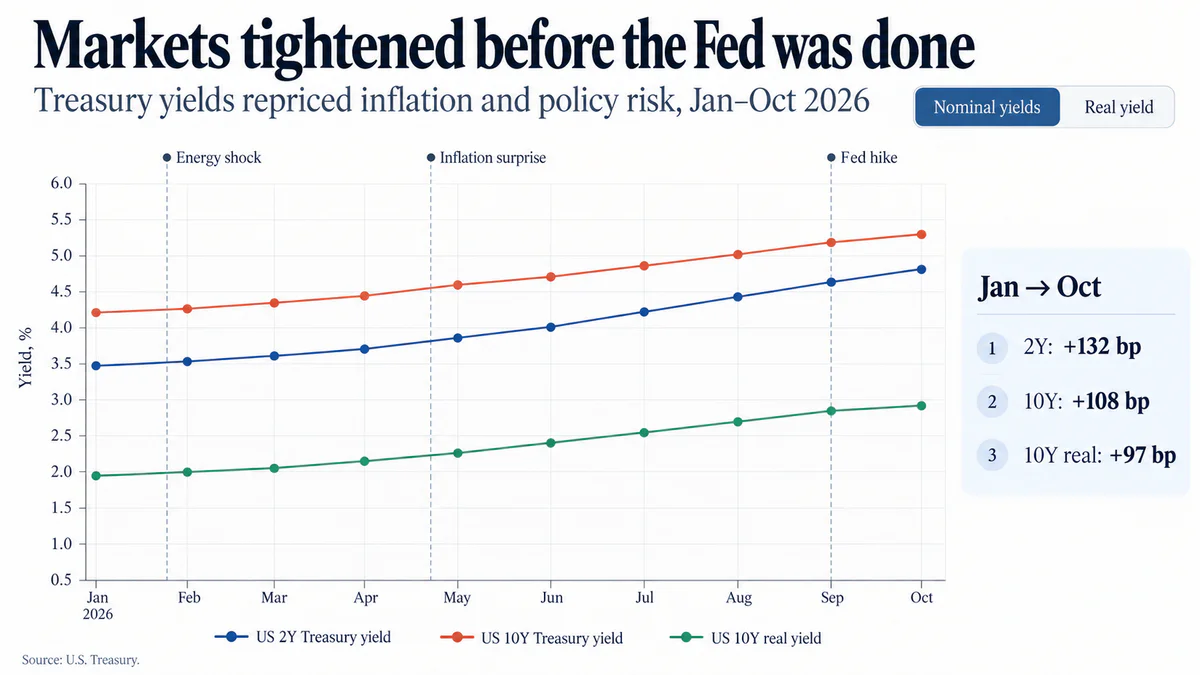
Real rates have also risen. The yield on ten-year inflation-protected bonds increased from about 1.94% in early January to 2.91% on October 6. This means that the problem is not only in higher inflation expectations. The real cost of capital itself has increased.
For the economy, the consequences are broad: government bond yields serve as a benchmark for mortgage rates, corporate lending, bond valuations, and stock valuations.
Therefore, the market is already partially doing the work for the central bank. The stronger financial conditions tighten on their own, the less need there may be for additional official rate hikes.
What the New Regime Means for Assets
High inflation and the return of the risk of rate hikes affect almost all financial markets, but the effect varies depending on the asset class.
Asset | Main Effect |
Bonds | rising yields pressure the value of old issues |
Growth Stocks | suffer from higher discount rates |
Banks | may benefit from margins but bear credit risks |
Dollar | supported by high relative yields |
Gold | balances between high real yields and demand for safe-haven assets |
Bitcoin | sensitive to liquidity, dollar, and real rates |
For bonds, rate hikes usually mean a decrease in the value of already issued securities, especially long-term ones. At the same time, new issues offer investors a higher current yield.
For stocks, the discount rate is important. The higher the risk-free yield, the lower the present value of future company profits. Therefore, growth companies, real estate, and businesses with high debt loads can be particularly sensitive.
However, the situation in 2026 differs from the usual tightening cycle due to the AI boom. The same investments simultaneously support demand for the products and services of some tech sectors.
For the dollar, the interest rate differential between the U.S. and other countries matters. If the Fed is forced to maintain a tight policy for longer, high dollar yields can support the American currency.
Gold faces a conflicting combination of factors. High real rates increase the opportunity cost of holding the metal, but inflationary and geopolitical risks boost demand for safe-haven assets.
Bitcoin should not be viewed as a mechanical hedge against CPI. Its short-term dynamics are influenced by global liquidity, real yields, the dollar exchange rate, and overall risk appetite.
When Inflation Can Truly Be Called a Second Wave
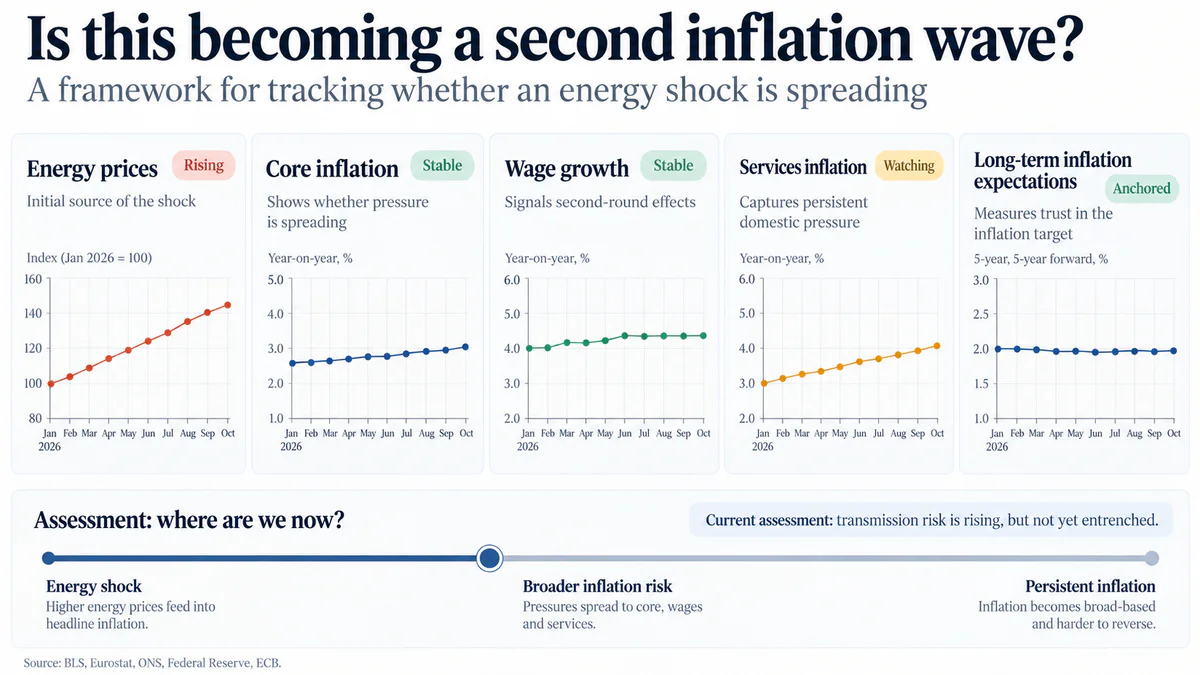
A rise in oil alone is not enough to declare a full-fledged second inflationary wave. More persistent indicators must change for this to happen.
The most important signals:
Acceleration of core inflation. In the USA — core PCE and core CPI, in the eurozone — HICP excluding energy and food, in the UK — core CPI and services inflation.
Wage growth. If workers begin to compensate for the energy shock through higher wage demands, inflation may become entrenched in services.
Increase in long-term inflation expectations. This is one of the most dangerous signals for any central bank.
Rise in producer prices. It shows how deeply cost increases pass through supply chains.
Strong demand. The more resilient the economy, the easier it is for companies to pass new costs onto the end consumer.
It is the combination of these indicators that will be more important than a single monthly CPI.
Three Scenarios for Rates in 2027
The further trajectory of monetary policy depends on how far the energy shock spreads through the economy.
Scenario 1: The Inflationary Shock Remains Temporary
Oil and gas stabilize, supply chains adapt, and the high base effect gradually reduces annual inflation. Core inflation and wages hardly react.
In this case, central banks may limit themselves to a small number of additional hikes or even move to a pause. Later, the question of rate cuts will return to the agenda.
Scenario 2: Inflation Spreads Further
Energy begins to significantly affect goods, services, and wages. Core inflation stops declining, and inflation expectations rise.
Then the current tightening ceases to be precautionary and turns into a full-fledged new cycle of rate hikes.
Scenario 3: The Economy Enters Stagflation
Energy remains expensive, inflation stays high, but economic growth and the labor market weaken sharply.
This is the most challenging scenario for central banks. Lowering rates is dangerous due to inflation, while raising them risks recession. Elements of this dilemma are already visible in the USA, where high inflation coexists with a noticeable cooling of the labor market.
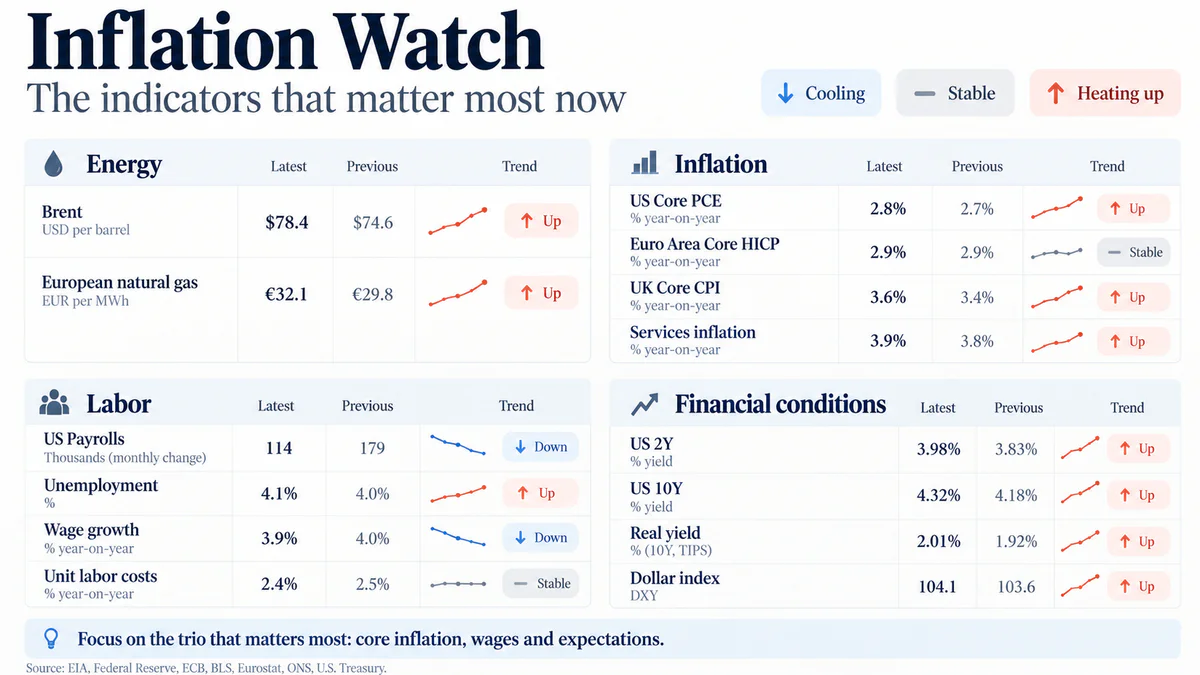
What Data Is Now Truly Important
To understand which scenario will unfold, it is not enough to only follow the meetings of the Fed or the ECB.
It is more useful to monitor several groups of indicators.
What to Monitor | What It Shows |
Brent and Gas | the strength of the initial energy shock |
Core CPI, PCE, HICP | whether inflation has spread beyond energy |
Services Inflation | the persistence of internal price pressure |
Wages | whether a second round of inflation is starting |
Unit Labour Costs | the cost of labor for businesses |
Inflation Expectations | confidence in central banks' targets |
Producer Prices | pressure within the production chain |
Unemployment and Payrolls | the economy's ability to withstand high rates |
Yields on 2Y and 10Y | how much the market is tightening financial conditions itself |
Real Yields | the real cost of capital |
The combination of core inflation + wages + inflation expectations is especially important.
If energy prices rise but these indicators remain stable, the likelihood of a prolonged new tightening cycle decreases. If all three begin to accelerate simultaneously, central banks indeed face a new inflation problem.
Cheap Money Canceled or Just Postponed
The new wave of inflation does not yet look like a repeat of 2022. Core price pressures are significantly calmer, long-term inflation expectations mostly remain stable, and the labor market in some economies is already showing signs of cooling. But the return to inflation around 2% has proven to be much less straightforward than expected at the end of 2025.
In a few months, the global macroeconomic scenario was changed by several factors: energy shock + tariffs + AI investments + government spending + unfinished disinflation.
Oil has become one of the most visible triggers of new inflationary pressure, but the future of inflation no longer depends solely on it.
The main boundary lies between price increases and the entrenchment of price increases. If the impact of expensive energy remains mostly within overall inflation, central banks can wait out a significant portion of the shock and then return to discussing rate cuts. If the pressure spreads to core inflation, wages, and expectations, the cost of money will need to be kept high for much longer — and possibly raised further.
Therefore, the main question at the end of 2026 sounds different than at the beginning of the year. Markets are no longer trying to understand how quickly the Fed, ECB, and other central banks can lower interest rates. Now they have to assess how much additional tightening is needed to prevent the new inflationary shock from becoming the new norm.
This material is prepared solely for informational purposes and does not constitute financial advice or a recommendation.