

Why the MiCA review started so quickly
Cryptocurrency regulation in the EU was introduced in stages. From June 30, 2024, MiCA provisions for asset-referenced tokens (ART) and electronic money tokens (EMT) issuers began to apply, and from December 30, the main rules for crypto-assets and service providers (CASP) came into effect. The maximum transition period for previously operating companies ended on July 1, 2026; in some countries, it was shorter.
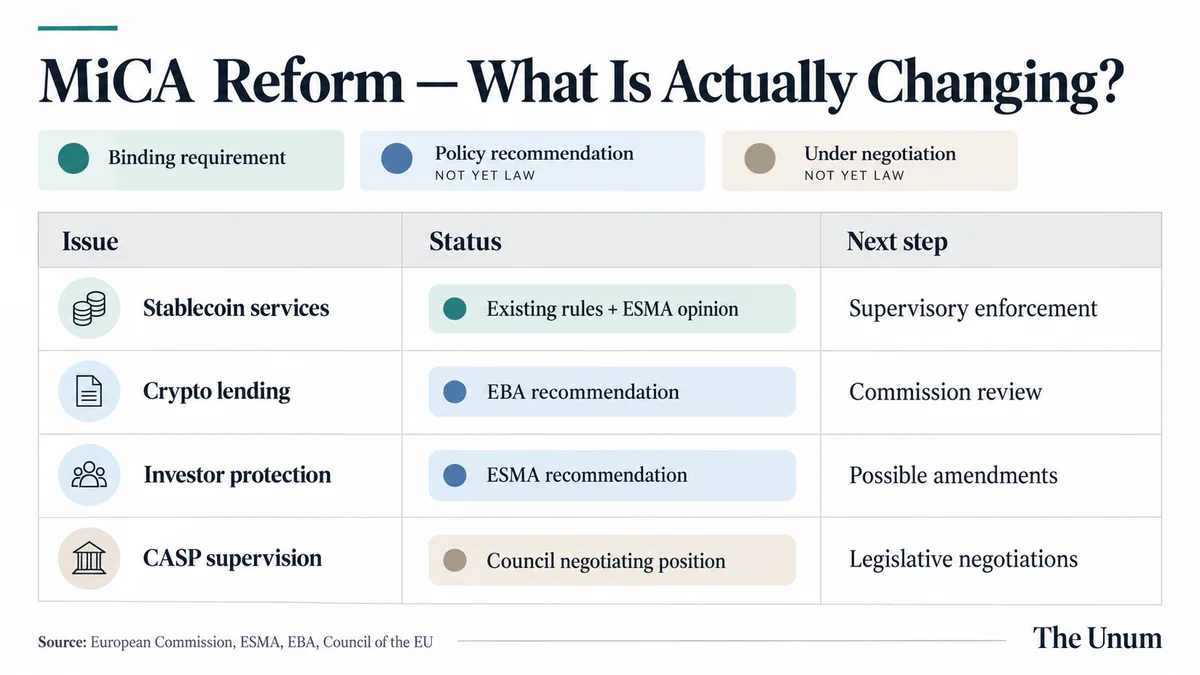
The MiCA review is provided for by the legislation itself. From May 20 to September 30, 2026, the European Commission collected proposals for a report on Articles 140 and 142. The European Banking Authority (EBA) and the markets regulator ESMA presented their proposals. These are currently recommendations, not adopted amendments. Among the identified issues are the classification of new tokens and crypto-asset lending, which is not covered by MiCA's special regime.
Stablecoins were the first test
On October 8, ESMA clarified the requirements for licensed CASPs: they must not provide EU clients with services involving ART and EMT tokens that do not comply with MiCA. The restrictions cover trading, exchange, transfers, custody, and other crypto services. If national regulators identify ongoing positions in non-compliant MiCA stablecoins, ESMA expects them to be resolved as soon as possible, but no later than three months after the publication of the conclusion. This is not a ban on all stablecoins but a clarification of the existing law.
ART are tokens that aim to maintain a stable value by linking to another value, right, or combination thereof, including one or more official currencies. EMT are linked to a single official currency. According to EBA data, as of September 1, 2026, 39 EMTs were issued under MiCA, while there were no authorized ARTs. The statistics highlight the difference between the two models but do not prove that the absence of ARTs was due to the law.
The scale of competition is evident in the ECB study: in January 2026, the capitalization of MiCA-compliant euro stablecoins was about €450 million, while dollar stablecoins worldwide were about $300 billion. These are different coverage indicators, so the markets cannot be directly compared. However, the gap shows how small the European segment of the stablecoin market is.
EBA is particularly concerned about international schemes with multiple issuers: in such structures, it is more challenging to control reserves and ensure token redemption in the event of a mass outflow of funds.
DeFi and lending caught between rules
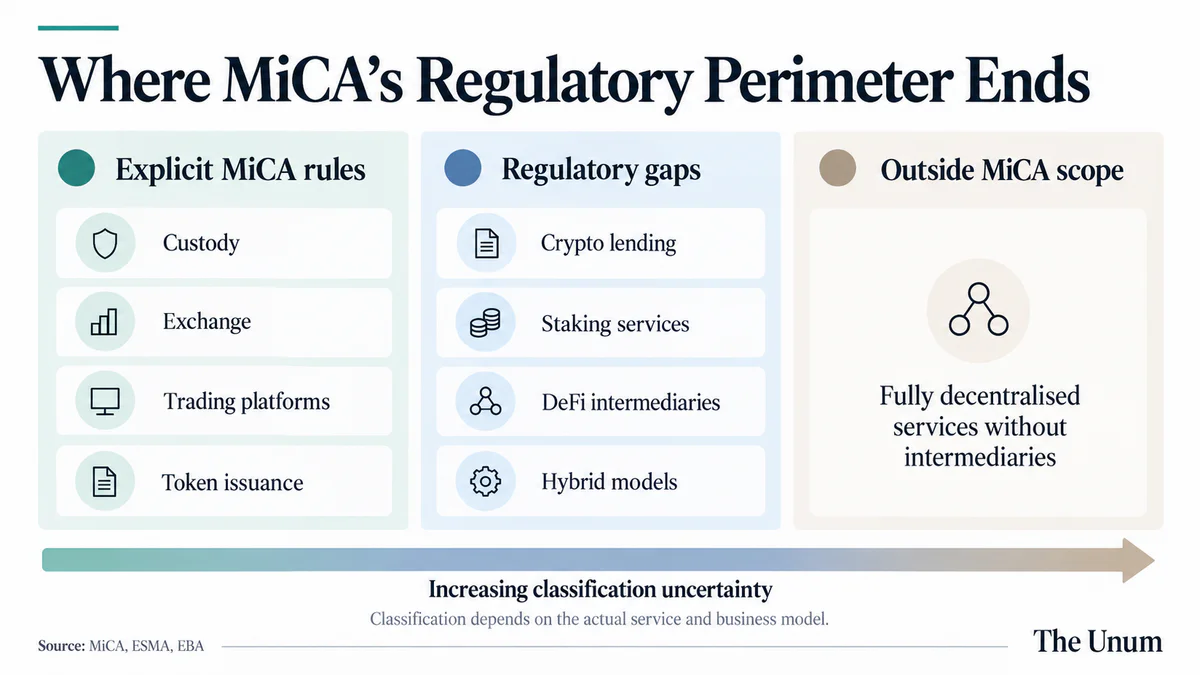
MiCA regulates a wide range of crypto services but does not create a separate comprehensive regime for crypto lending and staking. Meanwhile, the development of crypto products continues independently of the pace of legislative changes. In a joint study by EBA and ESMA, published in January 2025, crypto-asset lending or borrowing was identified in 16 EU countries, and staking in 23. The same study estimated the DeFi lending and borrowing segment in the EU at approximately €1.8 billion, and DeFi staking at €3.6 billion.
Investors face several risks: non-transparent yield conditions, forced collateral liquidation, and potential smart contract errors. Therefore, ESMA proposes establishing criteria for genuinely decentralized projects and creating a regulated service for intermediaries providing clients access to DeFi protocols. EBA supports the regulation of crypto lending. The main task is to define the responsibilities of intermediaries providing access to DeFi protocols and separate them from genuinely decentralized services without intermediaries.
One license does not guarantee uniform oversight
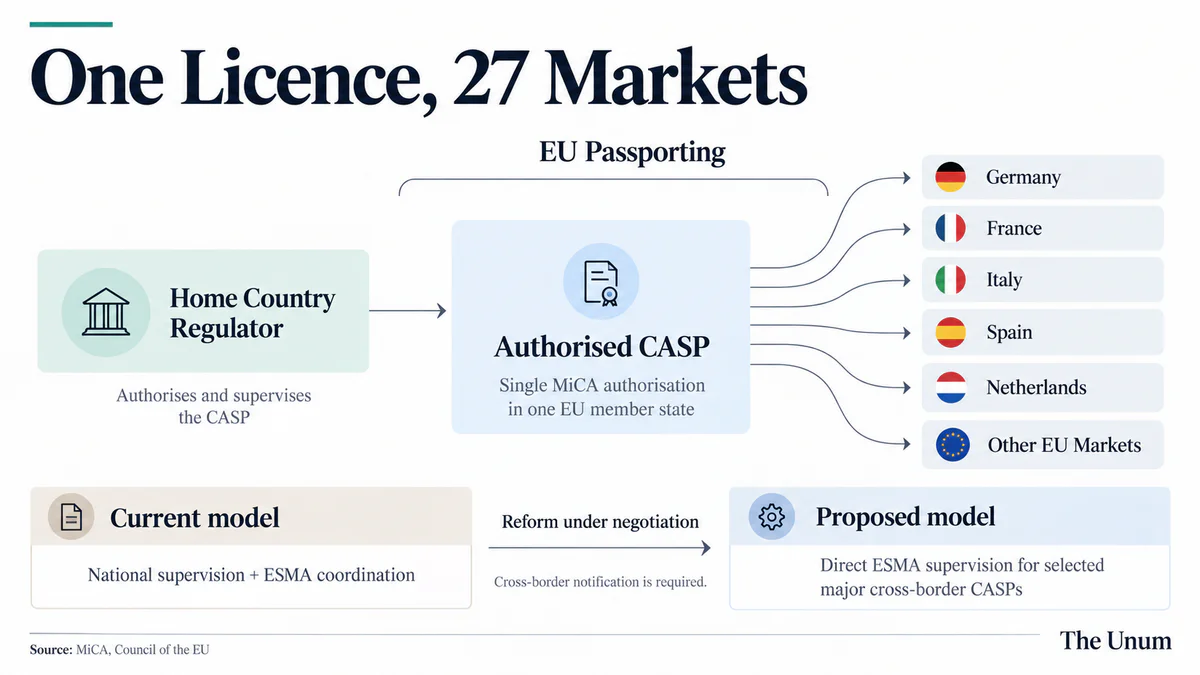
A MiCA license allows a crypto provider to offer services in other EU countries through a passporting mechanism, but the authorization is issued by the national regulator. This creates a risk of regulatory arbitrage—seeking the most lenient jurisdiction.
This is not a hypothetical scenario. In July 2025, ESMA reviewed the authorization of a CASP in Malta and found significant unresolved issues and insufficient assessment of individual risks. However, ESMA positively assessed the professional competence of the Maltese regulator. One case does not prove widespread violations but reveals the system's vulnerability.
On October 9, 2026, the EU Council agreed on the framework of a negotiating position: direct ESMA supervision is proposed to be extended only to the most significant cross-border CASPs, not to all crypto providers as initially proposed by the European Commission. The legislative process is not yet complete.
“Technology alone cannot eliminate legal fragmentation,” noted ECB Executive Board member Piero Cipollone in a speech on March 23, 2026. The quote refers to capital markets in general but is also applicable to the oversight of the crypto market.
Who Will Be Responsible for a Major Stablecoin Crisis
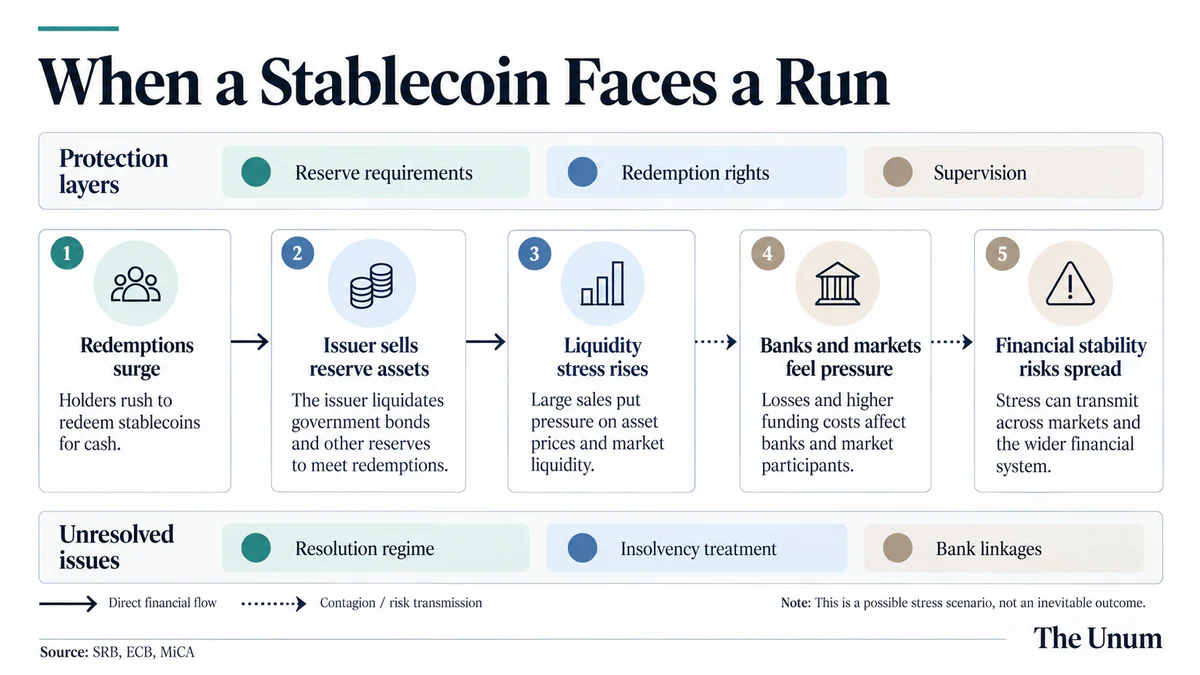
MiCA provides requirements for reserves and asset backing depending on the token category and issuer status, but it does not address all crisis resolution issues. On October 9, the European Single Resolution Board (SRB) highlighted that there is no special comprehensive crisis resolution mechanism for the systemic activities of non-bank issuers. Risks can be transferred to banks through funds placed by issuers on deposits, as well as through operations related to the storage and management of reserves.
In the event of mass token redemptions, the issuer will have to quickly convert reserves into cash. Selling reserves can exacerbate stress in financial markets. Thus, liquidity requirements do not yet resolve the issue of protecting token holders in the event of an issuer's bankruptcy.
Investor Protection Goes Beyond Licensing
In ESMA's recommendations from September 30, stricter rules for advertising crypto assets are proposed, including promotion through influencers, full disclosure of service costs, and specific requirements for describing staking and lending risks. ESMA also wants to expand its powers to combat fraudulent websites and unlicensed foreign companies.
If ESMA's proposals are adopted, clients will be able to receive more detailed information about fees, collateral, and potential losses. However, a CASP license does not protect against token price drops: market risk remains.
What Will Change After the MiCA Review
There are three realistic directions for the review:
Targeted amendments will expand requirements for crypto lending, DeFi intermediaries, and advertising without a complete overhaul of the law.
Centralization of oversight will transfer control of some large CASPs to ESMA and should reduce differences between countries.
Increased requirements will raise companies' compliance costs and may accelerate platform consolidation or the reduction of certain services.
These are scenarios, not an adopted plan: the European Commission is studying the proposals from the consultation participants. If a draft amendment is prepared, it must go through the established legislative procedure.
The first stage of MiCA created unified rules for entering the European crypto market, but the next must show whether they can work equally in 27 countries, protect investors during crises, and not push new products outside the regulated ecosystem. It is this balance, not the number of new prohibitions, that will be the true test of the European model.