Why Huang's departure was a turning point for Nvidia
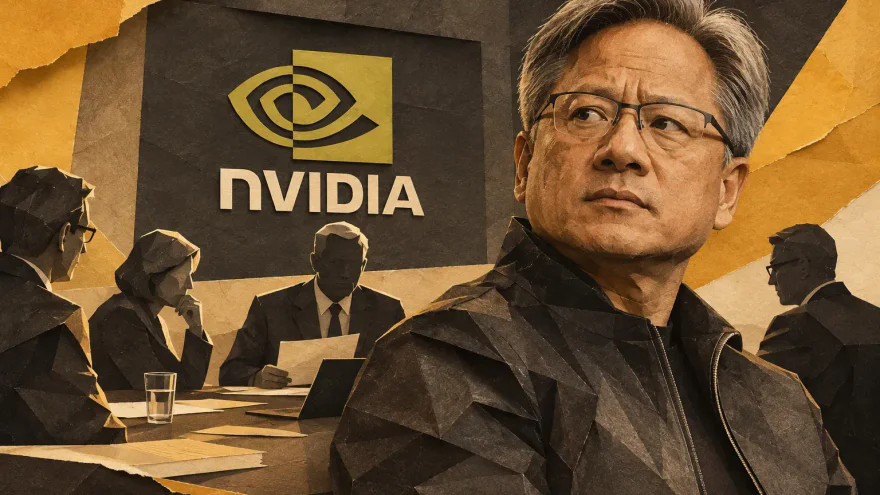
On November 12, 2026, Nvidia announced Jensen Huang's resignation from the positions of President, CEO, and board member. According to the Form 8-K document, published by the U.S. Securities and Exchange Commission (SEC), the board of directors accepted his resignation on November 11 with immediate effect.
Colette Kress, who has been overseeing Nvidia's finances since 2013, was appointed as interim CEO. She will continue to serve as CFO until a permanent CEO is appointed. Simultaneously, the board of directors appointed its first separate chairman, Harvey Jones, who has been a member since the company's founding. The search for a new leader will include both internal and external candidates.
The resignation was preceded by reports of Huang's personal connections, one of which raised suspicions among U.S. authorities regarding possible foreign intelligence influence. On November 8, the board of directors announced an independent investigation, while emphasizing that at that time, it had no grounds to believe national security or corporate secrets were compromised. The fact of the investigation does not imply that violations of export laws or the transfer of confidential information have been established.
For Nvidia, the implications extend far beyond a personnel decision. Huang was one of the three founders of the company in 1993 and throughout its history defined its technological and commercial strategy. Under his leadership, Nvidia evolved from a graphics processor manufacturer for computers to one of the largest suppliers of computing infrastructure for artificial intelligence.
Now the company must prove that its competitive advantages can be maintained regardless of the leader's identity. For investors, the resignation is a test of Nvidia's leadership continuity and corporate governance quality. The scale of the business makes this issue significant not only for Nvidia's shareholders but also for the entire industry, whose development is closely linked to its technologies. This creates additional risks not only for Nvidia but for the entire AI industry.
How dependent is Nvidia's business on one leader
Nvidia's position in the artificial intelligence market has been built over decades. The company did not limit itself to developing high-performance graphics processors (GPU), but created an entire technological ecosystem that includes computing accelerators, server systems, network equipment, and the CUDA software platform.
CUDA allows developers to use graphics processors for complex computations, including neural network training. Due to the compatibility of hardware and software tools, switching to alternative solutions may require additional costs and adaptation of existing systems. This advantage does not disappear after the CEO's departure, as it is based on accumulated technologies and the work of engineering teams.
However, dependence on Huang was not only evident in technological decisions. He was personally involved in shaping long-term strategy, building relationships with major clients, and promoting large-scale investment projects. Therefore, the leadership change creates uncertainty in several areas:
Development strategy. The new CEO will need to decide whether to maintain the previous pace of business expansion and entry into new segments of computing infrastructure.
Investment policy. Nvidia needs to support production growth while assessing the risks of large financial commitments.
Relationships with partners. Long-term agreements with cloud providers and AI developers require continuity in management decisions.
Technological leadership. The company must continue to develop its platforms amid growing competition from AMD, Broadcom, and specialized accelerators from major cloud operators.
Gil Luria, managing director at D.A. Davidson, noted in a comment to Reuters: “Mr. Huang concentrated a significant portion of decision-making in his hands.” According to the analyst, this complicates the transition to a new management model.
Meanwhile, Nvidia is approaching a leadership change with exceptionally strong financial performance. In the second quarter of fiscal year 2027, which ended on July 26, 2026, its revenue reached $96.2 billion, up 106% year-over-year. The Data Center division contributed $89 billion, or about 92.5% of total revenue. The GAAP gross margin was 75%, indicating high profitability of sales after accounting for direct production costs.
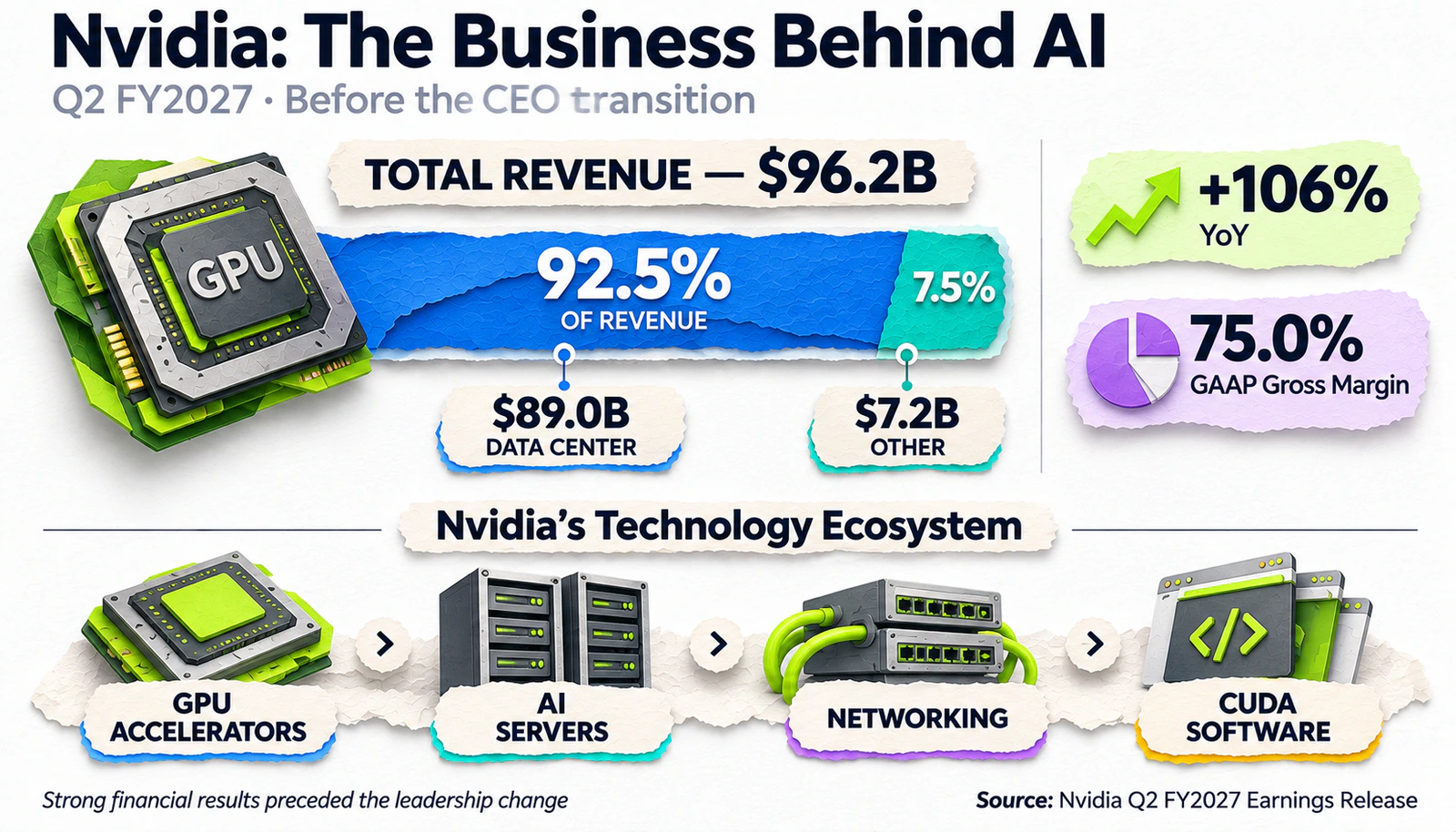
These results characterize Nvidia's financial position before Huang's resignation but do not yet allow for an assessment of the leadership change's impact on operational activities. The main question is whether Nvidia can maintain such high performance without the leader who has shaped its development for three decades.
How Huang's resignation affected Nvidia's stock and the tech sector
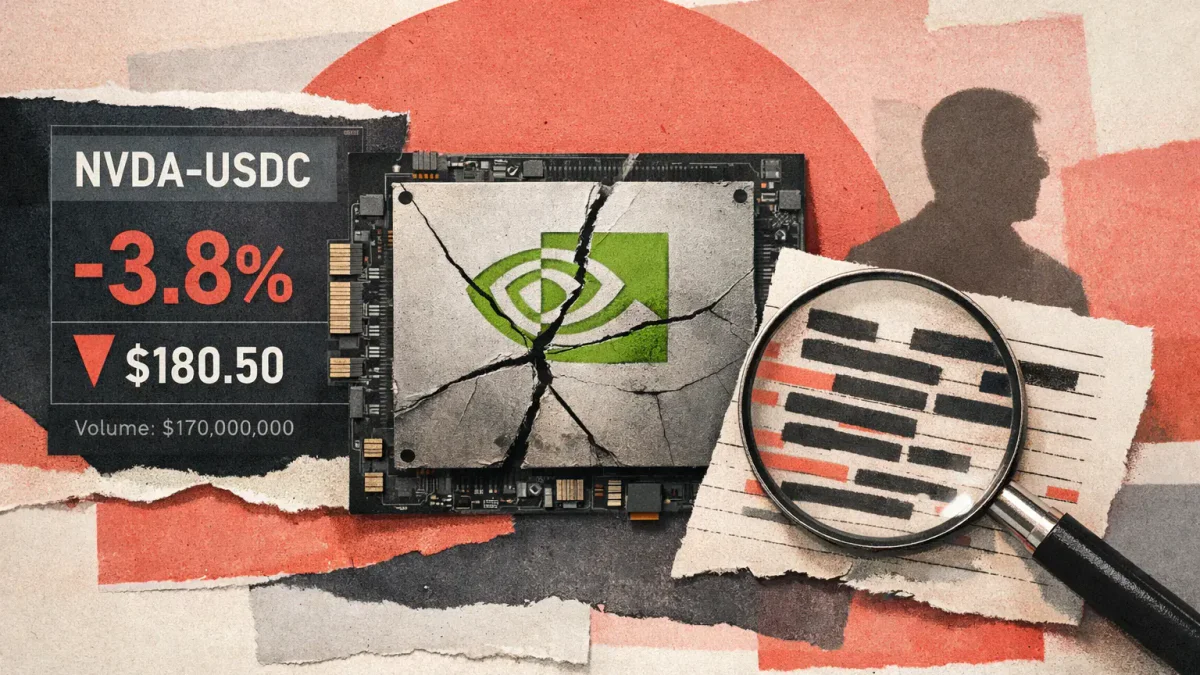
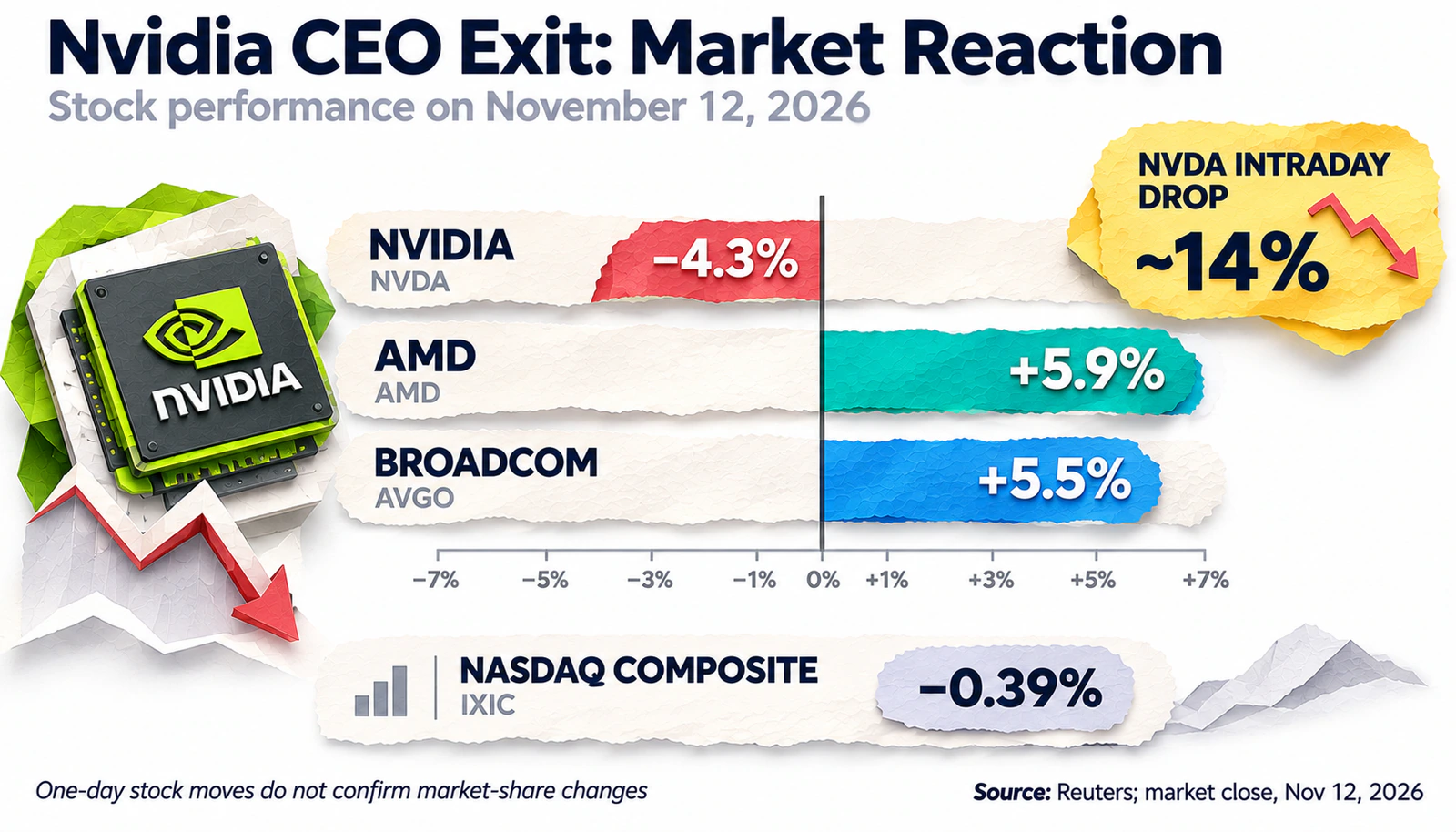
The stock market reacted to news of Huang's departure with sharp fluctuations. On November 12, Nvidia's shares were down about 14.4% at the start of the main trading session, but by the close, the decline had narrowed to 4.3%. The shares ended the day at $166.19.
The initial reaction was significantly stronger than the final change. The difference between the intraday low and the closing price reflects the change in investor sentiment throughout the day. According to Vanda Analytics, private investors bought Nvidia shares worth about $111 million in the first half-hour of trading.
Meanwhile, the dynamics of other chip manufacturers were opposite. At the end of trading on November 12, AMD shares rose by about 5.9%, and Broadcom by 5.5%. The Nasdaq Composite index, on the contrary, fell by 0.39%. These movements show that investors assessed the consequences of the leadership change differently: Nvidia's problems could be seen as a potential opportunity for its competitors.
However, the rise in AMD and Broadcom's stock prices does not mean they have already received additional orders or increased market share. Real redistribution of orders can be judged by financial reports, new contracts, and production indicators. The one-day dynamics primarily reflect traders' expectations. Nvidia's leadership change may intensify competition with AMD and Broadcom, although this is currently reflected mainly in investor expectations.
For Nvidia, it is also important how the assessment of its future income changes. If investors begin to doubt the company's ability to maintain previous growth rates, they may agree to pay less for each dollar of expected profit. This puts pressure on the stock price even in the absence of immediate deterioration in financial results. Nvidia's market capitalization depends not only on current profits but also on expectations of future business growth.
At the same time, the decline in tech indices cannot be entirely attributed to Huang's resignation. The market is simultaneously influenced by interest rates, inflation expectations, and doubts about the payback of large-scale AI investments. Therefore, when analyzing Nvidia (NVDA) stock prices, it is important to distinguish between the short-term reaction to corporate news and longer-term market trends.
What will change in Nvidia's strategy under new leadership
The appointment of Colette Kress may provide Nvidia with managerial stability during the transition period. Over the years at the company, she has been involved in financing its expansion, interacting with investors, and supporting business development during a period of rapid growth in demand for AI equipment.
In an official Nvidia statement, board chairman Harvey Jones expressed confidence that the transition will not disrupt the company's operations: "We expect the company's operations, commitments to customers, and product development plans to proceed without interruption."
This statement reflects Nvidia's management's position but does not eliminate uncertainty about future investment policy. According to Reuters, citing people familiar with internal discussions, Kress previously opposed some of Huang's large-scale financial initiatives, considering them overly risky.
One of the most sensitive areas remains Nvidia's investments in AI developers and cloud computing providers. The company not only sells them equipment but also participates in financing individual projects, helping to expand infrastructure that may later use its own chips.
This approach accelerates market development but creates interdependence between the equipment supplier and its buyers. If clients' financial capabilities deteriorate, Nvidia may face both a decline in chip demand and risks to its own investments. Changes in Nvidia's investment policy could affect cloud computing operators and the cost of GPU rentals.
Kress, with her significant experience in financial management, could theoretically pay more attention to project profitability and liability control. However, this remains an analytical assumption: the company has not announced any revisions to investment programs or withdrawal from major agreements.
A separate issue is related to the technological roadmap. According to Nvidia, the production of Vera Rubin systems is ramping up, and serial production deliveries began in the third quarter of the 2027 fiscal year. The change in CEO does not in itself mean a halt to these processes, as the development is handled by specialized engineering units and manufacturing partners.
The risk lies more in the potential shift in priorities. The new management must decide how actively to finance promising technologies, expand its own infrastructure, and support clients through investment capital.
Why Nvidia's Risks Could Spread to the Entire AI Industry
Nvidia's influence on the industry is determined not only by its revenue but also by its position in the global supply chain. Nvidia's position in the semiconductor industry makes changes in its strategy significant for the entire supply chain. The company develops computing solutions used by major cloud providers, research labs, and developers of commercial AI products.
Such concentration creates an effect of interdependence: Nvidia's decisions can influence the plans of semiconductor manufacturers, data center operators, and companies that require computing power for training and operating neural networks.
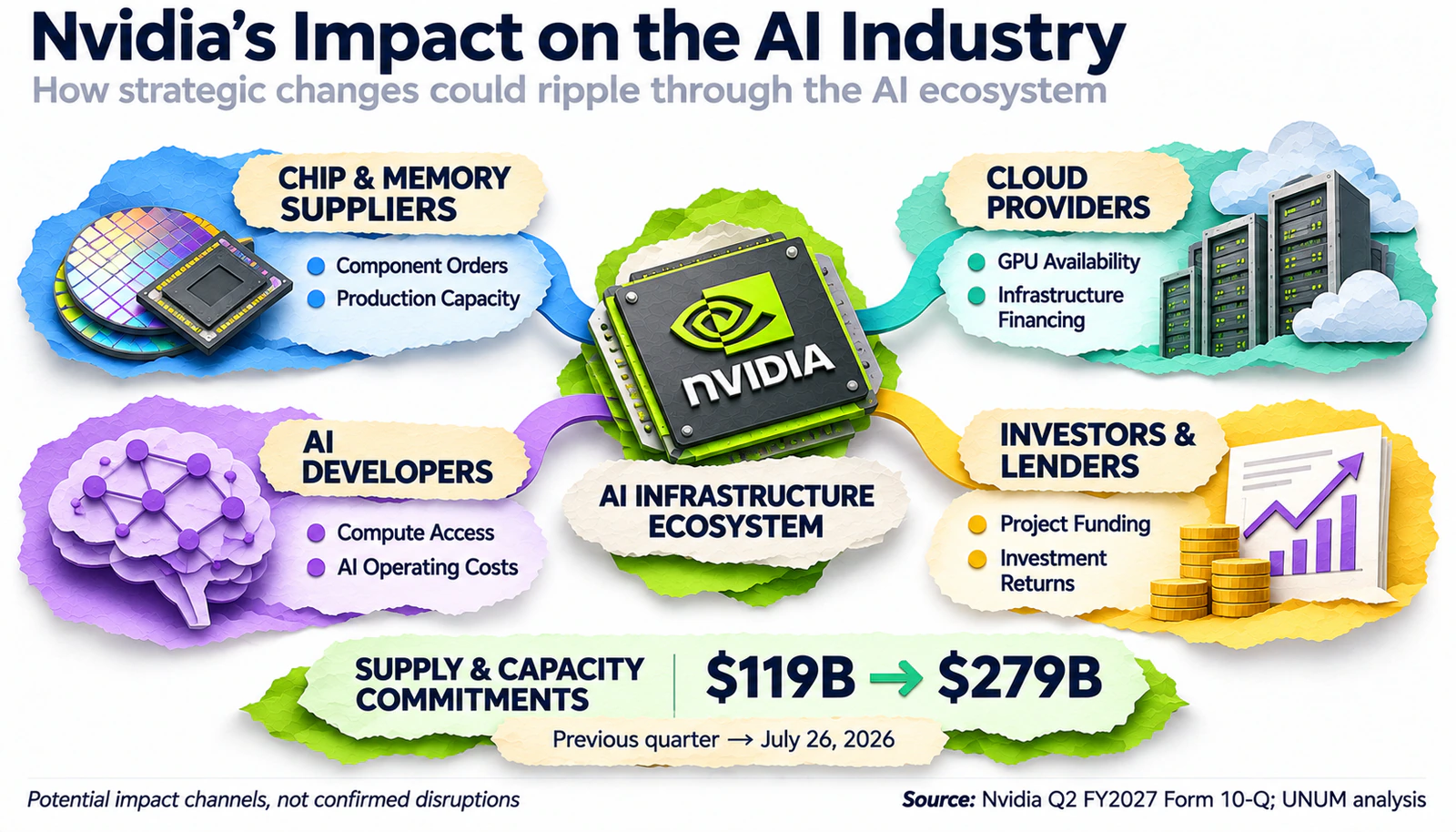
The scale of this interconnection is reflected in Nvidia's quarterly 10-Q report. As of July 26, 2026, the company's future commitments for component supplies and production capacities reached $279 billion compared to $119 billion in the previous quarter. A significant portion of these agreements is related to memory and capacities for manufacturing data center equipment.
Such commitments allow for the advance reservation of resources to meet demand but simultaneously increase the consequences of potential strategy changes. Some agreements allow for the postponement or adjustment of orders, but such actions may be accompanied by additional costs.
The potential impact extends to several interconnected market segments:
Component manufacturers. Changes in Nvidia's procurement plans can affect the load of enterprises producing chips, memory, and server system equipment.
Cloud providers. Changes in supply or financing conditions can affect the timing of data center expansions and the cost of renting computing power.
AI developers. Limitations on computing power or increased rental costs can raise expenses for model training and processing user requests.
Investors and creditors. A review of large infrastructure projects can change the valuation of companies whose revenue depends on the construction and operation of data centers.
The concentration of buyers is of particular importance. According to Nvidia's reporting, in the second quarter of the 2027 fiscal year, one direct client accounted for 16% of total revenue. This means that decisions by a limited number of major customers can significantly influence the company's financial results.
An additional source of risk is the so-called cyclical financing. This refers to a situation where a supplier invests in companies that then use the received capital to purchase its products or related computing services. Such a model is not a violation in itself but can complicate the assessment of which part of the demand is supported by sustainable end-user income and which depends on ongoing financing.
As a result, a potential tightening of Nvidia's investment policy will affect not only its own balance sheet. It could change the availability of capital for individual participants in the AI infrastructure market, especially for companies actively expanding through external financing.
However, it is premature to speak of an inevitable contraction of the entire industry. Nvidia continues to fulfill its existing commitments, and the largest technology companies have their own investment budgets. Moreover, the development of alternative processors can gradually reduce the market's dependence on a single supplier.
For example, Google is expanding its family of specialized TPU accelerators designed for specific artificial intelligence tasks. The impact of these solutions on competition is discussed in the UNUM analytical material “Why Google's Own AI Chips Are Becoming a Threat to Nvidia”.
Thus, the main risk for the industry is not the sudden loss of Nvidia's technologies, but the potential change in investment pace, financing conditions, and the distribution of orders among suppliers.
How Export Restrictions and China Complicate Nvidia's Position
The leadership change comes at a time of heightened attention from U.S. authorities on the export of advanced semiconductors. The U.S. is restricting the supply of certain high-performance chips and technologies to China, viewing them as strategically important for the development of artificial intelligence and national security.
Circumstances preceding Huang's resignation have intensified the discussion about the sufficiency of existing control mechanisms. Current U.S. export restrictions are already affecting chip supplies to China and Nvidia's international sales plans. According to Reuters, amid a U.S. Congress investigation, there have been increased calls to limit the supply of advanced AI chips to China.
However, legislative initiatives must be distinguished from existing restrictions. The mere discussion of new requirements does not mean they have already come into effect or will lead to the cessation of specific supplies. Specific additional measures should only be described with reference to relevant initiatives.
The financial implications of potential policy tightening cannot be assessed without considering existing restrictions. In its August forecast for the third quarter of the 2027 fiscal year, Nvidia expected revenue of about $108 billion with a possible deviation of 2%, and did not include revenues from the sale of Data Center computing products in China.
This means that some restrictions were already factored into the company's financial expectations before Huang's resignation. Additional pressure may arise if authorities expand the list of controlled technologies, change licensing conditions, or restrict certain methods of remote access to computing power.
In the long term, strengthening export barriers could stimulate the development of Chinese processors and software infrastructure. However, creating competitive alternatives requires time, investment, and access to advanced manufacturing technologies, so a quick shift away from Nvidia equipment is not guaranteed.
For the company's new leadership, export policy will remain one of the most challenging tasks. Nvidia needs to simultaneously consider U.S. regulatory requirements, international client interests, and its own strategy for maintaining leadership in the AI market.
Three Scenarios for Nvidia's Development After Huang's Resignation
The further consequences of the leadership change will depend on the speed of appointing a permanent CEO, the stability of demand for AI equipment, and decisions in the area of corporate investments. Based on these factors, three scenarios can be outlined.
Scenario | Main Conditions | Possible Consequences |
|---|---|---|
Stabilization | Quick appointment of a CEO, maintaining technological strategy, and fulfilling orders | Reduction of managerial uncertainty, strengthening investor confidence, maintaining development pace |
Cautious Restructuring | Stricter investment control and revision of certain financial agreements | Slowing down some infrastructure projects with potential reduction of financial risks |
Prolonged Crisis | Prolonged search for a leader, new export restrictions, and weakening demand | Pressure on Nvidia's stock, redistribution of orders, and reduction of investments in certain segments |
The first scenario suggests that the existing team will be able to continue implementing Huang's strategy without significant changes. In this case, the initial market reaction may gradually weaken, especially if subsequent financial reports confirm the stability of demand and profitability.
The second scenario is associated with a possible strengthening of financial discipline. Nvidia may maintain technological leadership but become more selective in investments in partners and infrastructure projects. Such restructuring could potentially reduce dependence on external financing, although it may become more difficult for some clients to attract capital for expanding computing capacities.
The most unfavorable scenario envisions the convergence of several factors: a prolonged managerial transition, tightening of export restrictions, and worsening conditions for financing AI infrastructure. In such a situation, the company may face order revisions and additional pressure on profitability, while its competitors gain more opportunities to strengthen their positions.
These scenarios are not forecasts with established probabilities. They illustrate which combinations of managerial, financial, and regulatory factors can alter the development trajectory of Nvidia and its associated companies.
Key Metrics for Investors to Monitor
The next significant event for the market will be the release of Nvidia's financial results for the third quarter of the 2027 fiscal year, scheduled for November 17, 2026. The report will cover the period ending October 25, so it will not be possible to directly assess the impact of Huang's resignation from these results.
Much more important will be the comments of the new management regarding future orders, investment commitments, and technological strategy. They will help to understand whether the company intends to maintain the previous expansion model or plans to adjust it in response to new risks.
In the financial reporting, special attention should be paid to the dynamics of Data Center revenue, gross margin, and obligations to suppliers. Sales growth with stable profitability will indicate sustained strong demand, while increased costs or changes in contract terms may indicate emerging pressure.
Equally important are the statements of the largest cloud operators about capital investments in data centers. Their investment budgets largely determine the demand for computing power and the prospects for AI chip manufacturers. Additional benchmarks will be the development of the Vera Rubin platform, new contracts, and decisions by the US authorities on export regulation.
The appointment of a permanent CEO for Nvidia deserves special attention. The choice of a leader with predominantly technological or financial experience may indicate which tasks the board of directors considers a priority for the next stage of the company's development.
At the same time, one quarterly report or a single corporate decision is unlikely to provide a definitive answer about Nvidia's future. A more reliable picture will come from comparing the results of several quarters with the dynamics of orders, capital investments, and changes in the competitive environment.
Jensen Huang's departure does not signify the end of growth for the artificial intelligence industry. Nvidia retains a developed technological ecosystem, production partnerships, and a large client base. However, the change in leadership has highlighted an important feature of the AI market: its development depends not only on the demand for computing but also on the stability of companies controlling key technologies and investment flows.
The coming months will show whether Nvidia can maintain its previous pace of development without its founder. For investors, the main question is not so much the identity of the next CEO, but the company's ability to sustain business growth, fulfill commitments, and maintain competitive advantages in an increasingly complex market.