
How Capital Flows in Bitcoin ETFs Changed in October
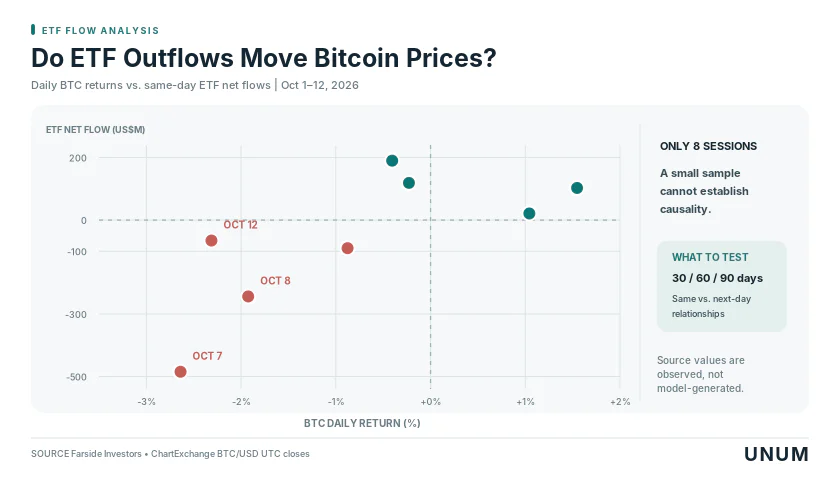
October began positively for American spot Bitcoin ETFs. According to Farside Investors, on October 1, the funds attracted $102.7 million, and on October 2 — another $189.9 million. After an outflow of $89.8 million on October 5 and an inflow of $118.8 million on October 6, the cumulative result of the first four trading sessions remained positive at $321.6 million.
The situation changed dramatically on October 7, when investors withdrew $484.9 million from the funds. This was the largest daily outflow for the period under review. In the next session, the net outflow was another $244.1 million, resulting in a total outflow of $729 million over just two days, completely offsetting the previous inflow.
On October 9, the funds briefly returned to a positive result, attracting $21.1 million, but by October 12, the net flow was negative again — minus $65.4 million. Thus, by the end of eight trading sessions, the cumulative net outflow from Bitcoin ETFs reached $451.7 million.
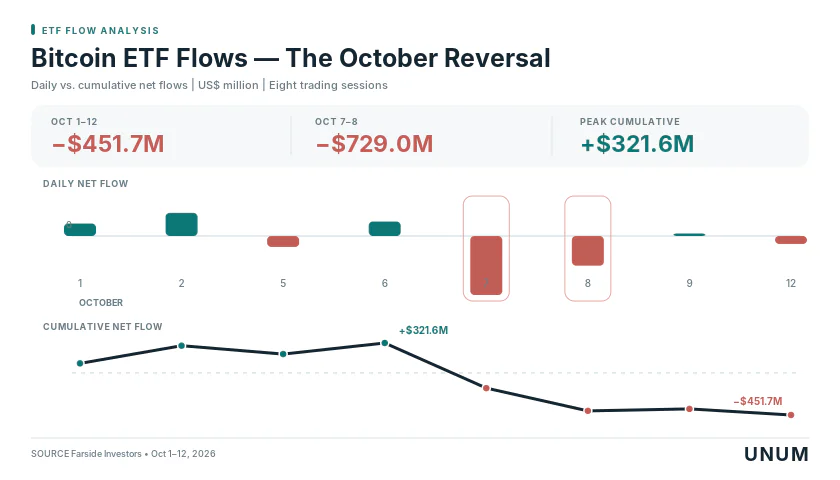
When interpreting these data, it's important to consider the nature of capital movement. The bulk of the negative result was formed by two sessions — October 7 and 8. Therefore, it is more about a sharp deterioration in demand on specific days rather than a proven prolonged outflow throughout the month.
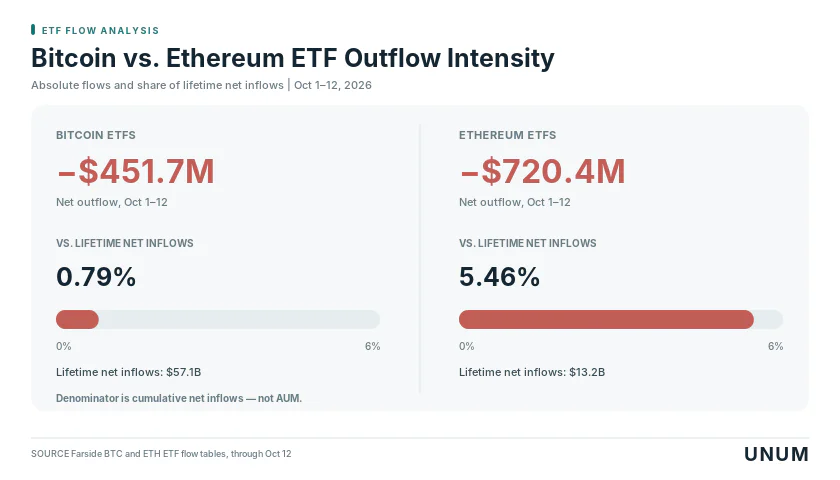
Scale also matters. According to Farside, the cumulative net inflow into tracked American Bitcoin ETFs since the launch of the respective products has reached approximately $57.1 billion. For context: $451.7 million is about 0.8% of the accumulated net inflow of $57.1 billion over Farside's observation history. However, this figure does not reflect the proportion of withdrawn assets and is not suitable for assessing the intensity of the outflow relative to the current AUM.
Why BlackRock Maintains Inflows While Fidelity Loses Investors
The overall statistics hide significant differences between individual funds. Even against the backdrop of the entire market's negative result, some Bitcoin ETFs continue to record positive capital flows.
The distribution for October 1–12 is as follows.
Fund | Issuer | Net Flow, $ million |
|---|---|---|
IBIT | BlackRock | +289.5 |
FBTC | Fidelity | −411.7 |
ARKB | ARK 21Shares | −214.9 |
GBTC | Grayscale | −78.9 |
BITB | Bitwise | −52.2 |
Other Funds | Various Issuers | +16.5 |
Total | −451.7 |
Source: Farside Investors. Calculated based on daily data for eight trading sessions from October 1 to 12, 2026. Figures rounded to $0.1 million.
Among Bitcoin ETFs, the most notable discrepancy is observed between BlackRock and Fidelity products. The former attracted $289.5 million during the period under review, while the latter recorded an outflow of $411.7 million. However, the result for IBIT cannot be considered unequivocally positive: on October 7, the fund lost $207.7 million, on October 8 — $5.5 million, and on October 12 — another $65.4 million. The last session is particularly indicative, as the negative flow for that day, according to Farside statistics, was solely attributed to IBIT.
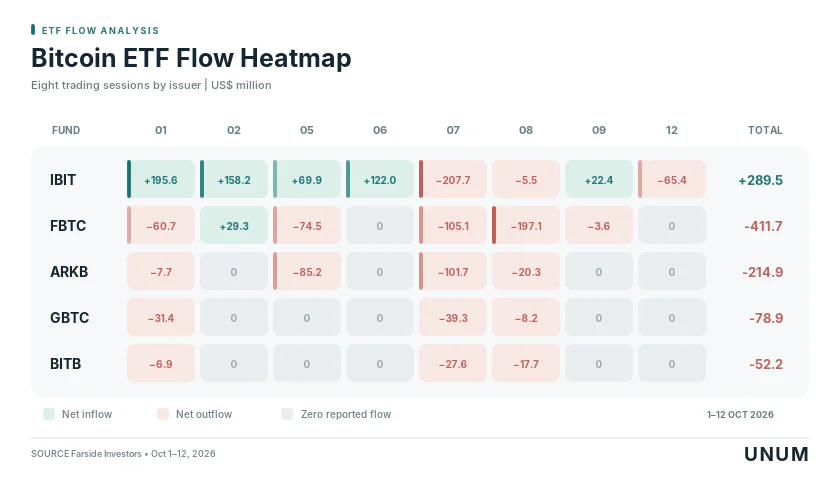
Differences between the funds can be explained by several factors. Among them are the level of fees, liquidity, trading spreads, investor composition, and asset allocation characteristics in investment portfolios. For example, according to Farside data, the annual fee for each of the IBIT and FBTC funds is 0.25%, while for ARKB it is 0.21%, and for GBTC — 1.50%.
However, fees do not explain everything that is happening. The positive flow into IBIT alongside the outflow from FBTC does not mean that funds are directly moving from one fund to another. To confirm such a hypothesis, additional data on investor positions and transactions are needed, which cannot be obtained solely from aggregated ETF statistics.
A more substantiated conclusion is that investor demand for Bitcoin through various ETFs is unevenly distributed, and large issuers do not necessarily show the same dynamics even under comparable market conditions.
Why Investors Are Reducing Positions in Cryptocurrency ETFs
To explain the capital outflow from cryptocurrency ETFs, it is necessary to compare the dynamics of the funds with changes in monetary policy and investor sentiment. The October outflow coincided with the Fed's rate hike and the increase in yields on U.S. government bonds. One of the most important factors was the monetary policy of the Federal Reserve System, which directly affects the cost of capital, bond yields, and the attractiveness of risky assets.
On September 16, 2026, the Fed raised the target range of the rate by 25 basis points to 3.75–4.00%, explaining the decision by the need to curb inflation. The minutes of the September meeting published on October 7 showed that the regulator remains concerned about inflationary pressure and is considering further actions based on incoming economic data.
For Bitcoin, this has several implications. High interest rates increase the attractiveness of fixed-income instruments and may limit investors' willingness to buy assets that do not generate interest income themselves. At the same time, expensive borrowed funds create less favorable conditions for trading with leverage.
The situation is also influenced by the yields on U.S. government bonds. According to FRED, the yield on ten-year Treasuries was 5.24% on October 1, reached 5.31% on October 5, and stood at 5.28% on October 7. By October 8, it had decreased to 5.22%, although the outflow from Bitcoin ETFs continued. This shows that the daily dynamics of the bond market cannot serve as the sole explanation for capital movements in cryptocurrency funds.
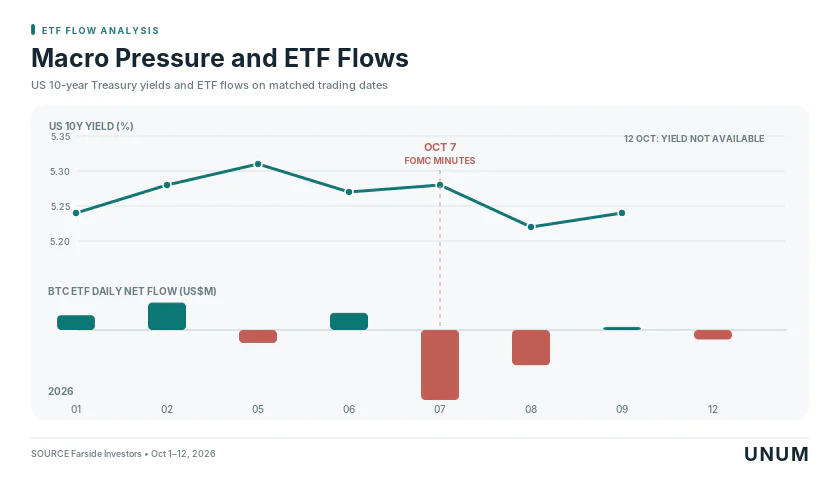
Amid ongoing geopolitical tensions, energy prices remained elevated, heightening inflationary risks and uncertainty regarding future Fed decisions. On October 12, Brent was trading above $106 per barrel, and the dollar strengthened amid geopolitical risks, demand for safe-haven assets, and expectations regarding inflation and Fed policy. This combination can increase investor caution and stimulate the reallocation of funds from volatile assets.
However, profit-taking, leverage reduction, or regular portfolio rebalancing cannot be ruled out. Public ETF statistics show the direction of capital flows but do not reveal the motives of each investor.
What BlackRock Research Says
A broader context is provided by the Q3 2026 Flow & Tell study, published on October 12.Kristy Akullian, head of investment strategy for iShares at BlackRock, notes:
Investor sentiment remained generally positive but became more subdued during the third quarter. Increased attention to diversification and protection against geopolitical risks indicates a more cautious approach to risk.
According to BlackRock client surveys, the share of respondents with optimistic expectations decreased from 53% on July 7 to 46% at the end of September, while the share of pessimistic respondents increased from 12% to 17%. Meanwhile, in the third quarter, cryptocurrency exchange-traded products attracted about $11 billion after an outflow of $4.1 billion in the second quarter.
These figures relate to a broader segment of cryptocurrency exchange-traded products, not exclusively to U.S. spot Bitcoin ETFs. Nevertheless, they demonstrate an important market feature: long-term interest in digital assets can persist alongside increased caution and the reduction of individual positions.
Does ETF Outflow Mean Direct Bitcoin Sales?
Negative capital flows are often interpreted as equivalent to direct cryptocurrency sales. However, the mechanics of spot Bitcoin ETFs are more complex, as investors trade fund shares, while operations with the underlying asset occur at another level.
When an investor sells shares of IBIT or another ETF on the exchange, the buyer may be another participant in the secondary market. Such a transaction does not necessarily mean that the fund immediately sells the corresponding amount of BTC.
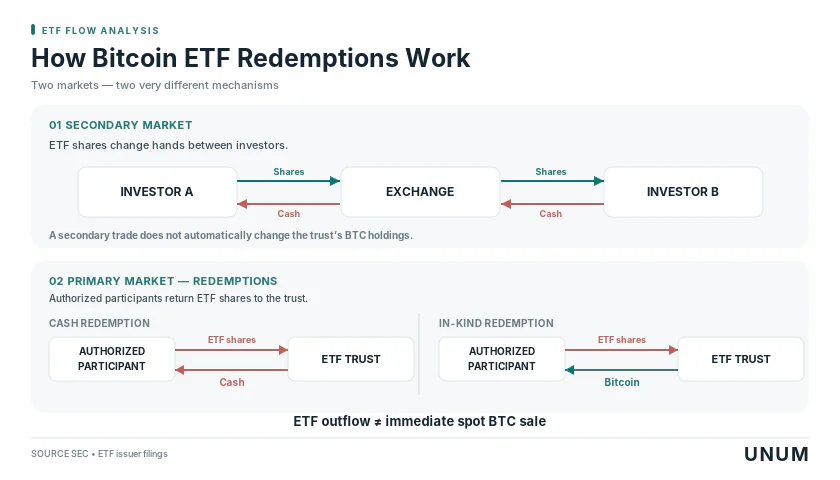
The change in the number of issued shares occurs through the mechanism of creating and redeeming large blocks of shares — creation/redemption. Authorized intermediaries participate in this process, and settlements can be made in cash or through the transfer of the underlying asset.
In July 2025, the SEC permitted the creation and redemption of cryptocurrency ETP shares with in-kind settlements. Previously, there were restrictions requiring cash settlements. IBIT's reports confirm the use of share redemptions with Bitcoin transfers. The specific order of cash and in-kind settlements is determined by the fund's documents in accordance with the terms of the operations.
Therefore, the outflow of $451.7 million should not be automatically equated to market sales of BTC for an identical amount at a specific point in time. For a more accurate assessment, it is necessary to compare the number of issued shares, Bitcoin reserves, redemption volumes, and the nature of the fund's settlements.
It is equally important to distinguish between net flows and assets under management (AUM). The latter change not only due to the inflow or outflow of funds but also as a result of fluctuations in Bitcoin's value. Even a fund with a positive net flow may face a decrease in AUM if the underlying asset falls sharply enough.
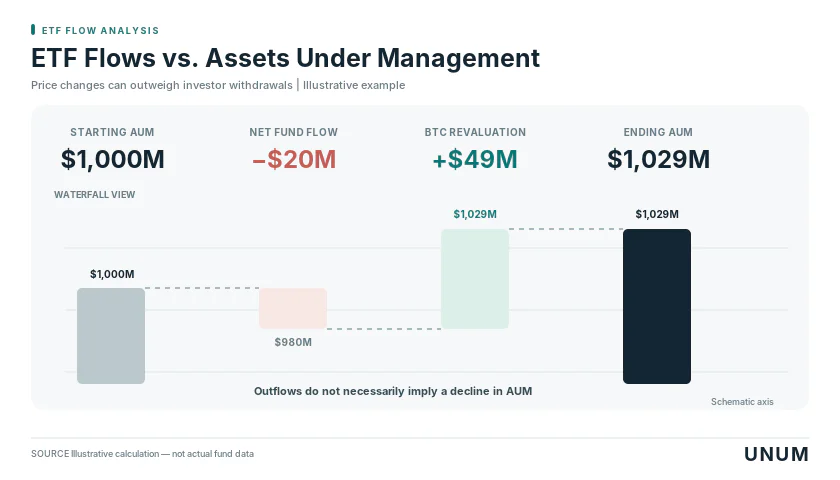
Bitcoin itself was under pressure during the period in question: on October 7, Bitcoin fell to approximately $82.9K, and on October 12, it traded in the range of about $81.8K–$84.4K. However, the coincidence of price weakness with ETF outflows does not prove that fund redemptions caused the price decline. The spot market is simultaneously influenced by exchange transactions, derivatives, position liquidations, and macroeconomic news.
The Outflow Affected Not Only Bitcoin but Also Ethereum
To assess whether the capital reduction is exclusively related to Bitcoin, it is necessary to examine similar data for other cryptocurrency ETFs.
According to Farside Investors, American Ethereum ETFs recorded a net outflow of $720.4 million from October 1 to 12, 2026. Thus, in absolute terms, the negative flow of ETH funds was approximately 1.6 times greater than that of Bitcoin ETFs.
The result was particularly notable for BlackRock ETHA, from which about $572.3 million was withdrawn over eight sessions. This contrasts with the positive accumulated flow into the Bitcoin fund IBIT of the same issuer.
Unlike Bitcoin ETFs, Ethereum funds recorded a negative cumulative net flow in each of the eight trading sessions. The largest daily outflow was observed on October 6, amounting to $201.9 million, and on October 12, investors withdrew an additional $85.4 million.
This dynamic indicates that the decline in demand affected more than just Bitcoin. However, comparing only absolute amounts is insufficient: the Ethereum ETF market differs significantly in terms of assets under management, so the relative intensity of the outflow may be different.
The contrast between IBIT and ETHA also does not allow for reducing investor behavior to simply moving away from a specific manager. It is likely that the market participants' attitude towards different cryptocurrencies and the specifics of positioning in particular funds play a role.
However, determining whether this is an exit from the cryptocurrency market as a whole or a redistribution of funds into other instruments is impossible without data on broader investment flows.
What Will Happen to Bitcoin if ETF Outflows Continue?
The October dynamics enhance the significance of Bitcoin ETF flows as one of the indicators of institutional demand. However, these figures alone do not allow for a reliable short-term forecast for Bitcoin, as the impact of funds on market liquidity must be assessed alongside macroeconomic conditions and activity in the spot and futures markets.
Three main scenarios for the further development of the situation are possible.
Demand recovery. Positive flows return to several major funds, their accumulated result over five and twenty trading days improves, and Bitcoin holds or regains lost price levels. Additional confirmation will come from an increase in BTC reserves in funds without a sharp rise in speculative leverage.
Market stabilization. Positive and negative flows alternate but do not form a sustainable trend. Assets are redistributed among funds, and the price of Bitcoin remains mostly within a range. In this case, the October episode can be interpreted as a temporary adjustment of positioning.
Increased pressure. Negative flows persist for several weeks and spread to most major Bitcoin ETFs. If the BTC price and the volume of coins in funds decrease simultaneously, and there is a reduction in open interest and liquidation of long positions in the derivatives market, the likelihood of a more prolonged deterioration increases.
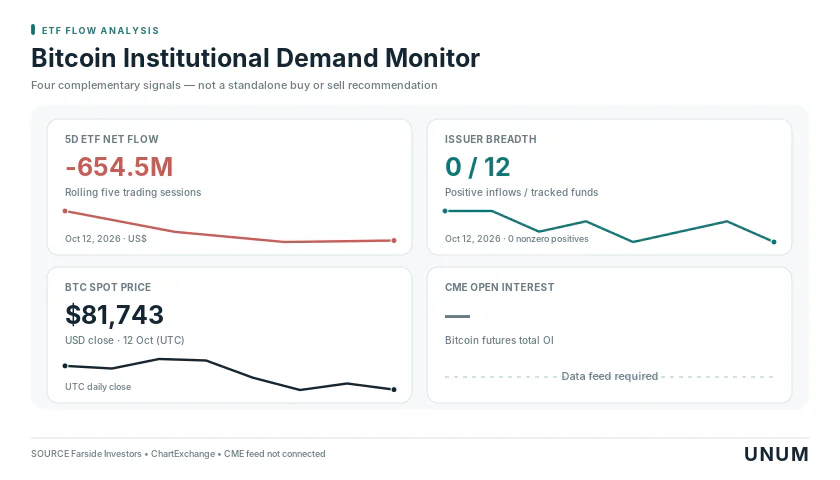
To assess these scenarios, it is not enough to track only the daily outflow of funds from Bitcoin ETFs. A more complete picture is provided by the accumulated net flows over 5 and 20 trading days, changes in BTC reserves, open interest in the CME futures market, funding rates for perpetual futures, US Treasury yields, and dollar dynamics.
The combination of several independent signals will be particularly indicative. For example, a prolonged ETF outflow amid declining open interest and falling Bitcoin may indicate an overall reduction in market risk. Conversely, a recovery in inflows with stable prices and moderate derivatives activity will be a more convincing sign of a return in spot demand than a single positive session.
An outflow of $451.7 million from American Bitcoin ETFs from October 1–12, 2026, shows that demand for cryptocurrency exchange-traded products has become less stable, and market sentiment remains sensitive to interest rates, bond yields, and geopolitical risks. However, the positive accumulated result of BlackRock IBIT and differences between issuers do not indicate a mass exit of investors from Bitcoin.
The additional outflow on October 12 confirms that the data is still insufficient to speak of stable stabilization. However, eight trading sessions are too short a period to conclude a long-term reversal in institutional demand. The determining factor will be the sustainability of capital flows in combination with changes in fund reserves and the behavior of Bitcoin itself.