Stablecoin Market Experiences Largest Reduction Since 2022
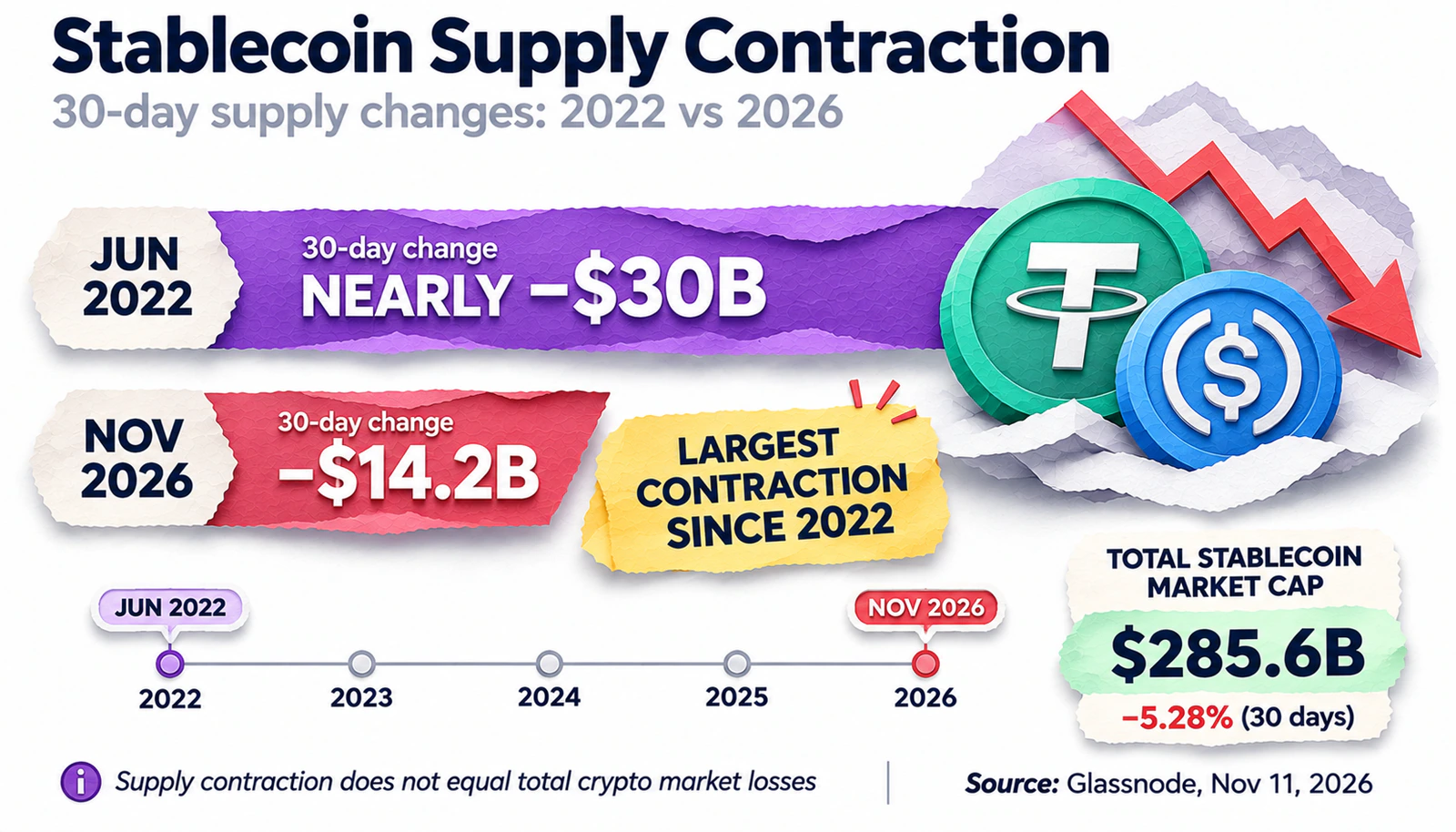
In the report from November 11, Glassnode analysts recorded a decrease in the total supply of tracked stablecoins by $14.2 billion over 30 days. Such a sharp reduction had not been observed in over four years. During the cryptocurrency crisis in June 2022, a similar figure approached $30 billion.
The new data indicates a significant change in the liquidity situation of the crypto market. Stablecoins, primarily pegged to the US dollar, are used for trading, settlements, and storing funds between transactions. Their supply provides an approximate estimate of the volume of digital dollars circulating within the cryptocurrency ecosystem.
According to DefiLlama, as of November 13, 2026, the market capitalization of stablecoins was about $285.6 billion, having decreased by 5.28% over the past 30 days. Previously, at the end of September, the figure exceeded $306 billion. Thus, the market has shifted from a period of supply expansion to a noticeable contraction.
The figures from Glassnode and DefiLlama should not be directly compared as results of a single calculation. They cover different dates and may differ in the composition of assets considered. However, both sources confirm the negative trend in stablecoin supply.
An important clarification concerns the very concept of capital outflow. A $14.2 billion reduction in supply does not mean that the market value of all cryptocurrencies decreased by the same amount. This figure reflects the change in the volume of stablecoins in circulation, not the total losses of investors or the size of Bitcoin sales.
Why Investors Are Reducing Investments in Stablecoins
Most of the largest stablecoins are structured to keep their value close to one US dollar. To maintain the peg, issuers back the issuance of tokens with reserve assets and provide a redemption mechanism.
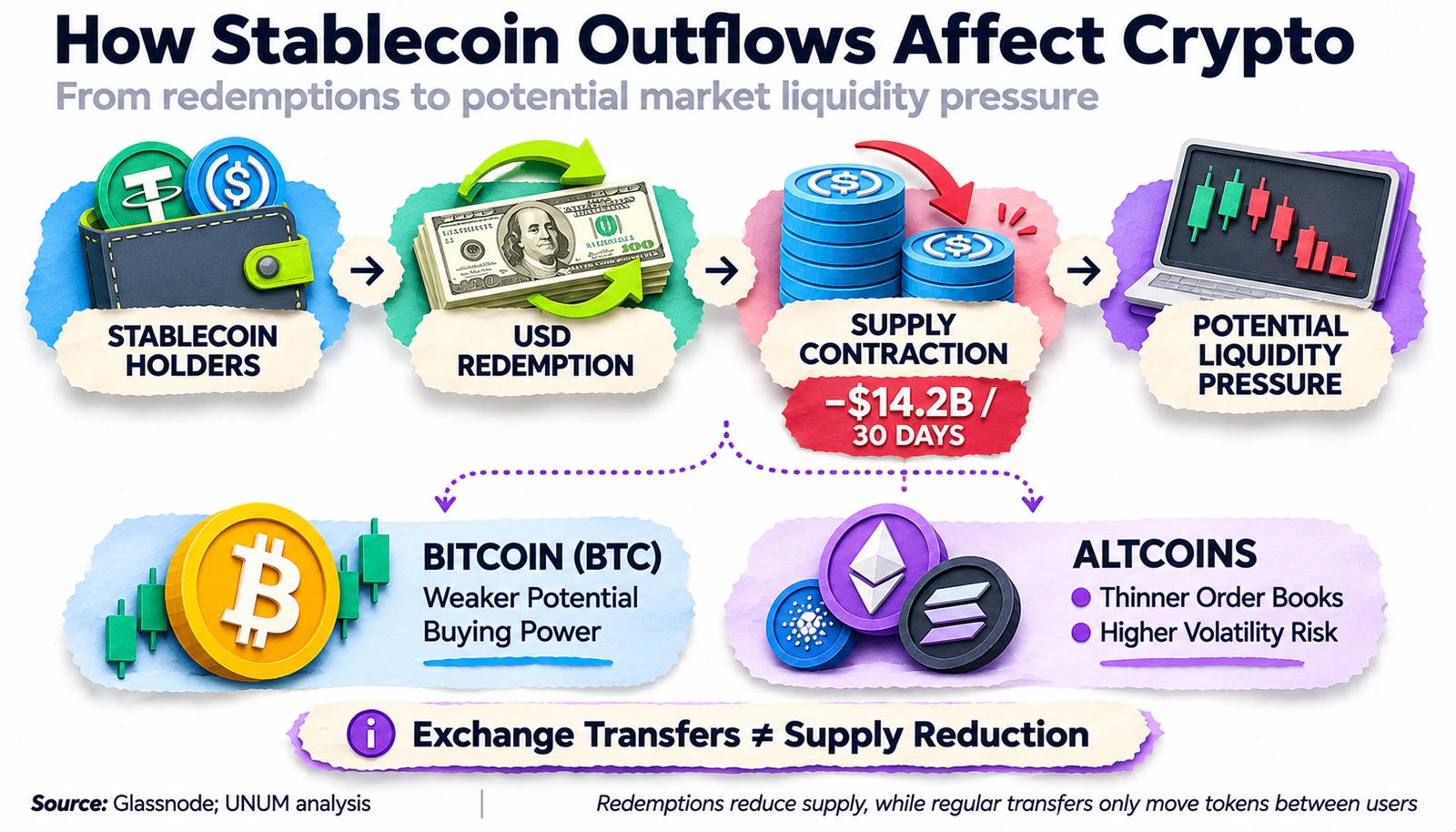
When a client entitled to direct redemption returns stablecoins to the issuer in exchange for dollars, the corresponding tokens are removed from circulation. For example, when redeeming 1 million USDC, Circle reduces the number of circulating tokens by 1 million. This mechanism differs from the usual sale of USDC on a cryptocurrency exchange, where tokens merely change ownership.
It is the predominance of redemptions over new issuance that can lead to a reduction in supply. However, determining the reasons for such operations is significantly more difficult, as public statistics do not disclose the subsequent actions of all recipients of funds.
Several factors can influence the supply dynamics:
Decreased interest in risky assets. When cryptocurrencies fall, investors may sell their positions and then redeem the received stablecoins, withdrawing funds from the crypto market.
Changes in the attractiveness of traditional instruments. Interest rates and government bond yields can influence investors' decisions to hold capital in cryptocurrencies, money funds, or other assets.
Reduction in trading and lending operations. With decreased activity from traders and borrowers, the need for stablecoins for settlements, securing deals, and operations in decentralized finance (DeFi) diminishes.
However, the reduction in supply cannot be automatically explained by a mass abandonment of cryptocurrencies. The statistics are also influenced by the specifics of the issuance and redemption of individual tokens, and some operations may be related to the redistribution of funds between different instruments.
In the report from November 11, Glassnode analysts outlined the consequences of the supply reduction as follows:
The reduction in supply means that holders are exchanging stablecoins for dollars and withdrawing these funds from the market, leaving fewer resources for market growth.
This interpretation reflects one of the main mechanisms of supply reduction. Public statistics do not allow determining what share of redemptions was provided by retail participants and institutional investors, nor where they directed the received funds.
Which Stablecoins Are Losing Capital the Fastest
The largest contribution to the reduction in supply was made by the two largest dollar stablecoins — Tether (USDT) and USD Coin (USDC). They account for the overwhelming majority of the sector's total capitalization, so changes in their supply significantly impact the overall figure.
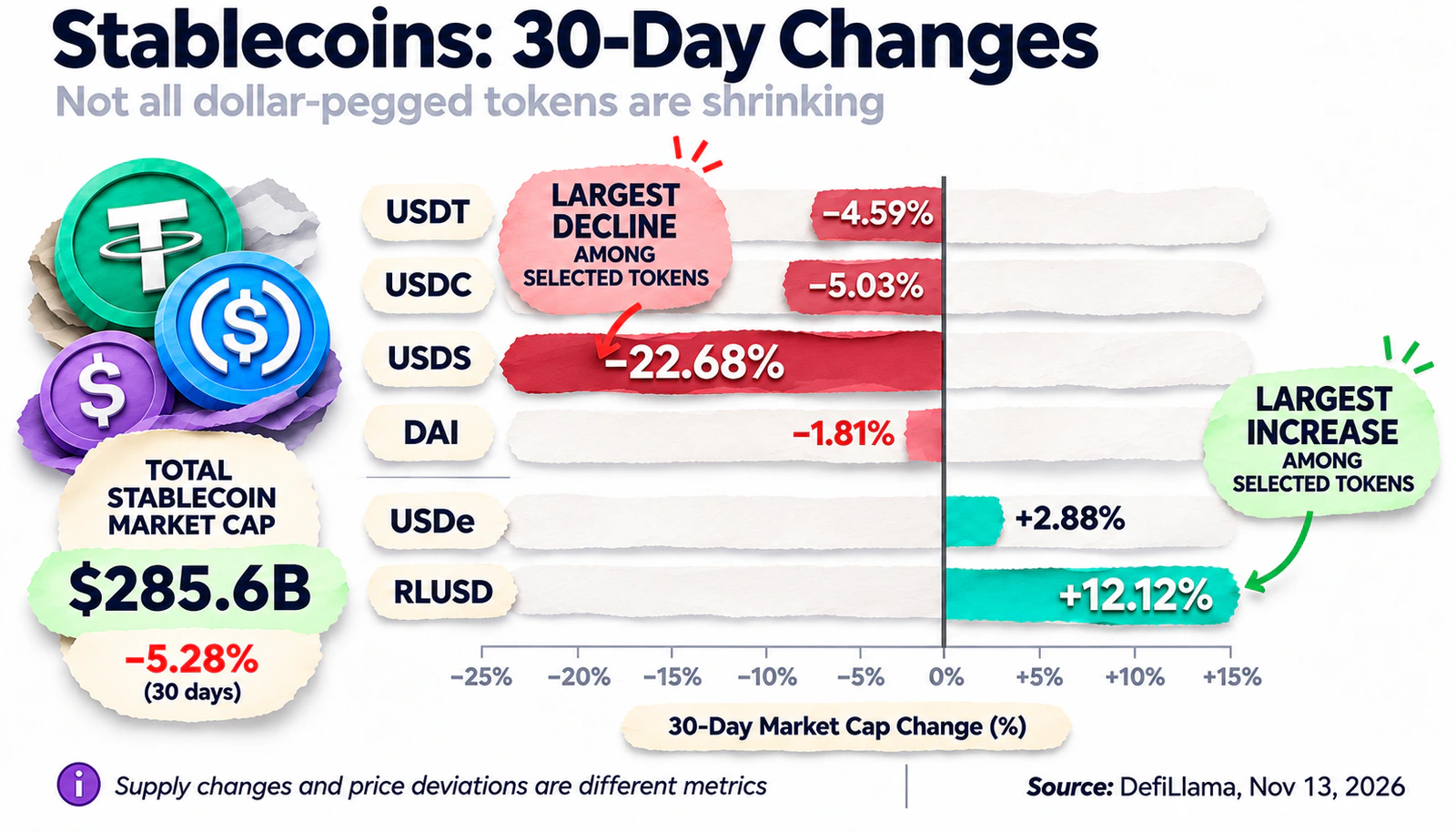
According to DefiLlama data as of November 13, the capitalization of USDT was approximately $175.5 billion, and USDC was $69.5 billion. Over 30 days, USDT's capitalization decreased by 4.59%, and USDC's by 5.03%, according to DefiLlama data. However, the dynamics of other stablecoins were mixed.
Stablecoin | Capitalization | Change over 30 days |
|---|---|---|
Tether (USDT) | $175.51 billion | −4.59% |
USD Coin (USDC) | $69.45 billion | −5.03% |
Sky Dollar (USDS) | $5.39 billion | −22.68% |
Ethena USDe (USDe) | $4.90 billion | +2.88% |
Dai (DAI) | $4.66 billion | −1.81% |
World Liberty Financial USD (USD1) | $3.17 billion | −24.75% |
Ripple USD (RLUSD) | $2.69 billion | +12.12% |
Source: DefiLlama, data as of November 13, 2026. Values are rounded.
Among the assets considered, USD1 decreased the most by 24.75%, followed by USDS at 22.68%. Meanwhile, USDe and RLUSD showed growth. This indicates that the decline in demand affects different categories of stablecoins unevenly.
When assessing such changes, it is necessary to consider differences between business models. USDT and USDC are primarily backed by off-chain reserves, including cash and short-term financial instruments. Other stablecoins use cryptocurrency collateral, collateralized positions, or special value maintenance strategies.
Therefore, changes in the supply of a particular asset may depend not only on overall market sentiment but also on the conditions of its issuance, the yield of related products, and demand within a specific ecosystem.
The simultaneous decline in the capitalization of USDT and USDC is particularly important for cryptocurrency exchanges. These tokens are widely used in trading pairs and provide a significant portion of settlements between market participants. Their current quotes can be tracked on the Tether (USDT) page in UNUM.
At the same time, a reduction in the supply of a stablecoin and a decrease in its price relative to the dollar represent different processes. The former reflects a change in circulation volume, while the latter indicates a deviation from the target peg. For a comprehensive assessment of the asset's condition, both indicators must be considered.
How the reduction of stablecoins affects Bitcoin and altcoins
The reduction in the supply of stablecoins can affect market liquidity, as these tokens are widely used for trading and settlements. On centralized exchanges and in DeFi, they allow participants to quickly switch between assets without returning to bank transfers each time.
When stablecoins are redeemed by the issuer, their supply decreases. If the received dollars do not return to the crypto market through other channels, the liquidity available for purchases may shrink. However, the impact on specific assets depends on where these stablecoins were located and what operations they were used for.
Why it might be harder for Bitcoin to recover
Sustainable growth of Bitcoin requires buying demand capable of absorbing the supply from sellers. Stablecoins serve as one source of such demand, but not the only one. Investors also purchase BTC directly for fiat currencies, through exchange-traded funds, and other financial instruments.
The November reduction in stablecoin supply coincided with a deterioration in several other market indicators. According to Farside Investors statistics, during the trading week from November 2 to 6, U.S. spot Bitcoin ETFs recorded a net outflow of about $1.28 billion. At the same time, Glassnode noted a negative Coinbase premium — an indicator reflecting the difference between the price of Bitcoin on the American platform and a comparable market benchmark.
The coincidence of these factors indicates a weakening of several sources of demand. However, it does not prove that the reduction in stablecoins was the direct cause of BTC's decline. Price movement also depends on sales by existing holders, stock market sentiment, and leveraged operations.
The interrelation of these factors is examined in more detail in the UNUM analytical material “Bitcoin fell to $73,700 — why BTC's decline cannot be explained solely by ETF outflows”.
Why altcoins might be more vulnerable
The consequences of reduced liquidity may be more pronounced in the segment of smaller cryptocurrencies. Unlike Bitcoin, many altcoins are available on fewer trading platforms, and their buy and sell order volumes are relatively small.
The order book depth shows the volume of buy and sell orders near the current price. The fewer such orders, the more a large transaction can change the market value of an asset.
If liquidity decreases simultaneously with a weakening of demand, the risks of sharp price fluctuations increase for smaller cryptocurrencies. The scale of potential impact depends on the specific token, the structure of trading pairs, and the activity of market makers — participants who support buy and sell orders.
The reduction in the total supply of stablecoins does not in itself prove a deterioration in the liquidity of each altcoin. Some trading platforms may maintain sufficient reserves, and certain tokens may attract capital even during a general market downturn.
Is the crypto market repeating the 2022 scenario
The similarity to the events of 2022 attracts attention due to the scale of the current reduction in stablecoins. However, the circumstances of the two periods differ significantly, so historical analogy must be used cautiously.
In May 2022, the algorithmic stablecoin TerraUSD (UST), which maintained a peg to the dollar through an exchange mechanism with the cryptocurrency LUNA, collapsed. After losing trust, the system faced massive redemptions and a rapid decline in the value of both tokens.
According to the Bank for International Settlements (BIS), TerraUSD's peak capitalization before its collapse reached $18.7 billion. The consequences spread to other segments of the crypto market, heightening concerns about the reliability of stablecoins and the stability of related credit products.
Available data on the reduction in supply does not in itself indicate a crisis comparable to the collapse of TerraUSD. Such a conclusion requires signs of problems with reserves, token redemption, or dollar pegging. The current market is predominantly occupied by USDT and USDC, whose mechanisms of backing and redemption differ from TerraUSD's algorithmic model.
Risk assessment should be based on several indicators: the issuers' ability to meet obligations, the quality and availability of reserves, the stability of the dollar peg, and the presence of redemption issues. Even a significant reduction in supply while maintaining the functionality of these mechanisms does not equate to insolvency.
Therefore, historical comparison is primarily useful for assessing the scale of liquidity changes. It does not allow for the conclusion that the cryptocurrency market will necessarily repeat the downward trajectory of 2022.
What indicators will help determine the return of liquidity
The future prospects of the stablecoin market depend on whether the reduction in supply continues or stablecoin issuance begins to exceed the volume of their redemption. A return to positive dynamics could indicate a strengthening demand for digital dollars, but this condition alone is insufficient to confirm the recovery of the entire crypto market.
To assess the situation, investors and traders should compare several indicators:
30-day change in stablecoin supply. A steady shift to growth will indicate that the volume of circulating tokens has stopped declining. It is important to consider not just a single day, but the trend over several weeks.
Issuance and redemption of USDT and USDC. Data from major issuers will help determine if market recovery is accompanied by an increase in the supply of major dollar tokens.
Stablecoin reserves on crypto exchanges. Their growth may indicate an increase in funds available for trading, but it does not guarantee that participants will direct them to purchase cryptocurrencies.
Cash flows into spot Bitcoin ETFs: sustainability of net inflow or outflow of funds. Positive dynamics of funds can serve as additional evidence of demand for bitcoin beyond direct stablecoin trading.
Trading volumes and order book depth. An increase in buyer activity while maintaining sufficient liquidity can make price recovery more sustainable.
When analyzing exchange reserves, it is important to distinguish between token movement and their redemption. Withdrawing USDT from a trading platform to a personal wallet does not reduce the overall supply of the stablecoin, although it does decrease its balance on a specific exchange.
Back in October, signs of a reduction in stablecoin reserves on certain exchanges appeared. As reported by UNUM on October 28, since the beginning of the month, Binance's stablecoin reserves have decreased by about 5% — from $43.2 billion to $41.1 billion. This data reflected changes in funds on the platform, not a direct reduction in the total number of tokens issued.
Indicators should be considered together. For example, a recovery in USDT supply amid continued capital outflow from Bitcoin ETFs may indicate an improvement in one market segment without a significant strengthening of demand for BTC. Similarly, an increase in trading volumes can accompany both purchases and large-scale sales.
A more convincing signal of improved market conditions could be the simultaneous growth of stablecoin supply, buyer demand, and exchange liquidity. However, none of these factors guarantee subsequent growth in cryptocurrency value.
A reduction in stablecoin supply by $14.2 billion became one of the most noticeable signs of a weakening cryptocurrency market in November 2026. The reduction in stablecoin supply was accompanied by a net outflow of funds from U.S. spot Bitcoin ETFs, indicating a weakening of one of the channels of investment demand.
However, the current situation differs from the systemic crisis of 2022, and the dynamics of individual stablecoins remain heterogeneous. The further development of the market will depend not only on new issuances of USDT and USDC but also on investors' willingness to direct capital into cryptocurrencies.
For assessing the prospects of bitcoin and altcoins, the decisive factor is not the mere presence of stablecoins in circulation, but how actively these funds are used for purchases, trading, and financing operations. It is the combination of money supply and real demand that will determine the sustainability of a potential recovery.