


On October 19, 2026, the Bank for International Settlements (BIS) published the study Competing Rails for Cross-Border Payments: Banks, Fintechs, and Stablecoins. Its authors, Harvard Business School economists Wenxin Du, Catherine Huang, and David Scharfstein, compared the total cost of cross-border payments through traditional banks, fintech companies, and stablecoins.
The results were mixed. Bank transfers can indeed be accompanied by high currency markups, while blockchain allows digital assets to be moved with minimal fees. However, when converting stablecoins into regular money, additional costs arise that can eliminate much of the initial savings.
How BIS Compared the Cost of International Transfers
The main difference of the study from most similar comparisons is the approach to calculating transfer costs. The authors evaluated not just the individual fee for sending money, but the total cost of the operation: from debiting funds from the sender's account to their receipt by the recipient in local currency.
To do this, they combined several data sources: statistics from the World Bank's Remittance Prices Worldwide, quotes from payment services Wise, Remitly, and the digital division of Western Union, a small sample of the authors' personal bank transfers, cryptocurrency exchange prices, and historical blockchain network fees.
Conversion rates were compared with Bloomberg BFIX market benchmarks. The difference allowed for determining the currency spread and associated hidden fees, which are not always listed separately in tariffs.
The authors identified two main components of the cost of international transfers: the deviation of the exchange rate from the market benchmark and the explicit fees of payment intermediaries. For stablecoins, trading fees of crypto exchanges, network fees, and costs for depositing and withdrawing funds were additionally considered.
This approach allows for comparing payment instruments with different business models. However, the study has limitations: the banking sample is small, tariffs depend on the amount and direction of the transfer, and some data on cryptocurrency liquidity covers previous years. Therefore, the results should not be seen as a universal ranking of the cost of all international payments.
Fintech Services Have Reduced the Cost of International Transfers, but Banks Maintain High Fees
In a small sample of the authors' personal bank transfers, the currency markup for EUR/USD and USD/EUR transactions was approximately 2.3–4.7%. This refers only to losses on the exchange rate, without additional bank transfer fees.
For transactions with the Singapore dollar and Swiss franc against the US dollar, markups in the examined examples also exceeded 3%. This is particularly noteworthy since insufficient liquidity of major currencies cannot fully explain such high conversion costs.
However, the main competitors to banks are not stablecoins, but specialized payment services. Wise, Remitly, and other operators reduce costs through local bank accounts, netting of counter payments, and use of the wholesale currency market.
Payment Channel | BIS Indicators | Calculation Features |
|---|---|---|
International Banks | Currency markup 2.3–4.7% | Small sample of personal transfers by authors, without explicit fees |
Fintech Services, $200 Transfer | Total cost about 2–3% | Depends on currency direction |
Fintech Services, $10,000 Transfer | Total cost about 0.4–0.6% for the first two groups of currency markets | For less liquid currencies, the cost is higher |
Stablecoins | Network fee in reviewed historical data usually below $1; trading fees of individual exchanges reach 1% | These are separate cost components, not the total cost of transfer |
According to BIS calculations, for $200 transfers from the US, the median total cost was about 2% for the most liquid currencies and approached 3% for less liquid directions.
Source: BIS Working Paper No. 1385, sections 5–6. The figures are derived from different samples and describe various components of expenses, so the table is not a direct tariff comparison of the three payment systems.
When the amount increased to $10,000, expenses decreased to approximately 0.4–0.6% for the first two groups of currency markets, although certain directions were noticeably more expensive.
The reduction in relative cost with increasing amounts is particularly noticeable when fixed fees are present. For example, a payment fee of $5 means a loss of 2.5% when sending $200, but only 0.05% when transferring $10,000.
The study also found significant differences between currency directions. For instance, large transfers in Indian and Indonesian rupees through some fintech services were relatively inexpensive, while payments in Philippine pesos and several other currencies could remain costly.
Another illustrative example is corporate transfers through a fintech platform used by a small American bank and an educational institution. The average currency markup for transfers in pounds, euros, and yen was about 0.83%, but for payments in Hong Kong and Singapore dollars, it reached approximately 1.45%.
Additionally, the platform charged a fixed fee of $8 per transfer. The BIS authors did not include it in the main calculation because its relative size was insignificant for large corporate payments.
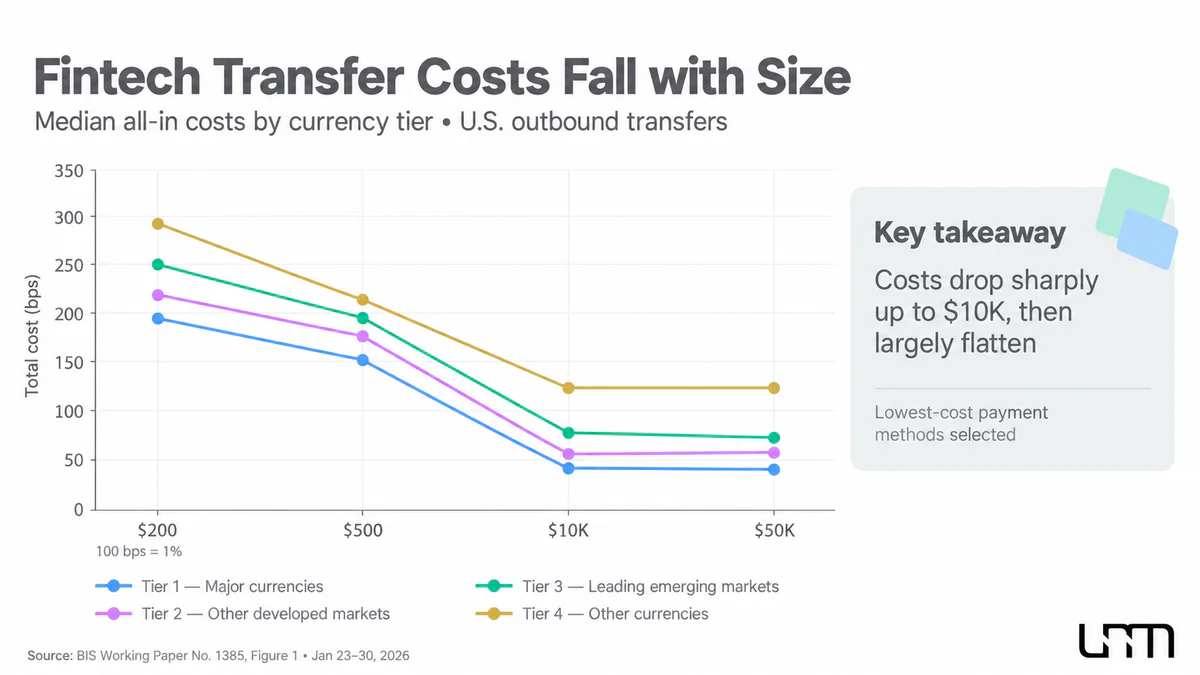
Thus, stablecoins are entering a market where traditional banks already face serious competition. To compare stablecoins and banks, it is not enough to consider only network fees — the full cost of international transfers must be assessed, taking into account the most efficient existing payment services.
Low blockchain fees do not guarantee cheap transfers
The main issue is that the cost of transfers in stablecoins depends not only on the blockchain. For international payments involving receipt of funds into a regular bank account, tokens must be converted from the sender's national currency and then back into the recipient's currency.
Transfers in USDT and USDC therefore often require additional operations of buying and selling tokens. The sender purchases stablecoins, transfers them to the recipient, who then exchanges the digital assets for money accepted in their country.
The BIS authors refer to this model as a stablecoin sandwich, a transfer scheme involving the purchase of a stablecoin at the start of the operation and its sale at the end.
The full cost includes four main components:
Purchasing the stablecoin. When exchanging fiat currency for USDT or USDC, the user may encounter a trading fee and a deviation from the market benchmark rate.
Transfer through the blockchain. The fee depends on the network used. According to BIS historical data for 2023–2026, average transaction costs in the reviewed blockchains were below $1, and in second-layer networks and some alternative blockchains, they were a few cents or less.
Reverse conversion. The recipient needs to sell the stablecoins for local currency. The final cost is determined by the exchange fee, exchange rate, and available liquidity.
Withdrawal of funds. Transferring money from a crypto exchange to a bank account may incur additional fixed or percentage fees.
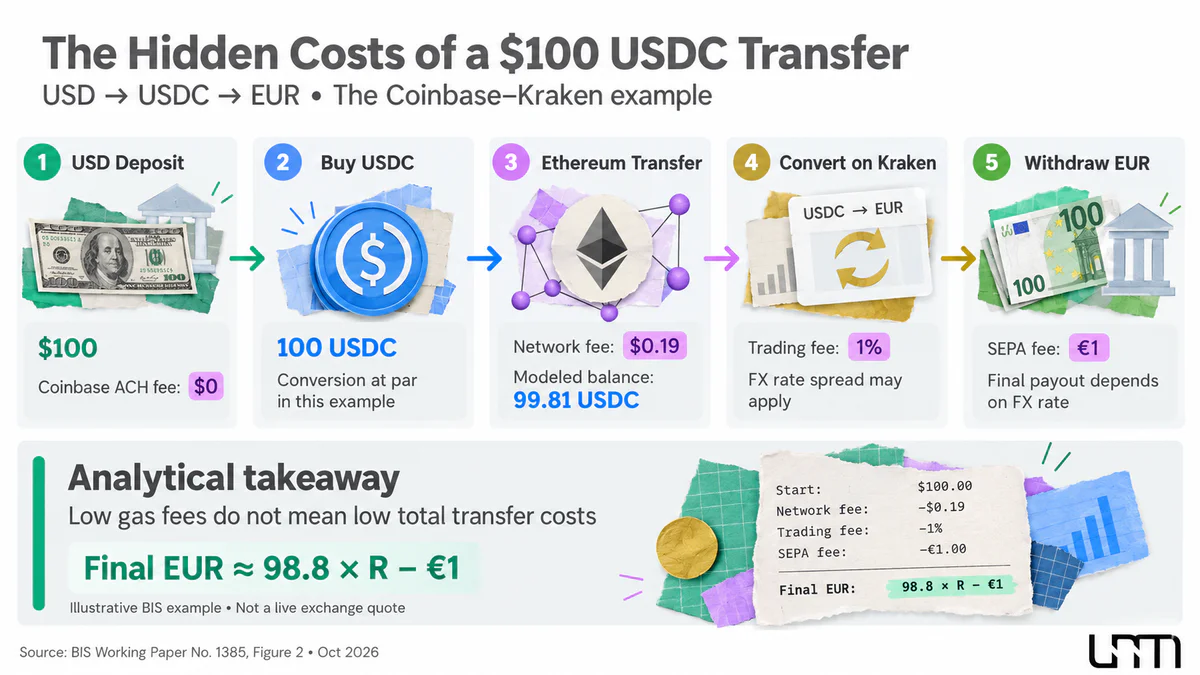
The study provides a calculated example of a transfer from the US to the eurozone via Coinbase and Kraken. The sender buys 100 USDC and transfers the tokens through Ethereum. For this operation, the authors use a network fee of $0.19.
However, the recipient then exchanges USDC for euros through Kraken with a trading fee of 1%, after which they pay an additional €1 for withdrawal through SEPA.
Importantly, the 1% fee applies to a specific Kraken tariff category for users with a small monthly transaction volume. According to BIS tariffs collected in May 2026, on five out of six reviewed centralized exchanges, trading fees for such clients ranged from 0 to 0.6%. Therefore, Kraken's tariff cannot be considered typical for the entire cryptocurrency market.
Nevertheless, the example shows that a low blockchain transaction cost can be accompanied by higher expenses for conversion and withdrawal of funds. Moreover, the conditional calculation does not account for some additional fees, including possible token withdrawal fees and transfers between different blockchains.
The authors of the study emphasize:
Thus, stablecoin-based payment infrastructure redistributes intermediary functions among organizations rather than eliminating them.
An additional source of costs arises when using decentralized exchanges. For example, exchanging USDC for EURC allows for currency conversion directly on the blockchain but requires payment of protocol fees and several transactions.
According to BIS, trading fees in major decentralized exchange pools in the reviewed sample typically ranged from 0.01% to 0.3%. However, these rates depend on the protocol, specific pool, and available liquidity. Meanwhile, withdrawing euros to a bank account still requires the involvement of a centralized intermediary.
Therefore, the advantages of blockchain payments are most evident within the digital infrastructure. When the recipient needs regular money, the final costs depend not only on blockchain technology but also on the cost of currency conversion and access to banking services.
When Stablecoins Really Prove Cheaper
The BIS study does not deny the benefits of cryptocurrency transfers. On the contrary, the authors found that in certain corridors, stablecoins provide more favorable currency conversion conditions than traditional payment services.
The advantage was particularly noticeable for transfers from developed countries to some developing economies.
According to a comparison of historical data from the World Bank for the period from Q1 2022 to Q1 2025, the total cost of regular international transfers in several expensive corridors ranged from 3% to 6%, whereas the currency component of stablecoin transfers calculated at exchange rates was close to zero or even negative.
However, this does not mean that a full transfer via stablecoins was cheaper by the same amount. BIS compared the total costs of regular transfers with the separate currency component of cryptocurrency operations. To assess the final cost, one must additionally consider trading commissions, blockchain transaction expenses, and withdrawal fees.
A negative currency conversion cost also does not mean that the user receives a free transfer with guaranteed profit. It shows that the observed exchange rate was more favorable than the chosen market benchmark.
According to researchers, currency restrictions, capital movement control, and currency market segmentation play an important role. In countries where access to the dollar is difficult, local buyers may agree to purchase dollar stablecoins at a premium.
As a result, a sender from another country sometimes gets a more favorable rate when exchanging USDT or USDC for the recipient's national currency.
However, such savings arise not only due to the efficiency of blockchain. They are related to the peculiarities of the currency market and may disappear with changes in demand, regulation, or liquidity availability.
Another limitation remains the liquidity of cryptocurrencies in specific currency corridors, determining how large an amount can be exchanged without significantly worsening the rate.
According to BIS calculations, the average daily trading volume of the euro against dollar stablecoins on centralized crypto exchanges from 2021 to 2025 was about $186 million.
For comparison, in 2025, the daily turnover of traditional currency instruments involving the euro reached approximately $2.7 trillion. These figures characterize markets of different scales and scopes: the first relates to a specific segment of crypto exchanges, the second to the broad currency market. The observation periods also differ.
Beyond the euro, only five of the studied currencies — the South Korean won, Turkish lira, Brazilian real, British pound, and Thai baht — showed an average daily turnover against dollar stablecoins of more than $10 million on centralized platforms.
The shallow market depth means that a favorable quote on the screen is not necessarily available for a large deal. When the order volume exceeds the supply at the best prices, the actual rate worsens, and conversion costs increase.
Thus, stablecoins can be competitive in certain currency corridors and for transfers that do not require costly conversion. However, fixed fees can reduce savings on small payments, and limited liquidity complicates large corporate settlements.
Who Will Win the Competition for International Payments
The main conclusion of the study concerns not only the cost of individual operations but also the development of cross-border payment infrastructure. Stablecoins are changing the structure of payment systems but do not eliminate the need for organizations that provide currency liquidity, compliance with legislation, and access to the banking system.
In a traditional international payment, these functions are distributed among banks and correspondent institutions. In the cryptocurrency model, a significant part shifts to crypto exchanges, liquidity providers, and stablecoin issuers, including Tether (USDT) and Circle (USDC).
For the user, this means that costs do not necessarily disappear — they may shift between participants in the payment system. For example, instead of a bank currency markup, they pay a trading commission to the exchange or cover the cost of a quick withdrawal.
A notable example is Wise, cited in the BIS paper. According to the company, the marginal operational costs for transferring from pounds to euros are £0.24 plus 0.06% of the transaction amount.
Of the fixed part, £0.11 goes to customer service, £0.06 to compliance with regulatory requirements, and £0.05 to other operational expenses. Direct banking fees, liquidity management, and currency operations account for only £0.02.
These figures describe the cost of service for Wise, not the fee that the client necessarily pays over the announced rate.
Thus, reducing the technological cost of money transfer does not eliminate expenses for customer verification, fraud prevention, sanctions control, and user support.
National instant payment systems, which are gradually integrating with each other, also become a serious competitor to stablecoins.
One example is Project Nexus, created with the participation of BIS. Its goal is to standardize the connection of domestic payment systems of different countries without the need to use a separate cryptocurrency asset.
The basis for such a model is already functioning bilateral connections, including PayNow–PromptPay between Singapore and Thailand, PayNow–DuitNow with Malaysia, and PayNow–UPI with India.
In April 2025, the central banks of India, Malaysia, the Philippines, Singapore, and Thailand established Nexus Global Payments to move towards the practical implementation of a multilateral system. In February 2026, Indonesia joined the project as the sixth country.
Meanwhile, the full international deployment of Nexus remains a separate stage of the project's development. Existing bilateral payment connections should not be equated with the already completed launch of the entire multilateral infrastructure.
Simultaneously, banks are experimenting with tokenized deposits, which allow settlements to be transferred to the blockchain without issuing independent stablecoins. In particular, Unum previously reported on a transaction by HSBC and Standard Chartered on SWIFT's blockchain infrastructure.
Payment companies are also adapting to new technologies. As reported by Unum, Mastercard announced the integration of regulated dollar stablecoins into its payment infrastructure and pilot projects with financial organizations.
In such models, the end user does not necessarily need to buy tokens themselves and interact with a crypto exchange: digital assets can be used within the payment service. However, the announced pilot solutions do not yet mean the widespread adoption of such settlements.
For investors, this changes the logic of market evaluation. An increase in the number of transfers in USDT and USDC does not necessarily mean a proportional increase in issuers' revenues or a decrease in fees for users. A significant part of the economic benefit may be distributed among exchanges, payment operators, and infrastructure providers.
The competitiveness of participants will depend on who can simultaneously ensure low transfer costs, sufficient liquidity, reliable conversion, and convenient access to national currencies.
Research by BIS shows that the technological advantage of blockchain exists, but it is not sufficient for automatic superiority over the banking system. Stablecoins can significantly reduce the cost of some international transfers, but the result depends on the currency direction, transaction amount, liquidity, and method of receiving funds.
As regulation and payment infrastructure develop, these conditions may change. Therefore, the key indicator of the effectiveness of USDT, USDC, and other stablecoins will remain not the blockchain fee size, but the total cost of the transfer, taking into account all intermediaries and the actual amount received by the recipient.