Why Supermicro's Forecast Was Unexpected
On October 20, 2026, the American company Super Micro Computer (Supermicro, NASDAQ: SMCI) presented a preliminary estimate of revenue and gross margin for the first quarter of the 2027 fiscal year, which ended on September 30, 2026. The company significantly raised its forecast amid increased demand for server platforms for artificial intelligence.
According to Supermicro's official announcement, the expected quarterly revenue is $18.5–19.5 billion instead of the previously forecasted $14.5–15.5 billion. Thus, the midpoint of the forecast range was raised by $4 billion, or 26.7%.
To assess the scale of changes, it's important to compare the new forecast with last year's financial results of Supermicro. In the first quarter of the 2026 fiscal year, which ended on September 30, 2025, the company generated about $5 billion in revenue. Therefore, the new forecast suggests an increase in quarterly sales by approximately 3.7–3.9 times, or 270–290% year-over-year.
Such dynamics indicate a significant acceleration of business, although part of the growth may be explained not only by the expansion of the entire AI server market but also by changes in Supermicro's share of orders from large clients.
The company also raised its gross margin forecast from 10.4–10.8% to 12–12.5%. This indicator reflects the share of revenue that remains after deducting the cost of sales. Supermicro's management associates the improved forecast with the structure of client orders and the range of products supplied.
The revision was significantly above analysts' expectations. According to Reuters, citing LSEG, the consensus forecast for quarterly revenue was about $15.23 billion. The new midpoint exceeds it by approximately 24.8%.
The reaction of the US stock market followed immediately after the publication of preliminary data. According to Reuters, Supermicro's shares gained about 11.3% in after-hours trading on October 20. Other server equipment manufacturers' stocks also showed positive dynamics.
However, the updated forecast cannot be considered the final financial result. The company warned that preliminary unaudited estimates may change after the completion of accounting procedures. Supermicro plans to publish the full quarterly report on November 3, 2026.
For investors, the combination of two factors is important: the rapid increase in expected sales and the improvement in forecasted profitability. Server manufacturers operate in conditions of high competition and significant costs for components, so an increase in turnover is not always accompanied by a comparable profit growth. This is why Supermicro's financial results are of interest not only to the company's shareholders but also to the entire semiconductor market.
What Supermicro's Results Say About AI Chip Demand
Supermicro does not manufacture graphics accelerators and other main semiconductor components itself. Its business is focused on designing, integrating, and supplying computing systems that use processors, GPUs, memory, networking equipment, and cooling technologies.
As data centers for artificial intelligence expand, the need increases not only for individual chips but also for ready-made server infrastructure. Therefore, Supermicro's order dynamics serve as an additional indicator of demand for equipment for training AI models and performing computational tasks.
However, data from one server manufacturer does not allow determining the scale of the entire AI infrastructure market. For a more objective assessment, it is necessary to compare them with the reports of companies that develop and manufacture semiconductors.
In August, Nvidia reported that its Data Center segment revenue in the second quarter of the 2027 fiscal year reached $89 billion, increasing by 117% year-over-year. The company's total quarterly revenue was $96.2 billion, with a GAAP gross margin of 75%.
Commenting on the results, Nvidia's founder and CEO stated:
Artificial intelligence has reached a tipping point. It performs useful work. The tokens it generates are productive and profitable. Now computing directly generates revenue.
The statement reflects Nvidia management's position: computing resources are becoming commercial infrastructure, not just research tools. However, the growing demand for GPUs does not guarantee sufficient return on investment for all data center operators.
A similar trend is reflected in the financial results of Taiwan's TSMC, the largest contract manufacturer of advanced chips. In the third quarter of 2026, its revenue reached $46.72 billion, increasing by 41.2% year-over-year in dollar terms.
High-performance computing (HPC) accounted for 68% of the company's quarterly revenue, and advanced technological processes with norms of 7 nm and below provided 79% of revenue from silicon wafer production. These data indicate high demand for modern processors and accelerators, although the HPC segment includes not only AI products.
Thus, the financial performance of Supermicro, Nvidia, and TSMC confirms the expansion of demand at multiple levels of the supply chain: from finished servers to specialized chips and manufacturing capacities. However, they do not guarantee the maintenance of current growth rates in the long term.
Who Will Benefit from the Increase in Server Orders
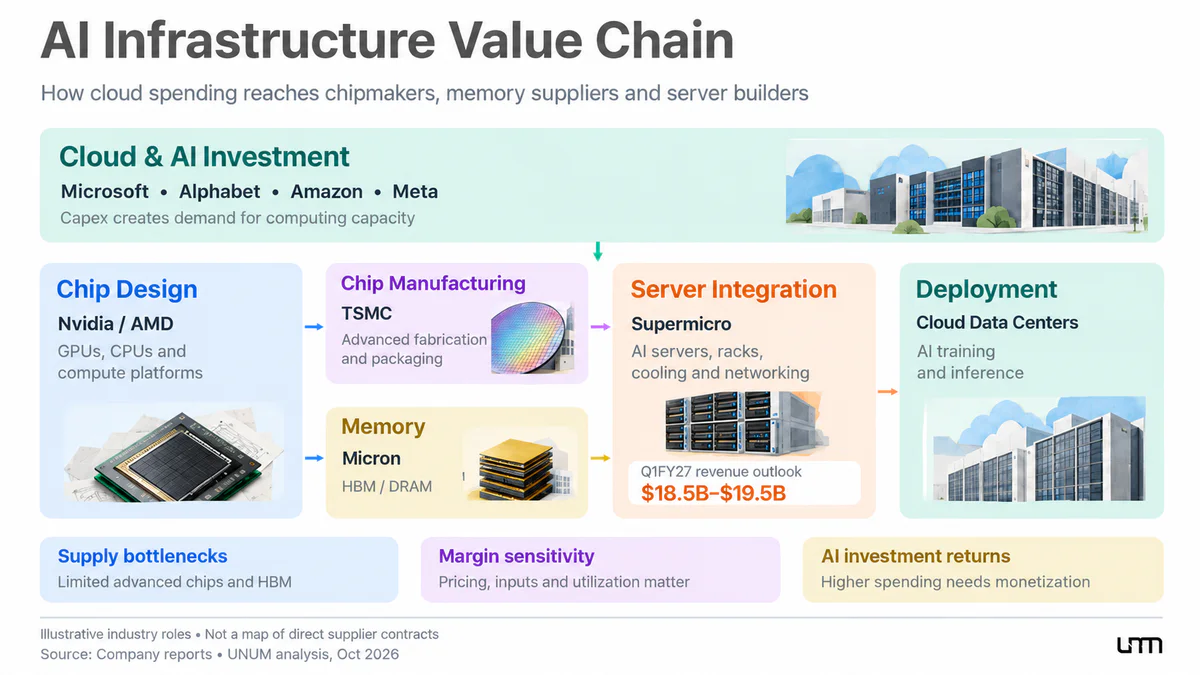
The additional demand for AI servers opens opportunities for manufacturers of GPUs, server processors, high-speed HBM memory, and contract chip manufacturers. However, the economic benefit is distributed unevenly among them.
Nvidia holds a strong position thanks to the supply of graphics accelerators and comprehensive computing platforms. Demand for such systems supports sales not only of GPUs but also of networking equipment and related components. Meanwhile, the high gross margin indicates significantly greater profitability of Nvidia's business model compared to server hardware integration.
AMD is also expanding its presence in the AI infrastructure market. In the second quarter of 2026, its Data Center segment revenue reached $6.7 billion, up 107% year-over-year. The company attributes the growth to demand for EPYC server processors and Instinct accelerators.
The segment's operating profit amounted to $2.1 billion compared to a loss of $155 million a year earlier. However, the comparison requires caution: in the same quarter of 2025, the company recorded about $800 million in expenses related to U.S. export restrictions on Instinct MI308 accelerators. The absence of similar expenses in the reporting period also contributed to the improvement in financial results.
For TSMC, the key advantage lies in the production of advanced chips for various developers. The company can benefit from market expansion regardless of which accelerators customers choose. However, expanding TSMC's production capacities requires significant capital investments and time.
Micron Technology deserves special attention. High-bandwidth HBM memory provides graphics and AI accelerators with fast access to data, which is critically important for the performance of modern computing systems.
By the end of the fourth quarter of the 2026 fiscal year, Micron reported revenue of $54.23 billion compared to $11.32 billion a year earlier. The company also reported large-scale shipments of HBM4 memory for a key customer's platform. Meanwhile, the growth in Micron's financial performance is linked not only to HBM but also to other memory market segments.
Company | Financial Performance | Main Growth Drivers |
|---|---|---|
Nvidia | Data Center Revenue — $89 billion, +117% y/y, Q2 2027 fiscal year | GPUs, computing platforms, and networking solutions |
AMD | Data Center Revenue — $6.7 billion, +107% y/y, Q2 2026 | EPYC server processors and Instinct accelerators |
TSMC | Total Revenue — $46.72 billion, +41.2% y/y in USD, Q3 2026 | Advanced processes, AI chip production, and HPC |
Micron | Total Revenue — $54.23 billion, Q4 2026 fiscal year | HBM, DRAM, and other types of memory |
Source: official quarterly reports of the companies. The figures relate to different reporting periods and segments, so they are not intended for direct comparison of business scales.
Differences in business models are crucial for investors. Nvidia and AMD generate revenue from the development and sale of computing components, TSMC from their production, and Supermicro from integrating equipment into ready server systems.
The growth in orders can support all industry links, but changes in prices, costs, and competition will affect their profitability differently. Therefore, the positive reaction of Supermicro's shares does not mean that the stocks of all semiconductor manufacturers have the same investment potential.
Why High Demand Does Not Guarantee Further Growth
Despite the strong financial results of the companies, the semiconductor sector remains dependent on the continuation of the investment cycle. Major tech corporations are increasing investments in AI, directing funds towards building data centers, purchasing computing equipment, and developing cloud computing.
The scale of these investments is confirmed by the reports of Microsoft and Alphabet.
In the fourth quarter of the 2026 fiscal year, Microsoft reported capital expenditures of approximately $41 billion, including the impact of financial leases. About two-thirds of the expenses were related to assets with relatively short lifespans, primarily CPUs and GPUs. Meanwhile, the company's operating cash flow was $55.4 billion, and free cash flow was $19.6 billion.
In the second quarter of 2026, Alphabet allocated $44.9 billion to capital investments, primarily in technical infrastructure. During the same period, its operating cash flow was $39.1 billion, and Google Cloud's revenue reached $24.8 billion, up 82% year-over-year.
These figures allow for an assessment not only of the scale of investments but also of the financial burden associated with infrastructure expansion. Microsoft's operating cash flow exceeded its capital expenditures, whereas Alphabet's capital expenditures for the quarter were higher than its operating cash flow.
It is important to note that capital investments support not only AI products. They also underpin cloud computing, traditional corporate services, and other business areas. Therefore, comparing total expenses with revenues solely from artificial intelligence would be incorrect.
The main risk lies in a potential mismatch between the pace of increasing computing power and the commercial return from its use. If revenues from AI products and cloud services grow more slowly than infrastructure expenses, clients may reconsider their investment programs.
Production Constraints and Cost Growth
An additional risk factor remains the limitations of production capacities. Advanced lithography, chip packaging, HBM production, and energy infrastructure construction require significant investments and long-term planning.
TSMC plans to allocate $60–64 billion for capital expenditures in 2026. At the third-quarter conference, the company's CFO Wendell Huang confirmed this forecast, linking the need for substantial investments to sustained multi-year demand, including the emerging agent AI market.
The company also expects that total investments for 2026–2028 will significantly exceed the expenditures of the previous three-year period.
However, the construction of new factories creates additional financial risks. Even with high production line utilization, increased costs for advanced technologies and overseas facilities may temporarily reduce profitability.
For example, TSMC's gross margin in the third quarter of 2026 decreased from 67.7% to 66.4%, a drop of 1.3 percentage points. The initial ramp-up of production using the 2-nanometer N2 technology influenced this metric, partially offset by other factors.
Supermicro's Dependence on Suppliers
There is also a more specific risk related to Supermicro's business structure. In its annual Form 10-K report, the company disclosed that in the 2026 fiscal year, one supplier accounted for 63.1% of total purchases.
Such concentration increases the company's sensitivity to partnership conditions, component costs, and potential supply disruptions. With limited availability of AI accelerators, even a large order portfolio does not guarantee timely contract fulfillment.
Additionally, Supermicro competes with Dell Technologies and Hewlett Packard Enterprise in the server solutions market. It is possible that part of the accelerated growth is related to the redistribution of orders among server suppliers, but comparable data from competitors is needed to verify this hypothesis.
Thus, the semiconductor industry faces three main sources of uncertainty:
Economics of AI projects. Can the revenue growth from artificial intelligence justify the capital expenditures of data center operators?
Production constraints. Will manufacturers of chips, memory, and server equipment be able to expand capacities without excessively increasing costs?
Financial stability. Can companies maintain high margins amid increasing competition and potential order slowdowns?
These factors will determine how much the current sales growth can transform into long-term profit increases.
What Awaits the Semiconductor Market in the Next 6–12 Months
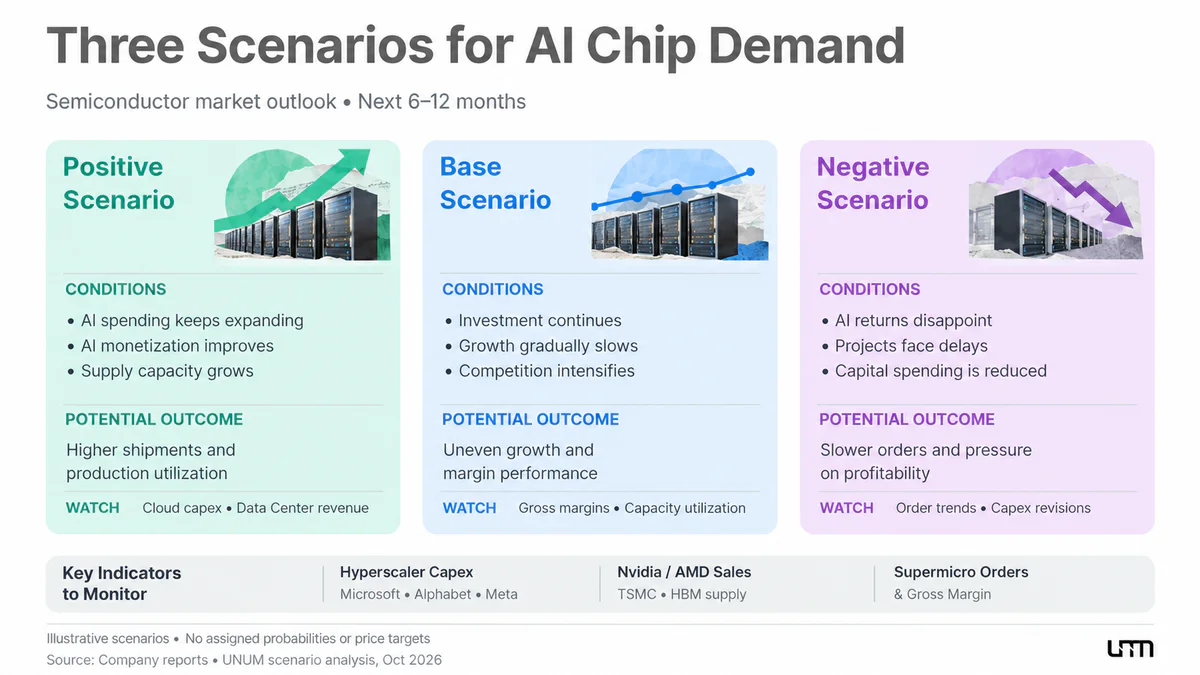
The increased revenue forecast for Supermicro strengthens the case for sustained high demand for AI infrastructure. However, the further development of the industry will depend on several interrelated conditions. To assess the prospects, let's consider three hypothetical scenarios without assigning quantitative probabilities to them.
Positive scenario. Major cloud providers continue to increase investments, new AI products generate additional revenue, and demand for computing resources remains high. In this case, Nvidia, AMD, TSMC, and memory manufacturers have the opportunity to increase supplies, capacity utilization, and profits.
Base scenario. Investments in AI infrastructure continue, but growth rates gradually slow after a period of rapid expansion. Competition among accelerator developers and server suppliers intensifies, and companies' financial results become more uneven. Manufacturers with high profitability, stable customer relationships, and access to critical technologies gain an advantage.
Negative scenario. Slowing AI monetization, financial constraints of data center operators, or delays in infrastructure projects lead to a reduction in new orders. Companies may reconsider capital expenditures, which will increase pressure on equipment suppliers and the stock valuations of technology companies.
To determine the future trajectory of the semiconductor market, it is most important to monitor several indicators:
quarterly revenue of Nvidia and AMD in the Data Center segment;
capital expenditures and production capacity utilization of TSMC;
demand and supply dynamics in the HBM memory market;
investment budgets of Microsoft, Alphabet, Amazon, and Meta;
margins and order fulfillment of Supermicro.
A separate benchmark will be the final report of Supermicro for the first quarter of the 2027 fiscal year, scheduled for publication on November 3. It will allow verification of preliminary revenue and margin figures, as well as clarification of the company's financial condition.
The sharp increase in Supermicro's forecast has become another confirmation of the high demand for computing power for artificial intelligence. The financial results of Nvidia, AMD, TSMC, and Micron show that the expansion of AI infrastructure is already supporting growth in several segments of the semiconductor market.
However, the sustainability of this process will be determined not only by the volume of server orders but also by the ability of technology companies to recoup investments in data centers. Strong results from Supermicro raise expectations for the industry but do not rule out risks of overheating in the AI market, production constraints, and subsequent demand slowdown.
At the same time, positive business prospects do not always mean the attractiveness of its shares. Even if the profits of semiconductor manufacturers continue to increase, inflated investor expectations may lead to a decline in stock prices. Therefore, further development of the sector needs to be assessed considering both the fundamental indicators of companies and their market value.