


After the Federal Reserve raised the rate to 3.75–4%, market attention has shifted to economic statistics. Now investors need to understand how ready the US economy is for high rates. The next week will provide several important benchmarks for this. The labor market will be in the spotlight: first, JOLTS job vacancy data will be released, followed by the ADP report, and on Friday, the official employment and unemployment statistics. The picture will be complemented by the industrial activity index, consumer sentiment, and eurozone inflation. The market will also closely watch Bitcoin and other risky assets, the Nike report, and the OPEC+ meeting.
Main Event of the Week – US Labor Market Check
Next week, traders and investors will receive several reports that will help assess the state of the US labor market.
On September 29, JOLTS for August will be released. This is statistics on the number of job openings, hires, and separations. In July, there were about 7.3 million job openings in the US, and the number of hires was about 5.1 million. The new report will show whether the high demand for employees persists.
On September 30, the ADP report will be published. It assesses changes in employment in US private companies based on payroll data from over 26 million workers. This is an independent labor market indicator that is released before the official statistics. ADP and the official BLS report are calculated using different methodologies, so the figures can vary significantly.
On October 2, the main report of the week – the Employment Situation for September – will be released. It will include data on the number of new jobs outside agriculture – Nonfarm Payrolls, unemployment rate, and wages. In August, the US economy created 162,000 jobs, and unemployment remained at 4.1%.
Why Is This Statistics Particularly Important Now?
The Federal Reserve is simultaneously monitoring inflation and the state of the economy. As long as companies are actively hiring, unemployment remains low, and wages are rising, the regulator has more opportunities to maintain a high rate or raise it again.
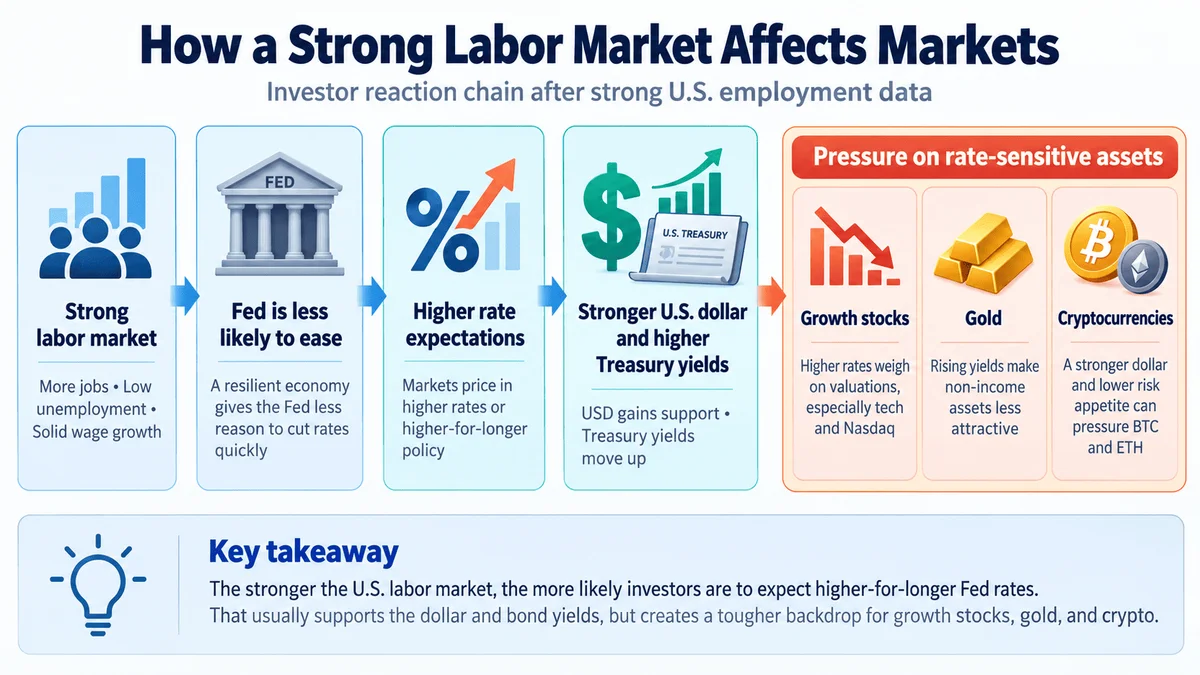
However, weak statistics do not necessarily mean growth for all risky assets. If the labor market begins to deteriorate too quickly, investors may see this not as a reason for a rate cut, but as a threat of economic downturn. Therefore, it is important not only to look at the Nonfarm Payrolls figure itself. It is worth looking at three indicators: the number of new jobs, unemployment, and wage growth.
For example, a situation where there are fewer jobs but wages continue to grow rapidly gives a mixed signal: the economy is cooling, but inflationary pressure remains.
What to watch: Nonfarm Payrolls, unemployment rate, average hourly wage, number of JOLTS vacancies, yield on two-year US government bonds, and the DXY dollar index.
How Confident Are Consumers About the Future
On September 29, the Conference Board Consumer Confidence Index will also be released. It shows how Americans assess their financial situation, the labor market, and economic prospects.
In August, the index fell from 90.2 to 89.4 points. At the same time, assessments of the current situation improved, while expectations for the coming months became more pessimistic. The next publication is scheduled for September 29.
For a trader, this indicator is useful as an additional check of the state of the economy. Consumer spending plays a significant role in the US economy. If people are confident in their income and jobs, they are more willing to make large purchases, use credit, travel, and spend money on services. A decline in confidence can gradually lead to more cautious behavior.
It will be especially interesting to compare Consumer Confidence with labor market statistics. If the number of vacancies decreases simultaneously with worsening consumer expectations, the market will receive a more convincing signal of economic slowdown. If consumer sentiment improves and employment remains strong, investors may decide that the economy is still coping with high rates.
What to watch: overall Consumer Confidence index, consumer expectations, and their assessment of job availability.
ISM Manufacturing: What Is Happening with American Industry
On October 1, the ISM Manufacturing PMI for September will be released – one of the main indicators of the state of the US industrial sector. The report is published on the first working day of the month.
PMI is based on company surveys. A value above 50 points usually indicates an expansion of activity, below 50 – a contraction. But traders should look not only at the overall index. There are several important components within the report:
New Orders shows the dynamics of new orders;
Employment helps assess enterprise demand for workers;
Prices Paid shows whether companies' purchase prices are rising or falling.
The last component is particularly interesting now. If companies simultaneously report high activity and rising prices, the market may see this as an additional inflationary risk. This creates an unpleasant combination for risky assets: the economy remains strong, prices rise, and thus, the Federal Reserve may maintain a high rate for longer. Weak PMI and falling prices, on the other hand, can strengthen expectations of a softer policy.
However, there is a third option: production slows down, but prices continue to rise. This scenario is more complex for the market because the regulator has to simultaneously fight inflation and consider economic deterioration.
What to watch: overall ISM Manufacturing PMI, New Orders, Employment, and Prices Paid.
Eurozone Inflation: Europe Remains in Focus
This week, important statistics will be released not only in the US.
On October 2, Eurostat will publish preliminary data on eurozone inflation for September. According to final data for August, annual inflation was 3.2%, up from 2.9% in July. Energy made a significant contribution to the rise in prices. For the market, the main question is whether the acceleration of prices continued in September.
High inflation reduces the European Central Bank's room for easing monetary policy. Therefore, an unexpected increase in the indicator may support European bond yields and affect the euro exchange rate.
It is especially important to look not only at the overall index but also at core inflation – an indicator without the most volatile components. It helps to understand how much price growth has spread to the economy as a whole.
For currency traders, the publication will be especially interesting through the EUR/USD pair. On Friday, it will be influenced almost simultaneously by two major factors: European inflation and the US labor market.
What to watch: overall and core eurozone inflation, energy prices, EUR/USD, and European bond yields.
Bitcoin: The Friday Report Is Also Important for the Crypto Market
Bitcoin has no direct connection with the number of jobs in the US. But labor market statistics can significantly change expectations for the Federal Reserve's rate, which in turn affects the dollar, the cost of money, and investors' willingness to buy risky assets. Therefore, Nonfarm Payrolls have long been an important publication for crypto traders.
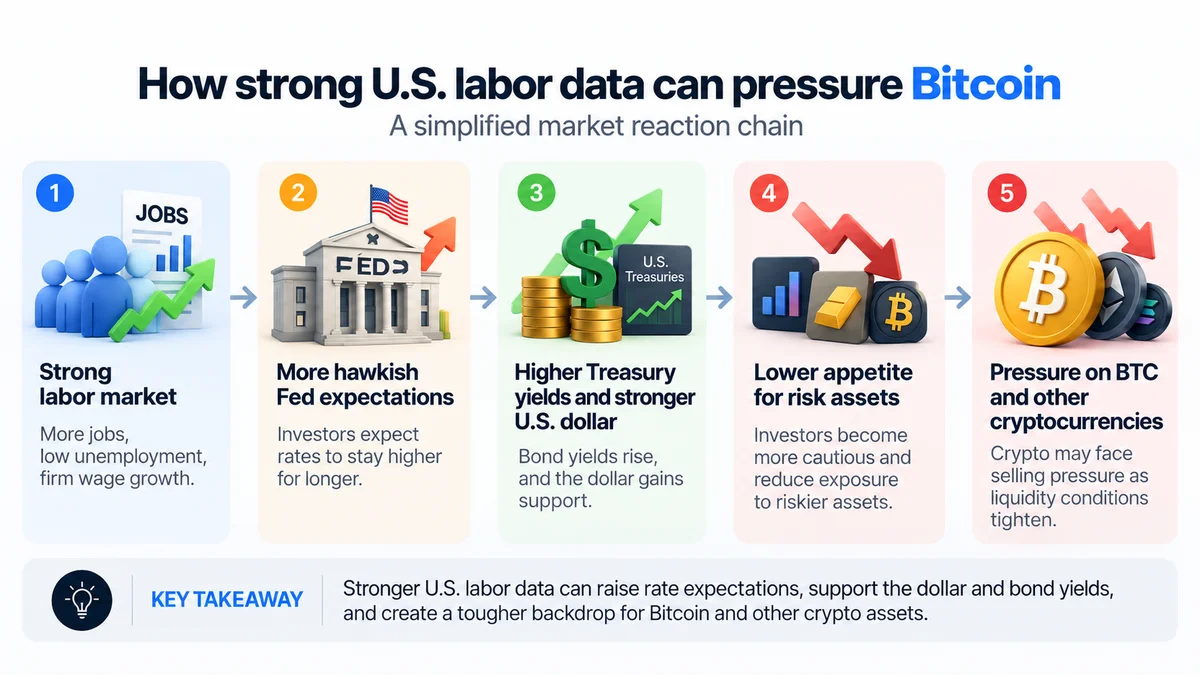
With weak statistics, the chain can work in reverse. If the likelihood of further rate hikes decreases, bond yields may go down, and conditions for risky assets become softer. But there is an important exception here. Very weak data can trigger fears of a recession. In such a case, investors may shy away from risk regardless of what the Federal Reserve does. Therefore, Bitcoin's reaction to a poor employment report does not necessarily have to be positive.
It is practically more useful to look not only at the first candle after the publication but at several markets at once. If after the report, the yield on two-year bonds falls, the dollar weakens, and the Nasdaq rises simultaneously, the upward movement of BTC receives macroeconomic confirmation.
If Bitcoin moves in the opposite direction, the reasons may already be factors within the crypto market itself. Among them are capital inflows and outflows from crypto-ETF, liquidation of positions in the futures market, and specific industry news.
What to watch: BTC/USD, ETH/BTC, DXY dollar index, yield on two-year Treasuries, and fund flows into crypto-ETF.
Nike: What the Company's Report Will Tell About the Consumer
In addition to macro statistics, there will be several corporate events during the week. One of the most notable will be Nike's report for the first quarter of fiscal year 2027. The company will release results on October 1 after the close of the main trading session in the US.
For the market, Nike's report is interesting not only for the dynamics of a single stock. The company sells clothing and footwear worldwide, so its results help assess the state of consumer demand. Investors will look at sales, business profitability, inventory levels, and management forecasts.
If Nike reports stable demand and improves expectations, this could be another argument in favor of the consumer still coping with high interest rates. Weak sales or a cautious forecast, on the other hand, will be especially noticeable against the backdrop of Consumer Confidence and labor market statistics.
And here arises an interesting opportunity to compare two types of data: at the beginning of the week, we will learn how American consumers assess their situation, and then we will see how their behavior is reflected in the real sales of a large company.
What to watch: Nike's revenue, margin, inventory, sales dynamics, and management forecast.
Seven OPEC+ Countries to Discuss Oil Production
Formally, the main trading week will end on Friday, but for the commodity market, an important event will take place on Sunday.
On October 4, seven OPEC+ countries participating in voluntary oil production cuts will hold another meeting. This group includes Saudi Arabia, Russia, Iraq, Kuwait, Kazakhstan, Algeria, and Oman. At the meeting on September 6, the countries decided to maintain September production levels for October. The next meeting is officially scheduled for October 4.
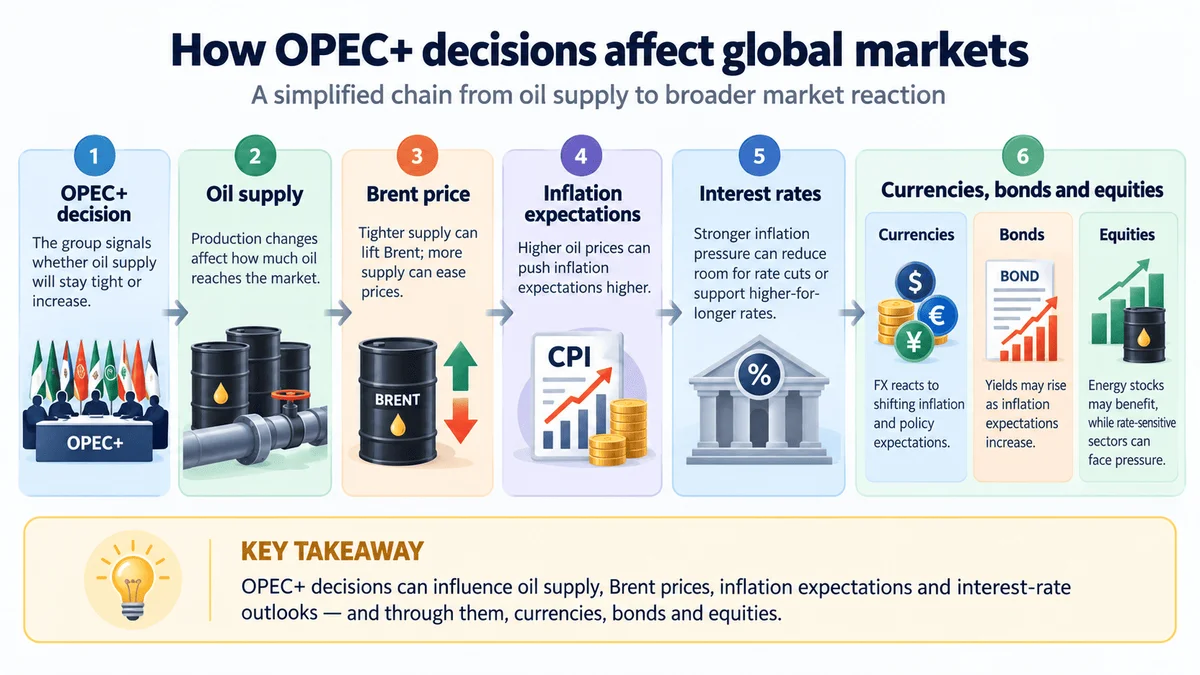
For the oil market, the main question is whether there will be signals of production changes in November. If the group decides to further restrict supply, it could support Brent and WTI. An increase in production, on the other hand, could put pressure on prices if demand does not grow at the same pace.
But the OPEC+ decision is important not only for oil traders. Expensive oil increases costs for companies and consumers and can intensify inflation. Therefore, significant movements in oil prices can eventually change expectations for central bank rates.
What to watch: OPEC+ decision, comments from member countries, Brent and WTI quotes.
Three Main Questions of the Week
1. Will the labor market provide the Federal Reserve with additional arguments for further rate hikes?
The answer will be sought in JOLTS, ADP, and the Friday Employment Situation report. Special attention should be paid to unemployment and wage data.
2. Is the US economy still coping with the high cost of money?
This will be indicated by Consumer Confidence, ISM Manufacturing, and corporate reports. If several indicators start to deteriorate, talks about economic cooling may intensify.
3. Will inflation become the main risk for markets again?
In the US, the answer will be partially given by wages and prices within ISM, in Europe – by the new inflation indicator, and in the commodity market, an additional factor will be the OPEC+ decision.
Main Events by Day
Mon, September 28 — start of the week and market positioning ahead of a series of employment reports.
Tue, September 29 — JOLTS for August, US Consumer Confidence Index.
Wed, September 30 — ADP Employment Report, last day of the month and third quarter.
Thu, October 1 — ISM Manufacturing PMI, Nike report.
Fri, October 2 — Nonfarm Payrolls, US unemployment and wages, preliminary eurozone inflation.
Sun, October 4 — meeting of seven OPEC+ countries on voluntary production cuts.