

A few years ago, one of the main arguments of Bitcoin supporters was quite simple: real growth would begin when institutional investors entered the market. Today, this scenario has largely been realized.
In the U.S., spot Bitcoin ETFs are operational, major asset managers offer access to cryptocurrency through familiar financial infrastructure, and Bitcoin has appeared on the balance sheets of public companies. Strategy has even turned BTC accumulation into the core of its corporate model.
However, the success of institutionalization has created a new question. If the most obvious new Bitcoin buyers have already appeared on the market, who should ensure the next major wave of demand?
This question becomes especially important during periods when capital inflow begins to slow down. In September 2026, Glassnode recorded a simultaneous weakening of several sources of new demand—from ETFs to corporate buyers. Yet, strong inflows into American spot ETFs returned within a few days.
Therefore, it is premature to say that Bitcoin has run out of buyers. The problem lies elsewhere: the market needs not just someone willing to buy BTC today, but a sustainable source of additional capital capable of maintaining demand at higher price levels.
Finding such a buyer could become one of the main questions in the next stage of the Bitcoin market's development.
Bitcoin Needs More Than Just Holders
The number of people and companies that already own BTC is important for assessing the spread of cryptocurrency, but this figure alone does not determine further price growth.
If an investor bought Bitcoin a few years ago and has simply held onto it since then, they remain an asset holder but do not create new demand at the moment. For the market to move to a higher price level, participants willing to invest additional capital and buy coins from those willing to sell at the current or higher price are needed.
In finance, such a participant is often called a marginal buyer. It is the willingness of the next buyer to accept a higher price that helps the market move forward.
This logic explains why analyzing Bitcoin demand cannot be reduced to the number of wallets, the size of the crypto exchange audience, or the total assets in ETFs. It is much more important to understand where the next dollar is coming from and how sustainable this capital flow remains.
Bitwise CIO Matt Hougan in June 2026 in the Weekly CIO Memo formulated a similar pattern while analyzing previous crypto market cycles:
Throughout the history of cryptocurrencies, new bull market cycles have relied on a combination of breakthrough products and new categories of investors.
In other words, previous major cycles were supported not only by technological developments and the emergence of new products but also by the entry of new groups of investors into the market. Now Bitcoin has once again reached a point where it is important for the market to understand who can become such a group next time.
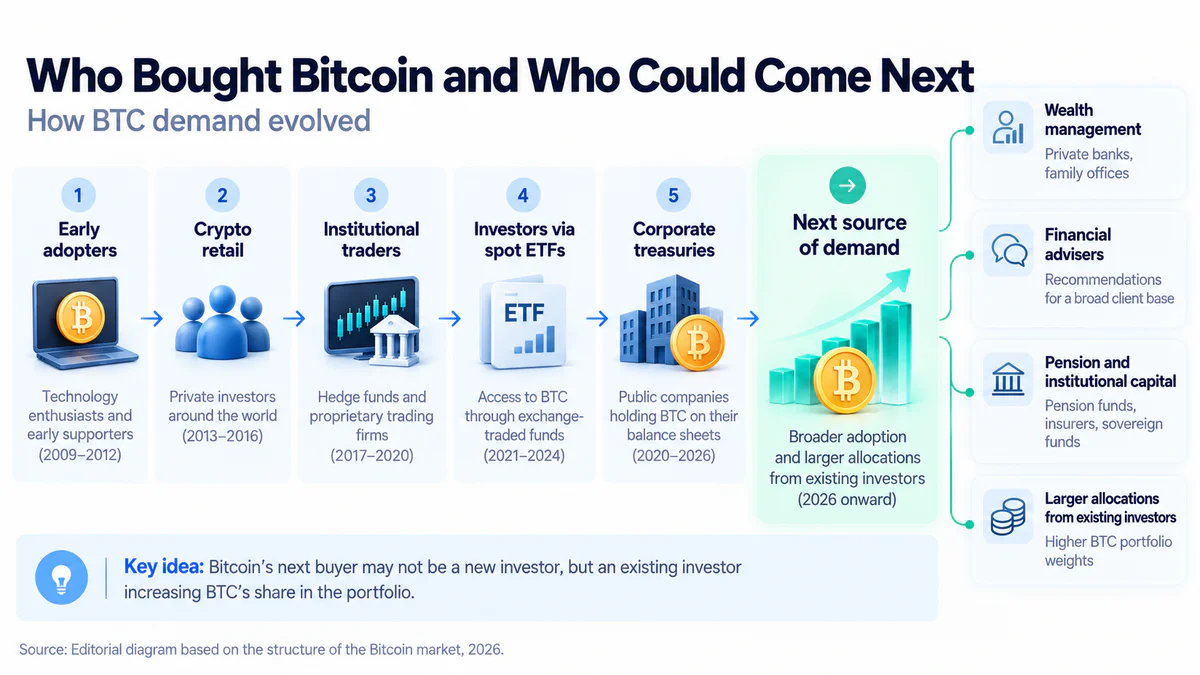
The Old Growth Engine Now Works Differently
In early cycles, one of the main sources of new demand was the retail investor. Bitcoin became more well-known, millions of new users appeared on crypto exchanges, and rapid price growth attracted the next wave of buyers. This effect was especially noticeable during periods of mass FOMO.
Today, separating retail and institutional demand is much more difficult, as private investors no longer need to open an account on a specialized crypto exchange or store coins themselves. They can gain exposure to Bitcoin through ETFs on a regular brokerage account, so a decrease in small wallet activity or changes in exchange flows does not necessarily mean retail demand has disappeared. Rather, the capital route itself has changed.
As a result, traditional indicators have become less clear-cut. Previously, the growth in the number of new users on a major crypto exchange could fairly well reflect the influx of retail investors, but today part of this demand may be passing through the traditional financial system.
The more important question remains: can the mass investor once again create a demand wave on the scale of previous cycles, or has a significant portion of the audience that wanted to buy Bitcoin already gained access and done so.
ETFs Opened the Door, But the Money Must Enter on Its Own
The launch of American spot Bitcoin ETFs has significantly simplified access to the asset. Investors no longer need to understand private keys, transfer funds to a crypto exchange, or solve storage issues themselves. Bitcoin has become available through the same accounts and infrastructure where stocks and bond funds are already located.
However, it is important to make a distinction here: an ETF is not an endless source of demand but rather an infrastructure through which this demand can come to the market.
The mere existence of a fund by BlackRock, Fidelity, or another manager does not mean constant Bitcoin purchases. For this, investors must direct new capital into such funds.
Therefore, when assessing institutional demand for Bitcoin, it is important to look not only at the total size of ETF assets but also at net new inflows.
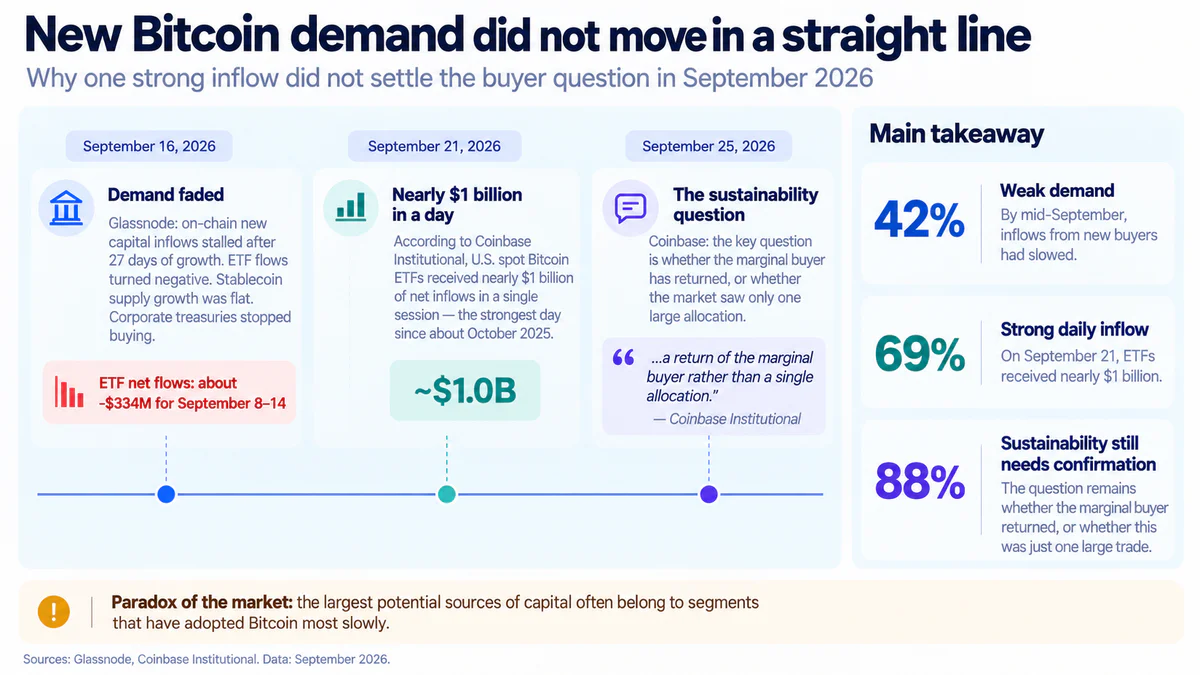
A good example was given in the second half of September 2026. On September 16, Glassnode analyst Frederik Thyssen wrote:
New demand has quieted: on-chain capital inflow stopped after 27 days of continuous growth, and ETF flows turned negative...
At that time, Glassnode noted several signs of weakening demand, including negative ETF flows, a halt in stablecoin supply growth, and reduced corporate buyer activity.
However, the picture changed quite quickly. According to Coinbase Institutional, on September 21, American spot Bitcoin ETFs received nearly $1 billion in a single trading session, marking the largest daily inflow since October 2025.
This is why one strong day does not yet answer the question of demand sustainability.
Senior Quantitative Strategist at Coinbase Institutional Colin Basco wrote that further ETF inflows could confirm:
...the return of the marginal buyer, rather than a one-time allocation.
This wording aptly describes one of the main problems of the current market. It is important not just to see a large purchase but to understand whether a sustainable marginal buyer has returned or if it is just a single large allocation.
Strategy Remains a Major Buyer but Cannot Be the Entire Market
Another notable source of demand has been corporate treasuries, with Strategy being the most well-known example of this approach. The company has effectively built a separate financial model around Bitcoin, using its own capital, debt instruments, and other funding sources to increase its BTC holdings.
The scale of its position is hard to ignore. In a statement dated October 5, Strategy indicated that as of October 4, it owned 848,000 BTC. On September 28, the company acquired 1,665 BTC, and on October 5, it announced the purchase of an additional 334 BTC.
For the market, this is a real source of additional demand, but the scale of Strategy leads to a more complex question: how many similar buyers can actually emerge in the future?
Corporate Bitcoin purchases depend on the state of capital markets, the cost of financing, the valuation of the company's own stock, and investors' willingness to support such strategies. Therefore, past purchase rates cannot be automatically projected into the future.
Moreover, Bitcoin's reliance on a few particularly large companies increases demand concentration. The more significant the role a small group of corporate buyers plays in new capital inflow, the more important the question becomes of what happens if they temporarily reduce activity.
September has already shown how quickly this effect can become noticeable. Glassnode included the slowdown in Bitcoin purchases by corporate treasuries among the signs of weakening new demand.
Strategy and other corporate holders can support the market, but for a prolonged new Bitcoin cycle, a significantly broader capital base is likely needed.
The Next Buyer May Not Be New at All
Here arises an important paradox: Bitcoin does not necessarily need hundreds of millions more people who have never owned it before.
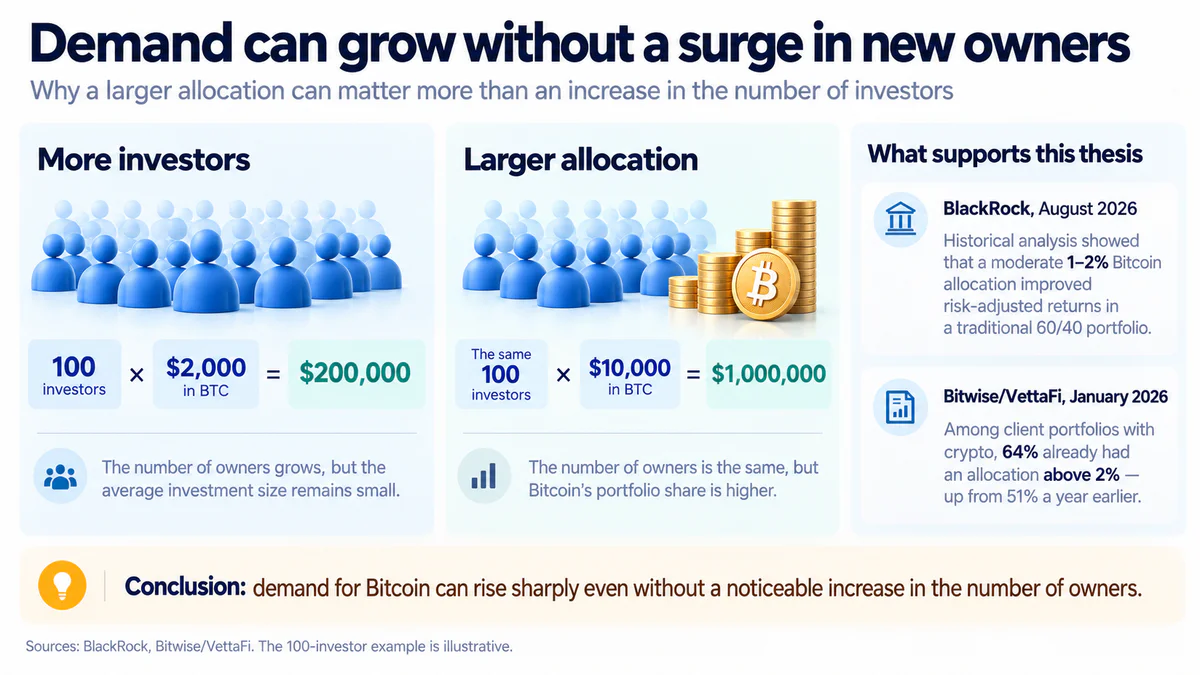
The next big source of demand might be among existing holders. If Bitcoin occupies 0.2% of an investor's portfolio and then its share increases to 1%, the owner remains the same, but the amount of capital directed into BTC increases several times over.
In the context of the capital management industry, pension capital, and other large segments, even a small change in average allocation can mean significant additional demand.
This scenario is gradually becoming part of the discussion within the traditional financial industry.
In August 2026, BlackRock's Head of Digital Assets Robbie Mitchnick wrote:
We believe that a weighted asset allocation can continue to serve as a potential tool for strategic diversification for long-term investors.
In the same study, BlackRock examined the historical effect of a moderate Bitcoin allocation of 1–2% in a traditional 60/40 portfolio. This does not mean that such a share is suitable for every investor, but it clearly shows how the discussion itself is changing.
Now the question is increasingly shifting from whether to buy Bitcoin at all to how much of the portfolio to allocate to it. This is a fundamental change for future demand.
Bitcoin Is Already Owned by Most Wealthy Crypto Investors
Recent data simultaneously confirms the potential of such a scenario and highlights its limitations.
In October 2026, CoinShares published the results of a survey of 2,230 investors with investment assets of at least $500,000 in the U.S., UK, France, Germany, Italy, Sweden, and Switzerland.
More than half of respondents in all seven countries already owned digital assets, and among crypto owners, Bitcoin was in the portfolio of an average of 80%.
At first glance, this might seem like bad news for the idea of the next new buyer, as a significant portion of the affluent audience is already familiar with the market. However, other survey results significantly change the picture.
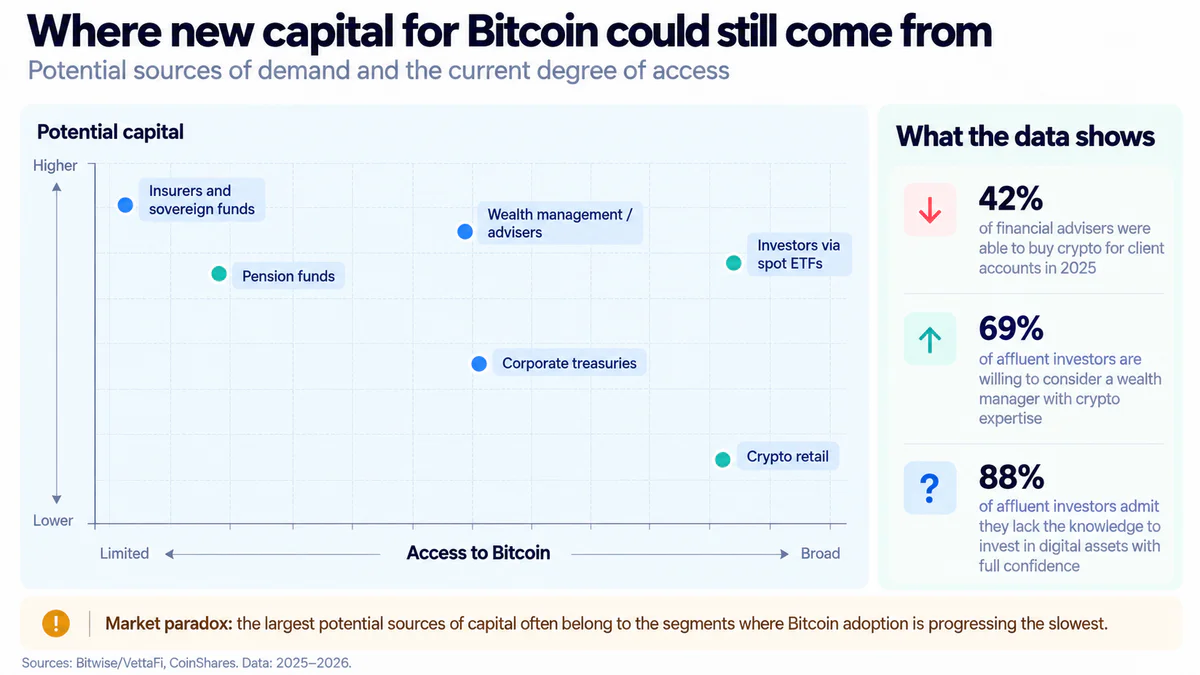
About 88% of respondents admitted that they lack the knowledge to invest confidently in digital assets independently. Meanwhile, asset managers turned out to be the most trusted source of information for this audience, and 69% of respondents were willing to consider working with an advisor who has expertise in cryptocurrencies.
The study has an obvious limitation: it was commissioned by CoinShares, which itself operates in the digital asset market, and the sample consisted of wealthy investors and does not represent all market participants. Nevertheless, the results show an important trend.
Potential new demand may arise not only from attracting new owners but also through more professional management of existing positions.
Financial Advisors Could Become the Next Capital Channel
Financial advisors appear to be one of the most interesting potential sources for the next stage of institutional Bitcoin adoption.
According to a survey by Bitwise/VettaFi among 299 financial advisors in the U.S., in 2025, 32% of surveyed advisors invested in crypto assets on client accounts, compared to 22% the previous year. However, only 42% said they even had the ability to buy cryptocurrency for clients.
This means there is still room for further expansion.
The dynamics of position sizes are no less interesting. Among client portfolios with crypto, 64% already had an allocation above 2%, compared to 51% a year earlier.
These data well illustrate a possible new model of demand growth. The market does not necessarily need to move from zero to tens of millions of new owners. A significant effect can come from a gradual transition from zero allocation to 0.5%, then to 1%, and further to a more noticeable share of the portfolio.
Meanwhile, advisors are interested not only in Bitcoin. Bitwise notes a growing interest from the professional audience in stablecoins and tokenization, meaning BTC now has to compete for new capital even within the crypto market itself.
Institutional Investors Have Arrived, But Not All
The phrase "institutional investors have already come to Bitcoin" also requires clarification, as the institutional market itself is far from homogeneous.
Hedge funds, family offices, pension funds, endowments, insurance companies, and sovereign wealth funds operate with different constraints and different speeds of decision-making. Some can relatively quickly add new assets to their portfolios, while others require months or years due to investment mandates, internal committees, risk requirements, and regulations.
In 2026, Bitwise conducted in-depth interviews with representatives of 15 large institutional investors. Participants included organizations from pension capital segments, endowments, multi-family offices, and sovereign wealth funds. Bitwise notes that even after a significant crypto market downturn, none of the respondents planned to reduce their long-term exposure to this asset class.
The sample is too small to generalize this result to the entire financial industry, but it shows that the potential for institutional demand cannot yet be considered exhausted.
The main question is how quickly this potential can turn into actual Bitcoin purchases. For the price, it is not the size of the capital that could theoretically come to the market someday that matters, but the speed at which it actually starts to work.
Bitcoin Competes for Every New Dollar
There is another problem that received less attention in previous cycles.
An investor does not choose between Bitcoin and no investment. They allocate capital among a large number of alternatives, including tech stocks, AI, gold, bonds, private lending, real estate, the money market, and other cryptocurrencies.
In June, Matt Hougan from Bitwise noted that in conversations with financial advisors, he also saw increased interest in stablecoins and tokenization.
This changes the very framing of the question. It is not enough for Bitcoin to remain merely an interesting asset—it has to compete for every next investment dollar with other opportunities in the global financial market.
For marginal buyers, this is especially important because the more attractive alternatives an investor has, the more compelling the investment case for Bitcoin must be.
How to See the Return of New Demand
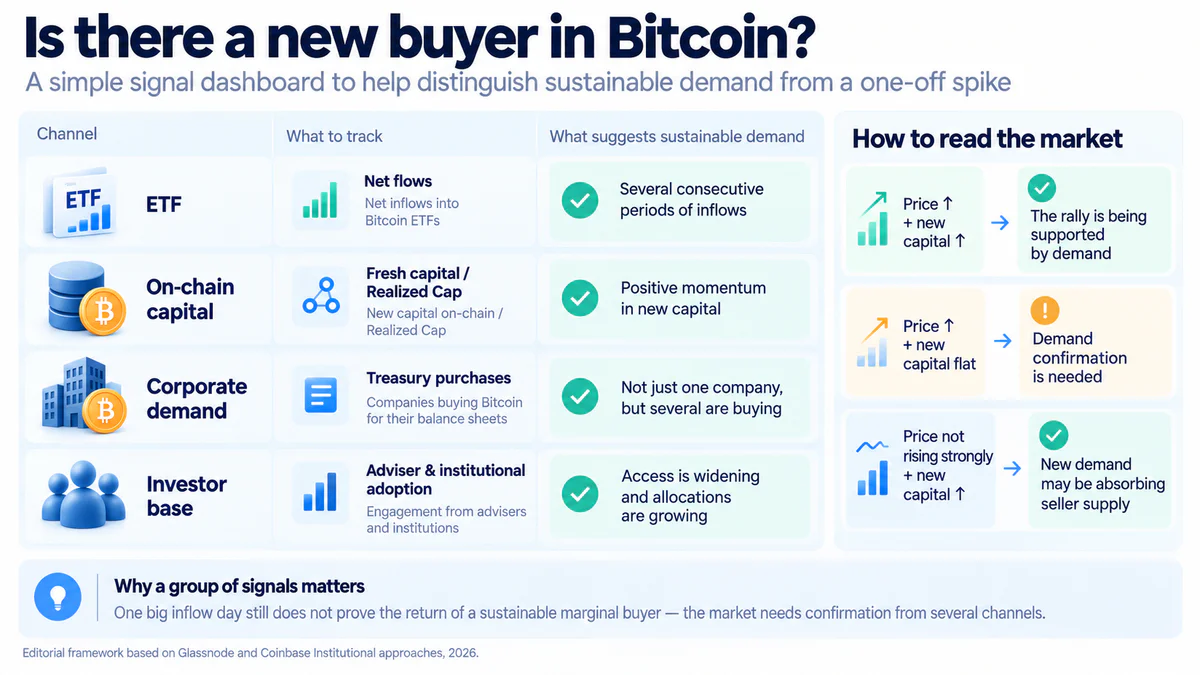
No single indicator can reliably answer the question of who is buying Bitcoin and how sustainable that demand is.
Price growth, for example, may be accompanied by strong ETF inflows but may also be related to limited supply from sellers, changes in derivative market positions, or short-term liquidations.
Therefore, it is wiser to assess Bitcoin demand across multiple dimensions:
net inflows and outflows from Bitcoin ETFs;
corporate treasury purchases;
changes in realized capitalization and on-chain new capital inflow;
activity of long-term holders;
stablecoin supply and overall crypto market liquidity;
behavior of retail investors;
spread of Bitcoin among advisors and institutional portfolios.
It is especially useful to see if these indicators confirm each other.
If the price rises simultaneously with sustainable ETF inflows and an increase in new on-chain capital, the argument for the return of demand becomes stronger. However, if prices rise and the main sources of fresh money remain largely unchanged, such movement requires more cautious interpretation.
How to Test the Hypothesis Yourself
For a preliminary analysis of such connections, AI tools can also be used. For example, Ask Axi from broker Axi allows you to explore market trends and events, ask questions about individual instruments, and compare different assets.
Instead of a general question about whether Bitcoin will rise, it is more useful to test specific hypotheses, such as comparing BTC dynamics with other risky assets or analyzing which events might have influenced current demand.
However, Ask Axi does not provide personal investment recommendations, so the results of AI analysis should be used as an additional information source, not as a ready-made trading solution.
Who Will Buy Bitcoin Next
Summarizing the above, it can be said that the market still has several potential sources of new capital.
One potential source of new demand remains the further spread of ETFs. The infrastructure already exists, but not all traditional financial capital has gained or used access to Bitcoin.
The second source could be the increase in allocations by existing investors. Even without a sharp increase in the number of owners, a transition from a small experimental position to 1–2% of a portfolio could significantly change the volume of demand.
The third channel could be financial advisors and asset managers, who can gradually turn Bitcoin from a separate speculative position into one of the standard components of some client portfolios.
Another potential source is large institutional categories, where adoption is still developing more slowly. Pension funds, endowments, insurance companies, and sovereign wealth funds have enormous capital but operate within much stricter investment frameworks.
Finally, corporate treasuries remain, although it would be too optimistic to expect that the Strategy model can be endlessly replicated on a comparable scale.
Therefore, the next wave of demand is unlikely to come from a single source. It may consist of many smaller changes—increased ETF allocations, expanded access through financial advisors, growth in existing owners' positions, and gradual involvement of institutional capital.
Bitcoin Hasn't Run Out of Buyers
Data does not yet allow us to conclude that demand for Bitcoin has reached its ceiling.
September 2026 clearly demonstrated this. In the middle of the month, Glassnode recorded a halt in new demand across several channels, but within a few days, American Bitcoin ETFs received one of the largest inflows in nearly a year.
The problem lies elsewhere. As the Bitcoin market matures, it becomes more challenging to find new large categories of buyers whose emergence can itself dramatically change the demand structure.
Retail investors are already well acquainted with Bitcoin, ETFs are operational, Strategy and other corporate treasuries are present in the market, and institutional infrastructure has significantly developed. Therefore, the next stage may be less spectacular than previous ones.
Instead of millions of new accounts on crypto exchanges, the market may see a gradual increase in allocations within the traditional financial system. Instead of one new category of buyers, there may be multiple channels through which capital will flow in small but potentially more sustainable streams.
This is why the main question for Bitcoin now is not whether there is anyone left who hasn't bought BTC yet.
It is much more important to understand who is willing to invest more capital in Bitcoin than today and whether this demand can remain sustainable enough to support the next stage of market growth.
This material is prepared solely for informational purposes and does not constitute financial advice or a recommendation.