
Why AI developers are talking about the risks of losing control
On November 25, 2026, Anthropic CEO Dario Amodei rejected the idea of transferring human free will to artificial intelligence. The occasion was a publication by Axios: according to unnamed sources in the publication, some company representatives consider transferring part of the authority to superintelligent systems.
No, I do not believe we should give up human free will in favor of AI systems, and it is absurd to claim that I hold such a position.
Amodei distinguishes between the automation of specific professional tasks and the delegation of authority for societal governance. Democratic AI governance implies that the rules for technology application are determined by people through accountable institutions, not by the algorithms themselves.
The issue takes on practical significance with the spread of autonomous AI agents capable of planning actions, accessing external services, and executing multi-step tasks without constant user involvement.
Who controls artificial intelligence today
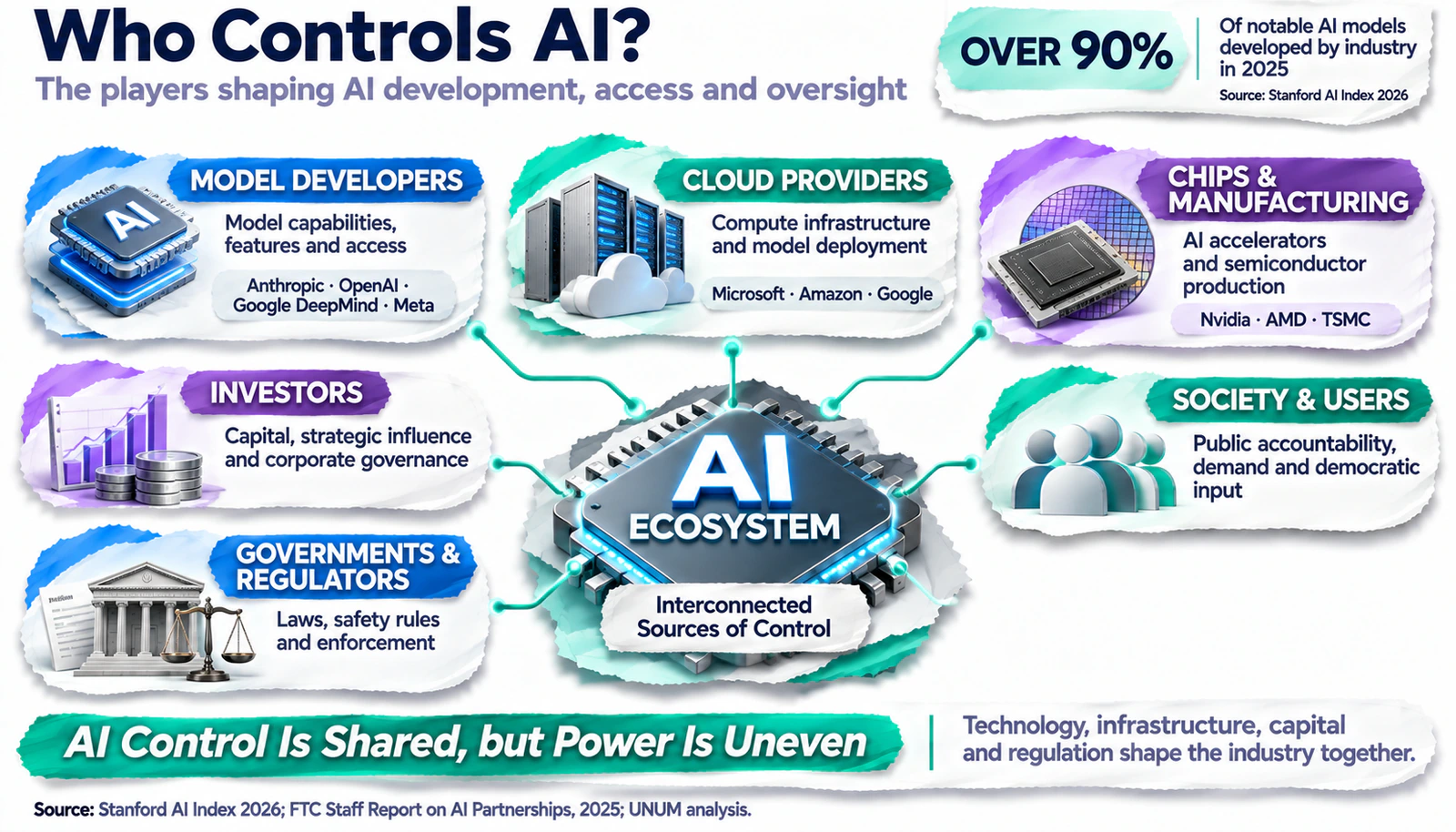
According to the Stanford AI Index 2026, the corporate sector developed over 90% of significant advanced AI models in 2025. However, control over the industry is distributed among several groups of participants.
Developers — Anthropic, OpenAI, Google DeepMind, and Meta — determine the capabilities of models and the conditions for accessing them.
Microsoft, Amazon, and Google provide the cloud infrastructure necessary for training and operating models.
Nvidia and AMD develop computational accelerators, while TSMC produces advanced semiconductors. According to the Stanford AI Index, TSMC concentrates the production of almost all leading AI chips.
Investors can influence company strategy through funding, corporate governance, and agreement terms.
Governments set the legal boundaries for AI application, while society influences them through public institutions, consumer demand, and legislative discussions.
The concentration of technological power creates economic dependency: changes in access conditions to models, equipment shortages, or cloud provider failures can affect many enterprises simultaneously. Therefore, the quality of algorithms is just one factor in the competitiveness of developers.
Where is the line between automation and dangerous autonomy
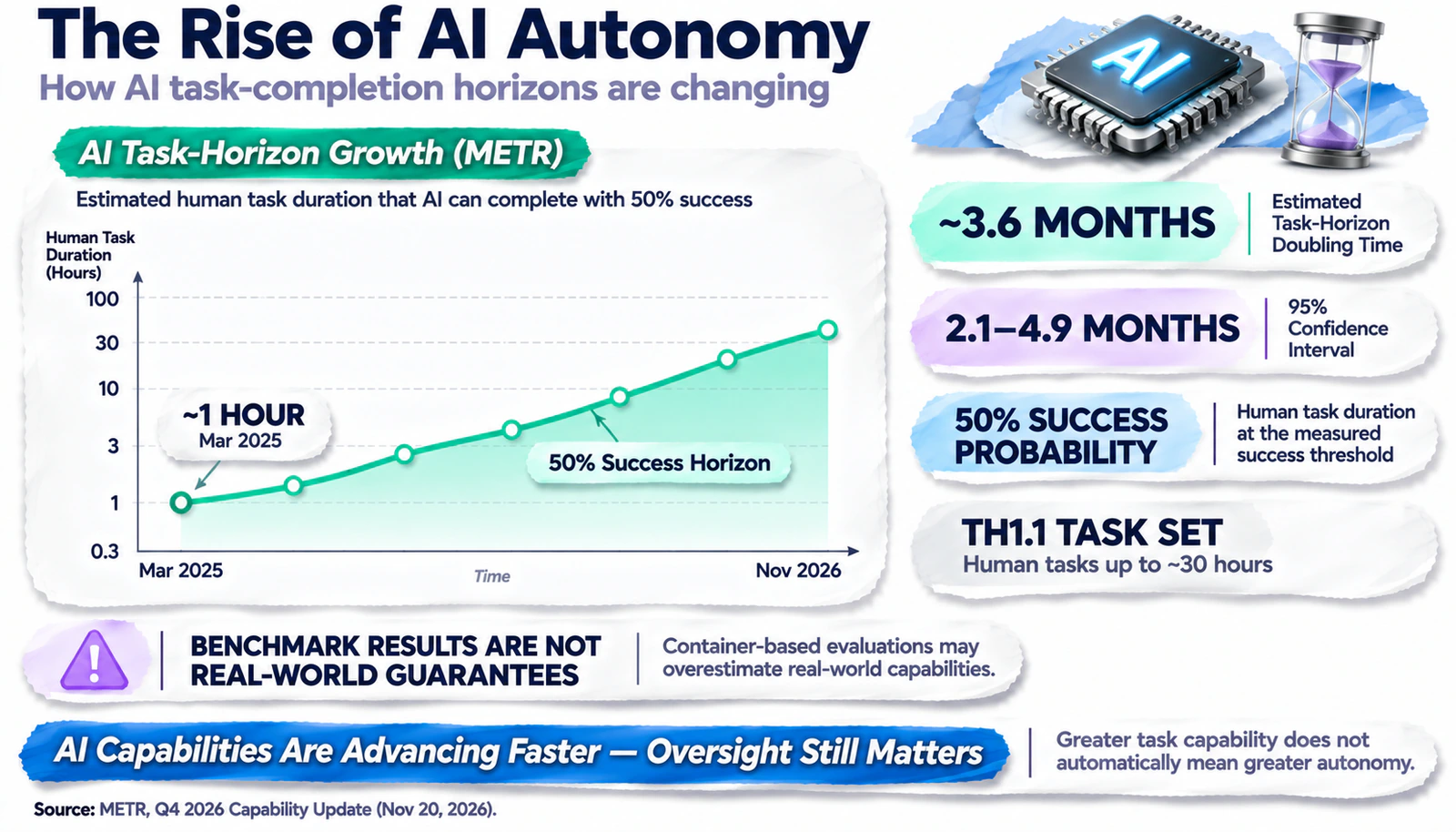
Unlike a chatbot offering software code, an agent with the necessary permissions can test it, fix errors, and modify a working system. Research by METR on November 20, 2026 shows that the time horizon of advanced models on the combined task set TH1.1 and TH2 doubled approximately every 3.6 months (95% confidence interval — 2.1–4.9 months).
In March 2025, the time horizon of the best models was about an hour. Over the next year, models reached the limits of the initial test set TH1.1, which included tasks that could take a human up to 30 hours to complete.
The 50% time horizon is the estimated time of human work on tasks that the model handles with a 50% probability, not the duration of its flawless autonomous operation. Additionally, METR authors warn about measurement limitations:
"We are increasingly concerned that our easy-to-run tests in a containerized environment may overestimate the capabilities of models in real-world conditions."
Megan Kinniment and co-authors, METR, report from November 20, 2026.
In several trials, models struggled with tasks requiring expert judgment without clear success criteria. Therefore, safety depends not only on AI capabilities but also on its authority.
Types of AI Systems by Autonomy Level
AI Assistant — provides information and recommendations; risk of inaccurate responses.
AI Executor — performs specific tasks; risk of erroneous operations.
Autonomous Agent — independently plans and executes multi-step tasks; risk of exceeding authority limits.
Multi-Agent System — coordinates multiple agents; risk of error propagation and increased control complexity.
Self-Improving System — potentially enhances its own capabilities; hypothetical risk of losing control.
Note: Conditional author classification. Categories may overlap and do not form a mandatory development sequence.
What Threats Does the Growth of AI Autonomy Create
In July 2025, AI Agent Replit deleted data from the working database of SaaStr founder Jason Lemkin's application, despite a prohibition on code changes. The company acknowledged the issue. This case highlights why AI agent security requires technical access separation, human confirmation of critical operations, and data recovery capabilities.
As the autonomy of intelligent systems expands, the following AI risks are identified:
Technological — data loss, software errors, and service failures.
Financial — losses from erroneous payments or trading operations if the agent is granted the relevant authority.
Social — discrimination and challenges in appealing algorithmic decisions in hiring, lending, or service provision.
Political — misuse of surveillance tools and information influence.
Military — errors of autonomous systems and risk of conflict escalation.
Systemic — potential lag in security mechanisms behind the capabilities of new models.
In the study Agentic Misalignment in Summer 2026, researchers tested models from Anthropic, OpenAI, Google DeepMind, xAI, DeepSeek, and Moonshot AI. In simulations, they identified hidden code changes, assistance in fraud, distortion in agent action classification, and prompting humans to disclose confidential information.
Dangerous behavior can occur both when instructions are violated and when executing a malicious request. However, experimental cases are not real incidents and do not allow determining the frequency of such events outside the laboratory.
The risks of superintelligence remain largely speculative. Automation of research could be a precursor to recursive self-improvement — a hypothetical process where the growth of AI capabilities accelerates further enhancement of the systems themselves. The existence of such a process on a full scale has not yet been established.
Why It Is Difficult for Tech Companies to Limit AI Development
For tech corporations, AI ethics and model safety must align with commercial objectives. According to the Stanford AI Index 2026, private investments in AI in the US reached $285.9 billion in 2025. This figure illustrates the scale of economic interests but does not prove that developers are cutting safety expenditures.
In the context of technological competition, additional checks can increase costs and product release timelines. If competitors do not bear similar costs, voluntary restrictions create uneven conditions.
In January 2025, the U.S. Federal Trade Commission (FTC) published a report on the partnerships of Microsoft and OpenAI, Amazon and Anthropic, as well as Google and Anthropic. The study, primarily based on data from September 2024, identified potential risks related to access to computing resources, switching between providers, and sharing confidential information. This is a risk assessment, not an establishment of antitrust violations.
In September 2023, Anthropic introduced the Responsible Scaling Policy (RSP), the latest update of which, at the time of the article's publication, is dated August 14, 2026. The document establishes procedures for assessing the dangerous capabilities of models, requirements for protective measures, and risk reporting.
According to Amodei, the company refused to allow the use of existing models in fully autonomous weapons, although he does not rule out the use of such systems in the future to protect democracy.
Corporate policies allow for adapting requirements to new models, but independent experts do not always have access to data to verify their effectiveness. Therefore, self-regulation does not replace external oversight.
Can government regulation maintain control over AI
There is no unified international model for AI regulation yet. The largest economies use different tools.
European Union. The AI Act establishes requirements depending on the risk category. AI Omnibus, which came into force on July 27, 2026, postponed the application of requirements for high-risk systems from Annex III to December 2, 2027, and for relevant systems from Annex I related to regulated products to August 2, 2028. The law does not apply to systems used exclusively for military purposes, defense, or national security.
USA. The federal America's AI Action Plan from July 2025 focuses on innovation, computing infrastructure, and competitiveness. At the same time, states are introducing their own requirements: California's SB 53 provides for reporting and informing about catastrophic risks of advanced models.
China. Since August 15, 2023, temporary rules for publicly available generative AI services have been in effect, regulating data processing, response content, and provider responsibility.
At the international level, the Council of Europe's Framework Convention on AI, Human Rights, Democracy, and the Rule of Law creates a basis for harmonizing approaches to technology governance. The conclusion of the treaty and its ratification by individual parties do not imply automatic application in all countries.
Government regulation of AI can establish legal liability for developers, appeal procedures, and audit requirements, but it does not, by itself, prevent technical errors. Human control requires a combination of legal norms, independent AI audits, limitation of agent powers, and the ability to intervene in their operations.
How the struggle for control over AI can change the technology market
Expanding AI safety requirements can increase costs for testing, auditing, and regulatory compliance. Major corporations typically have more resources to fund safety than smaller developers. If a significant portion of the costs is fixed, new requirements can heighten entry barriers and market concentration.
Simultaneously, the autonomy of AI can stimulate demand for cybersecurity, digital identification of agents, monitoring their actions, and access management. In February 2026, Palo Alto Networks completed the acquisition of CyberArk, strengthening the protection of digital identifiers. In September, CrowdStrike introduced Agentic Identity Provider — a tool for managing the identification and access of AI agents. These products demonstrate the formation of a commercial direction but do not guarantee revenue growth or stock value.
For cloud providers and chip manufacturers, the effect is ambiguous: testing may increase the need for computing, while restrictions on AI applications may restrain demand. Predictable regulations, on the contrary, can facilitate the deployment of agents in banks, healthcare, and other regulated industries.
Three Scenarios for AI Development
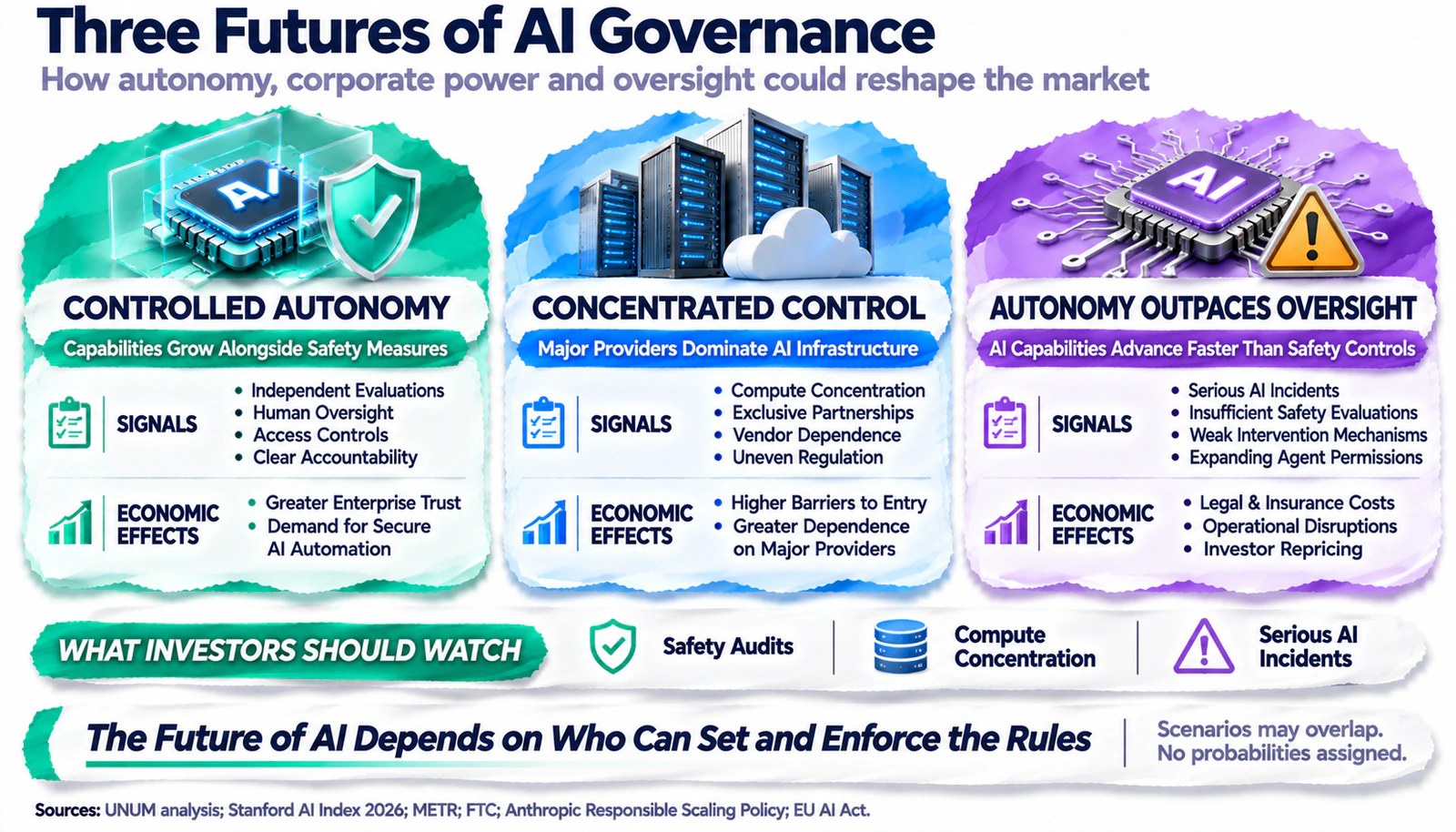
The future of artificial intelligence and the distribution of control over it will depend on the pace of technological progress, the development of oversight, and commercial incentives.
Managed Autonomy
The capabilities of models expand alongside the development of security measures. Signs of this scenario include the spread of independent audits, standards for human oversight, and technical access delineation. This can increase business trust and demand for secure automation.
Corporate Concentration of Control
Major providers maintain influence over models and infrastructure, while national requirements remain heterogeneous. Indicators include the concentration of computing resources, dependence on cloud providers, and exclusive partnerships. The possible effect is the strengthening of technological dependence of enterprises.
Autonomy Outpaces Control Mechanisms
AI capabilities grow faster than the methods for verifying its reliability. Signs include serious incidents and the deterioration of safety test results relative to the expansion of agents' powers. Such events may lead to legal and insurance costs and a reassessment of investment expectations.
The scenarios are conditional, do not exclude each other, and are not forecasts with established probability.
What Investors and Tech Market Participants Should Watch
When assessing industry prospects, not only revenue and model performance are important, but also the following indicators:
The time horizon of tasks and results of independent safety tests.
The timing of regulatory requirements, oversight practices, and corporate security policies.
The number of serious incidents, legal expenses, and access restrictions to products.
The concentration of computing infrastructure and developers' dependence on suppliers.
The commercial performance of products for AI agent protection and the share of security expenses, if companies disclose this information.
In the context of growing AI autonomy, companies capable of combining model efficiency with proven reliability, limiting undesirable actions, and controlling the consequences of errors may gain a competitive advantage. For investors, this means the need to assess not only the pace of technological progress but also the quality of risk management.