

Good news about Bitcoin does not always lead to a price increase. On January 11, 2024, trading of spot Bitcoin ETP shares, commonly referred to as ETFs, began in the US. They allowed for price exposure to Bitcoin through a brokerage account without directly purchasing coins. On the first day of trading, Bitcoin rose to about $49,000. But by January 12, its price fell below $42,000.
This does not mean that the ETF launch was an unimportant event. It's just that the significance of the event for the market and the price reaction on a specific day are different things. Participants might have prepared for the news in advance, expected a different outcome, or simultaneously reacted to other events.
To understand such movements, it's not enough to categorize headlines as 'good' or 'bad'. It's necessary to understand what exactly happened, what expectations have changed, and what the available data confirms.
Bitcoin's price is formed from the transactions of buyers and sellers. News can change their expectations and decisions. But movement after publication does not prove that it was this news that caused it.
Where Bitcoin's Price Comes From
As is known, Bitcoin does not have an organization that sets a single price for the entire world. On trading platforms, participants place orders: some are ready to buy BTC, others to sell. When conditions match, a transaction occurs.
On an exchange, the price of the last transaction becomes one of the current quotes. Market statistics websites can also show a composite price calculated from data from several platforms.
The price changes when participants agree to new conditions. If buyers purchase available offers and are willing to pay more, subsequent transactions may occur at higher prices. If sellers are in a hurry to sell, they have to agree to lower prices available in buyers' orders. Therefore, the expression 'more buyers than sellers' is not entirely accurate: each transaction has both sides. The volume of orders and participants' willingness to accept a different price are important.
The scale of movement is influenced by liquidity – the ability to buy or sell an asset without significantly changing its price. When there are many orders near the current quote, the market can more easily absorb a large transaction. If there are few orders, executing the same volume can shift the price more.
Bitcoin's rules limit the total issuance to about 21 million coins. But a limited quantity does not guarantee a constant increase in value. Already issued coins can be put back on sale, and demand for them can increase or decrease.
What News Affects Bitcoin
News matters when it can change demand, supply, market access, or participants' confidence. At the same time, some events affect several directions at once.
“To filter out 90% of noise and understand the real strength of an event, attention is paid to four key blocks: macroeconomics and regulator policies (US Federal Reserve, SEC), large capital movements (On-Chain data), key ecosystem and mining events, liquidity changes and stablecoins, issuance of new stablecoins (USDT/USDC). If new dollar liquidity enters the market, the market gains a physical resource for growth”, notes a business analyst from the crypto exchange Tradex.
Inflation, Interest Rates, and Economic Conditions
Bitcoin exists outside the banking system, but it is bought by people and companies who use credit, hold money in accounts, and invest in other assets. Therefore, central bank decisions affect the crypto market as well.
The US Federal Reserve influences the cost of credit and overall financial conditions. Changes in rates affect business and consumer decisions about spending and savings. The Fed's statements about its potential future policy are also significant.
For Bitcoin, this connection is indirect. More expensive money and reduced willingness to take risks can weaken demand for cryptocurrency. Softer financial conditions can support it. However, this is not a rule with a guaranteed outcome: the reaction depends on the reasons for the decision, expectations, and other market events.
Therefore, in news about inflation, it's important to look not only at whether the indicator increased or decreased. What matters is how much the result differed from published forecasts and what it might change in rate expectations.
Regulatory Decisions
New rules can change the operating conditions of exchanges, the availability of crypto products, and the participation of financial companies in the market.
But 'proposed a law', 'passed a law', and 'law came into force' are different events. Also, the permission of a specific product and the approval of the asset itself differ.
For example, on January 10, 2024, the US Securities and Exchange Commission (SEC) approved the listing and trading of shares of several spot Bitcoin products. In its statement, the regulator specifically emphasized: this decision does not mean approval or support of Bitcoin itself.
Company Purchases and Fund Flows
A report about a large company's BTC purchase can change perceptions of demand for the asset. However, it's first necessary to clarify whether it's an intention, an agreed plan, or a completed purchase.
With funds, another difference is important – between trading volume and money inflow. Trading volume shows the amount participants bought and sold fund shares for. Net inflow shows the difference between funds received and withdrawn. These are different indicators.
The difference is clearly visible in the data from the first week of trading American spot Bitcoin ETFs. We will analyze this example separately below.
Changes in the Bitcoin Network
One of the most well-known examples is halving. This is the network's rule-based reduction of new Bitcoin issuance per block by half. A block is the next record with transactions in the network's shared history.
On April 20, 2024, the block subsidy decreased from 6.25 to 3.125 BTC. Transaction fees are not included in the subsidy and continue to be paid to miners separately. Thus, halving reduced the issuance of new coins but did not affect Bitcoins already held by owners.
Halving does not occur unexpectedly. The mechanism is known in advance. Therefore, the fact of issuance reduction does not explain how the price should change on a specific day. It is necessary to consider both demand and sales of previously issued coins.
*All historical examples are provided to explain the mechanism of reading news. They do not describe the current market situation.
Failures, Hacks, and Large Transfers
Problems with a trading platform can raise doubts about the safety of funds and the ability to conduct operations. When reading such news, it's important to establish the scale: is it about a company, a specific service, or the Bitcoin network itself?
Large transfers between addresses also require careful interpretation. A transaction confirms the movement of coins but does not explain its purpose. Even a transfer to an exchange address does not prove that the coins were sold. It also does not indicate that the sale will occur immediately. The transfer may be related to storage, internal movement, collateral, or preparation for a deal.
Additionally, exchanges move funds between their own wallets. For example, the analytical service CryptoQuant warns that such internal transfers can inflate raw inflow and outflow metrics and create a false impression of seller pressure.
News | What it can change | What needs to be clarified |
Rate decision or inflation data | Financial conditions and risk attitude | How much the result differed from expectations |
Regulator decision | Market access and company operating conditions | What exactly is allowed or restricted and from what date |
Company BTC purchase | Demand and expectations regarding new buyers | Deal completed or just planned |
Fund data | Capital movement representation | Is it about turnover, net inflow, or asset value |
Halving | Rate of new coin issuance | What actually changed and what was known in advance |
Large BTC transfer | Expectations of a possible sale | Is the purpose of the transfer known and is the deal confirmed |
Business analyst Tradex notes:
Trading solely based on news background is one of the riskiest strategies in the crypto market, akin to roulette.
The main reasons for the danger:
Information noise and manipulation. The crypto market is extremely vulnerable to fake news, paid media publications, and coordinated hype through social networks (X, Telegram). Insiders often launch an information trigger to create artificial liquidity — 'driving the crowd' into a flat or rise, then selling their assets to them.
The rule 'Buy on rumors, sell on facts'. By the time the news appears in major media, large players (market makers and institutions) have already priced it in or are closing their positions. A private investor buying on the news often enters at the very peak.
Context distortion. News is an isolated event. Without understanding the overall trend, liquidity level on exchanges, derivatives situation, and fundamental network indicators, the same information trigger can cause completely opposite market reactions.
Why Bitcoin Can Fall After Good News
The market reacts not only to events but also to the difference between expectations and the result.
If participants anticipate an important decision in advance, some of them buy the asset before the announcement. After the publication, some may decide to sell it. Therefore, an event that expands market opportunities does not necessarily lead to an immediate price increase.
This behavior is often described with the phrase 'buy on rumors, sell on facts'. It is a market expression, not a reliable rule or instruction for action.
Let's return to January 2024. The approval of spot Bitcoin ETFs took place on January 10, and trading began on January 11. After rising to about $49,000 on launch day, the price fell below $42,000 the next day. This is the observed sequence of events.
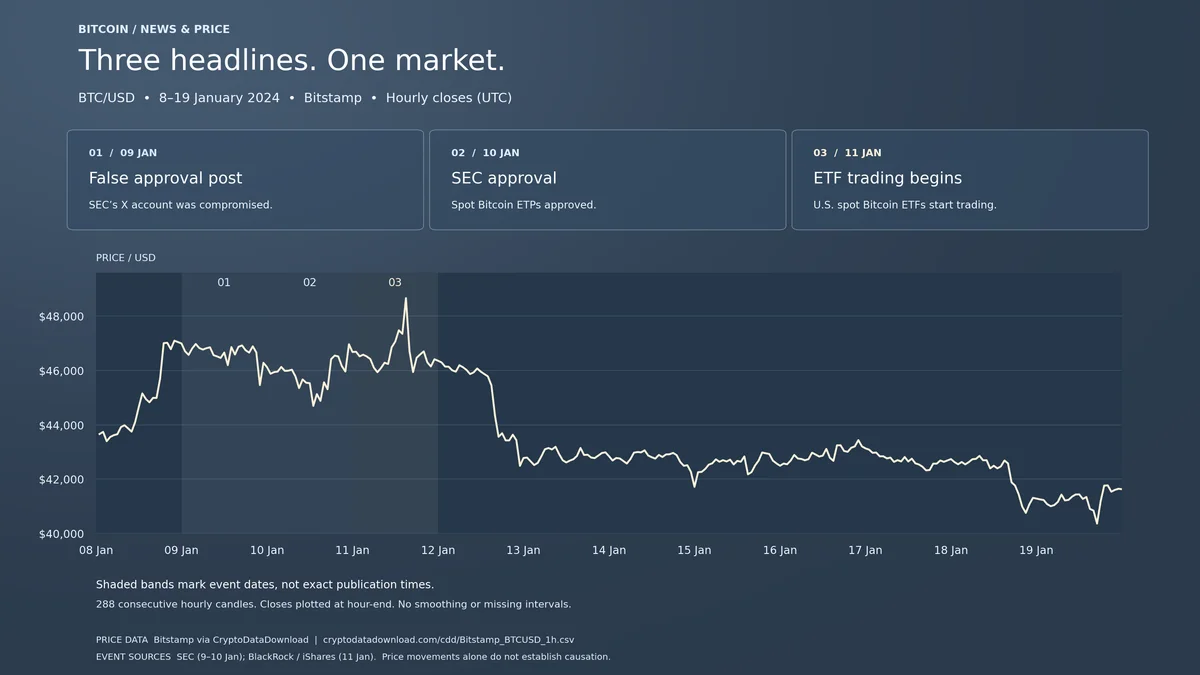
However, explaining the movement requires additional analysis. In a review dated January 19, Coinbase analysts suggested that the first week of trading corresponded to the 'buy on rumors, sell on facts' scenario. At the same time, they noted outflows from Grayscale Bitcoin Trust and inflows into other funds. This is an interpretation of a specific period, not proof of a single cause for the decline.
There are other reasons for an ambiguous reaction. Good news may be weaker than expected. A more significant message may be released simultaneously. And the movement that has begun can be amplified by trading features.
For example, some participants open positions with leverage: the size of the position exceeds the amount of their own collateral. If the market moves against them and the collateral becomes insufficient, the platform may forcibly close the position. This is called liquidation. Mass liquidation of positions can amplify the already started price movement. The direction depends on the type of positions and the conditions of the specific platform.
Therefore, the size of the decline does not always indicate how serious the news was. It may also reflect how the market was structured at the time of its publication.
How to Read Bitcoin News
To understand the significance of news for Bitcoin, it's important to delve into the details: what happened, what confirms the information, and how the event might affect the market. Six questions can help when reading a publication.
1. What exactly happened?
Start with the action that is truly confirmed. Did the company buy Bitcoins or is it just considering such a possibility? Did the regulator make a decision or request additional documents? Did the analyst report data or express an opinion?
Often the answer is already contained in the verb. 'Plans', 'may', 'expects', and 'completed' indicate different degrees of certainty.
2. Where is the primary source?
For a regulator's decision, it's an official document. For a company's purchase, it's the financial report or its own statement. For inflation, it's the publication of the statistical agency.
The primary source is needed not only to verify authenticity. It helps to see details that disappeared during retelling: timing, restrictions, deal size, and conditions.
A notable case occurred on January 9, 2024. A false message about the approval of spot Bitcoin ETFs appeared on the official SEC account on the social network X. Later, the regulator explained that the account had been hacked. In its statement, the SEC also reminded that it publishes official decisions on its website, and social media posts only duplicate such announcements.
This example shows why even a well-known account name does not replace the document referenced in the publication.
3. When did the event occur?
The news date and the action date may not coincide. A company may disclose a purchase some time after its completion. An old statement may reappear in the feed without context.
Therefore, it's useful to separate three moments: when the action was taken, when it was reported, and when the price movement began. Otherwise, one might mistakenly take a report of a past deal as the emergence of a new buyer right now.
4. What new information did the market learn?
Repeating known information differs from an unexpected decision. First, it's necessary to understand what was known before the publication and what expectations can be confirmed by sources.
The phrase 'the market did not expect this' also needs justification. The news should have survey data, a published forecast, or another explanation of what exactly the result is compared to. The opinion of one expert does not necessarily reflect the expectations of all participants.
5. How is the event related to demand or supply?
Try to formulate the connection without the words 'positive' and 'negative'. Does the news open access to the asset? Confirm an already completed purchase? Change coin issuance? Complicate fund withdrawal from the platform?
The clearer this mechanism, the easier it is to assess the content of the message. If there is no explanation between the event and the supposed price movement, you may be facing a confidently formulated guess.
6. What other explanations are possible?
One publication rarely describes the whole picture. Economic data could have been released in the same period, sales on other markets could have started, or large liquidations could have occurred.
Sometimes the available information is not enough to name the main reason for the movement. In such a case, it's more correct to leave the question open than to choose the most noticeable headline.
How to Correlate News with a Chart
A chart helps verify the sequence of events. But it shows price and time, not participants' motives.
First, find the moment of the first confirmed publication. Then look at what happened before and after. If the decline started earlier, a late article does not explain the beginning of the movement, although it could have influenced its continuation or scale. There may have been an earlier source of information, but it still needs to be found.
It's also important to compare several intervals. Movement in the first minutes and change over a day can differ in direction. In the ETF story, the price around $49,000 on January 11 and the drop below $42,000 on January 12 describe different moments. Choosing only one of them would create an incomplete picture.
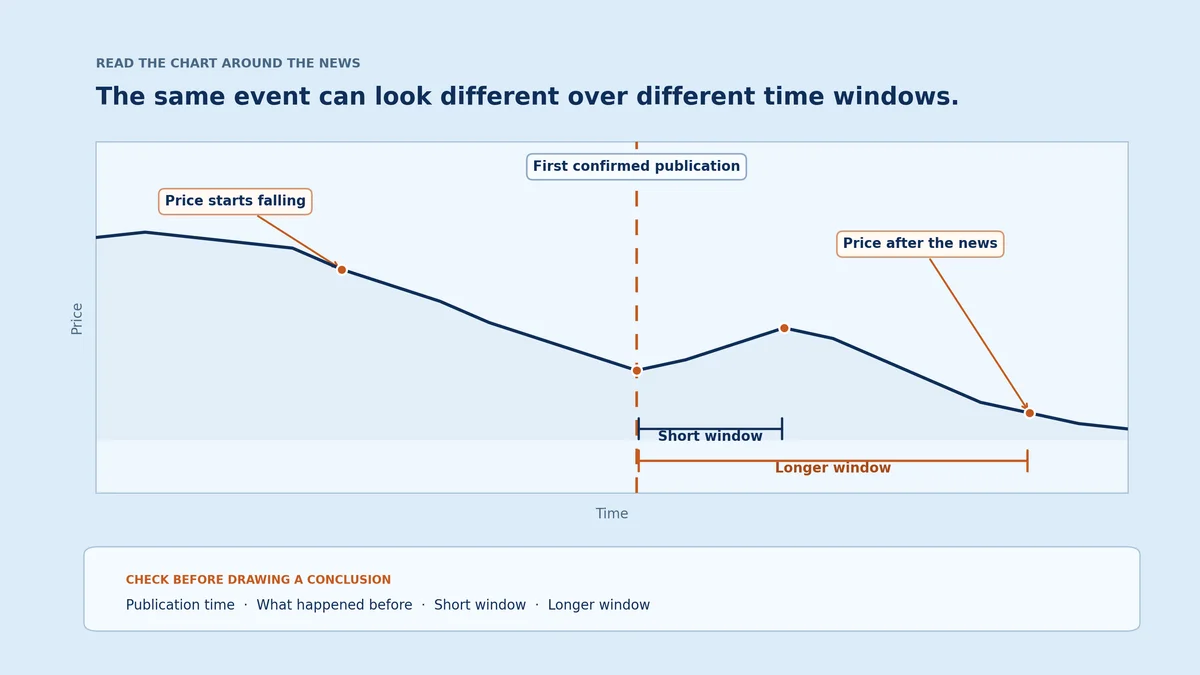
When reading a chart, it's useful to clarify:
Trading pair. BTC/USD and BTC/USDT are different markets. In the second case, Bitcoin is valued in USDT, a token that aims to maintain a peg to the dollar.
Source. Data from one exchange and a composite index can differ.
Time zone. Publication time and chart time need to be standardized.
Comparison period. Change over a calendar day differs from change over the last 24 hours.
Trading volume. It adds information about activity but does not explain its cause. Each executed trade has a buyer and a seller.
Therefore, the formulations 'Bitcoin fell after the news' and 'Bitcoin fell because of the news' are not equivalent. The first describes the order of events. The second asserts a causal relationship and requires additional arguments.
Three Real Examples: How Details Change the Meaning of News
Tesla: Purchase and Announcement of Purchase Are Different Events
On February 8, 2021, Tesla announced that it had purchased Bitcoins worth $1.5 billion. The company disclosed this in its 2020 annual report, specifying that it changed its investment policy in January 2021 and subsequently invested in cryptocurrency. At the same time, Tesla announced its intention to start accepting Bitcoin as payment for its products. At the time of publication, the purchase had already taken place, while accepting payments was still a plan.
After the information was disclosed, Bitcoin's price surged. According to a Reuters report from February 8, the increase reached approximately 20%, and the price rose to $47,565 during the day – a new record at the time. The agency linked the reaction to expectations that other large companies might follow Tesla's example.
One possible reaction mechanism was that participants expected broader use of Bitcoin by other companies: market participants learned that a well-known car manufacturer was willing to hold part of its funds in Bitcoin and considered it as a means of payment. This provided grounds to expect broader use of cryptocurrency and future demand from businesses. Such expectations could encourage other participants to buy BTC even after the news was released.
However, the price increase on February 8 cannot be described as a result of Tesla entering the market with a $1.5 billion order on that day. The company's purchase and the reaction of other participants to the announcement are two different events. The report confirmed the completed investments but did not disclose the exact timing of each transaction and did not allow determining how much Tesla's purchases themselves influenced the quotes.
SEC Hack: A False Message Can Also Change the Price
On January 9, 2024, at 16:11 Eastern Time, a message about the approval of spot Bitcoin ETFs appeared on the official SEC account on the social network X. It turned out to be false, as hackers gained access to the account. By 16:26, a refutation was issued through SEC Chairman Gary Gensler's account. The commission stated that approval had not yet occurred.
In this short time, the price managed to change sharply. According to Associated Press, after the false publication, Bitcoin rose from about $46,730 to nearly $48,000, and after the refutation, it fell below $45,200. These values show the sequence of movement but do not themselves prove participants' motives.
A likely explanation for the initial rise is related to what the market expected from ETFs. Such products would allow buying an instrument linked to Bitcoin's price through a familiar brokerage account. The approval message could be perceived as confirmation of future demand expansion. But after the refutation, the basis for this reaction disappeared, as the regulator had not yet made the announced decision.
This case shows that for a price movement, a real change in rules is not necessary. It's enough for participants to consider the information credible and start acting on it. At the same time, quotes cannot establish the motives of each buyer and seller or fully explain the scale of fluctuations.
The real SEC decision was made and published on January 10. Therefore, combining the events of two days into one story about 'ETF approval' is incorrect: first, the market reacted to a false message and its refutation, and then received the regulator's actual decision.
Bitcoin ETF: Why High Turnover Didn't Stop the Decline
On January 11, 2024, when American spot Bitcoin ETFs began trading, the BTC price rose to about $49,000. However, by January 12, it fell below $42,000. Thus, the launch of long-awaited products was accompanied first by a rise and then by a sharp decline in quotes.
At the same time, interest in ETFs was indeed high. In a Coinbase review dated January 19, a cumulative turnover of over $14 billion since the start of trading was reported. The net inflow as of January 18 was about $1.2 billion. These figures do not contradict each other, as they measure different things.
Turnover shows the value of transactions with fund shares. The same shares can repeatedly change hands from sellers to buyers, each time increasing turnover. Therefore, $14 billion in trading does not mean that funds received $14 billion for Bitcoin purchases. Net inflow shows how much money entered the products minus the withdrawn amounts.
So why did Bitcoin depreciate? One explanation is sales after the realization of a long-anticipated event. Participants may have been buying BTC in advance, expecting ETF approval and launch, and after trading began, they sold to lock in profits. This interpretation, known as 'selling on the news', was provided by market reviews. It explains the possible behavior of some participants but does not prove the motives of all sellers.
Simultaneously, there was a redistribution of funds. Coinbase estimated a possible outflow of more than $1.6 billion based on the decrease in assets under management of GBTC. Some investors also transitioned to new ETFs from other Bitcoin-related instruments. Therefore, even inflows into funds did not necessarily mean the emergence of entirely new money in the crypto market.
Positive inflow into ETFs could support demand but did not guarantee a price increase: outside of funds, other holders were also buying and selling Bitcoins. To understand what was happening, it was necessary to simultaneously consider expectations before the launch, subsequent sales, and the movement of funds between products. One impressive turnover figure did not reveal the whole picture.
What is known | What it does not yet prove |
The company disclosed a completed BTC purchase | That it is buying the same amount at the time of publication |
A message appeared on an account considered official | That the message is genuine and confirmed by a document |
ETF has high trading turnover | That the entire turnover became a new inflow of funds |
The price changed after the event | That the event was the sole reason for the movement |
What Mistakes Hinder Understanding News
Reacting to news is one of the most challenging moments for investors: it's important not only to quickly receive information but also to correctly assess its impact on the market. Emotional decisions, hasty trades, and incorrect interpretation of events can lead to mistakes even with experience. What mistakes most often prevent investors from objectively perceiving news and making informed decisions, explained business analyst Tradex:
Trading based on headlines without verifying the primary source (FOMO purchases). Investors see a loud headline in a Telegram channel or X and make a trade in the first seconds. As a result, they either fall for a fake or buy at the very peak of an emotional surge.
Ignoring leverage (Margin trading). At times of important news releases, spreads widen, and volatility skyrockets. Opening positions with high leverage before news releases is a guaranteed way to get liquidated from both sides (the market often makes sharp 'helicopters' up and down before determining the trend).
Lack of risk management (Stop-Loss). Hoping that the news 'must push the price up', retail investors do not place protective orders. If the market reaction is opposite (for example, due to profit-taking by large players), the investor becomes a 'forced long-term holder'.
Inability to distinguish short-term noise from a fundamental trend. Attempting to trade every minor statement or rumor. The short-term market reaction to news may last 15–30 minutes, after which the price returns to the main technical trend.
Bitcoin's price changes under the influence of numerous factors, and news helps to see only part of the overall picture. What matters is not only the event itself but also what participants expected from it and what was happening in the market at the same time. Therefore, even important positive news can be accompanied by a price decline.
Answers to Frequently Asked Questions
Why does Bitcoin's price change even at night and on weekends?
Crypto platforms usually operate around the clock. As long as participants make transactions, the price can change. At the same time, exchange-traded Bitcoin products, such as ETFs, are traded according to the schedule of the respective stock exchanges.
Can Bitcoin move without noticeable news?
Yes. Participants buy and sell for various reasons, and not every operation is related to a public statement. Changes in orders and liquidity can shift the price even without a loud headline.
Why does the same news cause different reactions?
The context changes: expectations, previous price movement, the state of other markets, and participants' willingness to buy or sell. The headline itself does not describe all these conditions.
Why is Bitcoin's price slightly different on various sites?
Services may use data from different platforms, different trading pairs, and different update times. Some show the last trade, others a calculated composite quote. For an accurate comparison, it's necessary to check the methodology of each source.
Can news accurately predict the price?
News helps to understand what has changed but does not reveal the future actions of all participants. Even a confirmed event does not provide a guaranteed direction and scale of price movement.
Careful reading starts with simple questions: what happened, where is it confirmed, and what remains an assumption. This approach helps to notice inaccuracies in headlines and understand the market without promises to predict its next move.
Related articles