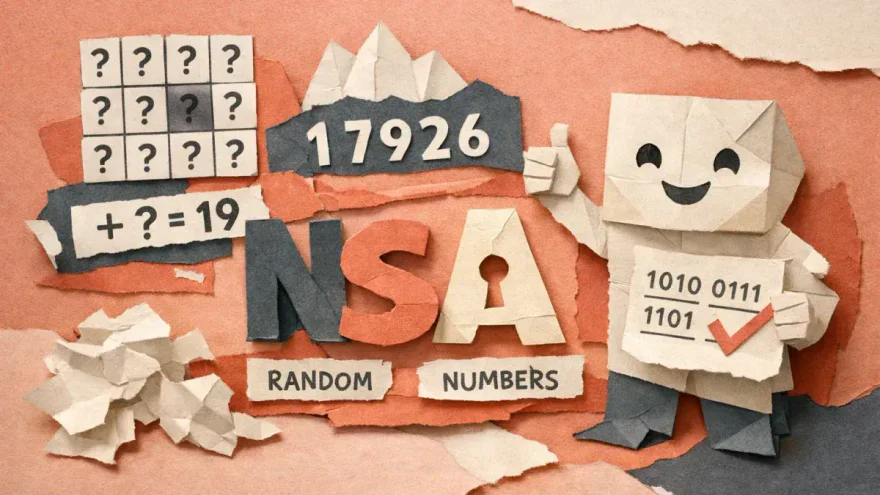
The artificial intelligence model Claude from Anthropic has solved one of the longest-standing mysteries in cryptography by determining the origin of random numbers provided by the U.S. National Security Agency (NSA) to the government in the late 1990s. These numbers, long suspected of having backdoors, were linked to a standard random number generation program using timestamps from 1997 and 1998. The model took less than 30 minutes to trace five obscure seed numbers used for NIST elliptic curve cryptography, confirming that a hidden backdoor from the NSA is less likely.
Users of NIST curves do not need to take any action, although questions remain about how some elements were chosen. Bitcoin was not affected as it uses secp256k1—a simpler curve with fewer opportunities to hide vulnerabilities, although potentially powerful quantum computers could pose a separate threat.
In 2000, the National Institute of Standards and Technology (NIST) adopted a set of curves provided by the NSA, but the mystery of the choice of some numbers used for their generation sparked much debate. The Claude model created a sequence for P-256, a widely used curve, and found an exact match with its published seed number on the 1842nd candidate. This was hailed as a "remarkable" discovery. After conducting research, Claude demonstrated that hidden vulnerabilities are most likely absent.
However, the team still cannot explain why the program skipped some suitable candidates and how other parts of the curves were chosen. It is important to note that Bitcoin was never part of this mystery, as its wallets rely on secp256k1, based on a simpler scheme. Nevertheless, a potentially powerful quantum computer in the future could pose a danger, as it could work backward and decrypt secret keys. Tensions are observed, but so far, no one has managed to create a quantum computer powerful enough to crack a Bitcoin key.
Later research showed that the Claude model used the lrand48 number generation found in old C programming libraries, and the results were publicly available from the start. The reward for solving the problem was $36,864 and will be awarded to the Internet Security Research Group, a nonprofit organization providing free security certificates for websites.
This material is prepared solely for informational purposes and does not constitute financial advice or a recommendation.
Related articles