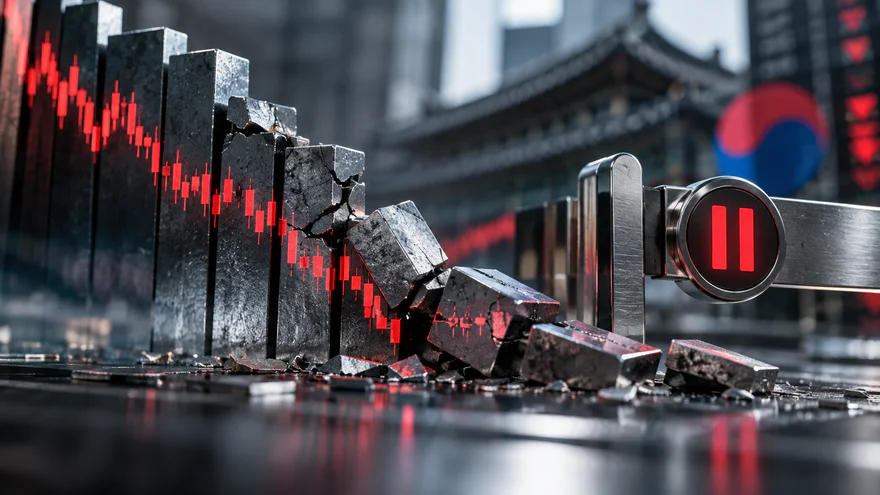
The South Korean KOSPI index fell by more than 8% on October 15, prompting the exchange to halt trading for 20 minutes. Markets in Japan, China, and Taiwan also declined, with the total losses of Asian markets exceeding $900 billion for the day. Shares of memory manufacturers Samsung and SK Hynix fell the most among major stocks, as investors are massively shedding risky assets following fresh U.S. inflation data that heightened fears of another Fed rate hike.
According to analysts from The Kobeissi Letter, the KOSPI's drop exceeded 8%, triggering the exchange's first-level emergency trading halt mechanism, pausing trading for 20 minutes; a second-level halt will follow if the index falls by 15%. The sell-off spread across the entire region. Analyst macropaperr estimates that Asian markets lost over $900 billion in capitalization for the day: KOSPI fell by 8%, Japan's Nikkei by 5%, China's SSE by nearly 2%, and Taiwan's market by 1.5%.
KOSPI has lost 21% over nine days and 41% from its historical peak in June. Shares of Samsung Electronics dropped by 9.7%, SK Hynix by 10.92%, Samsung Electro-Mechanics by 16.38%, and SK Square by 10.09%. According to investor MelvinInvests, the pressure on memory manufacturers has spread to all companies related to AI infrastructure.
The investor also referred to a column in the South Korean business newspaper Maeil Business Newspaper, whose authors warn that the global memory chip market may face an oversupply from 2029 due to the launch of new factories. Experts believe that South Korea's economy is increasingly dependent on Samsung and SK Hynix, and the country has two to three years to develop other industries before the cycle turns. MelvinInvests suggests that investors should consider this warning but does not share the market's panic.
This material is prepared solely for informational purposes and does not constitute financial advice or a recommendation.
Related articles