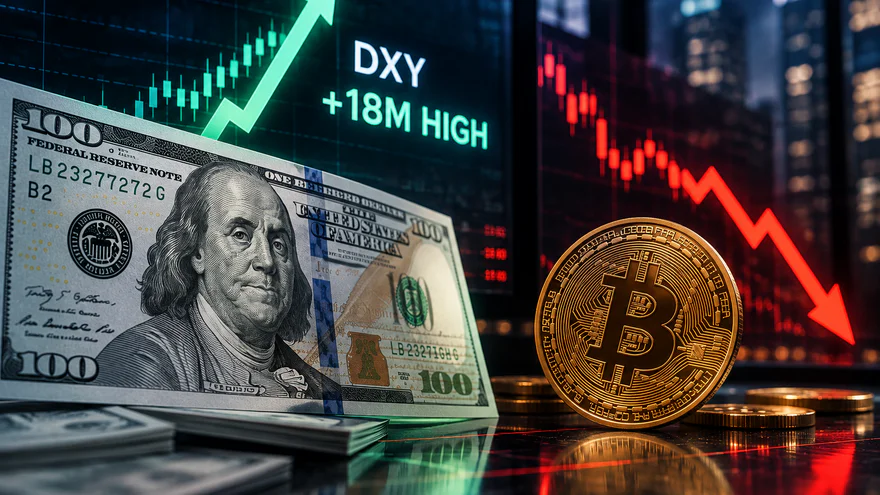
Bitcoin and Dollar Diverge at 200-Week Moving Averages

The US Dollar Index (DXY) and Bitcoin (BTC) ended the second week of November on opposite sides of their 200-week moving averages. As of the close of trading on November 13, DXY reached 103.41 points, gaining 1.11% for the week and settling above the long-term indicator at around 102.11. Meanwhile, on November 16, BTC was trading below $64,900, while its 200-week average was approximately $67,900.
The 200-week moving average reflects the average movement of an asset over nearly four years and is used by market participants to assess long-term trends. The price's position relative to the indicator may indicate a change in market dynamics, but it does not in itself predict the future direction of movement.
The strengthening of the dollar coincided with a revision of expectations regarding US monetary policy. Data released on November 10 showed that the Consumer Price Index (CPI) rose by 0.4% in October after a 0.6% increase in September. Despite the slowdown in monthly growth, the October figure exceeded analysts' expectations, heightening concerns about further interest rate hikes by the Federal Reserve.
The change in expectations was also reflected in the US government bond market. According to the US Department of the Treasury, on November 13, the yield on two-year Treasury notes was 4.88%, and on ten-year notes, it was 5.15%. Higher yields on dollar instruments can enhance their attractiveness compared to risky assets.
Against this backdrop, DXY settled above its 200-week average. At the same time, Bitcoin fell below a similar indicator. This opposite dynamic attracted the attention of cryptocurrency market participants, as a strengthening dollar is often accompanied by a decrease in demand for risky assets.
However, the relationship between the dollar index and the price of Bitcoin is not constant. The cryptocurrency market is also influenced by capital flows through exchange-traded funds, activity on spot and derivative platforms, position liquidations, and changes in overall investor sentiment towards risk.
The next important event will be the Federal Open Market Committee (FOMC) meeting scheduled for December 8–9. The interest rate decision is expected on December 9. On December 10, the US Bureau of Labor Statistics will release the Consumer Price Index for November.
New data could alter expectations regarding the Fed's future policy and affect the dynamics of the dollar, bond yields, and cryptocurrencies. However, Bitcoin's position below the 200-week average does not in itself confirm a continued price decline.
This material is prepared solely for informational purposes and does not constitute financial advice or a recommendation.
Related articles