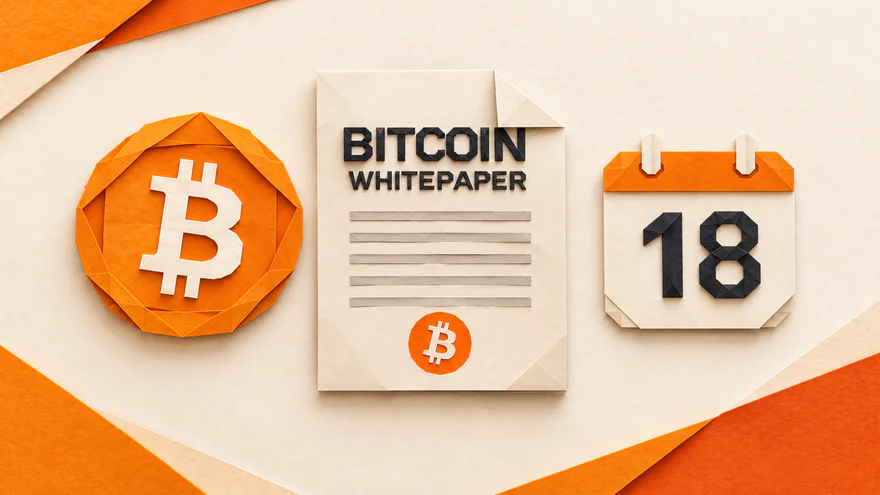
Bitcoin White Paper: 18 Years of a Document That Changed the Market
White Paper – a document that describes the idea, technical architecture, and economic model of a crypto project. It is the main documentation that investors, developers, and users familiarize themselves with before deciding to participate. The term did not originate from cryptocurrencies: in British practice, white papers were official documents on departmental policies. In the tech environment, the format has become a way to describe development without marketing ties and is also found in academic fields such as medicine, physics, chemistry, mathematics, and cryptography.
Bitcoin White Paper
The document was published on October 31, 2008, under the title “Bitcoin: A Peer-to-Peer Electronic Cash System.” It contains an abstract, introduction, conclusion, list of references, and technical sections: proof of work, timestamps, incentives, network rules, transaction verification. The key theme is the decentralized solution to the double-spending problem in a peer-to-peer network. Nakamoto highlighted the main advantage: direct exchange of electronic money without intermediaries, including banks and government institutions. Validation became possible in a decentralized environment through blockchain and PoW consensus, with mining rewards from issuance and transaction fees as incentives for participants.
Why White Papers are Needed
The text of the first white paper is written in an academic manner: problem statement, review of approaches, protocol description, attack analysis, sources. Early altcoins took this format as a model, although later projects often focused more on self-promotion. There is no single standard, but the logic is similar: problem and solution, technical aspects, tokenomics, roadmap and team, fundraising and community engagement. The presence of the document signals serious intentions, but it does not guarantee the implementation of what is stated.
Varieties and Reading
In addition to the classic white paper, there are Yellow Papers – specifications with formulas for developers, Lite Papers – shortened versions of a few pages, Green Papers – open discussions at an early stage. When reading, it is worth checking if the project solves a real problem, if there is technical specificity, how tokens are distributed and issuance is structured, whether the stages' timelines are specified, if the team can be verified, and if the risks are honestly described.
This material is prepared solely for informational purposes and does not constitute financial advice or a recommendation.