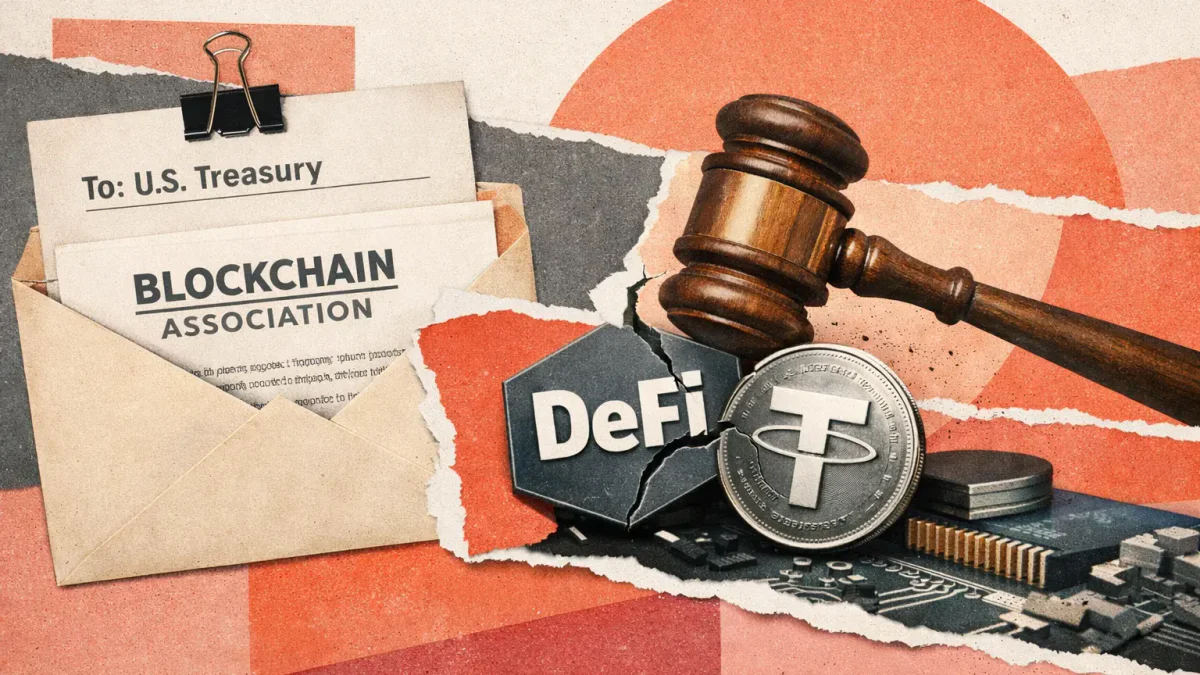
The Blockchain Association sent a 26-page letter to the U.S. Treasury explaining how the rules of the GENIUS Act should apply to DeFi, stablecoin trading platforms, and foreign payment tokens.
The group demands to exclude ordinary secondary trading from liability for knowingly participating in illegal stablecoin issuance, to check foreign stablecoins through official registries rather than through their own investigations, and not to impose new obligations on open protocols to identify wallets if the location of counterparties cannot be reasonably determined. The Treasury consultation ended on October 19, and the rules will still be reviewed.
The association supports the regulation of payment stablecoin issuance but wants clearer definitions of digital asset service providers (DASP) and liability limitations. This concerns Section 3 of the GENIUS Act, which regulates who can issue, offer, and sell such tokens in the U.S.; the law is set to take effect in January 2027. The group asks to maintain the distinction between companies working with clients and firms with their own assets—otherwise, proprietary traders will face intermediary requirements. Working on infrastructure itself should not make a person a service provider, but the letter does not ask to exempt firms just for the word 'decentralized'.
Regarding liability for illegal issuance, the association wants to establish that real knowledge and substantial assistance coordinated with the issuer are needed; simple trading or liquidity is not participation in issuance. The age of the token and the proximity of the transaction to issuance are not proof. A safe harbor is proposed for independent secondary activity; general restrictions cannot be introduced before the July 2028 deadline set by Congress.
For foreign issuers, exchanges and custodians are advised to rely on public records from the Treasury and the Office of the Comptroller of the Currency (OCC), maintaining exceptions when there is precise knowledge of non-compliance. The 'reasonably believes' standard for determining a recipient in the U.S. is contested: necessary tools may not be available when interacting with a public address.
The proposal was published in the Federal Register on August 18 (docket TREAS-DO-2026-0496, RIN 1505-AC95). Restrictions for foreign issuers are effective from January 18, 2027, and the general distribution restriction from July 18, 2028.
This material is prepared solely for informational purposes and does not constitute financial advice or a recommendation.
Related articles