Experts at the design automation conference discussed the impact of heat on photonics and the reliability of AI chip systems. Participants included Lang Lin (Synopsys), Jack Berg (Silvaco), Satish Radhakrishnan (Vinci), Chris Muet (Keysight EDA), and John Ferguson (Siemens EDA).
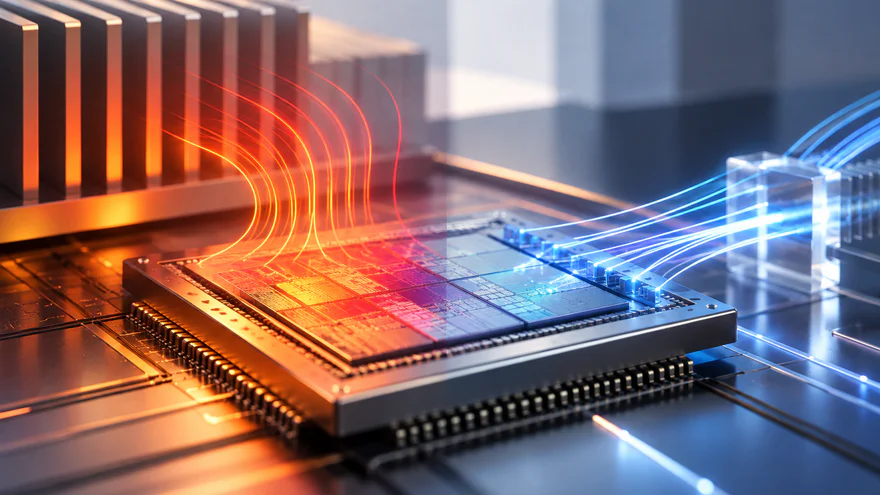
According to Muet, photonics has great potential for data centers but does not scale well. A large mesh switch requires many components and results in high losses. An additional issue is thermal sensitivity: there are heaters in the structure, and with thousands of heaters, calibration becomes a concern. Lin added that silicon photonics is a type of analog circuit: in digital transistors, the current switches, but in photonics, a constant current is always present, generating a lot of heat. Some of it is needed for the operation of the electronic integrated circuit, but it is important not to create hot spots.
Radhakrishnan noted that in-package optics integrate silicon photonics into the package and thermally isolate electronic and photonic integrated circuits. However, in modeling, the transient component is missing, which is exactly what is needed. Muet added that the difference in time constants complicates everything. Voltages can affect optical signals more than temperature. Ferguson confirmed: moving large elements creates new stresses.
Berg emphasized that photonics requires four solvers: electrical, mechanical, thermal, and optical. It is due to this complexity that photonics has remained the next big step for 30 years. Lin added that hierarchical modeling is important for the ecosystem: high-bandwidth memory manufacturers provide a chip model, and the integrator assembles the stack and runs thermal analysis.
Radhakrishnan pointed out the problem of data path aging due to electromigration, accelerated by heat. This is especially critical for automotive chips with a lifespan of 10-15 years. According to Berg, every 10 degrees results in a significant decrease in reliability. Lin highlighted a gap: there are practically no tools in the industry for accurately predicting thermally accelerated aging.
This material is prepared solely for informational purposes and does not constitute financial advice or a recommendation.
Related articles