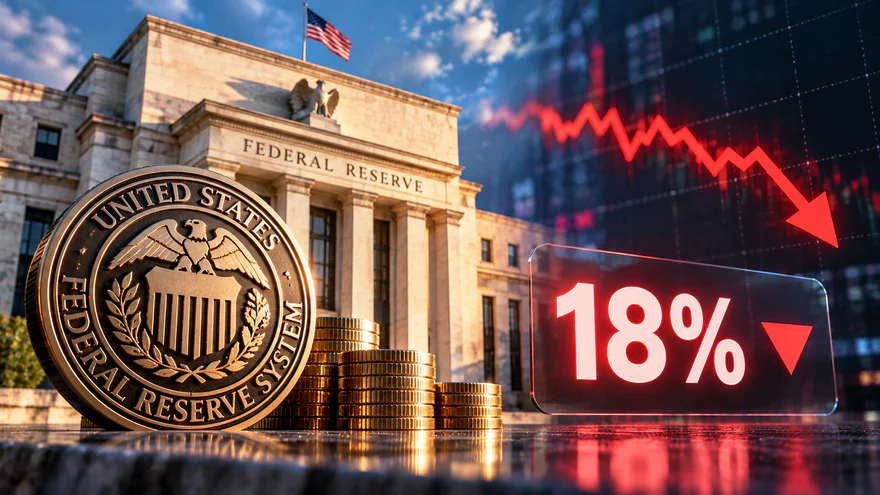
The Fed Allowed for a Rate Hike of More than 25 Basis Points
The minutes from the October meeting of the U.S. Federal Reserve showed that almost all participants expect the need for further interest rate hikes. Two participants considered a move of more than 25 basis points in December if inflation data turns unfavorable. However, at the meeting on October 27–28, the Fed maintained the rate in the range of 3.75–4%.
Why the Fed Maintained the Interest Rate
On November 18, the Federal Reserve released the minutes of the Federal Open Market Committee (FOMC) meeting held on October 27–28, 2026.
As a result of the meeting, the Committee maintained the target range for the federal funds rate at 3.75–4%. The decision was supported by 10 voting members of the FOMC, while two advocated for an immediate increase of 25 basis points.
Most participants deemed it appropriate to wait for additional economic data. This would allow for a better assessment of the impact of the September rate hike on the economy and determine how persistent inflation risks remain.
At the same time, almost all participants indicated that within their baseline forecasts, further rate hikes would likely be necessary to bring inflation back to the target level of 2%.
Under What Conditions the Fed Might Raise the Rate by More Than 25 Points
According to the minutes, two participants considered the need for a rate increase of more than 25 basis points at the next meeting if new data indicates unfavorable inflation dynamics.
This does not mean that the Committee has already agreed on such a move. The decision will depend on inflation indicators, labor market conditions, and overall economic conditions.
The next FOMC meeting is scheduled for December 8–9, 2026.
According to the predictive market Polymarket, cited in a report on November 18, traders estimated the probability of a December increase of 25 basis points at about 92.5%. The probability of a more significant move was around 5.1%.
These figures reflect the expectations of platform users and may change as new economic data becomes available. They are not a forecast by the Federal Reserve itself.
Inflation Remains Above the Fed's Target Level
In the October minutes, Fed staff presented estimates of September inflation based on the data available at that time.
The annual growth of the Personal Consumption Expenditures (PCE) price index was estimated at 3.6%. Core PCE inflation, excluding the most volatile components, was about 3.1%.
Both indicators were above the Fed's target level of 2%.
Among the factors supporting price pressure, participants highlighted the increase in energy costs, the effects of previously imposed trade tariffs, and high demand for goods related to the development of artificial intelligence infrastructure.
Investments in data centers and computing power increase the demand for equipment, materials, and skilled professionals. According to several FOMC participants, such an expansion of demand may drive price growth not only within the tech sector but also in related industries.
At the same time, participants expected a gradual easing of inflationary pressures. The prospects for returning inflation to the target will depend on the dynamics of energy prices, production capacities, and AI-related expenditures.
Why the Fed Is Concerned About AI Debt Financing
In addition to inflation, participants discussed risks to financial stability associated with the rapid growth of investments in artificial intelligence.
Fed staff noted the increase in debt obligations of companies financing the construction of data centers and the expansion of computing infrastructure.
Certain projects use complex financial structures, including equipment lease obligations that are not always directly reflected on company balance sheets, and interconnected financing schemes.
If the returns on AI investments fall short of expectations, such mechanisms could amplify financial losses and complicate the assessment of the actual obligations of market participants.
Almost all participants discussed the risks of a scenario where investors revise their expectations regarding the returns of AI projects.
What Additional Risks the Regulator Highlighted
The minutes also noted the high valuation levels of certain financial assets and the significant use of leverage by hedge funds.
In the event of a sharp price decline, investment funds may face the need to sell assets to reduce debt or meet investor demands for fund withdrawals.
In an adverse scenario, large-scale forced sales could increase market volatility and complicate transaction execution.
Special attention was given to the indirect connections of banks with non-bank financial institutions, including private lending funds.
Meanwhile, Fed staff assessed the banking system as resilient due to adequate capital levels. However, participants emphasized that during periods of market stress, previously unnoticed risks could emerge quite rapidly.
Thus, the October minutes reflect two main tasks for the Fed: curbing inflation through interest rates and monitoring financial risks that may intensify as investments in AI infrastructure grow.
This material is prepared solely for informational purposes and does not constitute financial advice or a recommendation.