
French company Pasqal has trapped rubidium atoms using a photonic chip
8/11/2026, 10:34 AM • Евгения Слив
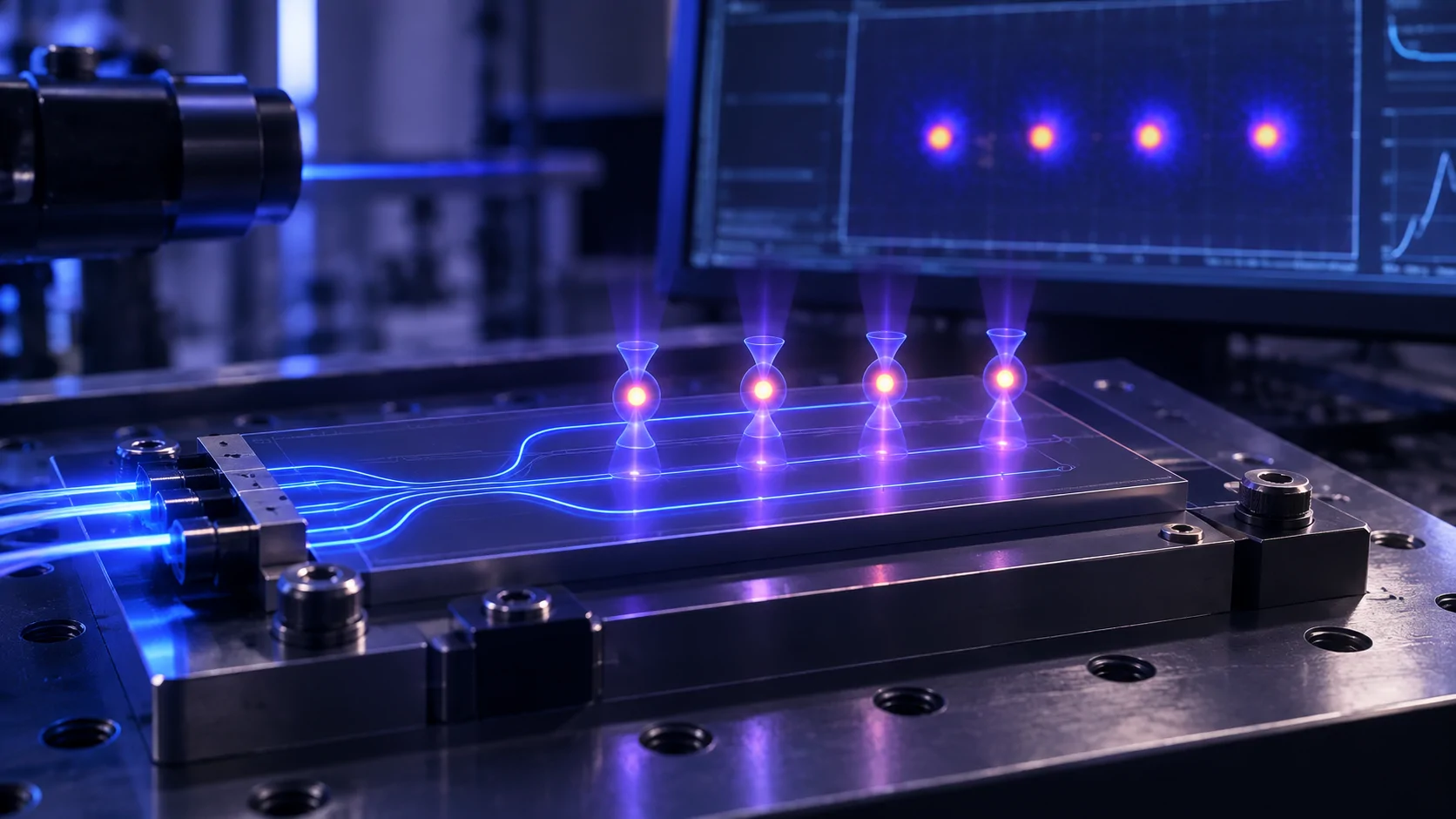
The French company Pasqal demonstrated the control of neutral atoms using laser light. This light is generated and routed directly on a photonic integrated circuit. The manufacturer claims the first such result for neutral-atomic quantum computers. In the experiment, one photonic chip successfully formed four independent optical traps. The researchers trapped four separate rubidium atoms in these special traps. The performance of the new chip system proved to be comparable to traditional optics. The lifetime of the trapped atoms was about twenty-seven and a half seconds.
Neutral-atom computers use focused laser beams to capture individual atoms. These special optical tweezers are the main tools for moving basic qubits. A significant part of such an optical system consists of rather bulky external components. Such equipment takes up too much space in modern laboratory conditions. Architecture becomes more complex as the total number of atoms grows. It becomes almost impossible to scale such installations using traditional methods. Pasqal is trying to transfer part of the infrastructure to photonic integrated circuits. Optical infrastructure is becoming the main bottleneck in scaling technology.
So far, we are talking only about a basic demonstration of the very principle of operation. Four atoms is difficult to compare with a full-fledged modern quantum processor. To develop the chip, the company used the technologies of its subsidiary Aeponyx. The developers successfully acquired this profile company last year. The purchase was focused on the integration of photonic circuits into the hardware platform. This should accelerate the transition to fault-tolerant quantum computing. The company expects to create future systems with ten thousand atoms. Such advanced processors will receive about one hundred full-fledged logical qubits. This approach will significantly reduce the overall complexity of the optical part of the processor. The production of quantum systems will become closer to a scalable architecture.