
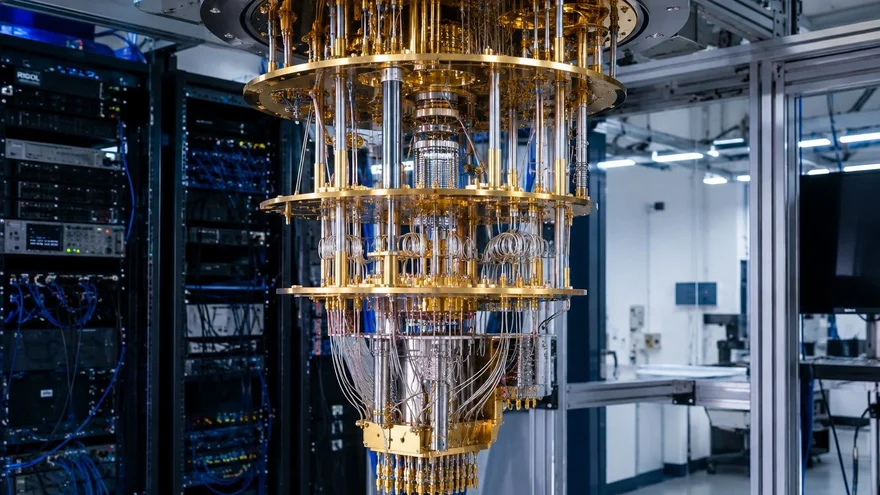
Fujitsu has presented a working prototype quantum computer built on diamond spin qubits with tin-vacancy centers (SnV). According to ForkLog, the company's engineers integrated these qubits with photonic integrated circuits that enable reading quantum states using light. The prototype operates at a temperature of approximately −271.6 °C, just one and a half degrees above the operating temperature of traditional superconducting quantum computers (approximately −273.13 °C). Fujitsu developed its own Hybrid Quantum Computing Platform, which allows users to manage the system without needing to delve into the details of the hardware architecture. The company positions its development as the first working prototype of a quantum computer of this type, integrating SnV centers and photonic circuits into a single functioning system.
The key advantage of Fujitsu's architecture lies in the principle of scaling through optical connections: individual quantum modules can be linked using light, enabling the creation of larger systems from several relatively small units. The company chose SnV centers over the more common NV centers due to their structural symmetry and lower susceptibility to external noise, which improves the stability and reliability of computations. To implement the prototype, engineers developed new technologies for bonding diamond with other materials and achieved a reduction in diamond layer thickness from hundreds of micrometers to hundreds of nanometers — a critical factor for integrating diamond structures with photonic circuits. The creation of the prototype was the result of three years of joint research by Fujitsu, Delft University of Technology, and the QuTech research center, which began in 2020. The project received support from the Dutch Holland High Tech program.
Fujitsu has already set ambitious milestones for the technology's development. By 2027, the company plans to create a multi-module prototype combining several diamond modules, while simultaneously beginning development of a hybrid architecture that integrates diamond and superconducting components. On the longer horizon — a system of 250 logical qubits by 2030 and a system of 1,000 logical qubits by 2035, although the company views these figures as technology roadmap plans rather than achieved results. The development demonstrates that quantum computing is gradually transitioning from laboratory experiments to more practical implementations that account for scalability and manageability requirements.