How Attackers Use Address Poisoning to Steal Cryptocurrency
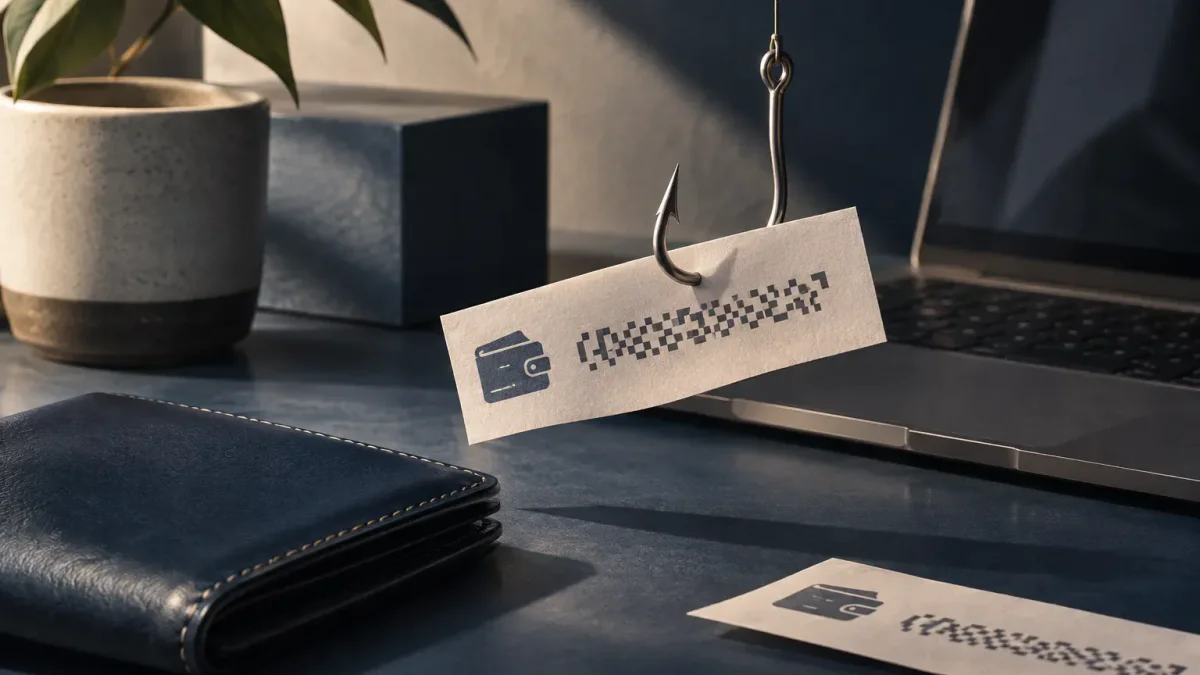
"Address Poisoning" is a type of cryptocurrency fraud where attackers use blockchain addresses that look similar to trick wallet owners into sending funds to the wrong recipient. The scheme's peculiarity is that fraudsters do not need to access private keys or hack the user's device: the transfer can be confirmed by the asset owner themselves.
How Address Poisoning Works
Blockchain addresses are long sequences of letters and numbers that are difficult to remember. For example, an Ethereum address consists of 40 hexadecimal characters and a 0x prefix. For convenience, crypto wallets and blockchain explorers often display only the beginning and end of the address, hiding its central part.
Fraudsters exploit this interface limitation. Suspicious records with details that look similar to familiar recipients' addresses may appear in the user's transaction history. Without careful verification, the user risks selecting the wrong address and confirming the transfer themselves.
In December 2025, as a result of such an attack, a cryptocurrency wallet owner lost nearly $50 million in USDT. Before sending the main amount, they conducted a test transaction, but subsequently transferred the funds to the fraudster's address.
The test transfer in this case did not provide protection against the subsequent error. It confirmed the correctness of the initial details but did not guarantee that the user would use the same address in the next transaction.
A similar scheme was used in November 2026, when fraudsters attacked an Ethereum wallet that had been inactive for almost 11 years. However, in this case, the owner successfully transferred funds to the correct address.
The Scale of Fraud
In the Blockchain Address Poisoning study presented at the USENIX Security conference in 2025, scientists analyzed transactions in Ethereum and BNB Chain from July 2022 to June 2024.
Researchers identified about 270 million fraud attempts targeting more than 17 million blockchain addresses. In 6,633 cases, funds were transferred to fraudsters. The confirmed damage amounted to at least $83.8 million.
However, the number of attack attempts is not equivalent to the number of affected users. Most suspicious operations do not result in financial losses, but even a small number of successful attacks can cause significant damage.
Why the Number of Suspicious Transfers is Increasing
In December 2025, the Fusaka update was activated on the Ethereum network, aimed at improving blockchain scalability.
According to an Etherscan study published in March 2026, the number of small transfers significantly increased within 90 days after the update.
Asset | Change in Number of Microtransfers |
USDT | +612% |
USDC | +473% |
DAI | +470% |
ETH | +62% |
Analysts associate this trend partly with reduced network fees. However, not all microtransfers are fraudulent: small-sum transactions also occur in legitimate blockchain application use.
Therefore, the provided statistics reflect the change in the number of small transactions, not a confirmed increase in the number of successful fraudulent attacks.
How Address Poisoning Differs from Other Types of Fraud
Address Poisoning is often confused with other threats related to cryptocurrency wallets. Despite the apparent similarities, these schemes differ in mechanism and purpose.
Threat | Feature |
Address Poisoning | Substitution of recipient details through visually similar addresses |
Dusting Attack | Using small transfers to analyze connections between addresses |
Clipper | Malware that substitutes copied details |
Phishing | Deceiving the user to obtain confidential data or confirm a malicious operation |
Receiving a suspicious transaction does not necessarily mean that attackers have gained access to the wallet. In address poisoning, the main risk arises when subsequently selecting the recipient of funds.
How Crypto Wallets Protect Users
Developers of crypto wallets and blockchain explorers are implementing mechanisms to detect suspicious operations.
MetaMask warns users if the selected address visually resembles previously used details. Etherscan marks suspicious addresses and tokens, hides some zero transactions, and shows warnings when copying potentially dangerous details.
However, automated systems do not guarantee the detection of all fraudulent operations. The absence of a warning from the application does not mean that the address is safe.
How to Protect Against Address Poisoning
The main way to protect yourself is to verify details immediately before confirming each transaction. It is especially important to take precautions when transferring large amounts.
Do not copy recipient addresses from transaction history.
Check the entire address, including the characters in the middle part.
Save verified details of regular recipients in the wallet's address book.
Obtain new payment details through a trusted communication channel.
When using a hardware wallet, check the recipient's address on the device's display.
Do not ignore warnings from crypto wallets and blockchain explorers.
After a test transfer, recheck the details before sending the main amount.
If funds have already been sent to an incorrect address, it is necessary to save the transaction ID, contact the support service of the platform used, and report the incident to law enforcement agencies. If the transfer is related to a centralized exchange, timely contact may help in the investigation.
Confirmed blockchain transactions are generally irreversible, and asset recovery is not guaranteed. Therefore, verifying details before signing the transaction remains the most reliable measure against address substitution.
This material is prepared solely for informational purposes and does not constitute financial advice or a recommendation.