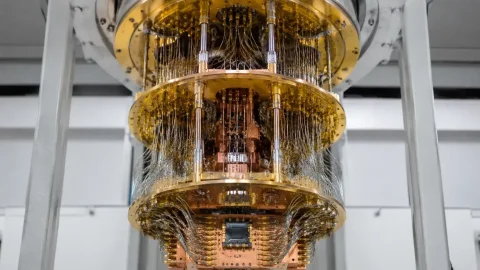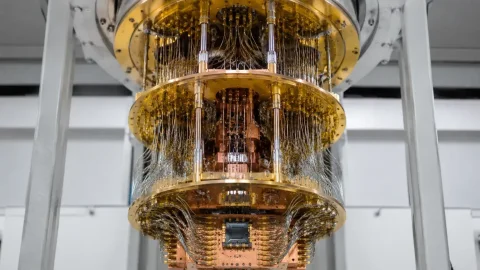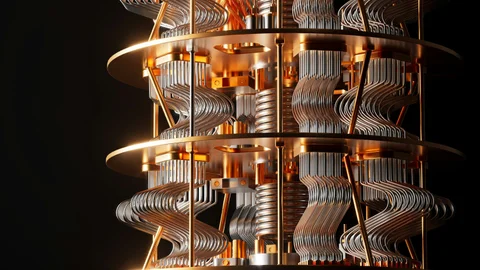
Researchers from Rutgers University, IBM, and other scientific institutions have demonstrated real-time control of a quantum system consisting of 100 qubits, according to Quantum Insider. For the experiment, scientists used the IBM Quantum Heron processor with 156 qubits, employing a chain of 100 interconnected elements. This scale allowed them to test how the system behaves under constant external interference, rather than just in idealized conditions of short computations.
The team alternated between two processes. The first involved operations that mixed quantum information and created chaotic behavior. The second consisted of measurements with the resetting of individual qubits, which helped return the system to a controlled state. In other words, the scientists intentionally entangled the state of the chain and then selectively reset some elements, observing how this affected the overall dynamics.
In total, the researchers performed nearly 5,000 operations between pairs of qubits and about 5,000 measurements and resets. When checks and resets were conducted frequently enough, the system transitioned from chaotic behavior to an orderly state. The results of the experiment matched theoretical predictions. This confirms that real-time feedback can keep a quantum system in the desired mode despite the accumulation of disturbances.
According to the researchers, this is one of the largest demonstrations of feedback-controlled quantum management to date. Such technology is considered a crucial component of future fault-tolerant quantum computers, which need to repeatedly check the state of qubits and correct errors during computations. Without such control, quantum machines quickly lose information due to decoherence and noise.
Recall that in September, IBM managed to reduce error suppression costs by 63 times on a 27-qubit processor.
This material is prepared solely for informational purposes and does not constitute financial advice or a recommendation.
Related articles