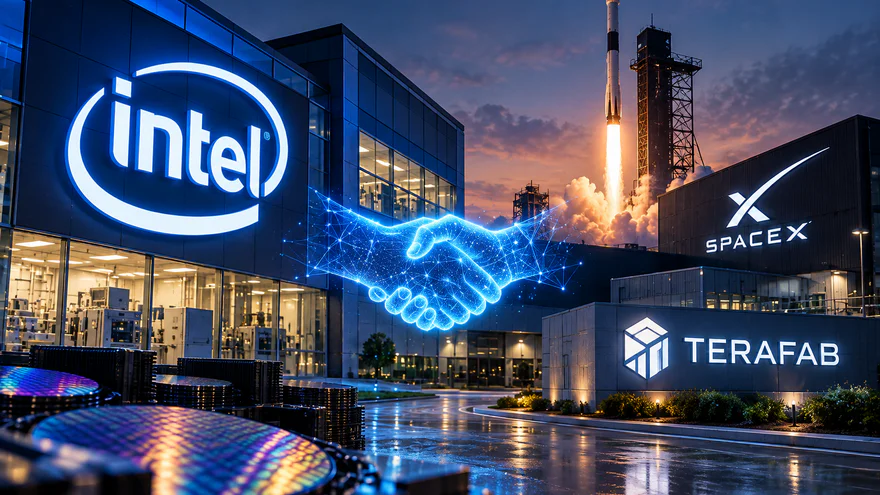
Intel is not stepping away from Elon Musk's largest hardware project. According to Bloomberg, the chipmaker will continue to work with Musk on Terafab, his massive chip manufacturing project. Earlier in October, Musk revealed that he had discussions with Taiwan Semiconductor Manufacturing Company, leading investors to speculate whether Intel's seat at the table would become more crowded.
Terafab is Musk's attempt to produce ultra-high-performance chips for artificial intelligence and robotics. The project is backed by three of Musk's companies: Tesla, SpaceX, and xAI. The planned facility in Texas aims for a computing capacity of 1 terawatt annually. The main site is located in Grimes County, Texas. Initial investments exceed $16.8 billion, and total costs could reach $119 billion over several phases. Intel joined the project on April 7, 2026, becoming the first publicly named foundry partner, announced alongside SpaceX, xAI, and Tesla. Later that month, Tesla added a technical detail: during the earnings call for the first quarter of 2026, the company indicated that it intends to use Intel's 14A process for Terafab. Intel CEO Lip-Bu Tan met with Musk in person before the April announcement and described the involvement as "highly strategic."
Until October 3, 2026, Intel was the only publicly named chip manufacturing partner in the project. Then Musk revealed negotiations with TSMC. These discussions are described as preliminary and informal. Intel's shares showed notable fluctuations after the news of the negotiations with TSMC emerged. No specific financial commitments related to Intel's role have been disclosed, nor the exact scope of its involvement. For Intel, Terafab represents a high-profile client relationship with a well-known demanding buyer. Continued participation gives the company a role in one of the most closely watched chip projects in the U.S. and a visible test for its 14A process. Without disclosed financial terms and a defined scope, Intel's stake in a project that could ultimately reach $119 billion remains an open question.
This material is prepared solely for informational purposes and does not constitute financial advice or a recommendation.
Related articles