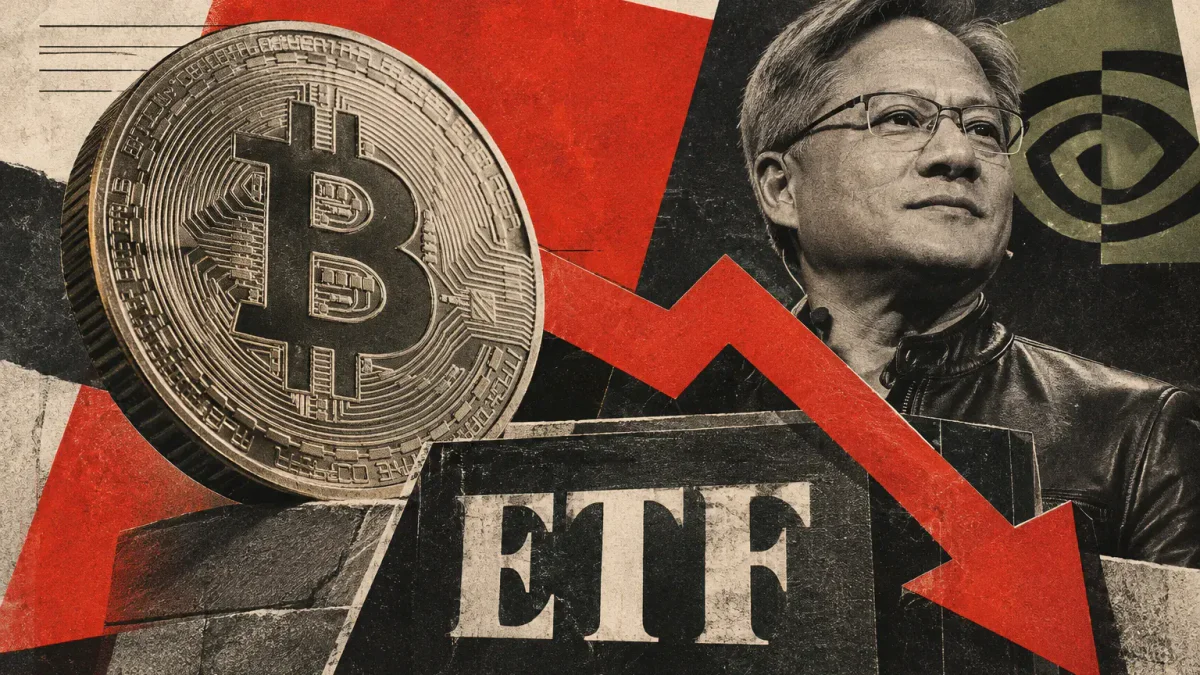
Main Events of the Week November 23–27: Market Recovery, US Inflation, and Outflows from Bitcoin ETF

Financial markets this week found themselves between attempts at recovery and persistent risks. Jensen Huang's return to Nvidia supported tech stocks, but accelerating inflation in the US, expectations of a Fed rate hike, and record capital outflows from Bitcoin ETFs prevented talk of sustainable stabilization.
Financial Markets in Numbers
US stock indices maintained positive momentum since the beginning of the week, despite the resumption of tech stock sell-offs on Tuesday and Wednesday. The most notable growth was demonstrated by the Russell 2000, reflecting the dynamics of small-cap US companies' stocks.
Index | Index Value | Change Since Start of the Week |
S&P 500 | 7,182.78 | +3.9% |
Nasdaq Composite | 23,585.80 | +4.3% |
Dow Jones | 50,182.95 | +4.2% |
Russell 2000 | 2,704.06 | +4.7% |
Index values are given in points as of the close of trading on November 25. On Thursday, US stock exchanges were closed due to Thanksgiving. Source: Associated Press.
On the morning of November 27, market recovery continued. According to Reuters, Nasdaq futures rose by 2.8%, and S&P 500 futures by 2%. Positive dynamics were also observed in European and Asian stock markets.
Jensen Huang's Return Supported Tech Stocks
On November 23, Nvidia's board of directors reinstated Jensen Huang as CEO. The decision triggered a significant stock market recovery: the chipmaker's shares rose by more than 31%, the Nasdaq Composite index added 6.5%, and the S&P 500 about 4.7%. However, in subsequent trading sessions, tech companies lost some of the gained positions.
“Huang's return is an enormous positive for Nvidia and the broader AI trade, removing a major source of uncertainty” – “Huang's return is an extremely positive event for Nvidia and the broader AI investment segment, eliminating one of the main sources of uncertainty,” noted Catalyst Funds' Chief Investment Officer David Miller in a comment published by Barron's.
The market reaction demonstrated the dependence of tech companies' valuations on investor expectations and management decisions. Meanwhile, questions about the return on large-scale investments in artificial intelligence remain open, and new US export restrictions create additional risks for equipment manufacturers.
Read more on UNUM: Nvidia halted AI server deliveries to four Southeast Asian countries.
Inflation in the US Heightened Expectations of a Fed Rate Hike
Data released on November 25 by the US Bureau of Economic Analysis showed an acceleration in annual PCE inflation from 3.6% in September to 3.8% in October. The core index, excluding food and energy prices, reached 3.3%. Simultaneously, the estimate of US real GDP growth for the third quarter compared to the previous quarter on an annualized basis was revised up from 3.4% to 4.3%.
The combination of sustainable economic growth and high inflation heightened expectations of another Fed rate hike in December. For stock and cryptocurrency markets, this means the continued risk of rising borrowing costs, and for tech companies, a potential increase in financing costs for new projects.
Read more on UNUM: Rising wages and inflation in the US heighten expectations of a Fed rate hike.
Outflow from Bitcoin ETF Reached a Historic Record
The cryptocurrency market continues to experience a lack of investment demand. As of the close of trading on November 25, the cumulative net outflow from US spot Bitcoin ETFs since the beginning of the month reached a record $5.39 billion, surpassing the previous monthly high of $4.51 billion set in June 2026. Negative investment flow dynamics persisted for seven consecutive trading sessions. With two trading sessions remaining until the end of November, the final monthly net outflow volume may still change.
A similar situation is observed in funds based on Ethereum (ETH), from which investors have withdrawn about $1.3 billion since the beginning of November.
After the recovery of Bitcoin (BTC) above $60,000 on the morning of November 26, the cryptocurrency continued to rise, exceeding $61,000 on the morning of November 27. However, the ongoing withdrawal of funds from funds indicates persistent investor caution. In these conditions, a short-term increase in quotes alone is not sufficient confirmation of the end of the correction.
More on UNUM:
Capital outflow from Bitcoin ETF reached a record $5.39 billion.
Coinbase CEO explained the possible capital outflow from Bitcoin by large IPOs.
Gold recovered after falling to a 15-month low
The price of gold fell below $3,500 per troy ounce on November 25, reaching its lowest level since August 2025. However, according to Reuters, by 11:04 UTC on November 27, quotes recovered to $3,677, adding 3.1% for the day and about 4% since the beginning of the week. The recovery was supported by a pause in the dollar's growth and stabilization of stock markets, although expectations of a Fed rate hike continue to limit the potential for further growth.
High interest rates increase the attractiveness of interest-bearing instruments, including government bonds, compared to gold. At the same time, uncertainty in stock markets and demand from central banks may remain supportive factors for the precious metal.
The dynamics of gold this week show that even traditional safe-haven assets remain sensitive to changes in monetary policy and investor sentiment.
More on UNUM: Gold recovered after falling to a 15-month low.
CrowdStrike announced the acquisition of Zscaler for $43.9 billion
American company CrowdStrike announced on November 23 the acquisition of Zscaler in a deal valued at $43.9 billion. The settlement is planned to be carried out with the buyer's shares, and the estimated value of one Zscaler share includes a premium of about 34% to the closing price on November 20. According to CrowdStrike's official press release, the completion of the deal is expected in the second half of the company's 2028 fiscal year, subject to regulatory approvals and Zscaler shareholder approval.
The planned merger of companies reflects the trend towards consolidation in the cybersecurity market amid the spread of artificial intelligence and the complexity of digital threats. The development of autonomous AI agents creates additional demand for solutions to protect corporate data, access control, and prevent unauthorized actions.
However, the decline in CrowdStrike's stock price following the announcement of the deal shows that investors continue to carefully assess the costs of large acquisitions and their payback prospects.
More on UNUM: CrowdStrike to acquire Zscaler for $43.9 billion.
What this week showed
The main trend of the week was investors' reassessment of risk. Despite the Friday recovery of stock markets, concerns remain about the return on AI investments, and accelerating US inflation limits the prospects for monetary policy easing. At the same time, a record outflow from cryptocurrency funds indicates weak investment demand, while the recovery of gold reflects the volatility of market sentiment.
In the near future, macroeconomic statistics, central bank decisions, and investment flow dynamics will be of particular importance to financial markets. You can follow upcoming publications and regulator meetings in the UNUM economic calendar.
This material is prepared solely for informational purposes and does not constitute financial advice or a recommendation.