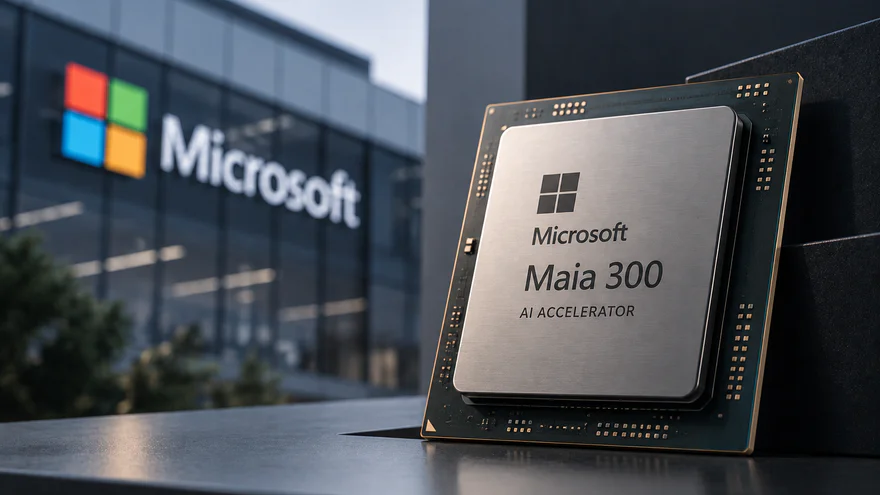
Microsoft engineers have introduced the third-generation AI chip Maia 300. The company plans to implement it in workloads starting in 2027. The corporation aims to make the Azure Maia family the main AI inference system for its products and services. Scott Guthrie, Executive Vice President of Microsoft's Cloud and AI Group, stated that the system should enhance the efficiency of cloud AI workloads and be better suited for reasoning models and agent tasks. According to him, Maia 300 will provide 40% more tokens per megawatt compared to leading GPU-based systems, including solutions from Nvidia and AMD. In a full configuration with 96 accelerators, the system delivers seven times the performance of the previous model.
According to the company, Maia 200 is already used in AI workloads, including Microsoft Copilot, GitHub Copilot, Microsoft Foundry, and Microsoft's own models. Microsoft AI head Mustafa Suleyman noted that to work with the company's models, it's necessary to control the entire stack down to the silicon. According to him, launching corporate models on the Maia chip remains a critically important direction for the team. Thus, Microsoft is expanding its own accelerator stack to serve AI services within its cloud infrastructure.
Recall that on October 10, the company released Microsoft-Decision-1, a model for routing, classification, prioritization, data verification, and workflow management. It is based on the open Qwen3.5-9B from Alibaba.
This material is prepared solely for informational purposes and does not constitute financial advice or a recommendation.
Related articles