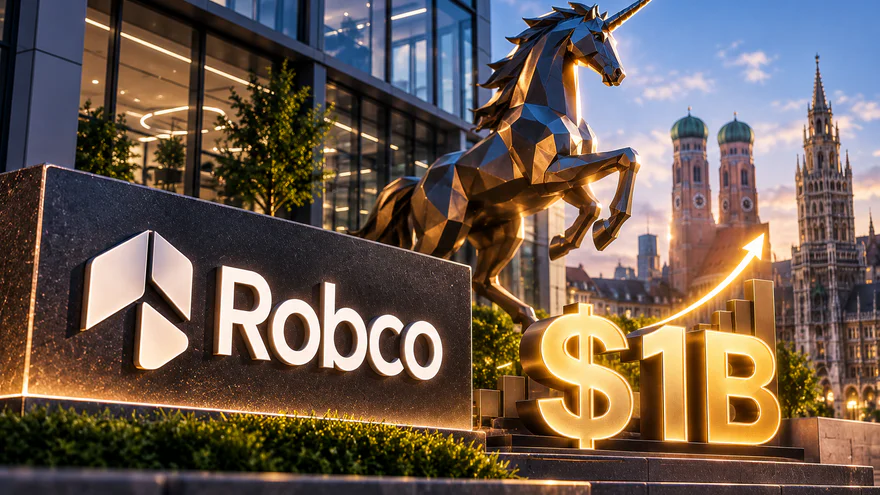
Munich-based startup Robco has achieved unicorn status, reaching a valuation of over one billion dollars. This value is double the valuation recorded at the beginning of the year. The company's CEO, Roman Hölzl, stated that he expects the company's revenue to triple this year, as it did last year. The company has raised an additional 40 million dollars in new capital. The round allowed employees to sell their shares at a profit. As Hölzl noted, capital was not the only lever for achieving the result, but it was these 40 million that allowed Robco to enter the unicorn club. Since its founding, the company has raised over 200 million dollars.
Robco has become the third unicorn in German robotics after Agile Robots from Munich and Neura Robotics from Metzingen. Founded in 2020 by researchers from the Technical University of Munich, the company developed a modular system for industrial robots that can be installed and launched in one to two days. The robots handle palletizing and pick-and-place tasks, where items are lifted and moved. The technology is based on proprietary software to which hardware modules are connected. With the help of a digital twin, components are configured and programmed remotely.
The latest round included international investors Sequoia, Lightspeed, and the Lingotto fund, as well as new ones – Cherry Ventures and European Tech Collective, a group of founders of successful European tech companies. Lightspeed investor Alex Schmitt noted that Robco is one of the few companies in Europe that not only explores physical AI but also implements it in factories. Sequoia partner Luciana Lixandru sees Robco working towards a future where AI not only generates content but also acts independently in the physical world.
According to Hölzl, the new funds were not necessary: about 100 million dollars remained in the account. The company currently has several hundred clients and more than 1,000 systems sold, including to BMW. Last year, revenue tripled. Next year, growth is expected to be supported by Alfie, an autonomous industrial robot set to hit the market in March.
Hölzl expects the American business to match the scale of the European one in a year and a half. To accelerate this, he himself moved to the US, opened a research lab in San Francisco, acquired Rapid Robotics, and established production in Austin, Texas. The plan is to return to Germany in less than two years.
This material is prepared solely for informational purposes and does not constitute financial advice or a recommendation.
Related articles