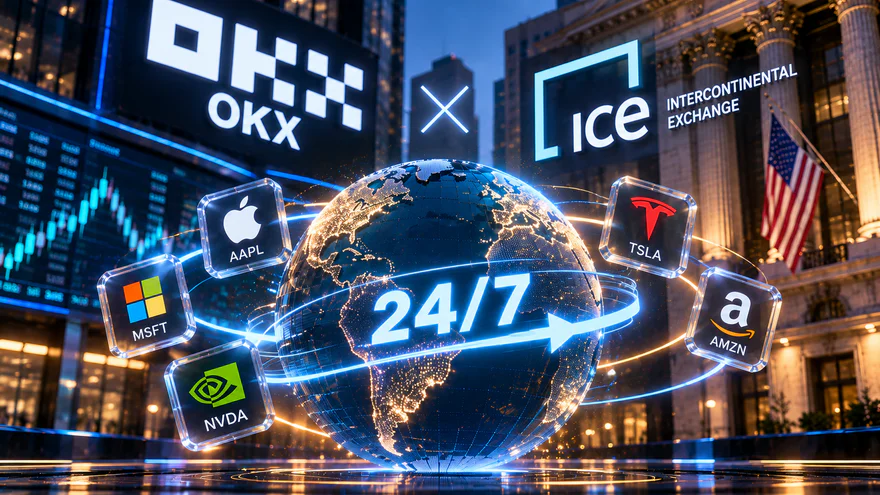
Nine companies, including Broadcom, CoreWeave, and Cerebras Systems, have opposed the trading of their tokenized shares on the OKXICE platform. They were joined by AppLovin, Applied Digital, Verizon, Rocket Labs, Applied Optoelectronics, and UnitedHealth Group. OKXICE is jointly owned by Intercontinental Exchange (ICE) and the cryptocurrency exchange OKX; ICE also owns the New York Stock Exchange (NYSE).
The platform applied to tokenize 63 major US stocks through restricted-access Uniswap V4 pools under the SEC's 'Innovation Exemption.' Companies had 30 days to object, otherwise silence was considered consent. Broadcom and other companies took advantage of this window. Applied Optoelectronics stated that it is unsure how this would affect its traditional stock price, liquidity, and volatility.
Nasdaq, a competitor to NYSE, also refused to allow its shares (NDAQ) on tokenized stock venues (TSV). 'As an issuer, after carefully considering the current considerations of the Innovation Exemption, we intend to opt out of TSV for Nasdaq, Inc. (Nasdaq: NDAQ),' it stated in its Q&A section. A Nasdaq representative told The Wall Street Journal that the company is committed to tokenization but does not want its tokenized shares traded on platforms that do not show 'best real-time prices.' The platform supported by OKX is just one of the TSVs. Nasdaq fears that TSVs outside the National Market System (NMS) could distort pricing and fragment liquidity; similar liquidity concerns were expressed by the IMF.
According to Nasdaq, companies should issue their own tokenized shares and have more control over where and how they are traded. In other words, Nasdaq opposes the OKXICE model: it allows TSVs to offer 'wrappers,' where a third party buys real shares to back the issued tokenized securities. Meanwhile, Nasdaq is partnering with Kraken, whose model allows companies to issue tokens directly. The two competitors are promoting two different models of tokenized stocks. It is still unclear whether others will opt out and which model the market will choose.
Meanwhile, the supply of tokenized stocks has reached $3.4 billion, and the monthly transfer volume exceeds $10 billion—about 1% of the stablecoin supply and a sign of sustainable adoption, despite growing opposition from some traditional companies and exchanges.
This material is prepared solely for informational purposes and does not constitute financial advice or a recommendation.
Related articles