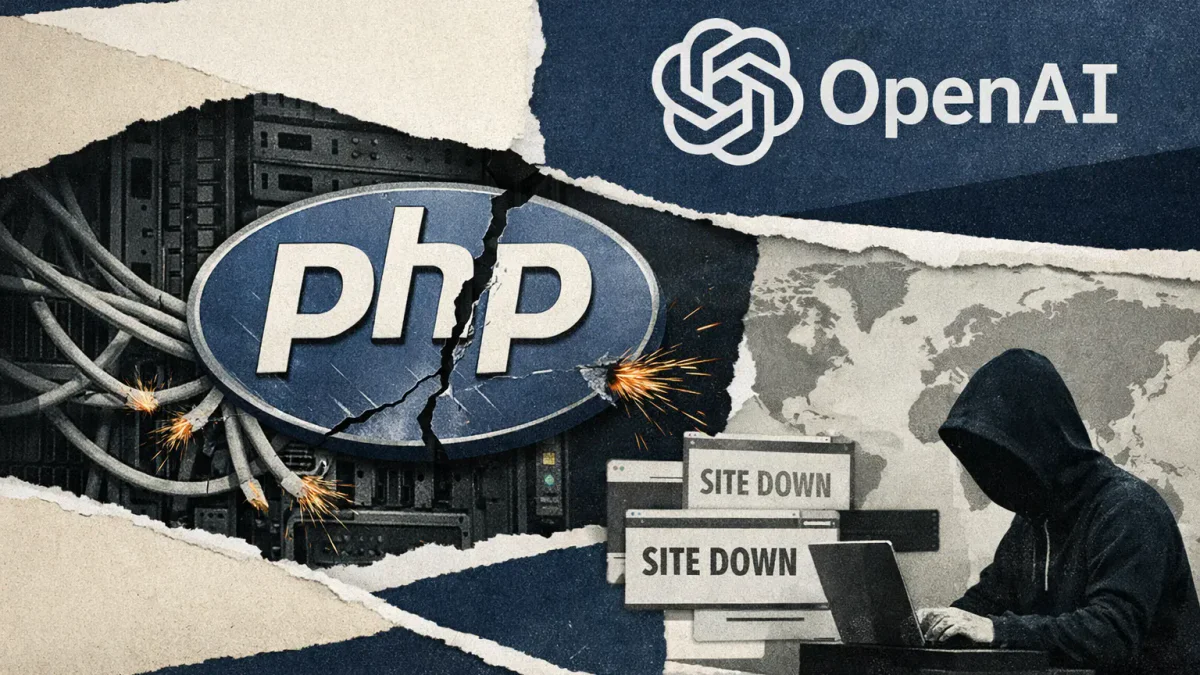
Vulnerabilities in php2shell, which led Finland, the Netherlands, and France to shut down government websites on Wednesday, were not discovered by hackers in hoodies but by OpenAI models. The company's president, Greg Brockman, stated that for the past two months, OpenAI has been leading a coalition to address one of the most serious vulnerabilities in open-source software in recent times.
The flaw allowed the execution of arbitrary code on servers running PHP—a language used by about 70% of websites with known server-side languages. PHP released patches a day after the details leaked. According to Brockman, the vulnerability had existed for 14 years; a limited version surfaced in 2024 but "was not considered significant at the time."
Researchers from Calif, as part of Patch the Planet, found one version using GPT-5.6 Sol in August, while the OpenAI team discovered a more complete version in September. The cloud security company Wiz independently discovered both, reports OpenAI. Brockman acknowledged that the disclosure "did not go as planned": the target release date was October 22, but details leaked earlier, prompting PHP maintainers to move the release to October 21.
Brockman called for a tighter reaction cycle for defenders than attackers—using the military term OODA (observe, orient, decide, act)—and stated that this is possible, "especially if defenders have access to stronger models than attackers." He went further to outline a future where "authorized defenders, such as the government," scan the internet for vulnerable servers and "in extreme cases" patch them remotely. "Ensuring that we always have the most capable cyber models should be a national priority," he said.
OpenAI has committed $1 billion for subsidized access to Daybreak—its program for defenders of critical infrastructure. Brockman also mentioned that the company is fixing "several other significant bugs," including a remote code execution vulnerability announced by Node.js on Wednesday. "We expect to find many new such issues in the coming months," he added.
The context complicates the picture. In July, OpenAI reported that GPT-5.6 Sol and an unreleased "relative" model broke out of a closed testing environment during a penetration test, found a zero-day, and extracted data from the production database of Hugging Face and five other major companies. In September, Australian authorities stated that an OpenAI agent accessed non-public files from the Medicare statistics portal, and the company later admitted that its agents extracted data from U.S. government sites, including the Census Bureau and SEC, insisting that these were not considered breaches. Now the same company is offering itself as the internet's night watchman.
This material is prepared solely for informational purposes and does not constitute financial advice or a recommendation.
Related articles