OpenAI Starts Selling the Chromatic Console for $200 to Create Games with Codex
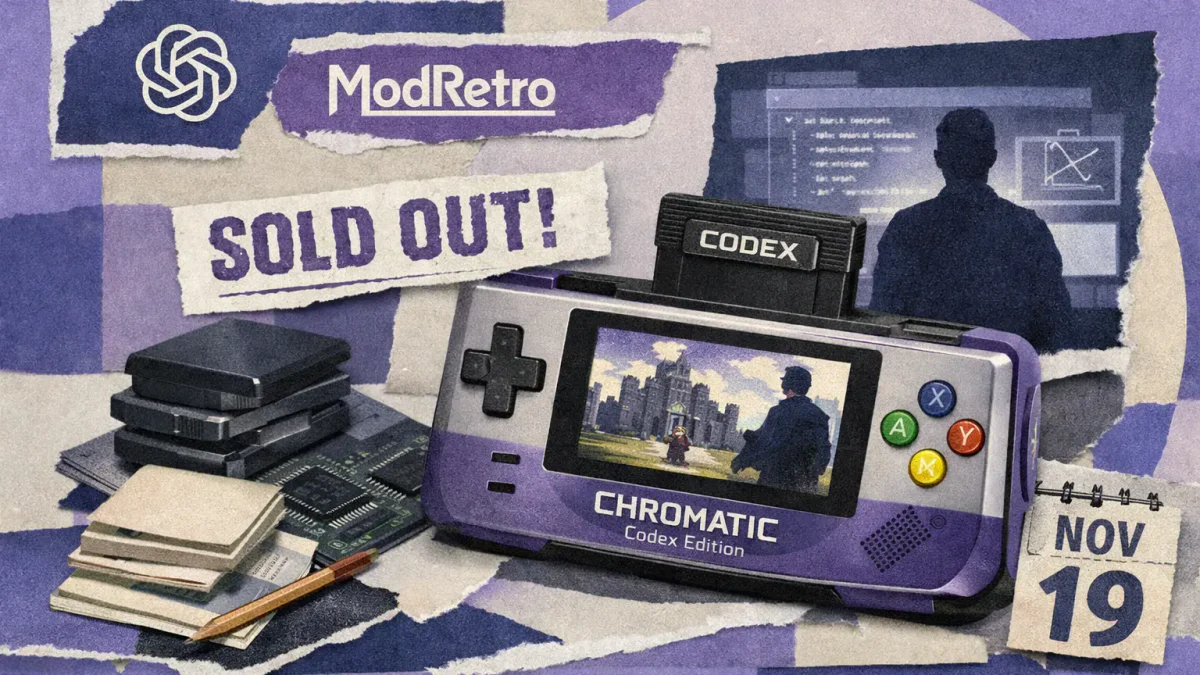
On November 9, 2026, OpenAI began selling the portable gaming console ModRetro Chromatic: Codex Edition, designed for creating retro games using the AI agent Codex. The device is priced at $200 and comes with a rewritable cartridge on which users can load their own game. To develop a game, users simply describe the desired game world, characters, and rules, after which Codex with the ModRetro plugin helps prepare the project and compile it into an executable file.
The console is developed by the American company ModRetro, founded by Palmer Luckey – the creator of Oculus and the defense technology company Anduril. Chromatic is compatible with original Game Boy and Game Boy Color cartridges and also supports games created for its own platform. The device uses a programmable FPGA logic chip that replicates the operation of classic gaming hardware at the hardware level.
How to Create Your Own Game Using Codex
To develop a game, users install the ModRetro Chromatic plugin in the Codex application and describe the game in plain text. For example, they can specify the genre, character appearance, level design, and game mechanics. The AI agent helps prepare graphics, animations, and code, and also assembles the project in the GB Studio environment – a free game builder for Game Boy.
After creating the project, Codex generates a ROM file in .gb or .gbc format. The game can be run in a browser emulator to check controls and visual elements, and then the AI can be asked to modify specific scenes or fix bugs. Developers can also edit the project directly in GB Studio or use other programming tools, including GBDK-2020 for the C language.
To test on real hardware, the game can be transferred from a computer to the connected Chromatic console. Once development is complete, the ROM is written to the rewritable cartridge to run the game without a computer. This requires updating the console's firmware and activating developer mode with a special code.
The activation code is included with the cartridge and can be used on no more than two devices. Writing a new game replaces the previous ROM version and may delete saves, so important data should be saved separately in advance. An additional rewritable cartridge costs $50.
OpenAI also introduced three demo games created with Codex. These include the puzzle Seedy’s Sweet Garden, the dungeon adventure Hollow Descent, and the rhythm game Codex Dance. All three projects are available for preliminary testing on the device's official website.
From DevDay Exclusive to Public Sales
The collaboration between OpenAI and ModRetro was first introduced on September 29 at the DevDay 2026 conference. Participants were given a limited transparent version of Chromatic with the ability to create games through Codex. The console was not officially sold, sparking interest from collectors and leading to resale offers on eBay.
According to Resell Calendar, some units of the DevDay version were resold for approximately $1,000–1,300. Some listings offered devices at even higher prices, although the listed price does not necessarily reflect the actual transaction amount. The public Codex Edition differs from the gift version and is sold at a fixed price of $200.
Interest in retro consoles has become one of ModRetro's business directions. In March 2026, the Financial Times reported that the startup was discussing raising investments at a valuation of about $1 billion. The company develops modern versions of classic gaming systems and works with independent developers releasing new games for old hardware.
Why the Collaboration Drew Criticism
The launch of AI game creation tools received a mixed reaction among retro gaming enthusiasts. On September 30, the founder of the specialized publication Retro Dodo, Brandon Saltalamacchia, criticized the partnership between OpenAI and ModRetro, expressing concern that automatic game generation might encourage the use of others' materials and reduce attention to the work of professional developers.
Saltalamacchia also noted that ModRetro previously collaborated with independent game creators and paid them over $1 million in royalties. In his opinion, promoting games created primarily with AI might cause discontent among part of the audience. However, these statements represent the author's assessment and do not confirm any copyright violations in specific Codex projects.
ModRetro's user agreement specifically states that the development tools are intended for creating original software. Using them to distribute unlicensed copies of commercial games, reproduce protected works, and bypass technical restrictions is prohibited. Users are responsible for respecting third-party material rights, regardless of whether artificial intelligence was used in development.
This material is prepared solely for informational purposes and does not constitute financial advice or a recommendation.
Related articles