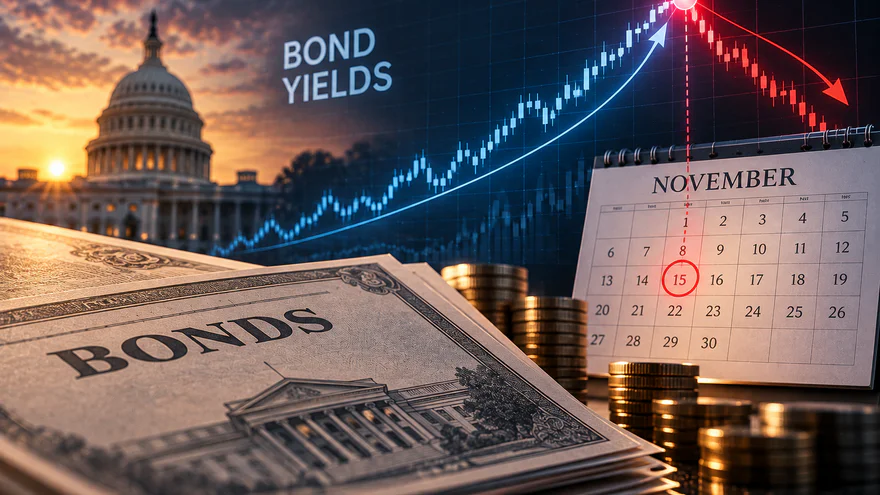
Peter Brandt Predicted US 30-Year Bond Yields Could Rise to 7%
Experienced trader Peter Brandt suggested that the yield on 30-year U.S. Treasury bonds has completed its correction and may rise to 6.5–7%. According to his assessment, after reaching a local minimum of 5.22%, the indicator resumed its increase, and a return below 5% is unlikely.
“Opinion – pull back in yields (30-Yr touched 5.22%) is over. Sub 5.0 unlikely. Next stop 6.5–7.0%,” Brandt wrote on November 10 in X. Translated: “In my opinion, the yield correction is over (30-year bonds reached 5.22%). A drop below 5% is unlikely. The next target is 6.5–7%.”
According to the U.S. Department of the Treasury, on November 10, the yield on 30-year bonds was 5.35%, and on 10-year bonds, it was 4.98%. Thus, the 30-year securities were 13 basis points above the minimum indicated by Brandt. Meanwhile, the projected range still significantly exceeds current market values.
How rising yields might affect mortgages and stocks
The yield on U.S. Treasury bonds is used by financial organizations as one of the benchmarks for assessing the cost of long-term borrowing. Its steady growth may contribute to an increase in mortgage and corporate loan rates.
American mortgage rates are more closely linked to the 10-year Treasury bond market, so a change in the yield on 30-year bonds does not automatically mean a similar increase in mortgage rates.
For the stock market, an increase in government bond yields can also be a pressure factor. A higher risk-free rate increases the required return on investments and may reduce the attractiveness of stocks, especially for companies whose valuation largely depends on future cash flows.
At the same time, the extent of the potential impact will depend on the reasons for the yield increase, inflation expectations, and the future monetary policy of the Federal Reserve.
What the forecast means for Bitcoin
At the time of preparing the original material, Bitcoin (BTC) was trading around $73,820, having lost approximately 11.7% over the previous 30 days. The rise in government bond yields may increase competition for investment capital, as investors have the opportunity to allocate funds in debt instruments with higher returns.
However, there is no direct correlation between bond yields and the BTC rate. The cryptocurrency market is simultaneously influenced by liquidity, demand from institutional investors, leveraged trading, and other factors.
Brandt's forecast is based on a technical assessment of yield dynamics and does not guarantee reaching the 6.5–7% level. For market participants, the key question remains how sustainable the yield increase will be and how it will affect borrowing costs and demand for risky assets.
This material is prepared solely for informational purposes and does not constitute financial advice or a recommendation.
Related articles