Physicists Transmit Message Through Wall Using Gravity and an Old Elevator
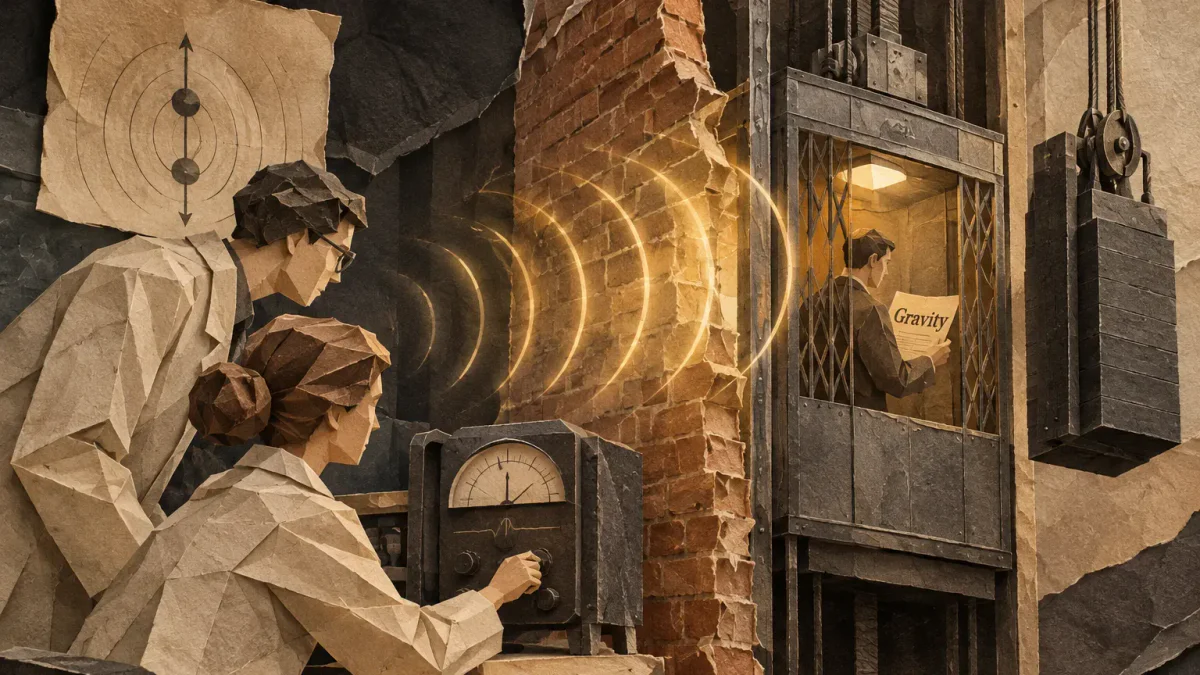
Scientists from the University of Queensland in Australia have, for the first time, demonstrated the transmission of an encoded message through a brick wall using changes in the gravitational field. For this, researchers used an elevator built in the 1950s and a sensitive device for measuring gravity.
The experiment did not require radio waves, wires, or other traditional means of information transmission. Its results were published in the scientific journal Science Advances.
The work demonstrated the fundamental possibility of creating a communication channel whose signal cannot be shielded by ordinary materials. However, practical application of the technology is still far off.
How scientists transmitted information through a wall
The basis of the experiment was the counterweight of an old elevator weighing about 1.8 tons, located in one of the university campus buildings.
Researchers moved the elevator between two floors, changing the position of the counterweight. Each of the two positions corresponded to a specific binary code value—zero or one.
A gravimeter, capable of registering extremely small changes in gravitational acceleration, was used to receive the signal.
The device was placed in an adjacent room, separated from the elevator shaft by a brick wall. It recorded changes in the gravitational field that occurred when the counterweight moved.
Thus, the researchers were able to encode a message with a sequence of movements of a massive object and reconstruct it on the receiving side.
The first successfully transmitted word was Gravity.
Transmission speed was 1 bit per minute
The main limitation of the experimental system was the low data transmission speed.
According to one of the study's authors, Andrew White, the old elevator moved quite slowly, so the system transmitted only one bit of information per minute.
It took about an hour to send one word.
The speed of such communication depends on several factors: the mass of the transmitting object, its movement speed, and the sensitivity of the receiving device.
Despite the low performance, the experiment confirmed the viability of the proposed principle.
Unlike radio waves, the gravitational field cannot be completely shielded by concrete, metal, or other known materials.
This potentially allows for the use of such a data transmission method in conditions where conventional wireless signals are significantly weakened.
What prospects does gravitational communication have
In the future, researchers hope to increase the system's sensitivity using more advanced measuring devices, including quantum sensors.
In particular, the use of devices based on cold atom interferometry, which can detect very weak changes in the gravitational field, is considered a promising direction.
According to the authors' calculations, with significant equipment upgrades, the communication range could theoretically be increased to about 500 meters.
Some optimization options also allow for increasing the transmission speed to 15 bits per minute.
However, these figures have not yet been achieved experimentally and imply a significantly more complex system.
Potential applications of the technology could include mines, underground structures, and underwater objects, where the use of radio communication is difficult.
However, the authors acknowledge that the existing method is too slow for most modern tasks.
The main result of the study remains the experimental confirmation that information can be encoded in changes in the gravitational field and read at a distance without the use of electromagnetic communication.
This material is prepared solely for informational purposes and does not constitute financial advice or a recommendation.