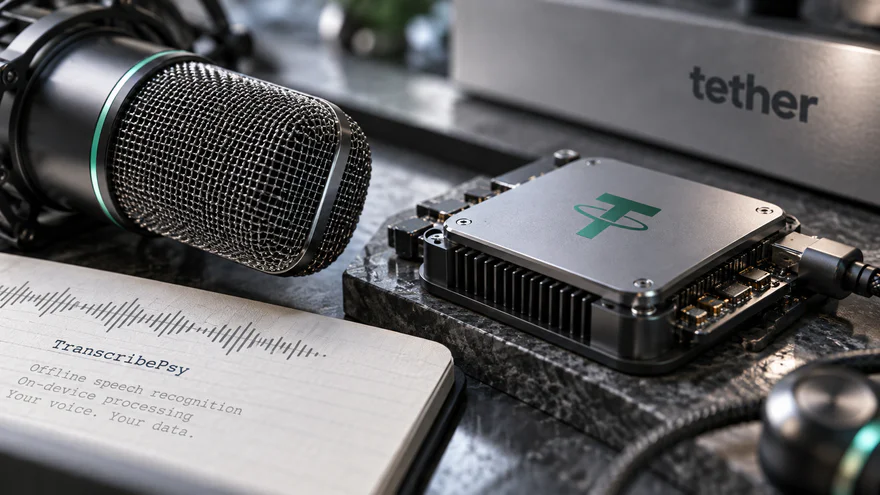
Tether has introduced TranscribePsy, a speech recognition model with 254 million parameters that can transcribe conversations directly on smartphones, smart glasses, and humanoid robots without sending audio to cloud servers. According to the Tether AI Research announcement on October 14, the open-source model supports multilingual speech recognition and is designed for devices with limited computing resources.
According to the company's tests, on an iPhone 17 Pro Max using the Core ML framework, the model transcribes 10 minutes of audio in 1.65 seconds. TranscribePsy is part of the QVAC AI project, which aims to launch AI applications directly on consumer devices while maintaining data privacy. Tether believes that local processing can be beneficial in medical consultations, legal interviews, therapy sessions, and journalism, where recordings may contain confidential information.
In tests, the word error rate (WER) was 8.02% on the Open ASR Leaderboard, 6.58% on Multilingual LibriSpeech, and 21.56% on Common Voice. The model was compared with larger counterparts, including Qwen3-ASR-0.6B, omniASR-CTC-1B-v2, OWSM-CTC-v4, and Whisper-Medium. According to researchers, on Multilingual LibriSpeech, TranscribePsy performed better than several models that are three to four times larger. In tests on six smartphones running on processors, the model was 2.6 times faster than the next fastest system and 5.7 times faster than Whisper-small. Tether has published the test configurations so researchers can replicate the results.
The model is released in four versions. One for laptops supports 25 European languages, a lightweight configuration is designed for eight common languages. For mobile devices, a GGUF version is available, running through parakeet.cpp, as well as a separate Core ML version optimized for Apple's Neural Engine. The models process continuous audio and output text shortly after detecting speech.
Tether's CEO Paolo Ardoino stated that the company wants users to maintain control over their conversations as voice-controlled devices become more widespread. "The future of AI should not mean that centralized platforms get a front-row seat into our personal lives," he said.
The model is distributed under the Apache 2.0 license, with weights, GGUF mobile builds, Core ML versions for Apple Silicon, and test configurations available.
This material is prepared solely for informational purposes and does not constitute financial advice or a recommendation.
Related articles