What Anthropic's Financial Statements Revealed Before the IPO
On October 26, 2026, Anthropic, the developer of the Claude AI model family, filed a public S-1 registration statement with the U.S. Securities and Exchange Commission (SEC). The company plans to conduct an initial public offering on Nasdaq under the ticker ANT, although the final price and number of shares offered have not yet been determined.
Anthropic's 2026 financial statements, disclosed as part of the IPO preparation, show how rapidly the company's business is developing. In the first six months, revenue reached $16.29 billion compared to $1.16 billion for the same period the previous year. This growth represents about 1300%, meaning revenues increased approximately 14 times.
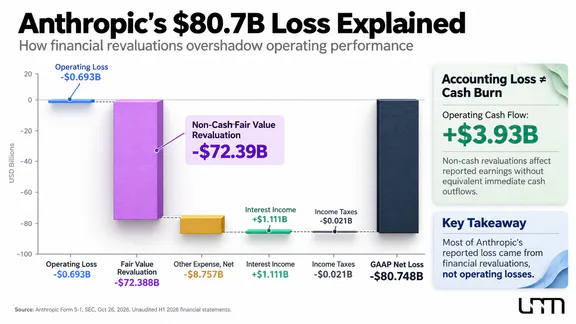
However, the net loss for the same period reached $80.75 billion, increasing more than sixfold. Meanwhile, the operating loss, reflecting the difference between revenue and expenses for core activities, decreased by almost 68%.
Key Financial Indicators of Anthropic
Indicator | H1 2025 | H1 2026 |
|---|---|---|
Revenue | $1.16 billion | $16.29 billion |
Operating Expenses | $3.30 billion | $16.98 billion |
Operating Result | −$2.14 billion | −$0.69 billion |
Net Result | −$12.97 billion | −$80.75 billion |
Operating Cash Flow | −$1.51 billion | +$3.93 billion |
Source: Anthropic, Form S-1, SEC. Unaudited data for the first half of 2025 and 2026. Values are rounded.
Notably, changes were observed in the second quarter of 2026, when Anthropic posted an operating profit for the first time in six quarters presented in the financial statements — about $974 million. Thus, despite the negative result for the entire half-year, by its end, current revenues already exceeded operating expenses.
This is a significant change compared to 2025, when, as previously reported by UNUM, revenue growth was accompanied by an increase in operating losses.
However, one profitable quarter does not yet prove the sustainability of the business model. To do so, it is necessary to understand why the net result differs so significantly from the operating result and what costs the company will incur in subsequent years.
Why Anthropic Incurred an $80.7 Billion Loss
The main reason for Anthropic's massive net loss is not the costs associated with developing and maintaining Claude, but rather the accounting treatment of financial instruments used to raise capital.
According to the financial statements, for the first half of 2026, the company recognized $72.39 billion in expenses due to changes in the fair value of convertible debt instruments, derivative liabilities, and SAFE agreements. These agreements provide investors with the possibility of receiving company shares in the future under certain conditions.
The mechanism works as follows: Anthropic raises funding through instruments that can later be converted into shares. When the valuation of its business increases, the estimated value of obligations to holders of such instruments also rises. According to applicable accounting rules, the change in value is reflected as an expense, even if the company has not paid the corresponding amount in cash.
A notable example is the convertible obligations to Amazon. As of June 30, 2026, their nominal principal amounted to about $6.2 billion, while the carrying amount, determined at fair value, reached $108.6 billion. This latter figure does not mean that Anthropic must immediately pay Amazon more than $100 billion in cash. The conversion terms provide for the receipt of shares, which may lead to the dilution of other investors' stakes.
Additionally, the company recognized $8.76 billion in other expenses net of income, including about $8.72 billion in adjustments to the value of other financial instruments. Together with the revaluation of convertible obligations at $72.39 billion, these charges formed about $81.11 billion in non-cash expenses. Their impact on the net result was partially offset by other items, including $1.11 billion in interest income.
Therefore, to assess Anthropic's financial position, it is necessary to distinguish between three indicators:
Net loss — $80.75 billion. Takes into account the results of core activities, revaluation of financial obligations, interest income, taxes, and other items.
Operating loss — $693 million. Shows that total business expenses for the half-year still exceeded revenue.
Adjusted operating profit — $1.62 billion. Calculated by the company after excluding certain items, including stock-based compensation and certain non-cash charges.
The latter indicator falls into the non-GAAP category, meaning it is calculated outside standard accounting rules. It helps assess the dynamics of core activities, but the excluded expenses are not necessarily devoid of economic significance. For example, employee stock compensation can increase the number of shares outstanding and reduce the stake of existing shareholders.
Thus, Anthropic's accounting loss of $80.7 billion is not equivalent to the amount of cash spent on operating Claude. However, the revaluation of financial obligations reflects the real economic consequences of raising capital, including the potential dilution of investors' stakes. Excluding these charges does not in itself mean the company has become sustainably profitable.
How Profitable is Claude's Business Model
To understand how sustainable Claude's economics are, it is necessary to examine the revenue structure of Anthropic and the costs of servicing AI models.
The company earns from subscriptions, access to models via API, and corporate solutions that allow integrating artificial intelligence into their own products and business processes. In the first half of 2026, about $13.06 billion, or 80% of revenue, came from the payment for actual model usage. Another $3.22 billion was obtained from subscriptions.
This structure means that Anthropic's revenues largely depend on the number of processed requests, not just the number of users.
For an AI model developer, this is both an advantage and a source of risk. As Claude's use by corporate clients expands, revenue can increase rapidly. However, each request requires computing resources, so the growth in load is accompanied by additional infrastructure costs.
The main change in Anthropic's economics is visible when comparing these expenses to revenue. In the first half of 2025, computing and infrastructure cost the company $2.33 billion, approximately double its income. A year later, expenses grew to $8.95 billion, but their ratio to revenue decreased from about 201% to 55%.
For every dollar of revenue, Anthropic now incurs significantly fewer computing costs than a year earlier. This indicates an improvement in operational economics but does not prove a reduction in the cost of each request: part of the computing power is purchased in advance, and its cost depends on the terms of long-term contracts.
Moreover, this indicator cannot be equated to gross margin. The computing expense item includes not only servicing user requests but also infrastructure for research, development, and training of language models.
At the same time, Anthropic continues to increase spending on personnel, sales, and promotion. Expenses for sales, marketing, and partnerships reached $3.17 billion compared to $120 million a year earlier. This category includes expenses related to the distribution of services through partner channels.
This expense structure shows that monetizing artificial intelligence depends not only on the number of clients but also on the cost of computing, the intensity of model usage, and the effectiveness of commercial channels.
A separate significance lies in the dependence on cloud platforms. In the first half of 2026, about 48% of Anthropic's revenue was obtained through cloud provider marketplaces. This provides access to corporate clients but simultaneously strengthens the influence of partnerships with Amazon, Google, and Microsoft. For example, as UNUM wrote, Anthropic is expanding Claude's international presence through Amazon Bedrock's infrastructure.
Thus, the ability of Claude's business model to generate sustainable profit depends not only on revenue growth rates. Equally important is whether the company can maintain the reduction in relative computing costs while simultaneously funding the development of more productive models.
How Much Money Anthropic Really Spends and What Risks It Bears
Another important change in the financial statements is the shift to a positive operating cash flow. In the first six months of 2026, Anthropic received $3.93 billion in cash from its core operations, compared to an outflow of $1.51 billion in the same period the previous year.
This means that inflows from operating activities exceeded the corresponding cash outflows. However, a positive cash flow does not guarantee the absence of future financial problems. Its magnitude also depends on the timing of settlements with customers and suppliers, and the indicator itself does not reflect all future payments on infrastructure obligations.
As of June 30, 2026, Anthropic's cash and short-term investments amounted to approximately $131.7 billion. A significant portion of the financial reserves was formed through raised capital: in the first half of the year alone, the issuance of preferred shares brought the company about $110.4 billion.
The main issue lies in the scale of future expenses on computational infrastructure.
According to the S-1, as of the end of June, Anthropic had about $265.6 billion in future minimum commitments under service procurement contracts, primarily related to cloud infrastructure. Additionally, the company disclosed approximately $321.4 billion in future undiscounted lease payments under concluded contracts for computational capacities that have not yet commenced.
After June 30, Anthropic entered into new and amended existing agreements for leasing and procuring infrastructure. These foresee an additional approximately $245 billion in future minimum payments, with the fulfillment of some agreements dependent on certain conditions. These amounts pertain to different categories and dates of obligations, so they cannot be mechanically summed without considering possible overlaps.
These are multi-year payments spread over periods of up to 20 years, rather than immediate cash outflows. However, the scale of the agreements shows how capital-intensive the development and commercial use of advanced AI models remains.
Here arises a significant mismatch: Anthropic's revenues predominantly depend on the actual consumption of AI services, whereas infrastructure obligations may persist regardless of the load on computational capacities.
If demand for Claude continues to grow rapidly, the acquired infrastructure will allow servicing more clients and increasing revenue. However, if growth slows, some computational resources may remain underutilized, while payments under long-term contracts will persist.
This problem is characteristic of the entire artificial intelligence market. In the analytical material by UNUM “AI Boom on Borrowed Money: Who Profits from Artificial Intelligence and Who Risks Not Recouping Investments” it is examined in detail how infrastructure costs and debt financing distribute risks among industry participants.
For Anthropic, the dual role of major tech partners adds additional complexity. Amazon, Google, and Microsoft provide computational capacities, participate in financing the company, or distribute its products, but simultaneously develop their own AI services. This partnership structure facilitates business scaling but increases dependency on a limited circle of infrastructure providers and their commercial terms.
Consequently, significant cash reserves reduce short-term financial risks but do not guarantee the return on accepted infrastructure obligations.
How Investors Should Evaluate Anthropic Before the IPO
Evaluating Anthropic before the IPO requires considering not only current revenue but also long-term obligations, potential share dilution, and profitability prospects. Therefore, investors looking at Anthropic's shares should not rely solely on net loss or a single profitable quarter.
Using the traditional P/E multiplier, which compares the company's capitalization with net income, is currently uninformative. With a negative net result, its value does not allow for a correct assessment of the business's value relative to earned profit.
For analyzing the developer of Claude, P/S and EV/Revenue indicators are more useful. The former compares market capitalization with revenue, while the latter compares business value with its income, considering differences in capital structure and financial obligations.
However, these multipliers also require caution due to Anthropic's exceptionally high growth rates.
For example, to illustrate, assume Anthropic's capitalization at the IPO will be $1.5 trillion, and annual revenue will equal twice the result of the first half of 2026 — about $32.6 billion. Then the conditional P/S would be approximately 46. At a capitalization of $2 trillion, the indicator would exceed 61.
This is merely an illustrative calculation, not an assessment of fair value. Doubling the half-year revenue is not a confirmed forecast for the entire 2026 and does not replace the calculation based on actual revenue for the last 12 months.
A high multiplier suggests that investors are willing to pay a significant premium for future growth. But the higher the stock price relative to current income, the more Anthropic's capitalization will depend on the company's ability to increase revenue and improve business profitability.
The discussion around such an assessment has already begun. Previously, UNUM reported on investor Michael Burry's criticism of Anthropic's valuation, who questioned the justification of the company's private valuation at $965 billion. However, a high valuation in itself does not prove the existence of a bubble — such a conclusion requires comparing the price with expected cash flows, risks, and business growth rates.
Anthropic itself warns of a possible slowdown in revenue growth:
We do not expect our revenue to continue growing at comparable rates.
This warning is particularly important given that new infrastructure commitments are made years in advance, while future revenue remains uncertain.
Key Metrics for Investors to Watch
After the initial public offering, it is advisable to evaluate Anthropic's financial results in four areas:
Revenue growth rate. How quickly revenues from corporate use of Claude are increasing and whether the client base is expanding.
Operating margin. Is positive operating profit becoming regular, or is the company returning to losses amid new expenses.
Computational costs relative to revenue. Does revenue growth continue to outpace the increase in costs for training models, servicing requests, and infrastructure.
Free cash flow and financial obligations. How much cash remains after capital expenditures and how well future payments are secured by expected revenues.
It is also necessary to consider Anthropic's corporate structure. According to the S-1, the founders plan to retain 50.1% of the votes on general issues through a special class F share. Meanwhile, the Long-Term Benefit Trust will have the authority to form the majority of the board of directors. This model limits the influence of common stockholders on company management and requires additional analysis of investor rights.
What Anthropic's Financial Reports Mean for Investors
Anthropic's financial results demonstrate that the development and commercial use of advanced AI models can generate multi-billion dollar revenues. The company has significantly increased its revenues, improved its operating margin, and achieved positive operating cash flow. However, the large net loss is primarily due to the accounting revaluation of financial instruments, not current expenses on Claude.
However, the improvement in operating metrics does not yet guarantee long-term profitability. The main investment risks are associated with a possible slowdown in revenue growth, the cost of computational infrastructure, and the need to fulfill long-term commitments regardless of actual demand.
For investors, the decisive factor will be the combination of these results with the company's valuation at the IPO. Even a rapidly growing business can turn out to be a poor investment if the stock price initially assumes excessively high future revenues.