


Why is Bitcoin Falling Despite Billions in ETFs?
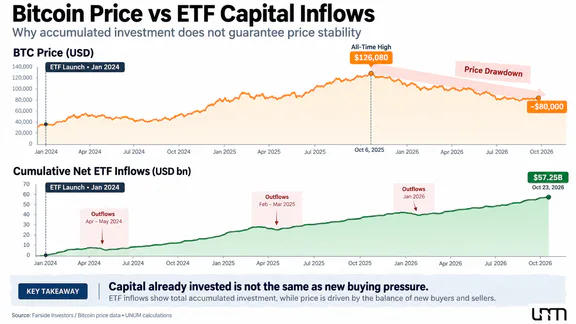
As of October 26, 2026, bitcoin was trading near $80,000, approximately 36-37% below the all-time high of $126,080 recorded on October 6, 2025. Meanwhile, institutional presence in the cryptocurrency market has significantly expanded: since January 2024, the accumulated net capital inflow into U.S. spot exchange-traded products on bitcoin (Bitcoin ETF) amounted to about $57.25 billion.
The contradiction is especially noticeable in the example of recent trading sessions. On October 19, the iShares Bitcoin Trust (IBIT) fund by BlackRock attracted $665.2 million, and the total inflow into U.S. spot bitcoin ETFs was $526.7 million. By October 22, the situation changed: investors withdrew $635.6 million from the funds, with $254.1 million from IBIT. The next day, the total outflow reached another $137.9 million.
Over the five trading sessions from October 19 to 23, the net inflow into U.S. bitcoin ETFs remained positive — about $301.2 million. However, these investments did not ensure a sustainable recovery in BTC price.
The scale of institutionalization is also confirmed by the assets of individual funds. According to BlackRock's report, as of October 23, the net asset value of IBIT was $65.88 billion. But this figure reflects the market value of the fund's property, not the amount of new investments. With a decline in BTC price, assets under management can decrease even without fund withdrawals.
Evaluating bitcoin's price in 2026 solely by ETF inflows is insufficient. It is necessary to consider changes in buyer structure, financial conditions, and seller pressure on the crypto market. Large investors can increase positions in favorable conditions but may reduce them if expectations regarding interest rates, liquidity, or acceptable risk change.
Therefore, the reasons for bitcoin's decline are not only related to the amount of attracted capital but also to how sustainable the new demand remains. The main question is who is willing to continue buying BTC in worsening market conditions and whether different investor groups can offset each other's reduced activity.
How Wall Street Changed the Structure of the Bitcoin Market
The institutionalization of the cryptocurrency market accelerated after January 10, 2024, when the U.S. Securities and Exchange Commission (SEC) allowed the listing and trading of shares of spot exchange-traded products on bitcoin. By January 11, they began trading on U.S. stock exchanges, providing investors with the opportunity to gain price exposure to BTC without independently buying and storing cryptocurrency.
Before this, access to bitcoin was available through crypto exchanges, investment trusts, futures products, and specialized intermediaries. However, spot bitcoin ETFs significantly simplified its inclusion in traditional investment portfolios.
Instead of opening an account on a cryptocurrency platform and organizing the storage of private keys, an investor can purchase fund shares through a familiar broker. Asset managers gained the ability to use bitcoin in portfolio strategies, and financial advisors could offer relevant instruments to clients within the existing infrastructure.
At the same time, the regulator immediately outlined the boundaries of its decision:
While today we allowed the listing and trading of shares of certain spot exchange-traded products on bitcoin, we have not approved or endorsed bitcoin itself.
The permission to trade exchange-traded products did not imply recognition of bitcoin as a reliable investment. The SEC assessed the compliance of instruments with legal requirements, not the future profitability of the underlying asset.
Further institutional infrastructure continued to develop. On July 29, 2025, the SEC allowed authorized participants to create and redeem shares of cryptocurrency exchange-traded products through the transfer of the digital assets themselves — the in-kind mechanism. The initial structure of American spot products provided for cash settlements.
As explained by the SEC, the new mechanism provides greater flexibility and can reduce transaction costs. However, it also shows why capital movement within ETFs cannot be directly equated to bitcoin purchases or sales on crypto exchanges.
Why Outflows from Bitcoin ETFs Are Not Equivalent to Direct BTC Sales
On the secondary market, investors trade fund shares among themselves. Such transactions do not always change the number of bitcoins owned by the fund.
If there is a need to create additional shares or redeem existing ones, authorized participants interact with the fund through an established procedure. The creation and redemption of shares are carried out through cash settlements or the transfer of BTC, depending on the terms of the specific product.
Therefore, a report of a $600 million outflow from an ETF does not necessarily mean that the funds sold bitcoins for that amount directly on cryptocurrency exchanges at that moment. Transactions may occur through the over-the-counter market, intermediaries, and other liquidity channels.
Nevertheless, steady inflows increase the potential need for funds in the underlying asset, while outflows can create opposite pressure. The scale of the impact is determined not only by the amount of cash flows but also by how effectively the market can absorb the corresponding operations.
Thus, institutionalization has expanded the demand for bitcoin, but at the same time, it has linked it to the mechanisms and investment decisions of the traditional financial system.
Who buys Bitcoin ETF and can this demand be considered long-term
The common perception that institutional investors in bitcoin control all the assets of spot ETFs does not correspond to the real market structure.
Buyers of shares can be hedge funds, investment advisors, family offices, pension structures, and ordinary private investors. Their goals vary significantly: some acquire BTC for the long term, while others use short-term market movements or relative value strategies.
In the annual letter to BlackRock shareholders for 2025, it was noted:
More than half of the demand for our bitcoin exchange product came from retail investors.
In the same statement, Fink reported that three-quarters of these retail investors had never previously owned iShares products. This indicated the ability of the bitcoin fund to attract a new audience but did not automatically classify them as institutional or long-term holders. The provided assessment refers to the period of the letter's publication and does not describe the structure of IBIT owners as of October 2026.
Some information about major participants is disclosed in quarterly 13F reports that institutional managers submit to the SEC. However, such reporting reflects only certain positions in securities and does not show all transactions, obligations, and hedging methods.
For example, a hedge fund may simultaneously buy a Bitcoin ETF and sell a BTC futures contract. In such a case, the purchase of shares does not necessarily indicate a bet on the rise in cryptocurrency value. The investor may be trying to profit from the difference between the spot and futures prices, reducing directional price risk.
Therefore, a large position in an ETF is not always equivalent to long-term investor confidence in bitcoin's growth.
There is also a limitation on the relevance of data. As of October 26, 2026, the full quarterly snapshot for the third quarter has not yet been published by all participants: the SEC's established deadline for submitting the relevant reports is November 16. Therefore, it is currently impossible to reliably determine the structure of all institutional positions at the end of September based on public documents.
The growth of ETF assets indicates expanded access to bitcoin, but it does not in itself prove that all the attracted capital will remain in the market during a significant price drop.
Institutional demand has become dependent on one large fund
One of the most significant changes in 2026 was the redistribution of demand between corporate bitcoin holders and exchange-traded funds.
In the first half of the year, corporate holders provided a significantly larger volume of BTC purchases than American spot ETFs, which recorded net outflows during this period. In the second half of the year, their activity decreased, while the role of exchange-traded funds grew noticeably.
In a study published on October 23, Coinbase Institutional senior quantitative strategist Colin Basco described this change as follows:
ETFs replaced companies with bitcoin reserves as the main buyer of bitcoin.
This assessment refers to the comparison of two specific categories of participants, rather than all buyers in the BTC market. However, it allows us to see how the sources of additional demand have changed.
Period | Corporate BTC Holder Purchases | Net Flows of Spot Bitcoin ETFs |
|---|---|---|
First half of 2026 | around +$14.5 billion | around −$5 billion |
From August 1, 2026, according to Coinbase estimate on October 23 | around +$1.5 billion | around +$6.4 billion |
Source: Coinbase Institutional, October 23, 2026. Data rounded, figures relate to periods of different durations and reflect demand estimates, not the full balance of all BTC market operations
In the first half of the year, corporate buyers were acquiring bitcoins even with negative ETF flows. Since August, the situation has changed: exchange-traded funds have become the main source of positive demand among these two categories.
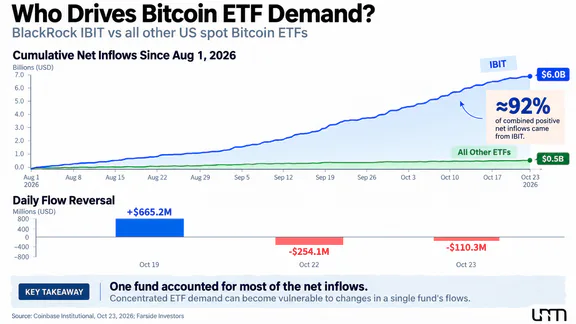
But a more important observation is that, according to Coinbase, since August 1, the BlackRock IBIT fund attracted about $6 billion in net investments, while all other U.S. spot Bitcoin ETFs together only about $0.5 billion.
Thus, IBIT accounted for approximately 92% of the total positive net inflow into U.S. spot funds for the period under review. However, the dynamics of individual products were uneven: some attracted capital, while others recorded outflows.
This distribution indicates a high concentration of demand. As long as IBIT consistently attracts funds, it can offset the weakness of other participants. However, if inflows slow down or turn negative, other funds may not provide comparable additional demand.
October inflows and outflows from Bitcoin ETFs show how quickly investor behavior changes even in the largest funds. After receiving $665.2 million into IBIT on October 19, investors withdrew $254.1 million on October 22 and another $110.3 million on October 23.
Therefore, market resilience is determined not only by the total volume of institutional investments but also by the distribution of new capital among buyers capable of independently supporting demand.
Why New Capital Doesn't Offset Seller Pressure
In the bitcoin market, several large categories of sellers and buyers operate simultaneously. In addition to ETFs and corporate treasuries, the supply is formed by long-term bitcoin holders, miners, cryptocurrency funds, speculative traders, and investors reallocating capital between assets.
Even significant purchases by individual participants do not guarantee a price increase if other sellers are willing to offer comparable or larger volumes at current quotes. Every completed transaction has a buyer and a seller, so the immediate impact on price is determined by the levels at which parties are willing to trade and how deep the market is.
One indicator of the state of internal cryptocurrency liquidity is the volume of stablecoin supply. These digital assets are widely used as a settlement medium in cryptocurrency trading.
The total stablecoin supply has decreased by about $12.7 billion relative to the May peak. Simultaneously, the seven-day Coinbase Premium indicator remained negative throughout October.
Coinbase Premium reflects the difference between the BTC price on Coinbase and comparable foreign platforms. Negative values may indicate a relatively weaker willingness of buyers on the U.S. platform to pay a premium for bitcoin.
However, both indicators have limitations. A reduction in stablecoin supply does not mean that the entire corresponding amount has left the BTC market, and a negative Coinbase premium does not cover all U.S. institutional demand, including ETF and over-the-counter transactions.
Cryptocurrency market liquidity depends not only on the volume of stablecoins but also on trading depth, market maker activity, and the state of the over-the-counter segment. Additional data on spot volumes, market orders, and operations of large participants are needed to assess overall liquidity.
Nevertheless, the reduction in stablecoin supply, negative Coinbase premium, and slowdown in corporate purchases indicate the weakness of certain demand sources.
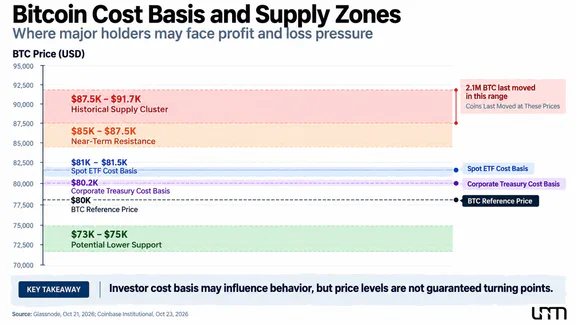
Additional information on the state of holders is provided by on-chain indicators. According to Glassnode on October 21, the average cost of BTC for the group of corporate holders tracked by the platform was about $80,200. The estimated cost of bitcoins in U.S. spot ETFs was approximately in the $81,000–81,500 range.
The indicators reflect the average acquisition price of underlying BTC by funds and companies, not the individual purchase cost of shares by end investors. They also depend on the composition of the tracked sample and the calculation methodology.
As the BTC price approaches the $80,000–$81,500 range, several large groups of holders find themselves near the breakeven level. When quotes fall below their average cost, some investors face unrealized losses. Some may see the decline as an opportunity to increase their position, while others may see it as a reason to reduce risk.
On October 15, Bitcoin briefly fell to around $80,100 before recovering above the estimated ETF cost. Meanwhile, corporate buyer activity remained significantly below previous peaks.
Long-term Bitcoin holders may also reduce positions when the price returns to the purchase level, but the mere fact of reaching the cost price does not guarantee sales.
Therefore, significant Bitcoin reserves of institutional participants do not automatically ensure an influx of new capital when the price falls. For sustainable market recovery, not only the capital already invested in the asset is needed, but also the willingness of new buyers to absorb supply at higher prices.
Corporate reserves no longer guarantee constant Bitcoin purchases
Public companies using BTC as a reserve asset have played a notable role in the institutionalization of Bitcoin. The largest example is Strategy, formerly known as MicroStrategy.
According to an official statement from Strategy on October 19, 2026, as of October 18, the company owned 848,517 BTC. The total acquisition cost was about $64.02 billion, with an average purchase price of $75,446 per coin.
Such volumes make the company's financial decisions significant for the market. However, owning a large number of Bitcoins and the ability to regularly acquire new coins are different characteristics.
Throughout 2026, Strategy increasingly focused on managing its capital structure. The company financed Bitcoin reserves by issuing securities, including instruments with dividend payment obligations.
According to Strategy's second quarter 2026 report, by July 26, the company had sold Bitcoins worth approximately $218.4 million since the beginning of the year to partially finance dividend payments on preferred shares.
This does not indicate a complete abandonment of the BTC accumulation strategy. However, it shows that a corporate holder can not only acquire cryptocurrency but also use part of the reserves to meet financial obligations.
On October 19, Strategy announced the purchase of 267 BTC for approximately $22.1 million. Simultaneously, the company announced a repurchase of STRC preferred shares for $193 million and an increase in the digital credit securities repurchase program to $3 billion.
Thus, corporate policy increasingly depends on the cost of capital attraction, the conditions for securities placement, and the need to maintain financial stability.
Additional uncertainty is created by changes in stock index rules. On October 15, MSCIapproved new criteria, according to which certain non-operational companies become ineligible for inclusion in MSCI global investment indices. The methodology provides for the assessment of the economic activity and financial performance of issuers. The final list of potentially affected participants is expected on November 11, and changes will take effect after the close of trading on November 30, 2026.
If a company's shares are excluded from a significant index, index funds following it may be forced to change their positions. However, this does not mean an automatic sale of Bitcoins by the company itself.
For Strategy, the consequences remain uncertain. Current index participants are subject to exclusion only if they do not meet the new requirements for the last two annual reporting periods, so the company's final status depends on the results of MSCI's review.
The main risk here is indirect. If market conditions limit the ability of companies with crypto reserves to attract new capital on favorable terms, their ability to acquire additional BTC may also decrease.
Therefore, corporate reserves should be viewed not as a constant source of guaranteed demand but as part of a broader financing system dependent on the state of the stock market.
How the Fed's policy affects Bitcoin price
One of the important features of the institutional market has been the sensitivity of BTC demand to global financing conditions. Large managers allocate capital between stocks, bonds, commodity assets, and alternative investments, assessing their expected returns and risks.
Bitcoin is part of this distribution alongside other instruments, but unlike government bonds, it does not provide coupon income on its own. Therefore, an increase in yields on relatively safe assets raises the opportunity cost of holding it.
In the fall of 2026, the macroeconomic environment was complicated by accelerating inflation in the United States. According to the official report from the Bureau of Labor Statistics, the Producer Price Index (PPI) rose by 1.3% in September over the month and by 6.3% year-over-year.
The monthly increase was the largest since March 2022. The main factor was the rise in energy prices: prices in the energy category increased by 10.8% over the month.
The PPI is not equivalent to consumer inflation, which the Federal Reserve targets when assessing price stability. However, it reflects changes in production costs, some of which may later be passed on to the prices of final goods and services.
The rise in inflationary pressure narrows the space for easing monetary policy and can support expectations of maintaining high rates. As of October 23, analysts at Coinbase Institutional noted that the futures market assessed the probability of a Fed rate hike in December at nearly 80%. This is a market assessment for a specific date, not a guarantee of a future decision by the regulator.
The next meeting of the Federal Open Market Committee (FOMC) will be held on October 27–28. Ahead of the decision, market participants are evaluating not only the likelihood of a rate change but also the tone of statements regarding future monetary policy.
The impact of inflationary pressure on central bank decisions is examined in more detail in the UNUM analytical material on the new wave of inflation and the cost of money.
Why a high rate can pressure BTC
The impact of monetary policy on Bitcoin manifests through several interconnected mechanisms:
Increased attractiveness of bonds. Higher yields on government securities raise investors' demands for potential returns on risky assets.
Increased cost of financing. Leverage and some arbitrage strategies become less attractive with high borrowing costs.
Reassessment of portfolio risks. Investment funds may reduce positions in volatile assets if expected market losses exceed acceptable levels.
Change in dollar liquidity. Expectations regarding rates and Fed policy affect the cost of dollar financing, which plays a significant role in international investments.
Additional pressure is created by rising oil prices amid geopolitical instability in the Middle East. The increase in energy prices can exacerbate inflationary risks and complicate central bank decisions. The impact of this process on the cryptocurrency market is detailed in the UNUM news about Bitcoin falling below $82,000 amid rising oil prices.
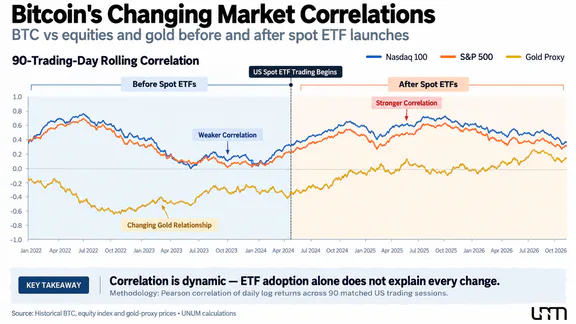
It is erroneous to assume that Bitcoin always falls alongside tech stocks or necessarily rises when interest rates decrease. Bitcoin's correlation with the stock market is not constant and can change depending on monetary policy, market shocks, and investors' risk attitudes.
In the study published on August 17, BlackRock Re-Underwriting Bitcoin, Robert Mitchnick, head of digital assets, noted the dual nature of Bitcoin's behavior:
Bitcoin can exhibit a dual nature: at times moving with risky assets during periods of deleveraging.
Mitchnick further explains that in other circumstances, Bitcoin can act as a potential hedge during geopolitical upheavals. In his assessment, periods of increased correlation between BTC and risky assets were more episodic than structural.
This interpretation is of interest but does not serve as proof of BTC's stable hedging properties. BlackRock manages one of the largest Bitcoin funds, so its assessments should be compared with independent market data.
To verify structural changes, one should compare Bitcoin's correlation with the Nasdaq-100, S&P 500, gold, and the dollar before and after the launch of spot ETFs, using comparable time intervals and considering differences in the macroeconomic environment.
Without such analysis, it cannot be confidently asserted that institutionalization specifically strengthened the link between BTC and traditional markets. A more limited conclusion is confirmed: institutional investment products have expanded the channels through which changes in financial conditions can affect demand for Bitcoin.
Why the decline may continue even without new bad news
The decline in Bitcoin's price is not only related to investors' decisions to sell the asset due to macroeconomic news. The liquidity of trading, the distribution of coins by purchase prices, and the state of the derivatives market also play a role.
When using leverage, even a relatively small decline in quotes can trigger forced closure of long positions. If counter demand is insufficient, additional sales amplify the price movement.
However, not every decline is accompanied by large-scale liquidations. According to Coinbase Institutional's estimate from October 23, the implied volatility of BTC over a one-month horizon was about 35% on an annualized basis, while the 30-day realized volatility, also recalculated on an annual basis, was about 24%. The latter value was lower than approximately 97% of observations since 2013.
This means that the market was in a period of relatively calm price fluctuations compared to its own history, despite a noticeable drop from the 2025 peak.
At the same time, funding rates for perpetual futures increased: Coinbase noted their rise from about 0.1% on an annualized basis on October 13 to 7.2% a week later. This dynamic indicates a recovery in demand for leveraged long positions, although it does not in itself prove excessive market overload.
Certain risks are also associated with the distribution of Bitcoins among holders. According to Glassnode data cited in Coinbase Institutional's research from October 23, about 2.1 million BTC were last moved at prices of $87,500–91,700. According to Coinbase analysts, this area could become a potential selling zone if quotes recover.
If BTC returns to these levels, some owners may close previously unprofitable positions without losses or with limited losses. Such behavior could hinder growth, although the exact volume of future sales is unknown.
In its research from October 21, Glassnode highlighted a closer resistance zone of $85,000–87,500, where the average cost of coins for certain groups of holders, large sell orders, and clusters of potential liquidations converged.
Below, the market is oriented towards several zones of average cost and technical levels. Coinbase Institutional identifies $80,000–82,000 as an area where the estimated cost of BTC for US spot ETFs and the 50-day moving average converge. If this zone is consistently broken, analysts consider $73,000–75,000 as the next potential support level.
These values are not guaranteed turning points. Technical support may not hold, and resistance may be overcome, especially with a sharp change in the macroeconomic environment or capital flow.
Therefore, the risk of Bitcoin moving near $80,000 should be assessed in conjunction with ETF flows, derivatives data, and current quotes, rather than solely based on the price's position relative to individual levels. Additional context is provided in the UNUM article on Bitcoin's minimal volatility before the Fed's decision.
Have institutional investors made the Bitcoin market more resilient?
The institutionalization of Bitcoin has both positive consequences and new potential vulnerabilities.
On one hand, the development of exchange-traded products has expanded the circle of investors, increased the diversity of available instruments, and simplified operations with BTC through regulated financial platforms. It has become possible to include Bitcoin in a wider range of investment strategies without direct interaction with cryptocurrency exchanges.
Investment funds and cryptocurrencies are increasingly interacting through products that allow managers to include BTC in traditional portfolio strategies. The participation of large financial companies stimulates the development of storage and settlement infrastructure and raises disclosure requirements.
A broader range of participants can potentially increase market resilience due to differences in investment horizons and strategies. However, this effect depends on how independently different groups of buyers act.
On the other hand, integration into the traditional financial system increases the importance of factors that previously might have seemed external to the cryptocurrency market. Fed decisions, the cost of dollar financing, fund portfolio constraints, and corporate capital raising conditions become important variables when assessing demand for BTC.
The change in purchase structure in 2026 is particularly indicative. In the first half of the year, corporate holders offset outflows from ETFs. From August, the leading role shifted to exchange-traded funds, with most of the positive flow concentrated in IBIT.
In such a situation, the scale of existing institutional investments ceases to be a sufficient indicator of resilience. To further assess the market, it is necessary to monitor several interrelated factors:
Capital flows in Bitcoin ETF. It is important not only to maintain a positive net inflow but also to distribute demand among funds. If purchases continue to be predominantly provided by IBIT, the market will remain sensitive to changes in the activity of its investors.
Corporate purchases. Their dynamics depend on the financial obligations of companies, the conditions for attracting new capital, and the market value of issued securities. Decisions by Strategy and other large holders can significantly change the demand structure.
Internal cryptocurrency liquidity. Changes in the supply of stablecoins, spot volumes, trading depth, and on-chain indicators help assess how actively new capital is entering the market outside of exchange-traded funds.
Monetary policy. The Fed's decision on October 28 and subsequent macroeconomic data can influence the cost of capital and investors' willingness to take risks.
Price dynamics relative to the cost of major holders. A sustained movement above these levels, accompanied by expanding demand and increased trading activity, would be a more substantial signal of recovery than a short-term price rebound.
At the same time, individual positive indicators do not prove the end of the correction. Inflows into ETFs may be accompanied by sales from other holders, and a decrease in bond yields may raise concerns about an economic slowdown.
The history of Bitcoin institutionalization shows that opening access to new capital is not equivalent to forming a permanent buyer. ETFs and corporate reserves can support demand, but the decisions of their owners depend on financial conditions, investment strategies, and risk assessment.
This is why the decline in Bitcoin in 2026 cannot be explained solely by investor disappointment or temporary weakness in the cryptocurrency market. It occurs in conditions of structural demand redistribution, where the role of some buyers decreases, others increase, and the macroeconomic environment limits the willingness of capital to move into risky assets.
Bitcoin and Wall Street are closely linked today through exchange-traded funds, corporate reserves, and portfolio strategies, yet expanding access to capital has not eliminated BTC volatility. Moreover, understanding its price now requires more than just monitoring cryptocurrency exchanges and on-chain data. It is necessary to consider the decisions of major managers, investment fund flows, and global financing conditions.
Institutional capital has changed the BTC market, but there is currently no basis to assert that it has created reliable protection against deep declines. At the same time, the reverse conclusion—that institutionalization has made Bitcoin more vulnerable—requires quantitative confirmation through comparison of correlations, volatility, and liquidity structure before and after the launch of spot ETFs.
The resilience of the new market structure will depend not so much on the volume of investments already attracted, but on the ability of different groups of buyers to support demand independently of each other—even during periods when high money costs and reduced risk appetite make buying Bitcoin less attractive.