
What Changed After OCC Approval
Cryptocurrency exchange Coinbase has received federal trust status, allowing it to expand institutional custodial services. On November 9, 2026, the company announced the final approval from the US Office of the Comptroller of the Currency (OCC) to establish Coinbase National Trust Company (CNTC). The new entity will be able to develop digital asset custody services under the supervision of the national banking regulator.
The decision was made in several stages. The application was registered on October 3, 2025, preliminary conditional approval was granted on April 2, 2026, and on November 6, the organization's status became effective. These dates are confirmed by the OCC registry.
The new trust company becomes part of the regulated banking infrastructure in the US, but its powers are limited to custodial and related services. Coinbase's new trust license does not extend to regular commercial banking services.
According to OCC document No. 1370, CNTC will be able to hold cryptocurrencies on behalf of clients, primarily institutional ones, and facilitate digital asset and cash transfers related to custodial accounts. The federal trust status does not provide for regular banking lending and the acceptance of insured deposits from the public. Clients' crypto assets do not receive FDIC insurance solely due to this authorization.
Another limitation concerns the structure of services. CNTC will be able to provide clients with access to staking, trading, and financing through other Coinbase group companies but will not perform these operations independently. Funds in custodial accounts are expected to be placed in third-party banks on a for-benefit-of basis, i.e., in the interest of clients.
In a corporate publication, Coinbase's Head of Trading and Custody, Rick Schonberg, emphasized: "Asset custody is at the core of our business."
This statement reflects the strategic significance of the new status, although the business itself has existed for some time. As early as 2018, Coinbase Custody Trust Company received a trust license from the state of New York and began operating under the supervision of the NYDFS.
The company now plans to transfer existing custodial operations to the federal structure within three years. Thus, it is not about creating a new direction but about regulatory restructuring, which potentially expands opportunities to work with large financial organizations.
The new status does not instantly change Coinbase's business model but creates conditions for expanding institutional services. The real financial impact will depend on how successfully the company can attract new clients and increase revenues from servicing their assets.
Why Coinbase is Seeking New Revenue Sources
Coinbase's revenues have historically been heavily dependent on the activity of cryptocurrency market participants. When prices and investor interest rise, trading volumes and commission revenues increase. During downturns, the mechanism works in reverse, as a decrease in transactions directly impacts revenue.
Coinbase's trading fees depend on transaction volumes, whereas custody fees can be received regularly. This distinction becomes especially important during periods of reduced investor activity when the company seeks to maintain revenues through non-trading products.
Coinbase's financial results for Q3 2026 highlight the scale of dependence on trading. According to the Form 10-Q report published with the SEC, the company's transaction revenue was $590.2 million compared to $1.05 billion a year earlier. The decline reached 44%.
Revenue from retail transactions decreased particularly noticeably. Income from retail transactions fell by 47% to $450.1 million. The company attributed this primarily to a 59% drop in spot trading volumes, which was only partially offset by new products, including prediction markets and derivatives.
Institutional transaction revenue also decreased—from $135 million to $91.7 million. This indicates that having large professional clients does not in itself shield Coinbase from the effects of market cycles.
How Revenue Structure Has Changed
Direction | Q3 2025 | Q3 2026 |
|---|---|---|
Retail Transactions | $843.5 million | $450.1 million |
Institutional Transactions | $135.0 million | $91.7 million |
Other Transactions | $67.7 million | $48.5 million |
Transaction Revenue | $1,046.3 million | $590.2 million |
Stablecoins | $324.5 million | $306.9 million |
Blockchain Network Rewards | $184.6 million | $85.7 million |
Interest and Financial Income | $64.8 million | $68.6 million |
Other Subscriptions and Services | $142.7 million | $109.0 million |
Subscriptions and Services | $716.6 million | $570.2 million |
Total Net Revenue | $1,762.9 million | $1,160.5 million |
Source: Coinbase Form 10-Q, Note 5 Revenue. Figures for 2025 are taken from the comparative data of Coinbase's Q3 2026 report. Amounts are rounded.
Including other revenue, Coinbase's total revenue amounted to $1,215.6 million in Q3 2026.
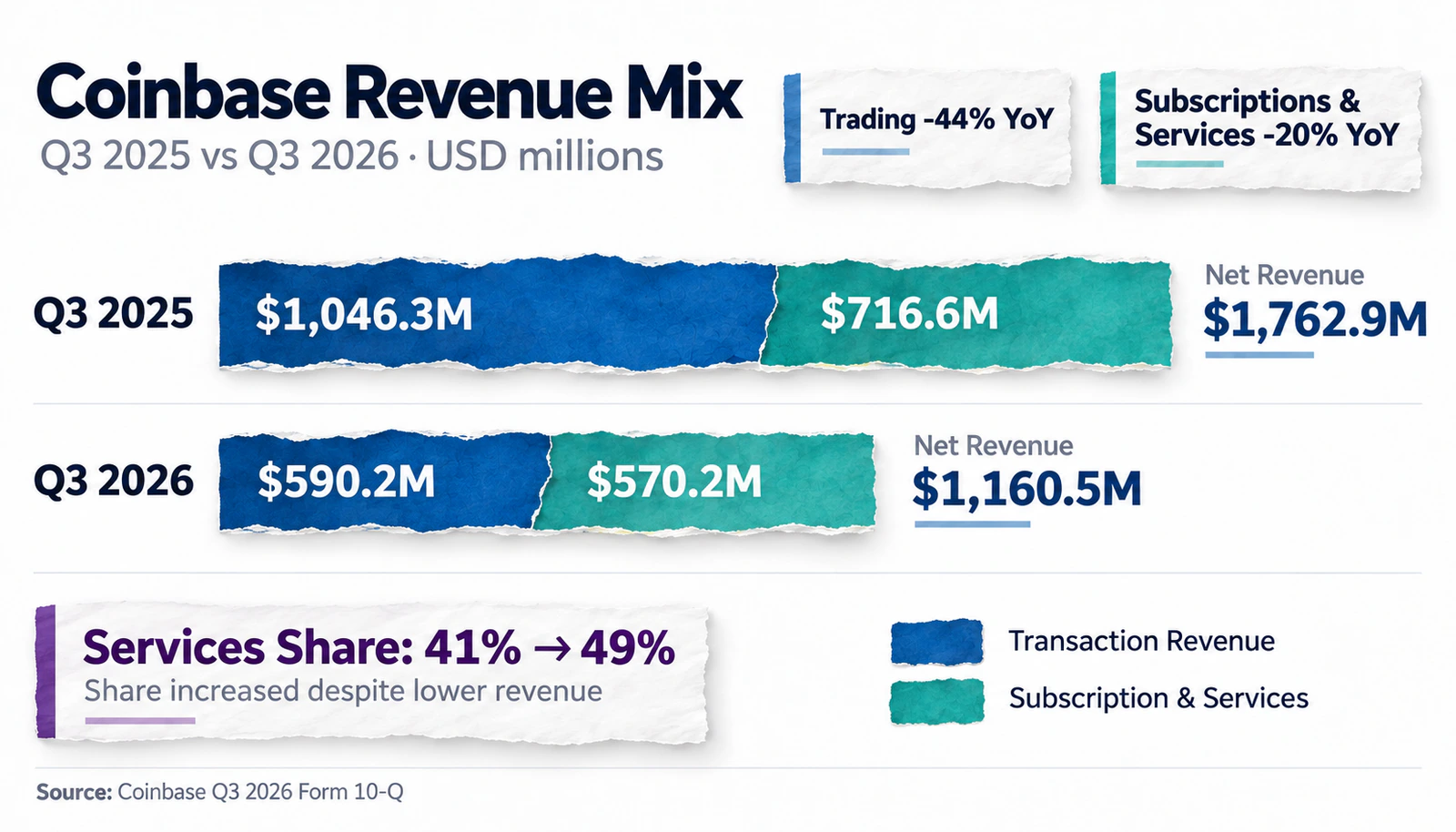
At first glance, the company is indeed moving towards diversification. The share of subscriptions and services in net revenue increased from 41% to 49%, almost equaling the transaction direction.
However, this result requires careful interpretation. In absolute terms, revenue from subscriptions and services also decreased, by 20% year over year. Its share grew mainly because trading revenues were falling even faster.
Meanwhile, the largest source of non-trading revenue remains stablecoins, which brought in $306.9 million for the quarter. Revenues depend on the size of reserves and interest rates, so they are also not fully protected from external economic factors. Blockchain network rewards decreased by more than half, to $85.7 million, primarily due to changes in the value of crypto assets and reward rates.
Therefore, the shift to services does not automatically mean a shift to stable income. For this, Coinbase needs to develop areas that are less dependent on the number of transactions, rates, and the value of digital assets.
Cryptocurrency custody potentially meets this challenge, as a custodian is needed by clients not only during active trading but also during periods of long-term holding of investment positions.
How Much Coinbase Can Earn from Cryptocurrency Custody
Custodial services involve a specialized organization responsible for the secure storage and servicing of client assets. For cryptocurrencies, this includes the protection of private keys, access control, transaction processing, record-keeping, and regulatory compliance.
Custody should be distinguished from investment management of crypto assets: a custodian ensures the accounting and safekeeping of assets but is not required to make investment decisions.
Unlike a trading commission incurred when executing a transaction, a custody fee may be charged regularly. If its size depends on the average value of assets in custodial accounts, the company earns revenue even in the absence of trading activity.
However, the size of such a business should be evaluated based on two indicators: the volume of assets under custody and the effective fee that clients actually pay.
Assets on Platform are not equal to Assets Under Custody
As of September 30, 2026, Coinbase reported $376.6 billion in Assets on Platform (AOP) — the aggregate value of cryptocurrencies and payment stablecoins placed or managed on the platform on behalf of clients.
Over the year, the figure decreased from $515.9 billion, primarily due to a decline in market prices. According to the company's calculations, the negative price effect amounted to approximately $160.5 billion, although an increase in the number of individual assets partially offset the decline.
Using the entire $376.6 billion as a base for calculating custodial revenue would be a mistake. AOP includes assets in various Coinbase products, not just institutional clients' funds under specialized custody.
A narrower indicator, Assets Under Custody (AUC), was disclosed in the Q3 2025 report. At that time, the volume of assets under custody reached $300 billion, setting a record. The company attributed the growth to inflows from cryptocurrency ETFs and corporate clients.
In the Q3 2026 documents, a separate comparable AUC value is not presented, so it is not possible to reliably calculate its annual dynamics based on these disclosures.
Additional confirmation of Coinbase's role in ETF infrastructure is contained in BlackRock's documents. In the 2025 annual report of the iShares Bitcoin Trust ETF (IBIT), Coinbase Custody Trust Company is listed as the primary custodian of the fund's bitcoins, with Anchorage Digital Bank as an additional custodian.
Thus, Coinbase already services large investment products, and its new federal status potentially enhances the competitiveness of this direction.
What fees does the custodian receive
On the public page of Coinbase Custody, an annual fee of 50 basis points, or 0.5% of the asset value, is indicated. There is also a setup fee ranging from zero to $10,000 depending on the terms of use.
The public fee of Coinbase Custody at 0.5% per annum does not reflect the confirmed effective rate for the largest ETFs. Their individual terms are not disclosed in the sources used.
It is also important to distinguish between the fees of different participants in the investment chain. For example, the 0.25% per annum indicated by BlackRock for IBIT represents the fund sponsor's fee, not the rate Coinbase receives for storing bitcoins.
A simple model can be used to estimate potential revenue:
Annual custodial revenue = average value of assets under custody × effective annual fee.
Assume Coinbase attracts additional assets for custody. Then the calculations yield the following results:
Conservative scenario. With an average annual balance of additional assets of $25 billion and a notional fee of 0.03%, the estimated revenue before expenses would be $7.5 million for the full year.
Base scenario. With an average annual balance of additional assets of $75 billion and a notional fee of 0.05%, the estimated annual revenue before expenses would be $37.5 million.
Optimistic scenario. With an average annual balance of additional assets of $150 billion and a notional fee of 0.08%, the estimated annual revenue before expenses would reach $120 million.
These rates are chosen solely for modeling revenue sensitivity. They are not confirmed rates of Coinbase's institutional contracts or a forecast of actual receipts.
Even the optimistic result remains relatively small compared to trading income. In Q3 2026, Coinbase's transaction revenue was $590.2 million. Assuming this quarterly level is maintained throughout the year, transaction revenue would be about $2.36 billion.
To achieve comparable annual custodial revenue, an average annual volume of paid assets under custody of about $4.72 trillion would be required at an effective fee of 0.05%. This is a mathematical benchmark, not an estimate of a realistic business volume.
However, comparing revenue does not answer the question of profitability. To do this, it is necessary to consider expenses, which can vary significantly between trading and custody.
Why High Revenue Does Not Guarantee High Profit
The custody business requires significant initial and ongoing investments. A company must maintain technical infrastructure, protect keys, prevent unauthorized operations, comply with regulatory requirements, and ensure service continuity.
Regulatory oversight by the OCC imposes capital, liquidity, and operational requirements on CNTC. According to the terms of preliminary approval, the new structure must maintain at least $60 million in Tier 1 capital. Suitable liquid assets must hold the greater of 50% of Tier 1 capital or $30 million. A separate reserve for 180 days of operational expenses is also required.
These conditions apply for the first three years of the structure's operation and may increase the capital required to conduct business. At the same time, funds reserved to cover operational expenses cannot be simultaneously counted towards meeting another liquidity requirement.
Diversification of income does not guarantee increased profitability if servicing new clients requires a comparable increase in expenses.
The potential advantage of custody is related to scaling. As the volume of assets increases, the costs of servicing them may potentially grow slower than revenue. However, confirming such an effect for Coinbase's custody division through public reporting is currently impossible.
Coinbase's public financial reporting does not disclose standalone operating profit or margin for the custody segment. Therefore, there is no basis to assert that custody is already more profitable than trading.
Why Institutional Demand May Support Growth
The development of cryptocurrency ETFs has significantly changed the role of custodians. Asset managers need organizations capable not only of storing digital assets but also of ensuring operational control, reporting, and compliance with financial regulators' requirements.
According to a joint study by EY-Parthenon and Coinbase, conducted in January 2026 among 351 institutional investors, 73% of respondents planned to increase investments in digital assets during the year.
Meanwhile, 66% of participants already had access to spot cryptocurrencies through ETFs or similar exchange-traded products, and 81% of investors with spot exposure preferred such regulated instruments to direct ownership of crypto assets through an exchange or wallet.
The study also shows changing infrastructure requirements. Investors are paying increasing attention to regulatory compliance, storage security, and the protection of cryptographic keys.
These results indicate potential demand growth but do not guarantee Coinbase an influx of new clients. The survey reflects investors' intentions, not actual transactions. Additionally, the study was prepared in collaboration with Coinbase itself, which should be considered when evaluating its conclusions.
An important constraint is the diversification of providers. According to the same survey, 61% of organizations use multiple custodians, while 36% prefer one. This model reduces operational risks and dependence on a single provider but simultaneously intensifies competition among custody companies.
The existence of such demand is also confirmed by the structure of American cryptocurrency ETFs. Previously, UNUM reported on changes in the composition of investors in bitcoin funds, including the reduction of positions by individual trading firms and the increase of investments by long-term institutional participants.
For the custody business, not only the total volume of investments is important but also the duration of asset holding. If funds and corporate investors hold positions for months or years, the demand for servicing remains even during periods of low trading activity.
However, the value of assets under custody still depends on the market. For example, if the Bitcoin price falls by 30%, the dollar value of the unchanged amount of BTC will also decrease by 30%. If the fee is tied to the value of assets, this will directly affect the custodian's potential income.
Competition with Banks Becomes More Intense
Federal approval opens up additional opportunities for Coinbase but does not create an exclusive position in the market.
As early as January 2021, Anchorage Digital Bank became the first cryptocurrency company to receive federal banking status from the OCC. The organization offers institutional custody, staking, settlements, and other services related to digital assets.
In December 2025, BitGo announced full OCC approval to convert into a national trust bank. In January 2026, the company reaffirmed its federal status in a statement regarding its public listing.
BitGo offers institutional custody and settlement services, operating under a unified federal oversight. This intensifies competition in the segment that Coinbase is targeting.
Simultaneously, traditional financial organizations are entering the market. In October 2026, BNY announced the expansion of its Digital Asset Custody platform in the European Union under MiCA regulation. The bank has been developing digital asset custody since 2022, leveraging its existing infrastructure for institutional clients.
Jennifer Barker, Head of Europe at BNY, explained the needs of such organizations:
To support increasingly digital strategies, institutions need solutions with the same resilience, oversight, and safeguards they rely on in traditional operations.
The statement indicates that traditional banks view digital asset custody as a continuation of their existing financial business rather than a separate experiment.
For Coinbase, this means competition on several fronts:
Reliability and regulation. Federal oversight enhances the comparability of Coinbase's regulatory status with other participants, but does not guarantee superiority in security.
Service cost. Large funds can negotiate individual rates, creating pressure on commission margins.
Product integration. Clients need not only secure wallets but also settlements, trading infrastructure, lending, and access to other financial instruments.
Existing client relationships. Traditional banks have long-standing connections with asset managers, pension funds, and financial corporations.
Coinbase retains a significant advantage with its specialized cryptocurrency infrastructure and broad product ecosystem. However, increased competition could lead to a situation where assets under custody grow faster than commission revenue.
Three scenarios for the development of the custody business
The financial impact of the new status will depend on Coinbase's ability not just to transfer existing accounts, but to attract additional assets and expand the range of paid services.
The conservative scenario suggests limited growth. Institutional clients continue to distribute assets among multiple providers, competition reduces effective fees, and new regulatory requirements increase costs. In such a situation, custody remains an important part of the ecosystem but does not become a standalone profit source comparable to trading.
The base scenario envisions gradual expansion. Coinbase attracts additional assets from funds and corporate clients, increases service volumes, and sells related services. Regular custodial payments support revenue, although the main financial effect may arise not from custody itself but from clients using other Coinbase products.
The optimistic scenario is associated with large-scale institutionalization of the market. The growth of cryptocurrency ETFs, tokenization, and corporate investments increases the need for regulated custody. Coinbase leverages its technological infrastructure and client base to expand its business, and the growth in volumes allows for the distribution of fixed costs over a larger number of serviced assets.
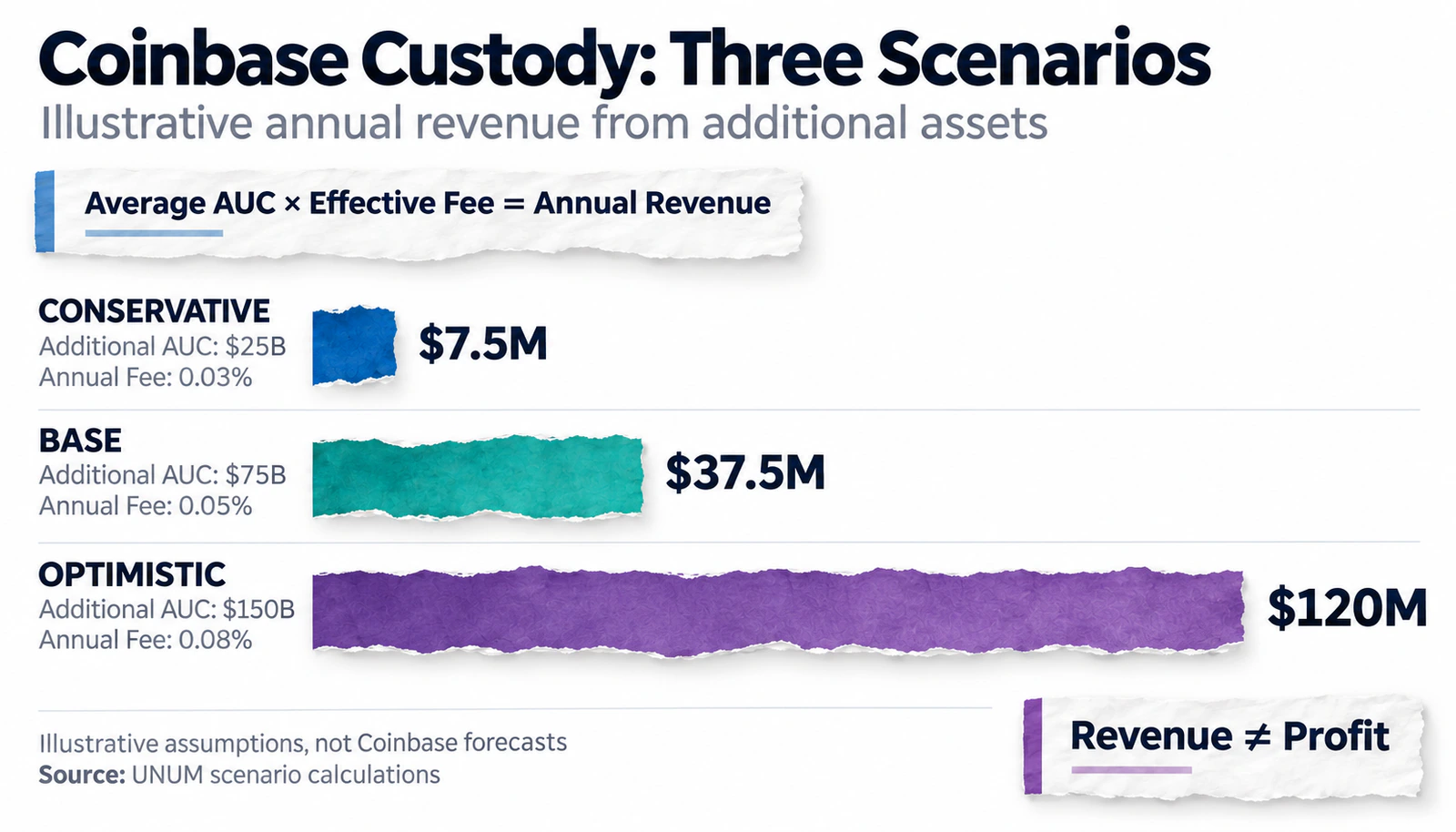
An important consideration is that transferring existing business from Coinbase Custody Trust Company to CNTC does not itself increase Coinbase's consolidated revenue. Financial results will only appear with the attraction of additional clients, changes in service conditions, improved efficiency, or expanded use of ancillary products.
Therefore, evaluating the success of the federal license solely by the size of the new structure's assets will be insufficient.
What might hinder Coinbase from earning more
Even with high institutional demand, the custodial business faces risks that limit its sustainability.
The first is related to the market value of assets. Custodial revenues potentially depend on the dollar valuation of cryptocurrencies. Price declines can reduce revenue even when the number of coins in client wallets remains unchanged.
The second risk is price competition. As new regulated custodians emerge, large clients gain more alternatives and may demand lower fees.
The third concerns operational responsibility. Key management errors, cyberattacks, technical failures, and breaches of internal procedures can lead not only to financial losses but also to regulatory consequences. In its Form 10-Q report, Coinbase specifically warns of potential liability for the loss or theft of client assets under its control.
An additional factor is revenue concentration. According to Form 10-Q, one counterparty accounted for 27% of Coinbase's total revenue in the third quarter of 2026, compared to 19% a year earlier. The company does not disclose in the corresponding line of the report what portion of this figure relates directly to custodial services. Nevertheless, high dependence on a single counterparty deserves attention when assessing financial stability.
Finally, federal status does not guarantee rapid profit growth. In addition to regulatory expenses, the company must remain competitive in a segment where profitability may be limited by large contracts and the scale of infrastructure costs.
Coinbase's profit depends not only on trading commissions but also on the value of investment crypto assets and other financial results. In the third quarter, the company reported $718.7 million in net income under GAAP, but adjusted EBITDA was $332.9 million. At the same time, the company recognized about $715 million in net positive results from the revaluation of investment crypto assets. Therefore, the net profit of a single quarter cannot be considered a direct indicator of trading or custodial profitability.
Investment risks of COIN shares are related not only to cryptocurrency prices but also to revenue structure, expenses, and competition. When evaluating Coinbase (COIN) shares, it is necessary to consider both the expectations of institutional business growth and the overall trading activity and financial results of the company.
Will Cryptocurrency Custody Become More Profitable Than Trading
Federal trust status strengthens Coinbase's position in the institutional services market, but it does not yet provide grounds to assert that the custodial direction will become more profitable than trading.
Financial data confirm three main conclusions.
Firstly, trading revenue remains the main separate source of income for Coinbase. Despite declining activity, in the third quarter of 2026, the company received $590.2 million in transaction proceeds, while standalone custodial revenue is not highlighted in the report.
Secondly, custodial services can enhance business predictability but not eliminate market risks. Regular fees can be received regardless of the number of transactions, but their size depends on the value of client assets, tariffs, and competition.
Thirdly, the most significant effect may lie in the expansion of the entire financial ecosystem. Asset custody creates long-term relationships with clients who also require trading, staking, financing, and settlement infrastructure. In this case, the value of the custodial business will be determined not only by direct fees but also by additional revenues from other Coinbase directions.
To test this hypothesis, investors need to monitor the volumes of Assets Under Custody, standalone custodial revenue, effective tariffs, servicing costs, and the growth of the institutional client base. The company does not yet disclose sufficient data for a full comparison of the profitability of custody and trading.
Thus, Coinbase's main opportunity lies not in replacing the cryptocurrency exchange with a custodial business, but in turning asset custody into the foundation of a broader financial infrastructure. Whether this model can provide profitability comparable to trading will be shown by future reporting periods and the company's ability to monetize institutional demand without excessive cost increases.